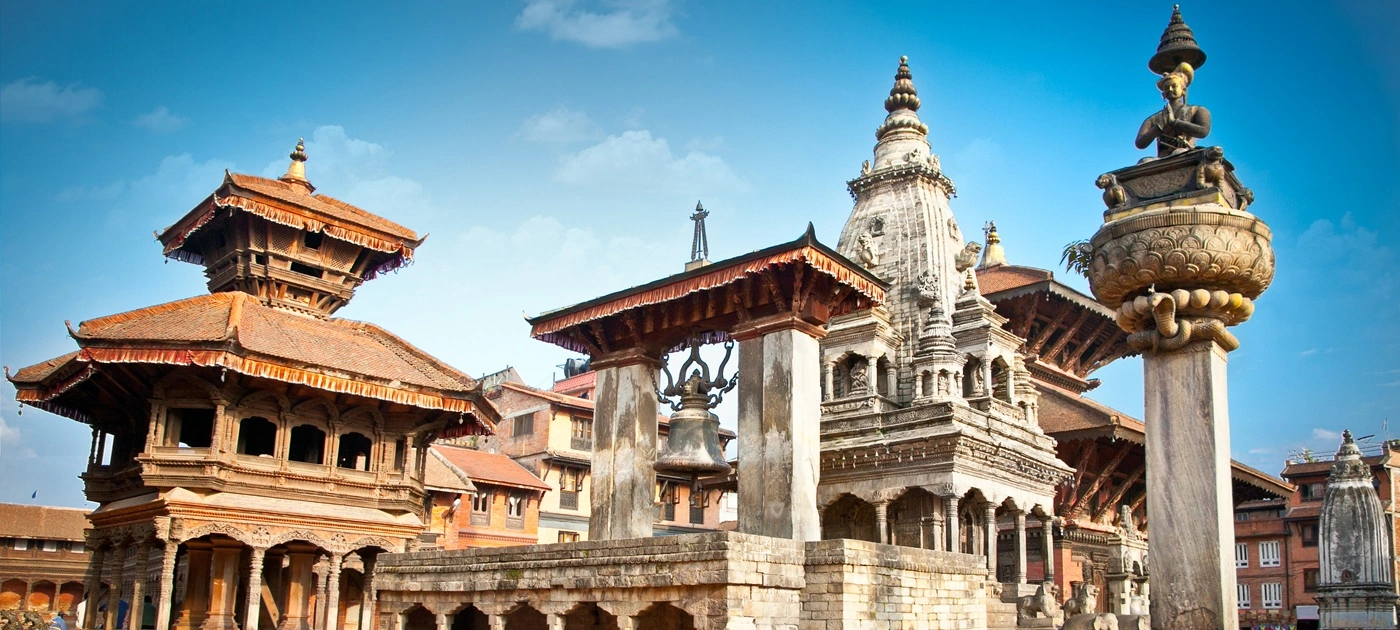
Bhaktapur Durbar Square, a UNESCO World Heritage site, brims with centuries-old temples and palaces that showcase the pinnacle of Newar art and architecture.
Bhaktapur Durbar Square

Stepping into Bhaktapur Durbar Square feels like stepping back in time. This historic plaza in Bhaktapur – known locally as Khwopa, the "City of Devotees" – was once the royal courtyard of a mighty kingdom. Today it stands as a living museum of medieval Nepalese life, renowned for exquisite woodcarvings, pagoda-roofed temples, and monumental squares.
The entire district is recognized as a UNESCO World Heritage Site for its outstanding cultural value. Visitors wandering the red-brick lanes here are treated to intricately carved windows, gilded doorways, and open courtyards that speak to a rich artistic heritage. It's a place where myth and history intertwine – where every temple, statue, and festival has a story to tell.
Located just 13 km east of Kathmandu, Bhaktapur was historically the jewel of the Kathmandu Valley's three royal cities. The Malla kings inhabited it from the 14th century until 1769, when the rising Gorkhali dynasty annexed it. In its golden age, Bhaktapur's palace complex boasted 99 courtyards and innumerable temples – far more than survive today.
Sadly, earthquakes have exacted a heavy toll over the centuries. Catastrophic quakes in 1833, 1934, and most recently 2015 toppled many structures, shrinking the square's once-sprawling footprint. Yet Bhaktapur endures: with international aid and careful restoration, many of its treasures have been rebuilt or reinforced, allowing the city's timeless beauty to persist. Wandering these streets, you'll see evidence of both ruin and rebirth – from supportive wooden struts propping up ancient walls, to fully restored pavilions that withstood the 2015 quake thanks to modern reinforcements.
Despite past hardships, Bhaktapur Durbar Square remains remarkably well-preserved and atmospheric. No cars are allowed inside the historic center, so one can leisurely explore the plazas and alleys on foot, often accompanied by the tinkling of temple bells and the laughter of locals.
The square and its surroundings are not just set pieces for tourists; they are the beating heart of Bhaktapur's living Newari culture. Here, potters dry their clay wares in the sun, shopkeepers sell the city's famed curd "Juju Dhau," and residents gather for daily worship in ancestral shrines. All of this happens amid monumental backdrops: tall temples soaring overhead and elaborately carved monuments at every turn.
In this travel guide, we'll dive deep into Bhaktapur Durbar Square – exploring its history, legends (mythology), major monuments, and vibrant festivals (jatras). From the Palace of 55 windows to the five-storied Nyatapola Temple, from hidden courtyards to the raucous Bisket Jatra celebration, we'll cover every detail that makes this place a must-see for history buffs, culture lovers, and everyday travelers alike.
(Note: "Bhaktapur Durbar Square" is often used broadly to refer to Bhaktapur's entire heritage core, which actually comprises multiple adjoining squares – Durbar Square, Taumadhi Square, Dattatreya Square, and Pottery Square. In this guide, we'll visit all these areas, since together they create the whole experience of Bhaktapur's old city.)
A Glimpse into History
Bhaktapur's story stretches back a millennium. According to historical chronicles, the city was founded in the 12th century by King Ananda Deva Malla, who established Bhaktapur as his capital. Thanks to its strategic position on the ancient trade route between India and Tibet, the city grew prosperous and became a center of art and religion. By the 15th century, Bhaktapur reigned as the capital of the whole Kathmandu Valley (then known as the Greater Malla Kingdom). When that realm split into three, Bhaktapur emerged as an independent Malla kingdom that would endure until the late 18th century.
The Malla period (12th–18th centuries) was Bhaktapur's golden age, leaving an indelible mark on the city's architecture and traditions. Successive kings poured their wealth into constructing magnificent temples, palaces, and squares. Notably, the trio of kings who ruled during Bhaktapur's 17th–18th century cultural peak – Jitamitra Malla (ruled 1663–1696), Bhupatindra Malla (1696–1722), and Ranjit Malla (1722–1769) – were great patrons of the arts.
Most of the spectacular shrines and monuments you see today were built or renovated under their reigns, as they competed in splendor with the neighboring Kathmandu and Patan kingdoms. King Bhupatindra Malla is remembered as an unparalleled builder and is depicted in many statues around the square, reverently kneeling with folded hands.
Bhaktapur's independence came to an abrupt end in 1769, when Prithvi Narayan Shah of Gorkha conquered the valley and unified Nepal. The Malla king Ranjit Malla, who had desperately tried to maintain Bhaktapur's glory, was exiled, and the city lost its political primacy. Ironically, this "time capsule" quality preserved Bhaktapur's medieval character, as development slowed under later regimes. By the time the modern era arrived, Bhaktapur was famed for its intact heritage.
Of course, nature had its say as well. The Great Nepal-Bihar Earthquake of 1934 devastated Bhaktapur, leveling nearly a third of its monuments and many homes. The beautiful Vatsala Temple and several pagodas were reduced to rubble in that quake. A massive rebuilding effort in the decades that followed – including projects funded by Germany and the USA in the 1980s/90s – helped restore many of the structures.
Then, in April 2015, another powerful earthquake struck Nepal. Once again, Bhaktapur's ancient temples shuddered; the graceful Vatsala Durga temple (painstakingly restored after 1934) collapsed entirely, among other damage. Yet many monuments survived, and reconstruction of the destroyed temples is ongoing even today. Impressively, the 5-tiered Nyatapola Temple – thanks to its sturdy engineering – emerged from both the 1934 and 2015 quakes almost unscathed.
Despite these trials, Bhaktapur Durbar Square retains an aura of timelessness. In 1979, it was among the first sites in Nepal to be inscribed as a UNESCO World Heritage Site, recognizing its unique ensemble of art and history. Walking its flagstone courtyards today, one can't help but imagine the days when this square bustled with Malla courtiers, visiting traders, and solemn priests performing rituals for the king. The past is palpably alive here, in everything from the tantric symbols on temple doors to the age-old festivals still celebrated with gusto each year.
Royal Courtyards and Palaces: The Heart of the Square
At the center of Bhaktapur Durbar Square stands the former Royal Palace complex, once a sprawling compound of 99 courtyards (chowks) where the kings and their extended families resided. Although much of the Palace was lost over time, its most famous section remains: the Palace of Fifty-Five Windows, also known as Pachpanna Jhyale Durbar.
This brick-and-wood building, with its long balcony of exquisitely carved windows, dominates the eastern side of the square. The Palace's construction began in the 15th century, but its definitive form – including all 55 of those lattice windows – was achieved in 1708 under King Bhupatindra Malla. He expanded and beautified the Palace, making it a showpiece of Newar craftsmanship.
Even today, the facade is known for its impressive array of carved wooden windows, each one a marvel of detail, featuring peacocks, lotus flowers, and divine beings. Local guides often point out the Palace's center bay window, which is especially ornate – it's said to have been the king's audience window where he could watch ceremonies in the square.
The Palace of 55 Windows once extended around numerous private courtyards. Visitors can still enter parts of the palace complex (now home to the National Art Museum). Through the Palace's open doorways, you might glimpse inner courtyards with sunken bathing pools and shrines where royalty performed daily worship.
One such hidden gem is the Royal Bath (Naga Pokhari) in the palace interior – a large stone water tank adorned with a gilded spout and encircled by serpent (naga) sculptures, used ritualistically by the Malla kings. Though entry is limited, peering from the Golden Gate, you can see its green depths and imagine princesses and princes taking their purifying morning dip.
Speaking of gates, the most mesmerizing artistry in the square is the Golden Gate (Suna Dhoka) set into the Palace's main entrance. This gate is a gilded masterpiece of repoussé metalwork, glowing like a jewel against the red brick walls. It was installed by King Ranjit Malla in 1754 as the grand portal to the Taleju Temple courtyard behind.
Framed by intricately molded gold panels, the arched tympanum above the door depicts the fierce Hindu goddess Taleju Bhawani (the royal tutelary deity) standing atop a multi-armed Garuda and attended by heavenly nymphs. Every inch is filled with detail – serpents' coils along the frame, and mythical monsters seem to spring forth, protecting the gate.
The Golden Gate is so stunning that one art historian declared it "the most lovely piece of art in the whole kingdom; it is placed like a jewel, flashing innumerable facets in its handsome setting". Passing through this gate truly feels like entering a sacred treasure vault of the past. Beyond it lies the Taleju Temple (dedicated to the patron goddess of the Malla kings), which is still an active temple – open only to Hindus on special festival days. Most of the time, the gate is as far as visitors can go, but gazing up at its lavish decorations is more than satisfying.
The Golden Gate (Sun Dhoka) of Bhaktapur Durbar Square – an exquisite, gilded portal commissioned by King Ranjit Malla in 1754. The torana above the door depicts Goddess Taleju in all her glory, flanked by divine attendants.
Flanking the Golden Gate are two stone guardians and inscriptions that commemorate its installation by Ranjit Malla. Stepping back, you'll notice that the gatehouse itself is painted a bright vermilion red – traditional for royal buildings – and attached to the white-plastered wing of the Palace. The contrast of a white wall, a red gatehouse, and a golden gate makes for a photographer's delight. This area often attracts local devotees who come to ring the large bell hung nearby and to offer prayers at a small shrine located beside the gate.
As you face the Golden Gate, on your left stands a massive bronze bell on a masonry frame. This is the famous Taleju Bell, erected in 1737 by King Ranjit Malla and popularly nicknamed the "Bell of Barking Dogs." Locals gave it that name because whenever it pealed, the dogs of the town would supposedly start howling in unison!
In the Malla era, this bell was struck every morning to signal the opening of the royal court and to announce daily curfew in the evenings. Today, it is rung to accompany rituals – for instance, it tolls when the Taleju goddess is worshipped each morning. Try giving it a gentle ring – its deep tone resonates across the square (and you might hear a stray dog join in). Next to this colossal bell, on a smaller plinth, sits another historic bell offered by King Bhupatindra Malla in 1699. Both bells speak to the importance of sound in Newar religious life; a ringing bell awakens the gods and disperses evil.
Directly across from the Golden Gate, in the middle of the square, your eye will be drawn to a tall column topped by a gleaming bronze figure. This is the Statue of King Bhupatindra Malla, the master builder of Bhaktapur, depicted in a posture of eternal devotion. The king is portrayed seated on a lotus with his hands pressed together in añjali mudra (prayer) toward the Palace, paying homage to Taleju.
The artistry of the figure – from its elegant crown to the delicate fingers – is superb; it was likely cast by the finest artisans of Bhaktapur's metallurgist caste. Fascinatingly, if you look at the king's right thigh, you can spot a small dent or hole. This is said to be damage from a bullet fired in 1769 during the war when Prithvi Narayan's troops invaded – a tangible reminder of Bhaktapur's last stand.
The fact that the statue survived that battle (and subsequent earthquakes) is miraculous. Locals treat the statue with great respect, often draping it with marigold garlands during festivals. It has truly become an icon of Bhaktapur's identity – the proud king surveying his city for centuries.
As you continue exploring the square's western end (closer to the main road entrance), you'll notice two colossal stone guardians standing imposingly near an old gate. These are the statues of Ugrachandi (Durga in her fearsome aspect) and Ugrabhairav (a brutal form of Shiva). Carved in 1706 and commissioned by King Bhupatindra Malla, the pair guard what was once a western palace gate.
Ugrachandi, the lion-skinned goddess with multiple arms holding weapons, snarls at onlookers while Ugrabhairav, fanged and muscular, mirrors her ferocity. The craftsmanship is striking – you can even see the demonic expressions and ornate jewelry carved in stone. These statues have a juicy legend: it's said that King Bhupatindra was so awed by the sculptor's work that he cut off the artisan's hands afterward, to prevent him from ever duplicating the masterpieces elsewhere.
(Some say this is just a myth – or a hoax spread in recent times – but it certainly adds drama to the tour!) True or not, the tale speaks to Bhaktapur's pride in its unique art. Don't forget also to admire the pair of massive stone lions near them, which likely gave the "Lion Gate" (Singha Dhoka) its name. With these fearsome guardians, one can imagine that enemies or evil spirits would think twice about entering the royal Palace in the old days!
Temples and Shrines of Durbar Square
Bhaktapur Durbar Square is not just about palaces – it's also a sacred space filled with temples, both large and small. The Malla kings were devout Hindus and Buddhists (the Newar culture blends both faiths), so they studded their palace domain with shrines to protective deities. Let's look at some of the key temples within the central square area.
Vatsala Temple and the "Barking Dogs" Bell
On the eastern side of the square, just in front of the 55-Window Palace, stood the elegant Vatsala Devi Temple – a stone temple dedicated to a form of the goddess Durga. It was built in the local Shikhara style (resembling a mountain peak) entirely out of finely carved sandstone. Before its destruction in 2015, this temple was one of the artistic gems of Bhaktapur, often compared to the Krishna Mandir of Patan for its style.
The temple is currently under reconstruction, but you can still see its tiered plinth and some rescued carvings. Historically, the Vatsala temple was renowned for its intricate ornamental work – from the chains of stone bells surrounding its roof to the friezes of goddesses adorning its sides.
Vatsala Devi is considered a protective mother deity of the city, and in fact, there were multiple Vatsala temples around Bhaktapur's Palace. The stone one in Durbar Square was the most prominent (sometimes specifically called "Siddhi Lakshmi Temple," as it enshrined an aspect of the goddess Lakshmi).
According to local belief, these temples were built to shield the city from epidemics, especially plague. One inscription even links the reconstruction of Vatsala Temple around 1715 with the hope of halting a deadly pandemic at that time. Such snippets show how closely religion and public welfare were tied in the Malla era.
At the base of the Vatsala temple sits the large bronze Taleju Bell (the "barking dogs bell" mentioned earlier), which has become an attraction in its own right. An inscription dates it to 1737 and credits King Ranjit Malla. If you're there in the morning, you'll likely hear it ringing to signal the first prayers of the day.
When struck, its reverberation is so deep that all the neighborhood dogs indeed start howling – a quirky phenomenon that gave rise to its nickname! In the past, this bell was also used to announce royal decrees and curfews each day. Stand next to the bell and you'll feel the history; the idea that for nearly 300 years this very bell has been sounding out across Bhaktapur at dawn and dusk is quite moving.
(Fun fact: Next to the main bell, you might notice stone figures of a male and female with a child and a dog. These are part of another Vatsala shrine nearby, and locals sometimes joke that even the statues cover their ears when the "barking dogs" bell is rung!)
Yaksheshwar Mahadev (Bhaktapur's Pashupatinath)
Near the Vatsala temple (just south of it) rises a distinctive two-tiered pagoda with a four-sided roof, often surrounded by devotees – this is the Yaksheshwar Mahadev Temple, one of the oldest surviving temples in the square. Built in 1484 by King Yaksha Malla's widow, Queen Karpuradevi, it was dedicated in memory of Yaksha Malla himself.
The temple's name essentially means "Yaksha's God" (referring to Lord Shiva in this case). It is popularly dubbed the "Pashupatinath of Bhaktapur" due to its architectural similarity to the famous Shiva temple in Kathmandu. Indeed, the temple is modeled after Pashupatinath: a modest two-tiered structure with four silver-plated Shiva lingam faces peeking out in cardinal directions. Inside, it houses a sacred linga (phallic symbol of Shiva) that is said to be a replica of the one in Pashupatinath.
Yaksheshwar is notable for a few reasons. First, it is among the few temples in the Durbar Square still actively worshipped daily by locals (most of the others are used mainly during festivals). If you visit in the morning or evening, you might see women lighting oil lamps and men ringing the bell as they circumambulate this shrine, offering milk or water to the Shiva lingam inside.
Second, the temple's struts and roof architecture feature some rather risqué erotic carvings. Don't be too shocked – such carvings are typical on Newar temples, meant to invoke fertility and keep away evil (it's said the sight of erotic scenes repels demons). You can spot carved wooden panels depicting amorous couples hidden under the eaves. These carvings survived even Victorian-era prudishness and are an eye-opening detail for keen observers.
South of Yaksheshwar Mahadev is a small shrine to Annapurna Ajima (a form of the goddess Parvati as provider of food). Locals sometimes refer to this little sanctuary as the "Guhyeshwari of Bhaktapur", again likening Bhaktapur's layout to Kathmandu's sacred sites (Guhyeshwari is a Shakti peeth temple near Pashupatinath).
It's fascinating how the Mallas intentionally replicated holy sites of Kathmandu within their own city, almost creating a microcosm of the valley's sacred geography. These subtle touches make wandering Bhaktapur feel like a discovery at every corner – even a tiny shrine has layers of meaning.
The Chyasilin Mandap: An Octagonal Marvel
In an open space south of the Palace, you'll notice an impressive eight-sided pavilion with a double roof – this is the Chyasilin Mandap, which translates literally to "Eight-cornered pavilion." Though it looks perfectly at home among the ancient temples, Chyasilin Mandap is actually a modern reconstruction of a 17th-century original.
The pavilion was first built around 1740 by a king of Patan (as a gesture of friendship to Bhaktapur's king) and served as a public gathering hall. It collapsed entirely in the 1934 earthquake and was left in ruins for decades. Then, in the 1980s, German-funded experts meticulously rebuilt it using historical drawings and new brick/wood – even incorporating hidden steel supports for strength.
The project was completed in 1987, and remarkably, this restored Chyasilin Mandap survived the 2015 quake intact while many older structures fell. It's a great example of conservation and innovation working hand in hand.
Today, the Chyasilin Mandap is a photogenic spot, boasting a unique octagonal base and elegant arcaded balconies. You might see local elders lounging in its shade, chatting and watching the world go by – exactly what it was used for centuries ago. Step up onto its platform and you get a lovely panoramic perspective on the square, framed by the Mandap's wooden pillars.
Notice the carved brackets under the roof, featuring motifs of flowers and mythical creatures; although newly made, they replicate traditional Newar designs. The Mandap really gives you a sense of how lively and utilized Bhaktapur's public spaces were (and still are) – not just temples for gods, but pavilions for people to gather, rest, and socialize.
Other Notable Shrines and Sights
Every corner of Durbar Square holds something noteworthy. A few more highlights to seek out:
Narayan Temple and Krishna Temple: Near the western entrance of the square, you'll find a small pagoda dedicated to Narayan (Vishnu) and a triple-roofed Krishna temple. The latter was part of a Char Dham representation – miniature temples of Kedarnath and Badrinath (Hindu pilgrimage sites) once stood alongside it.
These signify the Malla kings' attempt to bring the whole Hindu sacred realm into their capital. Though modest in size, they're richly carved and often overlooked by visitors. If you peek inside, you might see images of Krishna and his consort, Radha, dressed in bright clothing.
Yetkha Dyo Chen (Yetichapali): On the southern side of the square is a traditional resthouse with carved windows, historically used for sacred dances and as lodging for pilgrims. These sattals (rest houses) dot Bhaktapur, and one of them, the Yetichapali, is known for being where royal priests prepared for festivals. It's a reminder of the intangible heritage – music, dance, ritual – that animated these structures.
Taleju Chowk and Kumari House: Although closed to the public, the Taleju Temple courtyard, located behind the Golden Gate, is an important religious site. Within is said to be a temple housing Taleju's idol, and, historically, a Kumari (living goddess) would be brought here on specific festivals to bless the king.
Bhaktapur has its own Kumari tradition, distinct from Kathmandu's more famous one, and the royal family would have revered a young girl as the human embodiment of Taleju. While you likely won't see her on an average day, it's intriguing to know this practice continues in some form in Bhaktapur.
Stone Pillars and Inscription: In front of the Palace, aside from the king's statue, there are other stone pillars and objects. Look for a long stone inscription slab (it might be near the Golden Gate or mounted on a wall) – this could be the famous "Salute inscription" of Bhupatindra Malla, which records his victory and piety in multiple languages. Even if you can't read it, the script itself (in the old Nepalese script) is beautiful to behold.
Take your time wandering this central square. It's worth pausing under the shade of a peepal tree or sitting on a temple step to soak in the ambiance. The square is busiest in the late afternoon, when school children cut across on their way home and locals gather for a chat. The interplay of light on the brick and carved wood in the golden hour is magical. And remember that as impressive as Durbar Square's monuments are, there's even more to see just around the corner in Bhaktapur's other historic squares – which we'll explore next.
Taumadhi Tole: The Five-Story Nyatapola Temple and Bhairav Chariot
A short walk (just 100 meters) south of the central Durbar Square courtyard brings you to Taumadhi Square, another central plaza of Bhaktapur. Here, the skyline is dominated by one of Nepal's most significant temples: the Nyatapola Temple. This famous five-storied pagoda is the tallest temple in the Kathmandu Valley. Nyatapola rises an awe-inspiring 30 meters high on its lofty five-tiered platform. Climbing the broad stairway to this temple is a must-do experience in Bhaktapur – it literally elevates you above the city!
Nyatapola was built in 1702 AD by King Bhupatindra Malla, and its name means "Five Levels" in Newari (nyata = five, pola = roof). Each of its five pagoda roofs towers above the next, balanced on a massive, stepped base. The engineering of this temple is exceptional – its stout brick-and-wood structure was so well designed that it withstood an 8.3 magnitude earthquake in 1934 and the 7.8 quake in 2015 with barely a crack. In fact, Nyatapola's survival has become legendary, a testament to the architectural skill of the Newars.
The towering Nyatapola Temple of Taumadhi Square during the Bisket Jatra festival. Crowds of devotees climb its steps, which are flanked by guardian statues – from wrestlers at the base to goddesses near the top.
The temple is dedicated to Goddess Siddhi Lakshmi, a fierce Tantric aspect of Durga, who was the protective deity of the royal Malla family. Siddhi Lakshmi is so esoteric that her shrine inside Nyatapola is kept closed to all but priests – no public worshippers are allowed to enter the top level, which adds to the aura of mystery.
According to local lore, King Bhupatindra built Nyatapola specifically to subdue the raging power of Bhairava, the dread deity enshrined in the temple just across the square. As the story goes, Bhairava's temple (then smaller) was causing havoc, perhaps bringing ill fortune or unrest, so the king invoked Siddhi Lakshmi – an even more potent goddess – to "sit above" Bhairava and keep him in check. In legend, the erection of this towering temple effectively pinned down Bhairava's chaotic energy, saving the city from destruction. It's a classic tale of divine power balance: build a bigger, mightier shrine to pacify a wayward god.
Nyatapola's most striking feature (apart from its height) is the perfect symmetry of its design and the colossal stone guardians that flank its stairway. As you ascend the five levels of the plinth, you pass five pairs of guardian statues, each on either side of the steps, each symbolically 10 times more powerful than the pair below.
At the lowest level are two famous local wrestlers, Jayamel and Phattu, depicted kneeling with hefty maces – these men were said to possess the strength of 10 men each. Above them, on the next terrace, are two mighty elephants, each supposedly 10 times stronger than the wrestlers. Above the elephants are lion statues, stronger still than griffins (sarabhas), higher up – mythic creatures even more powerful; and finally, at the fifth level, just before the temple platform, stand two goddesses in stone: Baghini (Tigeress) and Singhini (Lioness).
These fierce females are attendants of Durga and represent the ultimate level of protection for the deity. This hierarchy of guardians is not only artistically impressive but also carries deep symbolism – it's like a spiritual security system. As you climb, take a moment at each level to appreciate the scale of these sculptures (the wrestlers alone are over 2 meters tall!). Children especially love posing beside the giant elephants or lions for photos.
Reaching the top of the Nyatapola plinth, you get an incredible panoramic view of Taumadhi Square and beyond. On a clear day, you can see green hills on the valley rim. Up close, you'll notice the temple's intricate woodwork – the struts under each roof are carved with forms of Lakshmi, elephants, and other deities; the door frames have elaborately carved toranas (arches) with metal gilding.
Little bronze bells hang along the roof eaves, tinkling in the breeze. If you visit around midday, the temple will likely be closed (and remember, the interior is off-limits); however, you can still walk around the platform. Often, you'll find local musicians sitting up here playing a flute or madal drum, adding a melodious soundtrack to the scene.
Nyatapola isn't just an architectural marvel; it's very much part of Bhaktapur's living culture. During Bhaktapur's biggest festival, Bisket Jatra in April (more on that later), the steps of Nyatapola overflow with spectators watching the tug-of-war of Bhairav's chariot below. The temple even appears on Nepal's currency notes, cementing its status as an icon. No visit to Bhaktapur is complete without a photo on Nyatapola's steps – you truly feel on top of the world (or at least atop Bhaktapur) when you're up there.
Facing Nyatapola, on the opposite end of Taumadhi Square, is another critical temple: the Bhairavnath Temple. Although dwarfed by Nyatapola's height, the Bhairavnath Temple is itself a three-story pagoda of considerable size and holds great religious significance.
Bhairava (a fierce manifestation of Shiva) is Bhaktapur's guardian deity, believed to protect the city. Initially, this temple was a small, single-story shrine built by King Jagat Jyoti Malla in the early 1600s. However, King Bhupatindra Malla later expanded it in 1717 by adding two more roofs, giving it its present majestic form.
The temple's extended, rectangular plan and triple roofline are distinctly different from Nyatapola's square shape, making for a beautiful contrast when viewed together. The Bhairavnath Temple features ornate windows and sculptures around its base, including guardians such as lions and tantric gods, which are worth examining up close.
Legends swirl around the Bhairavnath Temple. One popular tale says that only the head of Bhairava is worshipped here. Why just the head? According to a local myth, Bhairava would wander the streets of Bhaktapur in human disguise to enjoy the city's festivals.
During one Bisket Jatra, he was recognized, and a Tantric priest (or the king's men) swiftly decapitated him to keep him from leaving. Thus, Bhairava's head was enshrined in Bhaktapur, while his body vanished. Ever since, the god's head has remained in this temple, granting the city protection. It's a macabre yet fascinating legend that the locals readily recount. True to this story, the Bhairav idol in the temple is said to be a large mask-like head, which is revealed only during festivals.
Another layer of lore connects to Nyatapola: people say Goddess Siddhi Lakshmi (at Nyatapola) and Lord Bhairav (at this temple) are in a perpetual cosmic balance – her temple was built higher to keep Bhairav's power under control. Interestingly, during Bisket Jatra, images of Bhairav and his female consort Bhadrakali are taken out of this temple and placed in huge wooden chariots for a wild tug-of-war procession. As those chariots sway and nearly tip, one cannot help but think of the dynamic between these deities and the people's effort to let Bhairav loose, only to rein him in symbolically.
Architecturally, Bhairavnath Temple is rich in wood carvings and metal bell decorations on its roofs. The struts portray Bhairav in various forms, as well as other deities. The entrance usually features a large brass trident (trishul) and a khadga (ritual sword) planted before it, with a pair of stone lions guarding the doorway. If you happen to be in Bhaktapur during Bhairav's annual festival (Bhairav Astami), you'll see throngs of devotees here, as it's believed wishes are fulfilled by praying to Bhairav at this site on that day.
Together, Nyatapola and Bhairavnath Temples make Taumadhi Square a spiritual nucleus of Bhaktapur. The square itself is often alive with activity: vegetable vendors spread out their produce in the mornings, and souvenir stalls line the sides selling puppets, masks of Bhairav, and Thanka paintings.
Don't hesitate to climb up to the second-story terraces of any nearby café or restaurant – from there you can enjoy a terrific view of Nyatapola Temple rising above the bustle, with Bhairav's temple and the smaller community shrines dotting the square below. Sunset is particularly enchanting here, as the brick monuments glow in warm hues and a gentle wind rustles the prayer flags tied on temple roofs.
Dattatreya Square and the Peacock Window
Venturing further east through Bhaktapur's narrow lanes (a 10-minute walk from Taumadhi), you arrive at Dattatreya Square in the Tachupal neighborhood – another historic heart of Bhaktapur that feels like a village frozen in time. The centerpiece here is the Dattatreya Temple, a three-story pagoda with a rich history. In fact, Dattatreya Temple is one of Bhaktapur's oldest surviving temples, initially built in 1427 AD by King Yaksha Malla. It is said to be the only temple in Nepal dedicated to Lord Dattatreya, a deity who is a combined form of the Hindu trinity Brahma, Vishnu, and Shiva.
Legend claims that this entire temple was built using timber from a single mighty tree. When you gaze at its sturdy wooden pillars and struts, you can imagine the massive tree that might have been felled to create such a structure – a feat of resourcefulness and devotion.
The temple architecture is distinct, featuring two large roofs (rather than the typical three-tiered style) and a smaller third roof positioned above the deity's chamber. The rooflines are supported by carved Newari struts showing various tantric figures and multi-armed god forms. The temple rests atop a tall brick plinth, and out front you'll see two stone wrestlers – Jaimal and Phattu – again!
Yes, the same legendary strongmen depicted at Nyatapola also guard Dattatreya, each wrestling with stone serpents coiled around them. This repeating iconography suggests Yaksha Malla's time (15th century) already had these figures as symbols of strength.
Climb the few steps up to peek into the Dattatreya Temple's open doorway (removing your shoes if you step on the platform). Inside, on festival days, you might glimpse the three-headed statue of Lord Dattatreya. The atmosphere is serene; often, the temple interior is quiet, with only a faint scent of incense lingering in the air.
Dattatreya Square is less crowded than Durbar Square, allowing you to appreciate the artistry more easily. The temple's wooden facade is richly ornamented, with carvings of the ten incarnations of Vishnu and other deities. Every piece of wood seems alive with detail – it's no wonder the temple is considered a masterpiece of the early Malla period.
Just across from the Dattatreya Temple is a building of great significance to art lovers: the Pujari Math, a former residence of priests that now houses the Woodcarving Museum. But its real claim to fame is on its eastern wall – the Grand Peacock Window. Often hailed as "the Mona Lisa of Nepal", this iconic window is a 15th-century carved window featuring a peacock with a fanned tailfeather lattice.
The craftsmanship is unbelievable – the peacock's body and feathers are carved from a single piece of wood, with each feather eyelet opened to let light through. Surrounding the peacock motif are intricate floral patterns and divine figures. Over centuries, this window has become emblematic of Newari woodcarving skill. It miraculously survived the major quakes and remains intact in its original spot.
In the afternoon, when sunlight slants in, the perforated peacock design casts lovely patterned shadows inside the museum room. Travelers from around the world come specifically to photograph this "finest carved window in the Kathmandu Valley", and it lives up to expectations.
Bhaktapur's famous Peacock Window (Mayur Jhyal), a 15th-century masterpiece of woodcarving at Pujari Math. Its central peacock motif and lattice of feathers have earned it renown as one of Nepal's most beautiful windows.
Take a moment to appreciate how such an exquisite piece was hand-carved with primitive tools – a labor of love by Newar artisans. The Peacock Window is a symbol of Bhaktapur's artistic heritage and even features on local postcards and tourism logos. Inside the Pujari Math building, you can see more carved windows and doors on display, as well as ornate columns and struts salvaged from damaged structures. The Math itself, with its lovely courtyards and intricate doorways, is an architectural gem (it was restored in the 20th century with help from German experts, which is why it's in excellent condition).
Dattatreya Square has other sights as well: adjacent to the temple are two historic monasteries (maths) with beautifully carved doorways and windows in the same style. One doorway shows a garuda, serpents, and other Hindu symbols in fine detail. You'll also see several chortens (Buddhist stupas) and lingam-yoni shrines scattered around, reflecting the town's religious harmony. There is even a metal statue of a kneeling Malla king on a pillar here, reminiscent of the one in Durbar Square (though smaller) – this is said to be King Yoginarendra Malla, honoring the temple.
Don't miss wandering the side alleys around Dattatreya Square, known for its handicraft workshops. This quarter of Bhaktapur is renowned for its traditional puppet-making, mask-making, and woodcrafts. You can often peek into workshops where artisans are chiseling wood or hammering metal for statues. It's a wonderful place to buy a hand-carved souvenir; after being inspired by the Peacock Window, you might be tempted to take home a mini replica or a carved wooden frame.
By now, you've seen how Bhaktapur is a city of artisan clans – generations of skilled locals made each beautiful artifact in the squares. Whether stone sculptors, woodcarvers, bronze casters, or painters of thangka scrolls, the people of Bhaktapur continue to keep their ancestors' crafts alive in these very squares.
Before we leave Dattatreya, note that the square is also the site of a few interesting festivals and cultural performances (especially during Gai Jatra and other events, they have musical processions here). There's also a Brass & Bronze Museum in a building at one corner, displaying antique utensils, ritual metalware, and generations-old items from Bhaktapur's homes – a quiet but intriguing stop if you have time and a separate ticket.
Festivals and Jatras: Living Heritage of Bhaktapur
No guide to Bhaktapur is complete without delving into its vibrant festivals (jatras). The city's monuments truly come alive during these annual celebrations, when age-old rituals, music, and dance fill the squares. Bhaktapur's festivals are immersive cultural experiences that showcase the community's devotion and flair for drama. Here are a couple of the most famous ones to know:
Bisket Jatra – The Epic New Year Festival
Bisket Jatra is Bhaktapur's signature festival – a spectacular nine-day event in April that coincides with the Nepali New Year (around April 14th). It's often called "Biska" or "Bisket", and it is unlike any festival you've seen. The main activities of Bisket Jatra center on Taumadhi Square and the winding streets of the town, involving enormous wooden chariots, a towering ceremonial pole, and throngs of ecstatic participants.
According to popular legend, the term "Bisket" originates from bi-sika in Newari, meaning "the snake is defeated." Folklore recounts a time when two serpent demons terrorized Bhaktapur – in one tale, they inhabited the dreams of a local princess, killing each of her bridegrooms on their wedding night. Finally, a brave suitor stayed awake and slew the serpents, breaking the curse.
In another version, a giant serpent named Karkotaka menaced the land until a clever hero lured it out and vanquished it with divine aid. Either way, the theme is the triumph of good over evil, symbolized by the death of the serpents. To commemorate this victory, the people of Bhaktapur began celebrating Bisket Jatra, where long banners (interpreted as serpent carcasses) are hoisted up a tall pole and later torn down to signify the snakes' demise. In fact, the very name Biska Jatra is popularly said to mean "festival after the death of the serpents" in the Newari language.
The festival's highlight is the massive chariot procession of Lord Bhairava. Early in the festival, a huge unwieldy wooden chariot (shaped like a temple on wheels) is prepared near Taumadhi. Inside it is placed the god Bhairav's idol from the Bhairavnath Temple, along with a smaller chariot carrying the goddess Bhadrakali (Bhairav's consort).
On Bisket Jatra's main days, hundreds of strong local men drag these chariots through the streets in a dramatic tug-of-war between the eastern and western halves of town. The spectacle is exhilarating and a bit chaotic – imagine a teetering 25-foot-tall chariot, crowd-surfing slowly as teams of pullers yank it one direction, then the other, amidst the deafening crash of drums and clash of cymbals.
Thousands of spectators pack every inch of Taumadhi Square's temples and rooftops to watch. The energy is palpable; it's as if the whole city becomes a living theater. Bhairava's chariot sways dangerously, and occasionally, minor accidents occur, but devotees believe the journey represents Bhairava touring his city and blessing the people. The tug-of-war also has a competitive element – whichever side "wins" by pulling the chariot further is said to have good fortune.
Another key moment is the raising of the Yosin pole (lingo) at an open field (Yosin Than) at the edge of town. This is a tall wooden pole, approximately 25 meters high, with two long strips of cloth (banners) tied to its top – symbolizing the slain serpents. With great fanfare, the pole is erected on the first day of the festival.
It stands for a few days like a giant prayer flag, and then on New Year's Day, as dusk falls, it's ritually pulled down – an intense moment because the direction it falls is thought to predict the coming year's fortunes. When the pole crashes down, it formally ushers in the New Year amid joyful shouts.
During Bisket Jatra, the entire city transforms into a carnival. Street vendors sell snacks, families dress in their finest, and there are ancillary events like Sindoor Jatra in nearby Thimi (a parade where participants throw clouds of orange-red vermilion powder, akin to a local Holi).
In one village, there's even a tongue-piercing ceremony where a man pierces his tongue with an iron spike and parades, believed to absorb the community's sins – not for the faint of heart! All these happen concurrently as part of the broader Biska celebrations in the Bhaktapur area. Each locality (Thimi, Bode, etc.) has its own twist, but the Bhaktapur Durbar Square and Taumadhi area events are the most renowned.
If you are lucky to visit during Bisket Jatra, you'll witness Bhaktapur at its most passionate. The ancient temples provide a stunning backdrop to frenetic rituals that have been carried on for perhaps a millennium. It's one of those experiences where the past and present merge – a primeval rite in a medieval square, participated in by modern Nepalis with undiminished zeal. Please note that during Bisket, accommodations fill up, and certain areas can become very crowded for safety reasons. But the experience is well worth it, often described as Nepal's Mardi Gras with a spiritual twist.
Gai Jatra – A Carnival of Cows and Comedy
Come late summer (usually August), Bhaktapur celebrates Gai Jatra, the "Cow Festival," an extraordinary event with a distinctly different tone. Gai Jatra is observed in all three valley cities, but Bhaktapur's Gai Jatra is famed for being the most vibrant and humorous. What is it? Ostensibly, it's a day when families who lost a loved one in the past year honor the departed by sending a "cow" procession – since cows are believed to guide souls to heaven. In practice, this means young kids dress up in fantastical costumes (often as cows or deities) and join a joyous parade through the streets.
In Bhaktapur, each neighborhood constructs a decorative bamboo cow effigy called a Taha-Macha, draped in cloth and adorned with the photo of the deceased. These are carried through town in long processions. The children in costume dance and prance along, accompanied by traditional Newari music. It might sound somber, but Gai Jatra in Bhaktapur is actually full of laughter, satire, and revelry – it's a celebration of life as much as a remembrance of death.
One hallmark of Bhaktapur's Gai Jatra is the "Ghintang Ghisi" dance, a week-long series of street dances where men dress up as women (often hilariously) and groups perform synchronized steps to a catchy drum rhythm. These dances are both in memory of the dead and also to cheer up the living.
Historically, it's said that King Pratap Malla of Kathmandu initiated Gai Jatra to console his grieving queen by showing her that others had also lost loved ones; over time, it evolved into a carnival-like event. In Bhaktapur, the Ghintang Ghisi dancers with painted faces and cross-dressed attire inject a lot of comedy, often poking fun at social issues or public figures through skits and songs. The entire city becomes a stage for satire – it's actually one of the few times when Nepalis could historically lampoon authority without fear, under the mask of festival tradition.
During Gai Jatra day in Bhaktapur, you'll see long lines of Taha-Macha "cow" chariots snaking through narrow lanes, each led by family members singing and playing music. The central Durbar Square and Taumadhi Square are filled with throngs watching the parade of costumed characters.
You'll see children as Shiva, as Buddha, as kings and queens, as mythical creatures – it's very whimsical. Also notable are comic performances held on Dabali platforms, where performers deliver farcical sketches and political satire, much to the crowd's delight. It's somewhat akin to a Halloween parade mixed with a Day of the Dead ceremony, with a uniquely Newari twist.
In the evening, the mood can turn slightly rowdier. Traditionally, Bhaktapur's Gai Jatra involved families distributing homemade liquor and bhang (hemp) to participants, and there is a spirit of letting loose and speaking truths under the festival's protective umbrella. For visitors, it's generally safe, but do expect some friendly splashes of water or powder and joking interactions if you attend.
Gai Jatra's importance lies in its message: it helps families accept loss with a smile and brings the community together to acknowledge mortality without fear. Bhaktapur's folks say that their Gai Jatra is the most "enjoyable" because of these unique local elements – the Taha-Macha chariots, the cross-dressing dancers, and the freedom to be playfully irreverent. It's a beautiful example of how this city blends sacred and profane, mourning and mirth, into an unforgettable cultural expression.
Other Festivals and Cultural Highlights
Beyond Bisket and Gai Jatra, Bhaktapur celebrates numerous other festivals throughout the year (Newars have a saying: "12 months, 24 festivals!"). A few to mention:
Dashain and Tihar (Sept-Oct): The major Hindu holidays in Bhaktapur are marked by families visiting Durbar Square to swing on traditional bamboo swings and receive blessings from the gods. The Taleju Temple in the Palace is opened briefly for worship on Nawami (the ninth Dashain day), and goat sacrifices occur in the courtyard. During Tihar's last day (Bhai Tika), you'll find people flying kites and lighting oil lamps on temple steps.
Indra Jatra (Yenya): In Kathmandu, this is a huge event, but Bhaktapur has a smaller version with its own living goddess, Kumari, being pulled around in a chariot. If you're around in early autumn, you might catch the Bhaktapur Kumari making an appearance in Durbar Square, accompanied by masked dancers representing deities.
Maha Shivaratri: On this night devoted to Lord Shiva (February/March), devotees flock to the Yaksheshwar Mahadev temple in Durbar Square to light sacred fires and offer bel leaves. Since Bhaktapur is quieter than Pashupatinath, foreigners can witness the ceremonial all-night prayers in a more intimate setting.
Nag Panchami: Given Bhaktapur's serpent legends, the day to honor serpent deities (July/Aug) is observed by pasting snake pictures above doorways and perhaps holding special pujas at Taumadhi, where the Yosin pole is erected, acknowledging the serpents' power and appeasing them.
Newari New Year (Nepal Sambat) and Navadurga dances: Bhaktapur's own lunar New Year (usually around Tihar time) involves masked dance performances by the Navadurga troupe – performers wear terrifying masks of the Nine Durgas and roam the city with music, stopping to dance at squares, including Durbar Square. This is a fantastic sight if you happen upon it – an ancient ritual dance drama believed to ensure the city's protection for the coming year.
In essence, Bhaktapur is a city where culture is inextricably intertwined with daily life. Any day, you might stumble on a procession winding through an alley – perhaps a guthi (community group) carrying an idol to a pond for cleansing, or musicians practicing for a wedding, or villagers bringing offerings of harvest to the temple. The squares we explored are stages that have hosted these human dramas for centuries.
One delightful cultural tip: try the "Juju Dhau", Bhaktapur's famous king of yogurts, sold in small clay pots in and around the squares. It's thick, sweet, creamy, and considered an auspicious treat, especially during festivals. Locals will proudly tell you it's the best curd in Nepal – and after a day of walking, its incredible sweetness is heavenly.
Conclusion
Bhaktapur Durbar Square is more than just a collection of old temples – it's a thriving time capsule of Nepal's golden age, where every brick and beam has a story. We've journeyed through its history of kings and conquerors, stood awestruck before its artistic masterpieces, and glimpsed the myths that still enchant its people.
From the jewel-like Golden Gate and the stately 55-Window Palace to the sky-piercing Nyatapola Temple built to vanquish evil, from the serpents of Bisket Jatra being slain amid jubilation to the joyful jests of Gai Jatra that bring a city together – Bhaktapur offers a feast for the eyes and the soul.
International travelers and local visitors alike will find something to love here. If you're an architecture enthusiast, the square's Newar pagodas and palaces are a living textbook of design. If you're a spiritual seeker, the ambiance of devotion – ringing bells, wafting incense, monks and priests – lends a tranquil charm.
If you're into photography, every corner presents a frame-worthy scene, whether it's a sunlit, sculpted facade or a candid shot of an artisan at work. And if you want to experience authentic culture, Bhaktapur welcomes you to join in – sit on the temple steps and savor the scene, or time your visit to coincide with a festival to truly immerse yourself in the color and music of Newari traditions.
Despite the passage of time and the impact of natural disasters, Bhaktapur stands proud – a city that has refused to let its heritage fade away. Restoration continues; you may see scaffolding around some temples, a sign that the next generation is taking care of this legacy. By visiting here, you also contribute to its preservation (entry fees support maintenance), ensuring that future generations can wander through these medieval alleys and experience the same sense of wonder.
As you conclude your exploration, perhaps in the late afternoon when the temples cast long shadows on the square, take a final panoramic look around. You'll see children kicking a ball by the Palace, local women laying out rice to dry on the flagstones, a flute seller perhaps playing a soft tune in hopes of attracting a buyer, and above it all, the gilded roofs and carved timbers telling of a civilization's high point.
It's easy to imagine that Bhaktapur's old nickname, "Bhadgaon" (City of Devotees), is still apt – the city seems itself a devotee, eternally worshipping the art, gods, and ancestors that define it.
Bhaktapur Durbar Square is not just a destination – it's an experience of living history. Whether you come for a day or linger for more, it leaves an imprint on your heart. Don't forget to carry with you a bit of Bhaktapur's magic: maybe a little peacock carving from a local woodcarver, the taste of Juju Dhau on your tongue, or cherished memories of golden sunsets over temple rooftops.
As the Newars say in a toast, "Juija Dhanya Dhanya" – may you be blessed with a long life – and may Bhaktapur's heritage endure just as long, inspiring all who walk its sacred squares.
Need Help? Call Us+977 9851013196orChat with us on WhatsApp
Need Help? Call Us+977 9851013196