The Everest helicopter tour is the shortest honest route to the world's highest mountain. You leave Kathmandu in the dark, land twice in the Khumbu, and are back at your hotel before the city has finished its second cup of tea.
It is also the trip people book with the least information. Photographs of the landing zone tell you nothing about seat rotations, weight limits, or why the machine sometimes leaves without you standing in it.
So here is the whole morning, told the way we brief our own guests the night before they fly.
What an Everest helicopter tour actually is
An Everest helicopter tour is a one-morning round trip from Kathmandu to the high Khumbu, with a landing near Kala Patthar and a breakfast stop on the ridge above Namche Bazaar. Nothing about it is a trek.
The flight follows the Dudh Koshi valley northeast out of the Kathmandu basin, crosses into Solukhumbu, and lands at Lukla at 2,860 m to take on fuel. Fuel matters more than distance here.
A machine that lifts easily off a runway in Kathmandu behaves very differently in the thin air above 5,000 m, so it flies up light and refuels at low altitude.
From Lukla, the valley narrows. You pass Namche on its horseshoe hillside, the Tengboche monastery ridge, then the grey moraine of the Khumbu Glacier.
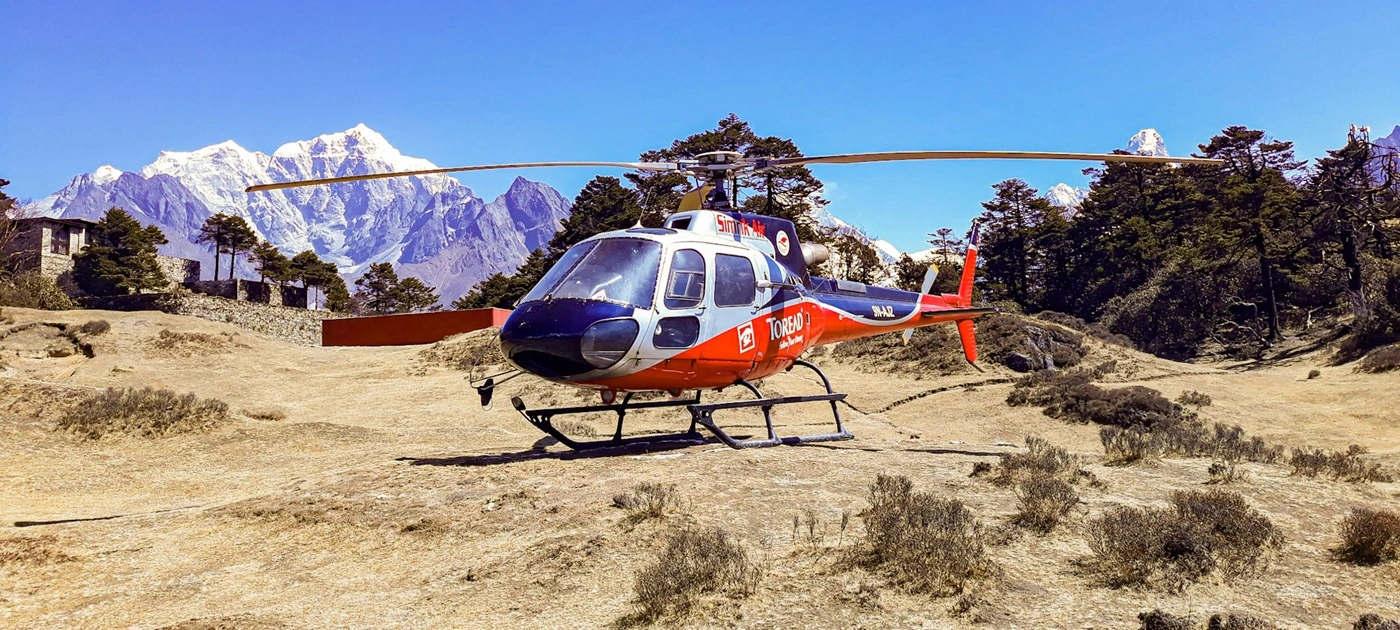
The landing is at Kala Patthar, the brown shoulder above Gorak Shep at 5,545 m. It is the highest place in the region a helicopter can safely set down with guests aboard, and the only one that gives you Everest's full south-west face without the Nuptse wall in the way.
You get ten to fifteen minutes on the ground. That is not stinginess; it is oxygen. At that altitude, the aircraft burns performance margin sitting still, and your body starts asking questions within the first few minutes.
Then you drop back down for breakfast on a ridge terrace above Namche at around 3,880 m, where the air is thick enough to enjoy the view while sitting down.
Ama Dablam fills the window on your left. Everest, from here, looks smaller and further away than it did twenty minutes earlier.
The morning, hour by hour
The whole thing runs on daylight and wind, which is why every good Everest helicopter tour starts absurdly early. Our guests are collected from their hotel while it is still dark.
Pre-flight is quick: a weight check for every passenger and bag, a met briefing from the pilot, and a boarding order set by that weight sheet rather than by who arrives first. Nobody enjoys the scales. Everybody wants a helicopter that climbs properly at 5,500 m.
Lift-off is usually between first light and about 7:30. The Kathmandu Valley slides away, terraced and smoky, and within a few minutes you are over the ridgelines east of the city with the snow line appearing on the horizon.
Roughly an hour of flying, broken by the Lukla fuel stop, puts you in the upper Khumbu. Pilots talk to each other constantly on this route — there is only one valley, and everybody uses it.
At Kala Patthar, the doors open into the cold that arrives all at once. Take your photographs quickly, walk slowly, and listen to the crew.
Breakfast on the ridge above Namche takes about forty-five minutes. Eggs, Sherpa bread, coffee that tastes better at altitude than it has any right to.
Then Kathmandu, and a landing back at the domestic apron by mid-morning. Most of our guests spend the rest of the day in Patan or asleep. Both are correct answers.
The whole round trip sits at four to five hours door-to-door in settled weather. Add a buffer to your afternoon anyway.
Kala Patthar landing or Base Camp overfly?
You land at Kala Patthar, and you fly over Everest Base Camp — not the other way round. This confuses more first-time bookings than any other detail.
Base Camp itself sits on moving ice at 5,364 m. It is a working glacier with tents, ladders, and expedition teams on it during the spring season, and it is not a landing zone for tourist flights.
What you get is a low pass over the tent city and the Khumbu Icefall behind it, close enough to count the yellow domes.
Kala Patthar is the landing. It is solid rock; it is higher, and the view from it is the one on the postcards: Everest's summit pyramid standing clear above the Nuptse ridge, with Pumori directly behind you.
Some operators land at Gorak Shep instead, a few hundred meters lower on the sandy flat. The view from there is noticeably worse — Nuptse blocks a good part of Everest. Ask which one your flight uses before you pay.
Weather sometimes makes the choice for you. If clouds are building in the upper valley, a pilot may put down lower and shorter, or turn at Pheriche and offer the flight again the next morning.
We would rather do that than push a marginal window.
We wrote a longer piece comparing the two options if you want the full picture before booking.
Why booking the Everest helicopter tour privately changes the morning
A private charter changes three things: who else is on board, how long you stand on Kala Patthar, and what happens when the weather moves. On a shared seat, none of those are yours to decide.
The two-passenger rule nobody mentions
Above about 4,500 m, the weight-to-altitude ratio limits these machines to two passengers per lift. Kathmandu to Lukla carries four. The final leg to Kala Patthar carries two.
That means the top section always runs as a shuttle. With a group of four, the helicopter takes two up, comes back for the other two, and repeats the process to bring everyone down.
On a shared tour, that shuttle is where the morning goes wrong. You are the pair sitting at Pheriche or Gorak Shep in the cold while strangers take their turn on the summit shoulder, and the schedule belongs to whoever booked first.
On a private flight, the rotation is still a rotation — physics does not negotiate — but it runs for your party alone, and your guide is on the ground managing it.
Weather windows belong to somebody
Shared flights fill by seat, so they launch when the seats sell. Private charters launch when the sky is right.
Our standing practice is to hold the first slot after dawn, because clouds in the Khumbu build from mid-morning almost every day of both flying seasons.
If that slot is unusable, we roll the flight rather than fly a compromised one — which is why we ask guests to keep a second morning free.
What a guide adds to a two-hour flight
A guide who has walked this valley knows what you are looking at, which matters more than it sounds when the window is full of white peaks that all look alike.
They also carry a pulse oximeter, monitor how you handle the landing, and maintain daily contact with our Kathmandu office.
If somebody in your party greys out at 5,545 m, the decision to leave gets made in seconds by someone who has made it before.
What does an Everest helicopter tour cost
Cost is driven by four factors: charter versus a shared seat, the number of people sharing it, the landing points you request, and the season you fly.
Published seat rates and charter rates move with fuel prices and demand, so we quote the current figure in your proposal rather than pin a number to a page that will go stale.
Sharing is cheaper per head and always less flexible. Chartering costs more and buys you the departure time, the rotation order, and the right to abort without an argument.
Party size matters in ways that surprise people. Because of the two-passenger ceiling up high, a group of six needs materially more flying time than a group of two — the same charter, more sectors.
Landing choices move the number too. A Kala Patthar landing plus a mountain breakfast is not the same flight as an overfly-only sortie that never touches the ground above Lukla.
Season is the quiet variable. Peak autumn mornings in the Khumbu are the most contested airspace in Nepal, and prices reflect that.
One thing to check on any quote, ours or anyone else's: whether the mountain breakfast, the national park entry, and the airport handling are included in the figure or bolted on afterward. Ours are inside it.
Altitude and safety on a flight that goes to 5,545 m
You can absolutely feel altitude on an Everest helicopter tour, because you go from 1,400 m to 5,545 m in about ninety minutes with no acclimatization at all. Most people are fine. Some are not, and the difference shows up fast.
Typical symptoms upon landing include lightheadedness, shortness of breath after ten steps, and a headache that occurs during descent. All of it resolves as you come down, which you do almost immediately.
The protections are simple. Move slowly on the ground — no running to a better photo spot. Skip alcohol the night before. Drink water in the morning even if you are not thirsty.
Our crews carry supplementary oxygen and an oximeter on every Khumbu flight, and the pilot's call to leave early is final. Nobody has ever regretted a short landing. Several people have regretted a long one.
Anyone with a heart or lung condition, a recent surgery, or a pregnancy should clear this flight with their own doctor first. The exposure is brief, but it is real, and honest medical advice beats optimism at that height.
Insurance should cover helicopter rescue and treatment up to 6,000 m. If your policy caps at 4,500 m, it does not cover this morning.
The best time to fly
Nepal's flying seasons are mid-March to mid-June (spring) and mid-October to mid-December (autumn), and the Everest helicopter tour runs best within those windows. Within any single day, the first slot after dawn is the clearest.
Autumn gives the sharpest air of the year. Post-monsoon skies are washed clean, visibility down the valley is long, and the mountain stands out hard against a blue that photographs almost fake.
Spring is warmer and hazier, with clouds building earlier in the afternoon. It has one advantage autumn cannot match: expedition season on the glacier, so a Base Camp overfly shows you the full tent city and the ladders going into the icefall.
Winter mornings can be spectacularly clear, but cold and wind cancel more flights, and the ridge lodges run reduced service.
The monsoon months are the honest ones. From late June through September, the valley is closed in for days at a time, and flights are canceled more often than they operate. We do not sell this tour, then.
Book two consecutive mornings if your itinerary allows. Weather in the Khumbu is a negotiation, and holding a second window is how you win it.
Who this morning is for
The Everest helicopter tour suits people who want to see Everest, not the twelve days it takes to walk there. That is a much larger group than the trekking industry likes to admit.
It works for travelers on tight schedules, for those whose knees have retired, and for families where one member wants Base Camp and the rest want Kathmandu.
It works for photographers who need one clean morning of light.
It also works as an add-on. Plenty of our guests fly in at the start of a Nepal trip, then decide over dinner that they want to do the trek after all.
Who should not book it: anyone who wants the mountain to be earned. If walking is the point, flying will feel like reading the last page first.
Children fly regularly and generally handle the short exposure well.
We keep the ground time at Kala Patthar shorter for young passengers and often skip the top landing altogether for under-eights, taking the breakfast stop instead.
What to wear and carry
Dress for a cold ridge, not a helicopter cabin. You will be outside at 5,545 m within two hours of leaving a warm hotel room.
- Insulated jacket, warm enough to stand still in
- Thermal base layer top and bottom
- Windproof outer shell
- Warm hat and gloves you can operate a camera in
- Sunglasses with real UV protection — glare off the glacier is severe
- High-factor sunscreen and lip balm
- Sturdy shoes with grip; the landing zone is loose rock
- Camera with a spare battery kept warm in an inside pocket
- Passport copy for the park permit check
- One litre of water
- Any personal medication, in hand luggage
Bag weight is part of the aircraft's weight sheet. Keep it to a small daypack per person and leave the suitcase at your hotel.
Everest helicopter tour FAQs
Where does the Everest helicopter tour land — Kala Patthar or Everest Base Camp?
It lands at Kala Patthar, a rock shoulder at 5,545 m above Gorak Shep, and flies over Everest Base Camp without landing there. Base Camp sits on the moving ice of the Khumbu Glacier and is not a safe or permitted landing zone for tourist flights. Kala Patthar also gives a better view of Everest's summit pyramid.
How long does the Everest helicopter tour take from Kathmandu?
Four to five hours door-to-door in settled weather. That covers hotel pick-up before dawn, roughly an hour of flying with a fuel stop at Lukla, ten to fifteen minutes on the ground at Kala Patthar, about forty-five minutes for breakfast on the ridge above Namche, and the return flight. Keep the whole morning free.
Do you get altitude sickness on the Everest helicopter tour?
Some passengers do feel it because the flight climbs from 1,400 m to 5,545 m in about ninety minutes without acclimatization. Light-headedness, breathlessness, and a mild headache are common at the landing and clear on descent. Move slowly, skip alcohol the night before, and tell your guide immediately if symptoms sharpen.
What does an Everest helicopter tour cost, and what changes the price?
Rates fluctuate with fuel prices, season, and demand, so we quote the current rate in your proposal. Four things drive it: charter versus shared seat, party size, which landings you request, and season. Because only two passengers can lift above roughly 4,500 m, larger groups need more sectors and therefore more flying time.
What is the difference between a shared and a private Everest helicopter tour?
A shared flight sells individual seats and launches when the seats fill; a private charter belongs to your party and launches when the weather is right. Private flying also controls the shuttle order at the top landing, the length of your ground time, and the decision to postpone. Sharing costs less and concedes all three.
Can children fly on the Everest helicopter tour?
Yes, and they usually handle the brief exposure well. For younger children, we shorten ground time at the top landing, and for under-eights, we often skip it entirely, flying the high circuit and stopping for the mountain breakfast instead. Every child still counts on the weight sheet, so tell us ages and weights when booking.
What happens if the weather cancels the Everest helicopter tour?
The flight rolls to the next usable morning, which is why we ask guests to hold a second day. If no window opens before you leave Nepal, the flight is refunded under the terms in your booking confirmation. Pilots turn back mid-route occasionally too; a partial flight is refunded pro rata by sector.
What should I wear on the Everest helicopter tour?
Layers for a cold, windy ridge: thermal base layer, insulated jacket, windproof shell, warm hat and gloves, and shoes with grip for loose rock. Add strong sunglasses and high-factor sunscreen — glare off the Khumbu Glacier is fierce. Keep luggage in one small daypack, because the bag's weight goes on the aircraft's load sheet.
Is the Everest helicopter tour worth doing if you have already trekked to Base Camp?
Many trekkers say the flight showed them a mountain they never saw from the trail. Walking the valley gives you Everest in fragments, always foreshortened behind Nuptse and Lhotse. From the air, you get the whole massif at once — the icefall, the Western Cwm, and the summit ridge in a single frame.
Flying with us
We run this as a private charter, in the first slot after dawn, with a guide on board who knows the valley by name rather than by map. If that is the morning you want, our Everest helicopter tour page has the departure details and the current rate. Take your time with it — the mountain has been there a while.