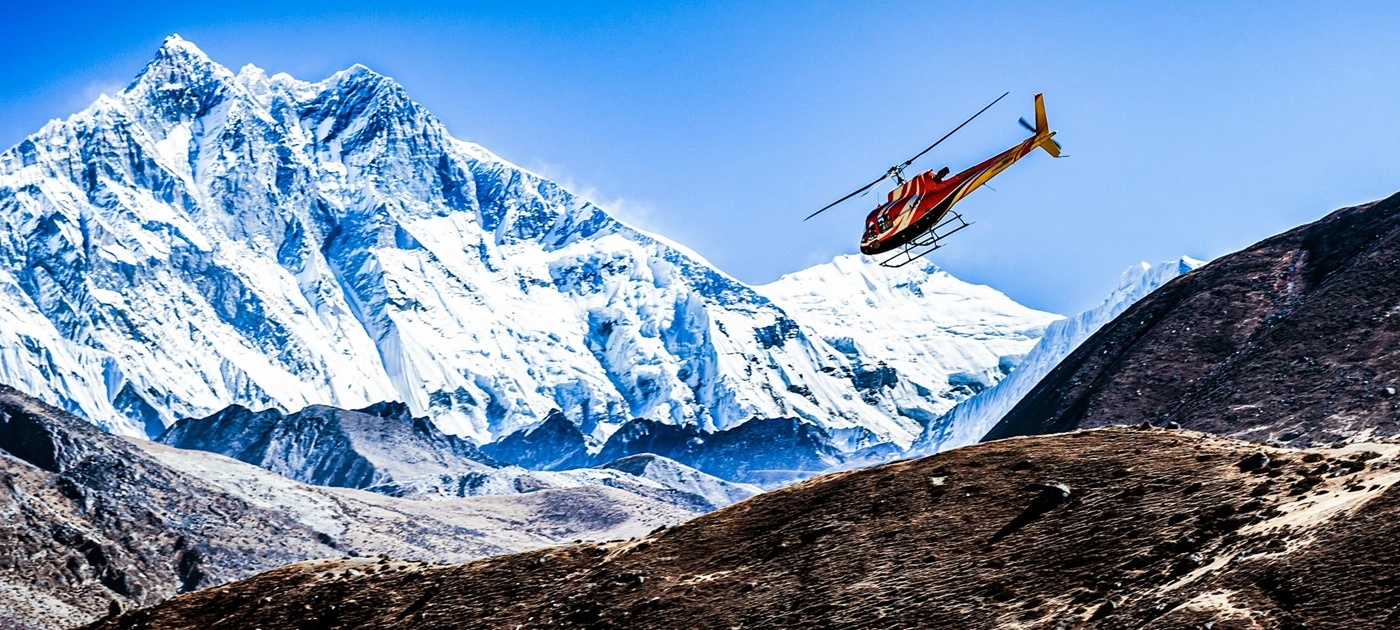
Travelers researching the Everest helicopter tour quickly discover that not all helicopter tours deliver the same experience. The phrase 'Everest helicopter tour' covers two operationally distinct products with meaningfully different itineraries, durations, pricing tiers, and traveler experiences.
The difference comes down to one question: does the helicopter make a high-altitude landing at Kala Patthar (5,545m) or near Everest Base Camp, or does it remain below that altitude, stopping only at the lower-elevation Hotel Everest View?
The two variants are sometimes presented with similar marketing language by operators who do not clearly differentiate between them. Travelers comparing quotes from multiple operators sometimes assume the price gap reflects operator tier or hidden inclusions when the actual difference is the landing component.
This guide explains both variants directly — what each includes, what each costs, who each is right for, and the operational reasons we offer both at our luxury tier rather than treating one as the default.
Quick orientation: If you have heard 'Everest helicopter tour' and pictured landing at the foot of the mountain at 5,545 meters for the close-up photographs, that is the landing version. If your priority is the aerial experience through the Khumbu valleys with the panoramic breakfast at the Hotel Everest View, but you do not need the high-altitude landing, the overfly version delivers exactly that at a meaningfully lower cost. Both are real Everest experiences. The right choice depends on what you specifically want from the day.
The Direct Comparison
The central reference for this guide. The two helicopter tour variants are compared across every dimension that affects the booking decision.
|
Dimension
|
Landing Version
|
Overfly Version
|
|
Maximum altitude reached
|
5,545 m (Kala Patthar landing)
|
3,880 m (Hotel Everest View)
|
|
On the ground at high altitude
|
10-15 minutes at Kala Patthar
|
None — aerial only at high altitude
|
|
Breakfast stop
|
Hotel Everest View 60-75 min
|
Hotel Everest View 60-75 min
|
|
Total duration
|
6-7 hours hotel to hotel
|
4-5 hours hotel to hotel
|
|
Departure time
|
05:30-06:00 from Kathmandu hotel
|
06:00-06:30 from Kathmandu hotel
|
|
Return to the hotel
|
Around 12:00
|
Around 11:00
|
|
Typical price (shared)
|
USD 1,100-1,500 per person
|
USD 600-900 per person
|
|
Typical price (private)
|
USD 4,500-6,500 charter
|
USD 2,800-3,800 charter
|
|
Weather sensitivity
|
Higher — high landing requires very stable conditions
|
Lower — wider operating windows
|
|
Same-day operating rate
|
~85-90%
|
~92-95%
|
|
Altitude exposure
|
Brief but significant — 5,545m for 10-15 min
|
Moderate — 3,880m for 60-75 min on ground
|
|
Photography from high landing
|
Close-quarters Everest from Kala Patthar
|
Aerial only — no on-ground close-quarters
|
|
Best for
|
Iconic close-up experience seekers
|
Aerial experience with cost or altitude considerations
|
What the Landing Version Delivers
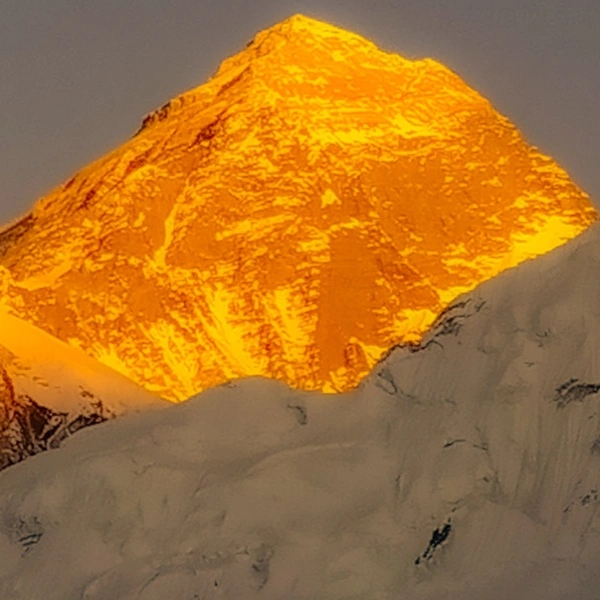
The landing version is the iconic Everest helicopter tour — the variant most travelers picture when they hear 'Everest helicopter.' The defining moment is the 10-15 minutes on the ground at Kala Patthar at 5,545 meters, where Everest is approximately 10 kilometers from the landing point, and the wind plume from the summit is visible above the ridge.
The Landing Sequence
- Pre-dawn departure from Kathmandu (05:30-06:00 hotel pickup) to catch the morning light at Kala Patthar
- Aerial transit through the Himalayan foothills with the major peaks rolling east as the flight progresses
- Refueling stop at Lukla airstrip — typically 10-15 minutes, with the option to step out for photographs
- Continued flight up the Khumbu valley with Everest, Lhotse, Ama Dablam, and Pumori visible in sequence
- Approach to Kala Patthar and the high-altitude landing — the pilot circles the landing zone to assess wind and snow conditions before committing
- 10-15 minutes on the ground at 5,545 meters for photography and the in-person Everest experience
- Departure from Kala Patthar and descent to the Hotel Everest View at 3,880 meters for breakfast
- 60-75 minutes at the Hotel Everest View terrace — panoramic Everest-Nuptse-Ama Dablam view with hot breakfast
- Return flight to Kathmandu, typically arriving at the hotel by 12:00
Why Travelers Choose the Landing Version
- The iconic close-quarters experience: Kala Patthar is the same vantage point that 12-day EBC trekkers reach after sustained exposure to altitude. The landing delivers that same view in a single morning.
- The 5,545m altitude credential: For travelers who want to say they stood at the foot of Everest, the landing version is the appropriate option. The overfly version does not deliver this.
- Photographic quality: On-ground photography at Kala Patthar produces compositions that aerial photography from a helicopter window cannot match — different perspective, different light, different scale relationship to the mountain.
- The bucket-list element: For many travelers booking Everest experiences, the Kala Patthar landing is the moment that defines the trip. The premium over the overfly version is justified by this specific moment for travelers who prioritize it.
What the Overfly Version Delivers
The overfly version is the aerial-only Everest helicopter experience — significantly less expensive than the landing version, more operationally reliable across weather windows, and well-suited to travelers whose priorities are the aerial Khumbu transit and the Hotel Everest View breakfast rather than a high-altitude on-ground landing. The variant is often called the 'Everest fly-over tour' or 'Everest mountain helicopter scenic' by operators, differentiating it from the landing product.
The Overfly Sequence
- Departure from Kathmandu around 06:00-06:30 from the hotel
- Aerial transit through the Himalayan foothills with the same visual progression as the landing version
- Refueling stop at Lukla airstrip — typically 10-15 minutes
- Flight up the Khumbu valley with the helicopter ascending to between 5,800-6,500 meters for the aerial Everest viewing without landing
- Aerial circle around the Everest-Nuptse-Lhotse-Ama Dablam massif for photography through the helicopter side windows
- Descent to Hotel Everest View at 3,880 meters for the breakfast stop
- 60-75 minutes at the Hotel Everest View terrace
- Return flight to Kathmandu, typically arriving at the hotel by around 11:00
Why Travelers Choose the Overfly Version
- Cost: The 40-60% lower pricing makes the Everest experience accessible to travelers whose budget does not support the landing version. For families of four or larger groups, the per-person cost difference becomes substantial in absolute terms.
- Altitude considerations: Some travelers have specific medical reasons to avoid exposure to altitudes above 5,545m — cardiac conditions, severe respiratory conditions, recent surgery, or late pregnancy. The overfly version's maximum on-ground altitude of 3,880m is meaningfully more tolerable for these profiles.
- Weather reliability: The overfly version has a wider operating window because it does not require the very stable conditions that the high landing demands. On marginal weather days, the overfly tour can sometimes proceed when the landing tour cannot.
- Time efficiency: The 4-5 hour total duration leaves the afternoon free for cultural Kathmandu rather than consuming the entire day. For travelers on tight schedules, time saving matters.
- Family-friendly: Families with young children typically choose the overfly version for lower altitude exposure and shorter duration. Children under 8 are generally not recommended for the high landing.
The Cost Differential Explained
The 40-60% price gap between the two variants is not arbitrary. The cost difference reflects four specific operational components.
Helicopter Operating Cost at Altitude
Helicopter operating costs increase significantly at altitude because the engines work harder, the fuel burn rate goes up, and the operational margins narrow. A high landing at Kala Patthar requires substantially more fuel than the same flight profile without the landing — the climb, the hover during the landing approach, the on-ground time with rotors running, and the climb out all consume additional fuel. The fuel cost difference alone accounts for roughly 25% of the price differential.
Pilot Tier and Risk Premium
The high-altitude landing at 5,545m requires a senior pilot with specific experience at Kala Patthar. Not every helicopter pilot is qualified for the landing — the regulatory framework and the operator's own risk management protocols restrict high-altitude landings to pilots with the appropriate tenure. The senior pilot tier commands a higher operating rate, and the risk premium for the high landing is embedded in the pricing. The overfly version uses the broader pool of qualified pilots for the lower-altitude flight profile.
Oxygen and Medical Infrastructure
The landing version requires onboard supplemental oxygen as a regulatory and operational standard. The oxygen system, the medical kit, and the protocol training that supports the high landing all add operating overhead. The overfly version operates with a lighter medical infrastructure because the altitude exposure profile does not require the same level of contingency planning.
Weather Reserve and Operational Flexibility
The landing version operates on tighter weather windows than the overfly version. Operators running the landing product carry larger weather reserves in their scheduling — additional contingency days, additional helicopter availability for weather-affected reschedules, and additional crew rotation. The flexibility costs money and is reflected in the premium of the landing version.
Weather Sensitivity and Reliability
Both variants operate weather-dependently, but the landing version is significantly more sensitive to specific atmospheric conditions than the overfly version.
What Each Variant Needs from Weather
- Overfly version: clear visibility for the Khumbu valley transit, manageable wind for the Hotel Everest View landing, no significant cloud development that would prevent the aerial circle around Everest
- Landing version: all of the above plus very stable wind at Kala Patthar (typically below 25-30 km/h), no fresh snow on the landing surface, clear visibility for the approach and departure, and the air temperature warm enough for safe rotor operation at altitude
The same-day operating rate reflects these differences. The overfly version completes on the originally scheduled day in roughly 92-95% of cases across the standard October-November and March-May operating seasons.
The landing version completes on the originally scheduled day in roughly 85-90% of cases — the remaining 10-15% reschedule to the following day or, in rare cases, convert to the overfly version with a partial refund of the difference. Our pre-trip team is direct about this at the time of booking, and travelers should leave a one-day buffer in their Kathmandu schedule regardless of which variant they choose.
Who Each Version Is Right For
The Kalapatthar Landing Version Is Right For
- Travelers prioritize the iconic close-quarters Everest experience above all other considerations
- Travelers who specifically want to stand at 5,545m at the foot of the mountain
- Photographers who want both aerial and on-ground compositions
- Travelers without medical contraindications to brief high-altitude exposure
- Travelers with the budget margin to support the premium and the schedule margin for possible weather rescheduling
- Travelers for whom this is the once-in-a-lifetime Everest moment that defines the trip
The Everest Base Camp Overfly Version Is Right For
- Travelers wanting the Everest aerial experience without the high-altitude landing premium
- Travelers with specific medical conditions that contraindicate brief exposure to 5,545m altitude (cardiac, severe pulmonary, recent surgery, late pregnancy)
- Families with young children — children under 8 are generally not recommended for the high landing, but tolerate the overfly version well
- Travelers on tight schedules who want the afternoon free for other Kathmandu activities
- Larger groups (4-6 travelers) where the per-person cost difference adds up substantially
- Travelers who have already done the EBC trek and want a return visit to the Khumbu region without revisiting Kala Patthar specifically
- First-time Nepal travelers wanting an Everest experience as one element of a broader Nepal itinerary rather than as the centerpiece
Combined and Hybrid Options
Several traveler profiles benefit from hybrid arrangements that combine elements of both variants or pair the helicopter tour with related products.
The Family Hybrid
Families traveling together, where the adults want the landing version and the children are not appropriate for the high altitude, sometimes book the overfly version for the family group, with one or two adults from the group transferring to a private landing charter on a separate day. The arrangement keeps the family experience together for the main tour and adds the dedicated landing experience for the adults who want it.
The Trek and Helicopter Combination
Travelers doing the standard EBC trek who reach Kala Patthar on foot sometimes add the overfly helicopter tour as a separate experience earlier in their Nepal trip to see the Khumbu from the air before walking through it. The combined experience produces a meaningfully richer perspective on the region than either component alone.
The Mountain Flight Alternative
For travelers seeking the lowest-cost aerial Everest experience, the fixed-wing Everest Mountain Flight from Kathmandu (USD 200-280 per passenger for a 60-minute parallel-to-the-range flight) offers a different but legitimate Everest viewing option that is significantly less expensive than either helicopter variant.
The mountain flight does not include the Hotel Everest View breakfast or the Khumbu valley transit at altitude, but it does provide the eye-level summit view that ground-level viewpoints cannot match. The three options — landing helicopter, overfly helicopter, mountain flight — cover the full price spectrum from USD 200 to USD 1,500+ per passenger and produce three meaningfully different experiences.
How Our Team Handles Both Variants
- Both variants are offered at the luxury tier: We operate both the landing and overfly versions with the same operating standards — small-group flights (4-5 passengers per helicopter), AS350 helicopters, senior Khumbu-experienced pilots, onboard supplemental oxygen, and the Hotel Everest View breakfast included as standard.
- Pre-trip qualification for the landing version: We confirm medical compatibility for the high-altitude exposure at the inquiry stage and recommend the overfly version for travelers whose medical profile makes the landing inappropriate.
- Weather decision discipline applied to both: We reschedule rather than push flights through marginal conditions, regardless of which variant the traveler booked. The discipline is the same; the threshold for safe operation is different between the two variants.
- Honest pricing transparency: We quote the landing and overfly versions with the same operator overhead and the same inclusion list. The price differential reflects only the operational components covered above, not the hidden margin.
- Partial-refund protocol if the landing converts: On rare occasions when the landing version cannot operate safely on the day but the overfly version can, we offer the option to convert with a partial refund of the price difference rather than a full cancellation. The protocol is disclosed at booking.
Frequently Asked Questions
What is the actual difference between the landing and overfly helicopter tours?
The landing version makes a 10-15-minute high-altitude landing at Kala Patthar (5,545m), at the foot of Mount Everest. The overfly version flies the same Khumbu valleys but does not make the high landing — the helicopter stays in the air for the high-altitude portion and only lands at the Hotel Everest View at 3,880m for the breakfast stop. Both versions include the Hotel Everest View breakfast and the aerial transit through the Khumbu. The defining difference is whether you stand on the ground at 5,545m or whether you experience that altitude from the air.
Is the landing version worth the extra cost?
Depends on the traveler. For travelers prioritizing the iconic close-quarters Everest experience, the standing-at-the-foot-of-the-mountain moment, and the bucket-list element, the premium of the landing version is justified by the experience it delivers. For travelers prioritizing the aerial experience, the Hotel Everest View breakfast, the cost efficiency, or the time efficiency, the overfly version delivers most of what makes the helicopter tour valuable at 40-60% lower cost. The question is not which version is objectively better — both are real Everest experiences. The question is which dimensions matter most to the specific traveler.
Can I switch from the landing version to the overfly version if weather prevents the landing?
Sometimes. On marginal weather days when the high-landing version cannot operate safely but the overfly version can, we offer the option to convert with a partial refund of the price differential. The protocol is disclosed at booking. On days with worse weather when neither variant can operate, the tour is rescheduled to the following day. The reverse conversion (booking an overfly and upgrading to a landing on a particularly clear day) is generally not operationally feasible due to helicopter and pilot scheduling constraints in the landing tier.
Is altitude sickness more likely on the landing version?
Possible, but uncommon, given the brief exposure at Kala Patthar. The 10-15 minutes on the ground at 5,545m without prior acclimatization produces a more aggressive altitude exposure than the multi-day EBC trek, but the brevity limits the time for altitude sickness symptoms to develop. Supplemental oxygen is available on board. Travelers with specific altitude sensitivity should discuss the tour with our pre-trip team. The overfly version's maximum on-ground altitude of 3,880m is significantly more tolerable for altitude-sensitive travelers.
Which version is better for photography?
Different rather than ranked. The landing version produces close-quarters on-ground photography at Kala Patthar that the overfly version cannot match — these are the iconic Everest-pyramid-against-the-blue-sky photographs that define the visual record of the trip for most travelers. The overfly version produces aerial compositions through the helicopter's side window during the high-altitude pass, which the landing version captures as a secondary product. Photographers seeking a comprehensive visual record sometimes book the landing version on day one of their Nepal trip and the mountain flight on a separate day to capture the cockpit-altitude perspective.
Can children do either version?
Children 8 and older typically do the overfly version comfortably. Children under 8 are generally not recommended for the helicopter tour at all due to altitude exposure and cabin pressure changes. The landing version is generally not recommended for children under 12 because of the 5,545m altitude. Families with mixed ages often choose the overfly version for the family group and consider a separate adult-only landing charter on a different day if the adults specifically want the landing experience.
How early should I book each version?
For both versions, 6-10 weeks ahead for the strongest seasons (mid-October to early December and mid-April to mid-May). The landing version has a tighter capacity due to the senior pilot tier requirement. Last-minute bookings (1-2 weeks before departure) are sometimes possible during shoulder seasons but rarely during peak weeks. Travelers planning either variant should book at the same time as the rest of the Nepal itinerary rather than as a last-minute add-on.
What is the best season for each?
Autumn (mid-October to early December) is the strongest single window for both variants — stable post-monsoon weather and crisp visibility. Spring (mid-March to mid-May) is the second-strongest window. The landing version benefits more from the stable autumn conditions because the high landing requires a tighter weather window. The overfly version operates reliably across a broader range of conditions and is more weather-flexible in shoulder seasons. Both variants generally do not operate during the monsoon (June-September).
Is breakfast at Hotel Everest View included in both versions?
Yes. Both the landing and overfly versions include the breakfast stop at the Hotel Everest View at 3,880m as standard. The breakfast typically runs for 60-75 minutes on the terrace, with panoramic views of Everest, Nuptse, and Ama Dablam. The hotel is one of the most photogenic single locations in the Khumbu, and the breakfast moment is often the highlight of the day for travelers, regardless of which variant they booked.
Can I do a private charter of either version?
Yes for both variants. Private charter pricing runs USD 4,500-6,500 for the landing version and USD 2,800-3,800 for the overfly version. Private charter is the operationally cleaner option for couples and groups of 3-5 travelers seeking privacy, schedule flexibility, and a controlled experience without the shared-flight dynamic. For solo travelers, the shared flight option in either variant works well at the per-person pricing.
Book Your Everest Helicopter Tour With Us
Tell us your priorities — close-quarters Kala Patthar experience or aerial Khumbu transit with breakfast, your dates, your group size, and any medical conditions our pre-trip team should know about. We return a written proposal within 24 hours that covers the appropriate variant, the operating standards, the weather contingency plan, and integration with the rest of your Nepal trip. Both versions are real Everest experiences — and the right one depends on what you specifically want from the day.