Top 10 Mount Everest Viewpoints: A Complete Guide
The question 'where can I see Mount Everest' has more answers than most travelers expect. Everest can be seen from a 5,545-meter rocky ridge at the foot of the summit pyramid, from a freshwater lake at 4,790 meters surrounded by glaciers, from a 3,860-meter Buddhist monastery on a forested ridge, from a 2,175-meter hill station accessible by road from Kathmandu, and from the window seat of a fixed-wing aircraft cruising at 25,000 feet. Each option produces a meaningfully different visual experience and matches a different traveler profile.
After years of running Everest-region departures across the spectrum from full EBC treks to single-morning helicopter tours, our team has developed a clear understanding of which viewpoint works for which traveler.
The factors that determine a good match are physical capacity, available time, photographic priority, cultural interest, and budget. This guide walks through the ten most significant Everest viewpoints in Nepal, explains what each one offers, identifies the practical constraints, and points to the Alpine Luxury Treks product that efficiently gets travelers to each one.
A note on Everest visibility. The summit of Mount Everest is frequently obscured from nearby viewpoints by its own shoulder ridges or by the massive Nuptse and Lhotse walls. The Everest Base Camp at 5,364 meters on the Khumbu Glacier — the destination of the standard EBC trek — has almost no direct view of the Everest summit because the West Ridge blocks the line of sight. This is why Kala Patthar, at 5,545 meters, is the actual Everest viewpoint that EBC trekkers climb to. Each viewpoint in this guide has a specific geometric relationship to the mountain that we describe accurately rather than romantically.
The Ten Viewpoints Comparison Table
The central reference for this guide. The table compares all ten Everest viewpoints across elevation, access method, difficulty, what is visible from each, and the matching Alpine Luxury Treks product. The deeper detail on each viewpoint follows below.
|
Viewpoint
|
Elevation
|
Access
|
Difficulty
|
What You See
|
Best Product
|
|
Kala Patthar
|
5,545 m
|
Trek from Gorak Shep
|
Strenuous
|
Close-up of the Everest summit pyramid 10 km away
|
EBC trek/helicopter tour
|
|
Gokyo Ri
|
5,357 m
|
Trek from Gokyo village
|
Strenuous
|
Four 8000m peaks plus Ngozumpa Glacier
|
Three Passes / Gokyo trek
|
|
Renjo La
|
5,360 m
|
Pass crossing Gokyo to Thame
|
Strenuous
|
Symmetrical Everest-Lhotse-Nuptse over lakes
|
Three Passes trek
|
|
Nangkartshang
|
5,083 m
|
Day hike from Dingboche
|
Moderate
|
Lhotse south face plus Ama Dablam
|
EBC trek acclimatization
|
|
Kongde Ri
|
4,250 m
|
Trek or helicopter to the lodge
|
Moderate
|
180-degree Khumbu panorama
|
Khumbu cultural trek
|
|
Hotel Everest View
|
3,880 m
|
Trek from Namche or helicopter
|
Easy / Helicopter
|
Everest-Nuptse-Ama Dablam from the terrace
|
Helicopter tour / EBC trek
|
|
Tengboche
|
3,860 m
|
Trek from Namche
|
Moderate
|
Everest above the monastery framing
|
EBC trek
|
|
Pikey Peak
|
4,065 m
|
Drive plus 3-4 day trek
|
Moderate
|
300 km Himalayan sweep from Solu
|
Pikey Peak short trek
|
|
Nagarkot
|
2,175 m
|
Drive 1 hr from Kathmandu
|
None
|
Distant Everest pyramid 175 km away
|
Kathmandu day trip
|
|
Mountain flight
|
7,500 m (aircraft)
|
60-min flight from Kathmandu
|
None
|
Eye-level Everest from cockpit altitude
|
Everest mountain flight
|
1. Kala Patthar — The Standard EBC Trek Viewpoint
Kala Patthar (literally 'Black Rock' in Nepali) is the iconic Everest trekking viewpoint, and the destination most travelers visualize when they imagine the EBC trek. The ridge at 5,545 meters sits on the southern flank of Pumori and provides the closest accessible viewpoint to the Everest summit on the Nepal side of the mountain.
The reason Kala Patthar exists as a distinct destination from Everest Base Camp itself is geometric — EBC at 5,364 meters on the Khumbu Glacier sits behind the West Ridge of Everest and the Nuptse wall, with no direct view of the summit. Kala Patthar's higher elevation and position to the south provide a clean line of sight to the summit pyramid that EBC does not.
The Visual Experience
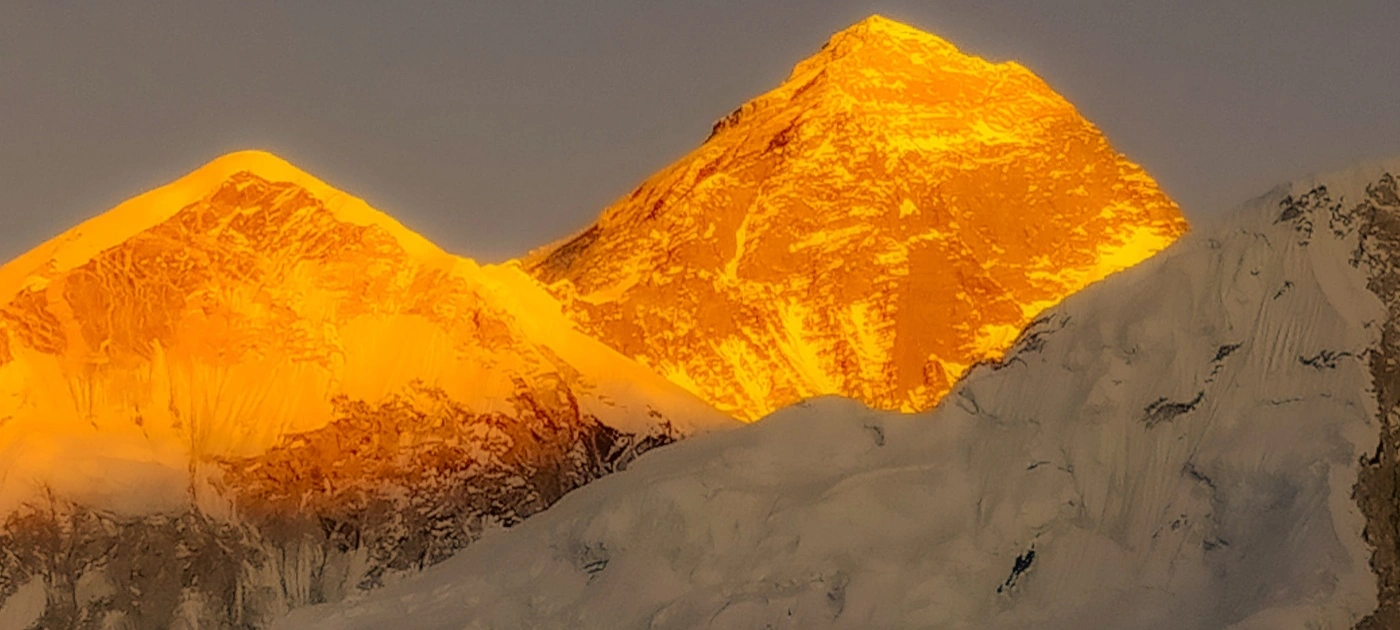
The summit of Everest sits approximately 10 kilometers from Kala Patthar — close enough that travelers see the wind-driven snow plume rising from the summit ridge on most days. The pre-dawn climb is the traditional approach because the sunrise produces the iconic visual sequence — the summit illuminating first in gold while the Khumbu Glacier below remains in deep shadow, then the light cascading down the West Face as the sun rises. The sunset alpenglow produces the reverse sequence with pink and orange tones on the West Face.
Access and Difficulty
- Access from Gorak Shep (5,164 m), the last settlement on the EBC trail
- Vertical gain of approximately 400-500 meters
- Non-technical scramble over boulders and scree — no climbing skill required
- Ascent time 1.5-2.5 hours, depending on acclimatization
- Oxygen at 50% of sea-level concentration — the altitude is the primary challenge rather than the terrain
How We Get You There
Two ways. The standard luxury EBC trek (12-14 days) takes travelers to Kala Patthar on foot with full acclimatization — the gold-standard approach that produces the strongest physical and emotional experience.
The Everest helicopter tour lands at Kala Patthar for a 10-15-minute visit to the summit for travelers who cannot commit to a two-week trip. Both deliver the same view from the same point, but the trek-and-helicopter combinations produce very different overall experiences. Our pre-trip team helps travelers choose the appropriate option.
2. Gokyo Ri — The Four 8000-Meter Panorama
Gokyo Ri, at 5,357 meters, sits on the western side of the Khumbu in the Gokyo valley and is widely considered by experienced trekkers to offer a superior overall Everest experience compared to Kala Patthar. The reason is the panoramic breadth.
From the Gokyo Ri summit, four of the world's fourteen 8,000-meter peaks are visible simultaneously — Everest at 8,848 meters, Lhotse at 8,516 meters, Makalu at 8,481 meters, and Cho Oyu at 8,201 meters. No other accessible viewpoint in the Khumbu produces this single-frame four-peak view.
The Foreground
The visual reward extends beyond the distant 8000-meter peaks. The Ngozumpa Glacier — the longest glacier in Nepal — runs immediately below the Gokyo Ri ridge. The six Gokyo Lakes form a turquoise chain at altitudes between 4,700 and 5,000 meters along the valley floor.
The lakes are designated a Ramsar wetland of international importance and hold religious significance for both Hindu and Buddhist traditions. The combination of glacial foreground, lake-system mid-ground, and 8000-meter peak backdrop produces compositions that experienced photographers consistently rate among the strongest in the Himalaya.
The Fifth Lake Extension
For travelers wanting an alternative perspective without the Gokyo Ri summit climb, the half-day walk north from Gokyo village to the Fifth Lake (Ngozumpa Tsho) at approximately 5,000 meters provides what experienced guides call the 'scoundrel's viewpoint' — a vertical perspective of the Everest North Face on the Tibet side that is not visible from any other Nepal-side trekking location.
The Fifth Lake walk is the appropriate alternative for travelers who reach Gokyo but choose not to climb Gokyo Ri itself.
How We Get You There
The Gokyo Valley is the western section of the Three Passes trek and can also be combined with a dedicated Gokyo trek if the full Three Passes is too demanding. Both itineraries deliver the Gokyo Ri summit. Our Three Passes trek (18-21 days) combines Gokyo Ri with a Cho La pass crossing into the Khumbu Valley and a Kongma La pass back to Dingboche — the comprehensive Khumbu experience.
3. Renjo La Pass — The Symmetric Three-Peak View
Renjo La at 5,360 meters is one of the Three High Passes of the Khumbu and serves as the route between the Gokyo valley and the quieter Thame valley to the west. The pass is widely regarded as producing the most symmetric and aesthetically composed Everest view in the entire Khumbu — the angle places Everest, Lhotse, and Nuptse in a single jagged horizon, with the Gokyo Lakes reflecting the peaks in the foreground.
Why the Renjo La View Differs
From Renjo La, the three major peaks of the central Khumbu — Everest, Lhotse, and Nuptse — align in a way that no other accessible viewpoint produces. Most viewpoints place the peaks at different distances, resulting in a less unified visual horizon.
Renjo La's positioning at the western edge of the Gokyo system gives a frontal-on perspective in which the three peaks read as a single mountain wall rather than three separate summits. The composition is what professional landscape photographers travel to the Khumbu specifically to capture.
The Difficulty
The pass crossing is genuinely demanding — 8-10 hours of trekking from the Gokyo side over steep rocky terrain, with the altitude exposure adding to the physical load. The descent to the Thame valley on the western side takes travelers through one of the quieter and more culturally authentic sections of the Khumbu, including Thame village itself — the traditional home of many famous Sherpa mountaineers, including Tenzing Norgay.
How We Get You There
Renjo La is integrated into our Three Passes trek as the western pass of the three-pass circuit. Travelers wanting Renjo La specifically without the full Three Passes can do a Gokyo-Renjo-Thame combined trek of approximately 16-18 days. Our luxury operating model includes helicopter access to Lukla in both directions, which makes the longer durations operationally feasible without adding excess Lukla weather risk.
4. Nangkartshang Peak — The Acclimatization Viewpoint
Nangkartshang Peak at 5,083 meters sits directly above the village of Dingboche and serves a dual role on the EBC trek — primary acclimatization hike on the standard rest day in Dingboche, and a meaningful Everest viewpoint in its own right.
Most travelers underestimate Nangkartshang's value because the peak is overshadowed by Kala Patthar in the trekking literature, but the view it produces is genuinely excellent.
The View from Nangkartshang
From the Nangkartshang summit, the visible peaks include Everest, Lhotse, Makalu, Cho Oyu, and Ama Dablam — a five-peak panorama that covers more of the Khumbu than Kala Patthar's narrower view. The angle on Lhotse is particularly strong — the massive south face of Lhotse fills much of the frame because Nangkartshang sits directly across the Imja valley from it. The view of Ama Dablam from this angle reveals ridge structures that are not visible from the more conventional Namche or Tengboche viewpoints.
Acclimatisation Function
The dual function is what makes Nangkartshang particularly valuable on the EBC trek. The 5,083-meter summit provides the 'climb high, sleep low' altitude exposure that the body needs to develop acclimatization for the higher Kala Patthar climb later in the trek. Most travelers on our luxury EBC departures complete the Nangkartshang hike as part of the standard Dingboche rest day rather than as a separate add-on.
5. Kongde Ri — The Hidden Bird's-Eye Viewpoint
Kongde Ri at 4,250 meters (for the lodge) and 5,300 meters (for the Farak Ri extension) sits on a high ridge on the opposite side of the Dudh Koshi valley from the main EBC trail. The viewpoint produces what experienced operators consider the single most impressive panoramic perspective on the entire Khumbu — a 180-degree unobstructed vista across the valley to Everest, Lhotse, Nuptse, Ama Dablam, and Thamserku in a single horizon.
Why Kongde Differs
Most Khumbu viewpoints sit within the valley structure of the mountains they are viewing, looking up at the peaks from below or alongside them. Kongde sits across the valley, looking directly at the Khumbu massif from a position outside it. The result is a view that captures the entire mountain system as a single visual entity rather than as a series of summits glimpsed from inside.
Travelers who have completed the standard EBC trek and return to Kongde frequently describe the perspective as the most revealing of the whole Khumbu region — they finally see the geographic structure that they walked through but could not previously visualize as a whole.
Why Most Travelers Miss It
Kongde is rarely included in standard EBC itineraries due to limited access. Reaching the Kongde Lodge requires either a substantial detour off the main trail or a dedicated helicopter approach. Most commercial operators skip it.
Our luxury operating model includes Kongde Ri as the optional 2-day extension for travelers who want the comprehensive Khumbu visual experience and have the time available. Helicopter access to the Kongde lodge is also available for travelers seeking the viewpoint without the full multi-day approach.
6. Hotel Everest View at 3,880 Meters
The Hotel Everest View at 3,880 meters on the Syangboche ridge above Namche Bazaar is the comfort-and-accessibility option among the Everest viewpoints. Established in 1971 with every guest room designed to face the Everest panorama, the hotel sits at an altitude where the body can spend extended time safely while still delivering a meaningful close-up view of the mountain. The terrace overlooks Everest, flanked by Nuptse and the visually striking Ama Dablam.
The Visual Composition
From the hotel terrace, the alignment produces a three-peak frame — Everest at the center-rear, Nuptse to the immediate left of Everest in the foreground, and Ama Dablam dominating the right side of the composition with its pyramid shape and the hanging glaciers that give the peak its distinctive silhouette.
Many travelers find Ama Dablam more visually striking than Everest itself from this angle because Ama Dablam's proximity makes it loom larger in the frame. The Everest summit appears as the dark triangle on the northern horizon — recognizable, photographic, but smaller in the frame than it appears from the higher Kala Patthar viewpoint.
Why the Hotel Everest View Works
- The 3,880-meter altitude allows extended time at the viewpoint without altitude sickness risk
- Hotel infrastructure — heated rooms, hot meals, proper accommodation — makes the experience comfortable rather than rugged
- Daily helicopter access from Kathmandu via the Syangboche airstrip allows single-day or overnight visits
- The breakfast on the terrace is operationally the most photographic single moment on most Khumbu helicopter tours
- Standard acclimatization destination for EBC trekkers during the Namche rest day — climb from Namche to the hotel and back in 2-3 hours
How We Use the Hotel Everest View
Every Everest Helicopter Tour we operate includes breakfast at the Hotel Everest View as the standard mid-itinerary stop between the Kala Patthar landing and the return to Kathmandu. Our luxury EBC trek departures include the hotel as the destination for the acclimatization hike on the Namche rest day.
The hotel is effectively the operational hub for Khumbu helicopter tourism and the right choice for travelers seeking the Everest experience with hotel-tier accommodation rather than basic trekking lodge accommodation.
7. Tengboche Monastery — The Cultural Viewpoint
Tengboche Monastery at 3,860 meters is the spiritual anchor of the Khumbu and one of the most photographed locations in Nepal. The monastery sits on a ridge surrounded by ancient pine and rhododendron forest, with the Lhotse-Nuptse wall and the Everest summit visible behind the monastery's distinctive roofs and golden pinnacles.
The view differs from the high-altitude technical viewpoints because the framing element is cultural rather than geological — the monastery in the foreground gives the Everest backdrop an architectural anchor that pure-mountain viewpoints lack.
The Sunrise Sequence
Tengboche is particularly known for the sunrise sequence. The first light reaches the Everest summit while the monastery courtyard is still in shadow. The monks begin their morning chants in the prayer hall as the light moves down the mountain. The audible component — the deep horns and chanting from the prayer hall — combined with the visual sequence on the mountain, produces a moment that travelers consistently describe as the most memorable single experience of the EBC trek.
Ama Dablam from Tengboche
Tengboche is also widely considered the strongest viewpoint for Ama Dablam in the entire Khumbu. The peak rises directly to the south-east of the monastery, with its vertical walls and sharp ridge structure fully visible from the monastery courtyard.
The Ama Dablam framing from Tengboche has appeared on more Khumbu photographs than perhaps any other single composition in the region. Photographers who travel to the Khumbu specifically for Ama Dablam time their Tengboche visit for the late-afternoon golden hour when the western light catches the full face of the peak.
How We Use Tengboche
Tengboche is a standard overnight stop on our luxury EBC trek departures. Travelers spending the night at Tengboche get both the sunset and sunrise sequences. Departures timed to overlap with the Mani Rimdu festival (typically late October to mid-November) experience the monastery's most significant annual cultural observance — the masked Cham dances, the prayer ceremonies, and the festival activity that draws Sherpa families from across the Khumbu.
8. Pikey Peak — The Hillary Perspective
Pikey Peak at 4,065 meters in the lower Everest region (Solu, south of the main Khumbu) offers a fundamentally different Everest experience from the high-altitude viewpoints. Sir Edmund Hillary famously named the view from Pikey Peak as his favourite in all of Nepal — a notable assessment given Hillary's deep familiarity with the entire range. The reason is the panoramic breadth afforded by the lower elevation and southern position.
The 300-Kilometer Sweep
From the Pikey Peak summit, the visible Himalayan chain extends approximately 300 kilometers from the Dhaulagiri and Annapurna ranges to the west through the central Himalaya to Mount Kanchenjunga to the east. Everest appears as a dark, majestic pyramid in the center of this sweep rather than as the dominant single peak it appears to be from the closer Khumbu viewpoints. The wide-angle perspective gives travelers a sense of the Himalayan scale that is harder to grasp from inside the range.
Why Pikey Peak Matters for Some Travelers
- 4,065-meter maximum altitude reduces the AMS risk significantly compared to 5,000+ meter Khumbu viewpoints
- No Lukla flight required — the trailhead is accessible by an 8-10 hour drive from Kathmandu, eliminating the Lukla weather delay risk that affects all standard Khumbu trips
- 4-8 day total trip duration fits inside short Nepal trip windows that the 12-14 day EBC trek does not accommodate
- Lower commercial volume — Pikey Peak receives a fraction of the trekker traffic that the main EBC trail carries
- Authentic Sherpa and Rai village cultural experience along the trail with rhododendron forest and traditional monastery infrastructure
- Significantly lower trip cost than EBC-tier expeditions because of the shorter duration and the lack of Lukla helicopter charters
Who Pikey Peak Is Right For
First-time Nepal travelers with limited time, travelers concerned about altitude exposure at 5,000+ meters, families seeking an Everest experience at moderate altitude, and photographers seeking the wide-angle Himalayan perspective rather than a close-up of the Everest summit. We run Pikey Peak as a dedicated short-trek option for these traveler profiles.
9. Nagarkot and Chandragiri — The Kathmandu Day-Trip Viewpoints
For travelers whose Nepal trip does not include the Khumbu, two viewpoints near Kathmandu produce a meaningful (if distant) Everest view. Both are accessible as half-day or full-day trips from the city center.
Nagarkot at 2,175 Meters
Nagarkot, approximately 32 kilometers east of Kathmandu, is the historic hill station that has anchored mountain viewing in the Kathmandu Valley for generations. On clear mornings — particularly in the post-monsoon October and November window — Mount Everest is visible as a small dark pyramid on the north-eastern horizon approximately 175 kilometers away.
Eight of the thirteen major Himalayan ranges visible from Nepal can be seen from Nagarkot on the clearest days. The experience is fundamentally a drive-up viewpoint with comfortable hotel accommodation, sunrise viewing terraces, and no physical effort required.
Chandragiri Hill at 2,551 Meters
Chandragiri Hill on the south-western edge of the Kathmandu valley is accessible via a modern cable car system that runs from the valley floor to the ridge summit. The visibility from Chandragiri is broader than Nagarkot in some respects — the perspective covers the Himalayan range from Annapurna in the west to Everest in the east — but Everest itself is more distant from Chandragiri than from Nagarkot.
The cable car access makes Chandragiri the right option for travelers with limited mobility or with very young children, where the Nagarkot drive may be more demanding.
How We Use Nagarkot and Chandragiri
Both viewpoints are featured in our Kathmandu Valley cultural tour itineraries and as Everest-on-a-budget alternatives for travelers whose schedules do not allow the trek or helicopter options. The Nagarkot sunrise overnight stay is a standard add-on for cultural travelers wanting the Himalayan panorama without the multi-day commitment. We are direct that the Everest view from either point is meaningful but distant — these are not substitutes for the Kala Patthar or Hotel Everest View close-up experience.
10. Aerial Viewpoints — Mountain Flights and Helicopter Tours
The aerial options complete the Everest viewpoint spectrum. Two distinct products operate — fixed-wing mountain flights and helicopter tours with landing.
Everest Mountain Flights
Fixed-wing aircraft depart Kathmandu daily during the operating seasons and fly a 60-minute aerial parallel-to-the-range route. Every passenger receives a guaranteed window seat. The aircraft cruises at approximately 7,500 meters, offering passengers an eye-level perspective on the Everest summit — a perspective that no ground-based viewpoint can replicate.
The mountain flight offers a substantial Everest experience for travelers who cannot trek, cannot helicopter, or have limited time in Nepal. The cost is significantly lower than that of helicopter tours (typically USD 200-280 per passenger), and the operational window is broader because fixed-wing aircraft fly in weather conditions that helicopters cannot use.
Helicopter Tours with Landing
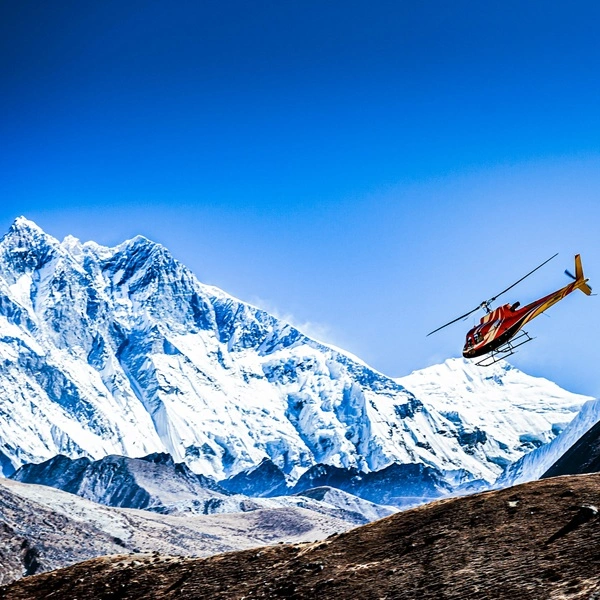
The Everest Helicopter Tour combines the aerial transit through the Khumbu valleys with a high-altitude landing at Kala Patthar or near Everest Base Camp and breakfast at the Hotel Everest View. Total trip duration is 6-7 hours from Kathmandu hotel to Kathmandu hotel.
The combined product offers more than the mountain flight (because of the on-ground time and the close-up landing) but at a higher cost (USD 1,100-1,500 per person shared; USD 4,500-6,500 for a private charter). The choice between a mountain flight and a helicopter tour depends on whether the traveler wants an immersive landing experience or a lower-cost aerial-only overview.
Photography from the Air
Aerial photography from both options produces compositions that ground-based viewpoints cannot match. The mountain flight delivers eye-level summit shots through the window. The helicopter tour offers compositions through the side windows during transit, plus on-ground photography opportunities at the high landing. Photographers seeking comprehensive Everest documentation often combine the helicopter tour for close-up shots and the mountain flight for panoramic, at-altitude perspective.
Choosing the Right Viewpoint for Your Trip
The ten viewpoints work for genuinely different traveler profiles. The matching framework that we use at the inquiry stage:
- First-time Himalayan traveler, two weeks available, good fitness: EBC trek to Kala Patthar via Tengboche. The iconic Everest experience, including the Nangkartshang and Tengboche viewpoints en route.
- Experienced trekker seeking the comprehensive Khumbu Three Passes trek covering Gokyo Ri, Renjo La, Cho La, and Kongma La. The complete Khumbu visual and cultural experience.
- Limited time (1-2 days), but want a close-up of Everest: Everest Helicopter Tour covering Kala Patthar landing and Hotel Everest View breakfast in a single morning.
- Limited time and budget-conscious: Everest Mountain Flight for the 60-minute aerial Everest experience at the lowest cost tier.
- Short trip with moderate fitness, want the panoramic Himalayan sweep: Pikey Peak short trek (4-8 days) for the wide-angle view that Hillary called his favorite.
- Cultural traveler staying in Kathmandu: Nagarkot sunrise overnight or Chandragiri cable car day trip for the distant Everest view without leaving the valley.
- Family with mixed ages and fitness levels: Hotel Everest View helicopter tour combined with Nagarkot extension — the no-trekking option that still delivers genuine Everest moments.
- Photographer wanting the comprehensive visual record: Three Passes trek for the close-up plus mountain flight for the aerial perspective — the most thorough single-trip Everest photography program available.
Timing and Visibility
Atmospheric clarity in the Khumbu and from the Kathmandu valley follows a predictable seasonal pattern.
- Mid-October to late November: Strongest single visibility window. Post-monsoon atmospheric clearing produces the maximum transparency and the sharpest mountain detail. Recommended for all ten viewpoints, including the distant Nagarkot perspective.
- Mid-March to mid-May: Second-strongest window with the rhododendron bloom in the lower trekking valleys. Pre-monsoon haze can soften distant peaks, but mornings remain consistently clear.
- December to February: Crystal-clear conditions but extreme cold and shorter operating windows. Higher Khumbu viewpoints can be inaccessible due to snow. Nagarkot, Chandragiri, and Pikey Peak remain accessible.
- June to September (monsoon): Generally not the right window — heavy cloud cover obscures the high peaks from most viewpoints. Brief, clear windows exist after monsoon storms, but planning a trip around them is operationally difficult.
Photography Technical Notes
High-altitude Everest photography presents specific technical considerations that ground-level photography does not.
- UV radiation is significantly more intense at 5,000+ meters — use UV filters and circular polarisers to manage glare and protect sensors
- Cold temperatures (down to -20 °C at Kala Patthar in winter) drain lithium-ion batteries rapidly. Carry spare batteries in inner clothing layers to maintain warmth
- Wide-angle lenses (16-35mm) work best for Gokyo Ri, Renjo La, and foreground-rich compositions
- Standard zoom (24-70mm) covers village scenes at Namche and Tengboche
- Telephoto (70-200mm or longer) delivers the summit detail at Nagarkot and the Hotel Everest View
- Tripod use at sunrise and sunset is meaningfully helpful, but the weight cost on long treks requires consideration
Frequently Asked Questions
Can you actually see Mount Everest from Everest Base Camp?
No — and this surprises most travelers. The Everest summit is not visible from Everest Base Camp itself because the West Ridge of Everest and the Nuptse wall block the line of sight from EBC's position on the Khumbu Glacier at 5,364 meters. Kala Patthar at 5,545 meters is the actual close-up Everest viewpoint that EBC trekkers climb specifically for the summit view. The EBC visit is meaningful for the experience of standing at the foot of the mountain and seeing the Khumbu Icefall, but the iconic Everest summit photograph comes from Kala Patthar.
Which is better, Kala Patthar or Gokyo Ri?
Different rather than ranked. Kala Patthar offers the closest possible Everest summit view from Nepal — its 10-kilometer proximity allows observation of the wind plume and the details of the summit pyramid. Gokyo Ri gives the broader four-8000-meter panorama with the Ngozumpa Glacier and the Gokyo Lakes in the foreground. Photographers often prefer Gokyo Ri for compositional reasons; first-time travelers often prefer Kala Patthar for the iconic summit view. Travelers doing the full Three Passes trek see both.
Can I see Everest from Kathmandu?
Yes — on clear days from Nagarkot or Chandragiri, both within 1-2 hours of Kathmandu by road or cable car. Everest appears as a small dark pyramid on the north-eastern horizon at approximately 175 kilometers distance. The visibility is best in October and November during the post-monsoon clearing window. The experience is meaningful but is qualitatively different from the close-up viewpoints — Everest appears as one peak among many rather than as the dominant single mountain it becomes at Kala Patthar.
Which viewpoint requires the least physical effort?
Nagarkot and Chandragiri both require essentially no physical effort — drive or cable car access to the viewpoint, with no walking beyond what travelers choose to do at the destination. The Hotel Everest View at 3,880 meters is accessible by helicopter for travelers seeking close-up Everest views without the effort of trekking. The Everest Mountain Flight (a 60-minute aerial tour) requires no walking and offers a substantial Everest experience.
Can children see Everest?
Yes, with appropriate viewpoint selection. Children under 10 are typically not well-suited to the high-altitude Khumbu viewpoints due to the risk of altitude exposure and sustained physical demands. Nagarkot, Chandragiri, Pikey Peak (with appropriate pacing), the Hotel Everest View by helicopter, and the Everest Mountain Flight all work for families with children. Our Everest with Children blog covers the broader family-trip framework in detail.
How long do I need at each viewpoint?
Varies significantly. Kala Patthar visits are deliberately short — 10-30 minutes at the summit due to the altitude. Gokyo Ri and Renjo La summit visits run 30-60 minutes, given the better-tolerated altitude. Tengboche monastery rewards a full afternoon and the following morning to catch both sunset and sunrise. Hotel Everest View visits range from 60-90 minutes for breakfast-and-photography to overnight stays. Nagarkot rewards an overnight stay to catch the sunrise, specifically, rather than just a daytime visit.
What is the best season?
Mid-October to late November is the strongest single window across all ten viewpoints — post-monsoon atmospheric clearing produces the sharpest detail and the longest visibility ranges. Mid-March to mid-May is the second-strongest window with the rhododendron bloom adding visual texture to the lower trekking sections. December and February are usable for the lower viewpoints (Nagarkot, Chandragiri, Pikey Peak), but the higher Khumbu viewpoints become operationally difficult because of snow and extreme cold.
Can I combine multiple viewpoints in one trip?
Yes — and we recommend it for travelers with two weeks or more available. The EBC trek alone covers Kala Patthar, Nangkartshang, Tengboche, and the Hotel Everest View. Adding the helicopter return to EBC gives travelers the aerial perspective on the same valleys they walked through. The Three Passes trek covers all of those plus Gokyo Ri and Renjo La. Combining Pikey Peak with an EBC helicopter day visit gives the wide-angle and close-up perspectives in a single trip. Our pre-trip team designs the combined-viewpoint itineraries based on the traveler's specific priorities.
What lens should I bring?
For comprehensive coverage, a wide-angle lens (16-35mm), a standard zoom (24-70mm), and a telephoto (70-200mm or longer) cover the full range of compositions across the ten viewpoints. If traveling light, the 24-70mm covers most situations adequately. Photographers prioritizing distant Nagarkot or Chandragiri views need a telephoto lens for summit detail. Photographers prioritizing close-up compositions at Gokyo Ri or Renjo La benefit from a wide-angle lens. Our EBC Photography Guide covers the details.
Plan Your Everest Viewpoint Trip With Us
Tell us which viewpoints matter most to you, how much time you have for Nepal, and your fitness baseline. Our team returns a written proposal within 48 hours covering the appropriate viewpoint match, the route, the integration with the broader Nepal trip, and the pre-trip preparation if any. There are ten ways to see Mount Everest from Nepal, and the right one depends on what you actually want from the experience. We design the trip around the answer rather than around the default.