Nepal’s City of Fine Arts
Patan Durbar Square: The Architecture
The most architecturally refined of the three Kathmandu Valley Durbar Squares. Where Kathmandu’s square is chaotic, and Bhaktapur’s is medieval, Patan’s is elegant — a concentrated display of Newari temple architecture and Malla-era craftsmanship.
|
Monument
|
What It Is and Why It Matters
|
|
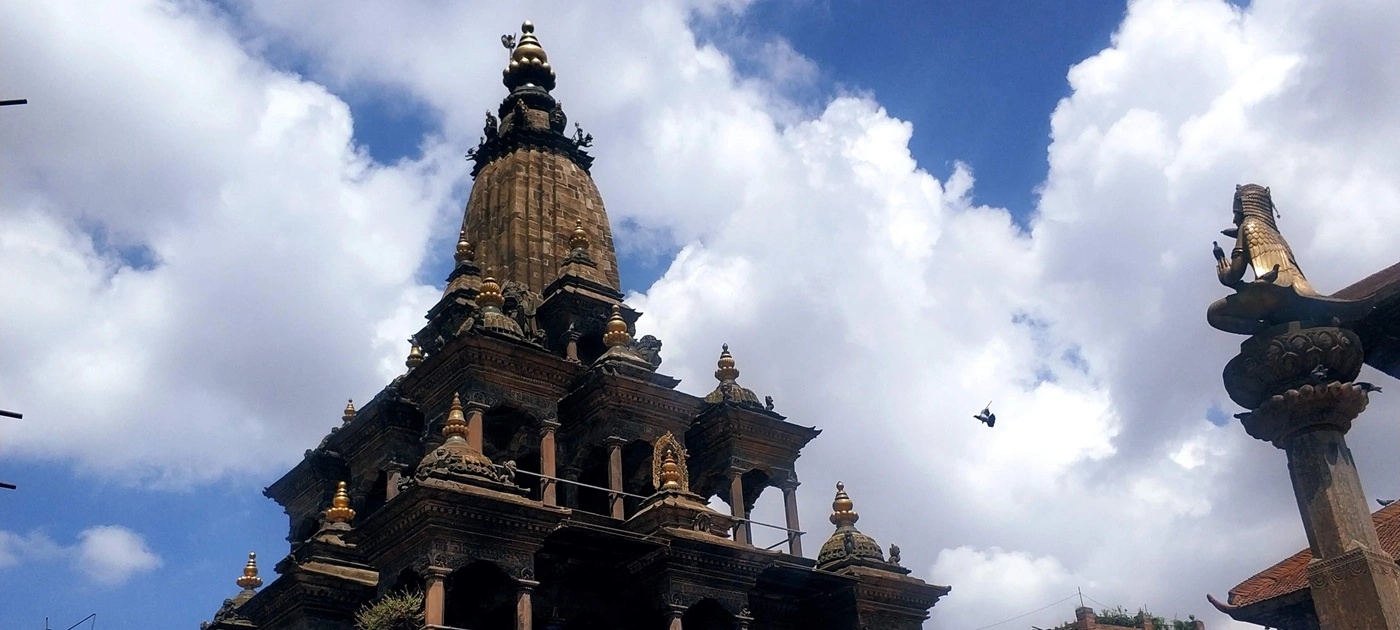
Krishna Mandir
|
The only stone shikhara temple in Nepal. 21 spires. Carved stone panels depicting scenes from the Mahabharata and Ramayana. Built in 1637 by King Siddhi Narsingh Malla. The finest piece of stone architecture in the valley.
|
|
Golden Temple (Hiranya Varna Mahavihar)
|
12th-century Buddhist monastery. Gold-plated facade. Active monastic community. The courtyard is one of the most visually stunning spaces in the valley. Lay community members take turns as caretaker monks on a rotating basis.
|
|
Mul Chowk
|
The oldest surviving royal courtyard in the valley. Intricate Newari woodcarving on every strut, window, and doorframe. Taleju Temple within the courtyard (restricted access — viewable from outside).
|
|
Sundari Chowk
|
The royal bathing courtyard. Tusha Hiti — a sunken royal bath with exquisitely carved stone spouts depicting deities. One of the finest examples of Malla-era stone carving.
|
|
Mahabouddha Temple
|
The “Temple of 1,000 Buddhas.” Every terracotta brick bears a Buddha image. Modeled after the Mahabodhi Temple in Bodhgaya, India. Located in a narrow courtyard behind the square — easy to miss without a guide.
|
Patan Museum: The Finest in Nepal
Inside the Durbar Square complex. Housed in a restored Malla-era palace wing. The collection focuses on Hindu and Buddhist bronze statuary, woodcarving, and ritual objects spanning 1,500 years. The presentation is an international museum standard — well-lit, clearly labeled, and chronologically arranged. Allow 1-2 hours. The courtyard cafe serves excellent coffee and overlooks the square.
The Artisan Quarter: Where the Serious Money Goes
Shakya Statues — Lost-Wax Bronze
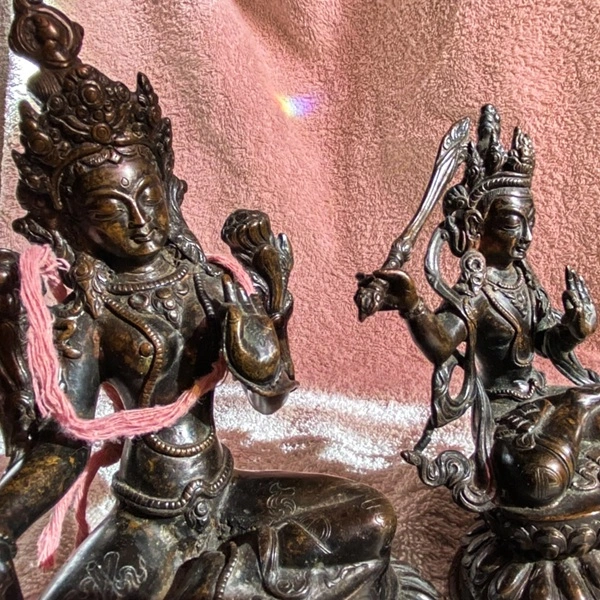
56 master craftsmen from the traditional Newari Shakya clan. The lost-wax casting method: a wax model is sculpted by hand, encased in clay, fired (the wax melts out), and molten bronze poured into the void. The rough casting is then chiseled, filed, polished, and gilded with 24-karat gold leaf or oxidized copper.
A single statue takes up to six months. Medicine Buddha. Vajradhara. Manjushri. Tara. These are not decorative objects. They are ritual artifacts with a 1,500-year artistic lineage. We arrange private workshop visits where you watch every stage of the process.
Singing Bowl Workshops
Authentic Nepali singing bowls are forged from a sacred alloy of seven metals: gold, silver, copper, tin, iron, zinc, and mercury (or lead). They are hand-hammered — not machine-pressed — to produce specific acoustic frequencies used in meditation and sound healing.
In the workshops behind Patan’s square, you watch the hammering, test the resonance of different bowls, and select acoustically with guidance from resident sound therapy practitioners. This is how you avoid the mass-produced tourist bowls in Thamel that contain three metals and produce nothing.
Apala Jewels — Bespoke Gold
Boutique studio in Patan. You collaborate with in-house designers on hand-drawn sketches. 22 and 24-karat gold. Certified diamonds. Turquoise, amethyst, lapis lazuli, and Himalayan diamonds. Their founding philosophy: imitation is a crime. Every piece is unique. Bridal collections, heirloom statement pieces, antique-inspired designs. We arrange private appointments.
Indigo Gallery and Tashi Gallery
Ethical contemporary art at international museum standards. Indigo Gallery fosters local talent and provides verified provenance — an ethical alternative to the illicit antique trade. Tashi Gallery provides the same caliber. These are where serious collectors source contemporary traditional art. We connect guests with gallery directors for private viewings and commission discussions.
Yala Mandala
Four floors of curated handmade artisanal goods in a restored Newari building. Contemporary paintings, sculptures, high-end ceramics, bespoke furnishings, and luxury scents. All handmade. All Nepali. The concentrated alternative to browsing a dozen scattered workshops.
Thangka Painting Studios
Thangka paintings are geometric blueprints for meditation, not mere art. Authentic pieces take months. The canvas is prepared with a chalk-and-glue ground. The geometric proportions are drawn using traditional Tibetan Buddhist iconographic rules.
Mineral pigments are mixed by hand. 24-karat gold leaf is applied for halos and divine attributes. In Patan’s studios, you watch the process from canvas preparation to the final application of gold. You can commission a personalized piece — a painting of your family’s protective deity, designed and executed over several months, shipped to you on completion.
Beyond the Square
Rudra Varna Mahavihar
A 1,200-year-old Buddhist monastery. Still active. The courtyard is cluttered with centuries of devotional objects: brass statues, stone sculptures, prayer wheels, and butter lamp holders accumulated over a millennium. This is not a museum — it is a functioning spiritual space where the accumulation itself is the experience. Monks chant in the prayer hall. Pigeons circle the courtyard. Time moves differently here.
Kumbheshwar Temple
One of only two five-story pagoda temples in the Kathmandu Valley (the other is Bhaktapur’s Nyatapola). Dedicated to Shiva. The sacred pond in the temple courtyard is fed by an underground channel believed to originate from the holy Gosaikunda Lake 60 km to the north. During Janai Purnima (August), the pond becomes the site of a major ritual bathing festival.
Where to Stay and Eat
The Inn Patan: 10 rooms in a restored 100-year-old Newari townhouse, one minute from Durbar Square. Brick-and-timber courtyard for private dining. The most intimate boutique experience in the Kathmandu Valley. Book well in advance — 10 rooms fill fast.
Dining: the Patan Museum courtyard cafe for coffee with a Durbar Square view. Baber Mahal Revisited (15 minutes by car) for upmarket boutique shopping and French dining at Chez Caroline. For the Newari feast experience, we arrange private dinners in restored heritage homes in the backstreets of Patan — multi-course meals prepared from closely guarded recipes, served by local historians who narrate the Newari civilization over each course.
How to Visit
|
Format
|
Time
|
What You Get
|
|
Half-day
|
3-4 hours
|
Durbar Square, Krishna Mandir, Golden Temple, Patan Museum. Private guide and vehicle from Kathmandu.
|
|
Full-day artisan
|
6-8 hours
|
All above plus: Shakya Statues workshop, singing bowl selection, Thangka studio, Mahabouddha Temple, Rudra Varna Mahavihar. Lunch at Patan Museum cafe.
|
|
Full-day collector
|
6-8 hours
|
Museum + Indigo Gallery private viewing + Apala Jewels bespoke consultation + Yala Mandala. For guests who came to buy.
|
|
Overnight at Inn Patan
|
24+ hours
|
Everything above, plus an evening private Newari feast in a heritage home. Dawn walks through the square before tourists arrive.
|
Getting there: 20 minutes by private vehicle from central Kathmandu. Patan is technically a separate city (Lalitpur) but shares the metropolitan boundary with Kathmandu. No separate entry fee for the city — the Durbar Square has a separate ticket (NPR 1,000, ~$7.50 for foreign visitors).
PATAN + BHAKTAPUR IN ONE DAY?
Possible but not recommended at the luxury level. Each city deserves a full day. If you must combine, do Patan in the morning (square + museum + one workshop) and Bhaktapur in the afternoon (square + pottery + Juju Dhau). But you will miss the depth of both. Our recommendation: Patan for a full artisan day, Bhaktapur for a full cultural day, or overnight.
Frequently Asked Questions
What is Patan known for?
- Metalwork. Patan (Lalitpur) has been the metalwork capital of Asia since the 3rd century BCE. Lost-wax bronze casting, singing bowl forging, gold jewelry, and Thangka painting. The Durbar Square is a UNESCO World Heritage Site. The museum inside it is the finest in Nepal.
How far is Patan from Kathmandu?
- 20 minutes by private vehicle. Patan shares the metropolitan boundary with Kathmandu. It is the closest of the three Durbar Squares in the valley.
What is the Shakya Statues workshop?
- 56 master craftsmen from the Newari Shakya clan are producing museum-grade bronze statuary using the 1,500-year-old lost-wax method. A single piece takes up to six months. Gold-gilded and oxidized copper. Medicine Buddha, Vajradhara, Manjushri, Tara. We arrange private visits to watch every stage.
Where do I buy authentic singing bowls?
- In the workshops behind Patan’s square. Authentic bowls use seven metals (gold, silver, copper, tin, iron, zinc, mercury/lead) and are hand-hammered. Resident sound therapy practitioners guide your selection by acoustic resonance. Avoid the machine-pressed three-metal bowls in Thamel.
What is the Golden Temple?
- Hiranya Varna Mahavihar. A 12th-century Buddhist monastery with a gold-plated facade. Active monastic community. Lay members take rotating turns as caretaker monks. The courtyard is one of the most visually stunning spaces in the Kathmandu Valley.
Can I commission custom jewelry?
- Yes. Apala Jewels in Patan: boutique studio, hand-drawn collaborative design, 22-24 karat gold, certified diamonds, Himalayan stones. Philosophy: Imitation is a crime. Every piece unique. We arrange private appointments.
What is the Patan Museum like?
- International museum standard. Housed in a restored Malla-era palace. Hindu and Buddhist bronze, woodcarving, and ritual objects spanning 1,500 years. Well-lit, clearly labeled, chronologically arranged. Allow 1-2 hours. Courtyard cafe with Durbar Square views.
Is Patan suitable for children?
- Yes. The museum is visual and interactive for older children. The bronze workshops fascinate children 8+ (watching molten metal pour). The Golden Temple courtyard is safe and atmospheric. Singing bowl testing is hands-on. Pottery and Thangka studios offer some participation.
How does Patan compare to Bhaktapur?
- Patan is the artisan city: bronze, gold, singing bowls, and contemporary galleries. Bhaktapur is a living medieval city: pottery, woodcarving, food culture, pedestrianized streets. Both are essential. Patan for making and buying. Bhaktapur for immersing and tasting.
Do you include Patan in your itineraries?
- Yes. We include a full day in Patan as an artisan day in every Kathmandu Valley program. For guests interested in commissioning bronze or jewelry, we schedule Patan early in the trip so pieces can be started and shipped after departure.
The Final Word
Bhaktapur is where the Newari civilization lives. Patan is where it works. The potters are in Bhaktapur. The metalworkers are in Patan. The yogurt is in Bhaktapur. The gold is in Patan. The medieval streets are in Bhaktapur.
The museum is in Patan. You need both. But if you came to Nepal to take something home that is worth more than a photograph — a bronze deity, a singing bowl tuned to a specific frequency, a gold necklace designed by hand on a sketch that exists nowhere else — Patan is where you find it.
Tell us what you want to commission. We will schedule the workshop visits and gallery appointments before you arrive.
Looking to commission something from Patan?
Bronze, gold, singing bowls, Thangka — tell us what you want and we schedule the artisan appointments before you arrive.