Where the government governs, the monks chant, and once a year, a 20-meter silk painting erases your karma at sunrise.
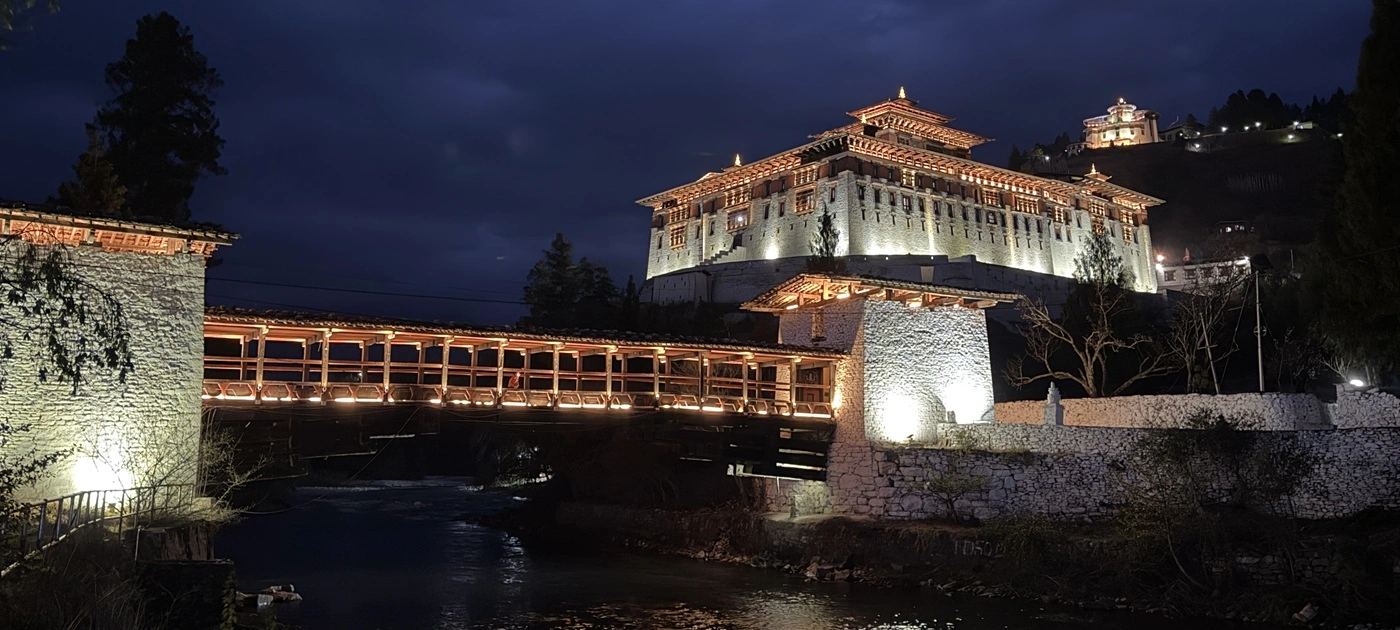
Rinpung Dzong

Most fortresses are relics. Rinpung Dzong is still at work. On any given Tuesday, government clerks process land disputes in one wing while two hundred monks chant their morning liturgy in another. District judges hear cases down the hall from a chapel housing a sandalwood stupa. This is the defining paradox of Bhutan's dzong architecture: these buildings aren't churches or courthouses or barracks—they're all three, simultaneously, by design. And Rinpung Dzong, towering above the Paro Chhu river in western Bhutan, is the finest surviving example of that idea.
Its name translates to "Fortress on a Heap of Jewels"—a name bestowed by Guru Rinpoche himself, according to canonical accounts. Today, it anchors the Paro Valley's entire heritage ecosystem: the National Museum perches on the hill above it, the ancient Nyamai Zam bridge crosses the river below it, and the valley's sacred sites radiate outward from it like spokes. If Tiger's Nest is Bhutan's spiritual icon, Rinpung Dzong is its institutional spine.
History
From a Pauper's Temple to a National Fortress
The cliff where the dzong stands was recognized for its strategic and spiritual potency long before any fortress existed. In the 15th century, local inhabitants offered the rocky crag of Hungrel to a man named Gyelchock—a lama who'd returned from studying theology in Tibet only to be denounced by his own brother and dismissed by his community as a pauper. Ostracized but undeterred, Gyelchock built a small temple on the site, believed to sit above the "soul lake" of a local protective deity. That temple grew into a five-story fortress called Hungrel Dzong, and Gyelchock's descendants governed the valley from it for generations.
Everything changed in 1644, when the Lords of Hungrel recognized the authority of Zhabdrung Ngawang Namgyal—the Tibetan Buddhist lama who was systematically unifying Bhutan into a single state—and surrendered their ancestral fortress. The Zhabdrung demolished it.
In its place, he built something far larger: a colossal military and administrative complex designed to project absolute state power and defend the Paro Valley against the Tibetan invasions that would continue for over a century. By 1646, Rinpung Dzong was complete.
- 15th Century: Gyelchock builds Hungrel Dzong, a five-story fortress-temple on the sacred promontory above the Paro Chhu.
- 1644: Lords of Hungrel surrender the site to Zhabdrung Ngawang Namgyal, who demolishes the old fortress.
- 1646: The expanded Rinpung Dzong is a military bastion, administrative center, and monastery in one.
- 1649: The Utse (central tower) and the Ta Dzong watchtower were built by the first Paro Penlop.
- 1678: Tenzin Rabgye formalizes the Paro Tshechu festival within the dzong's courtyards.
- 1906: A devastating fire destroys the Utse and most of the complex. The massive Guru Thongdrel is miraculously saved.
- 1969: Flooding on the Paro Chhu sweeps away the historic Nyamai Zam bridge; timbers are recovered downstream, and the bridge is rebuilt.
Present
On Bhutan's UNESCO Tentative List. Houses ~200 monks, the district governor's office, and judicial courts.
The 1906 fire is worth lingering on. It tore through the complex during a politically sensitive moment—just a year before Bhutan's first hereditary king was enthroned. Ancient statues, historical archives, and centuries of religious relics were incinerated. But one object survived: the Guru Thongdrel, a 20-by-20-meter silk appliqué originally crafted by Lama Nawang.
Its rescue from the flames was interpreted as divine protection over the valley's spiritual lineage. The dzong was rebuilt faithfully, without architectural blueprints or iron nails, using only interlocking joinery and rammed earth—the same methods used to build it the first time.
Architecture
A Building That Governs and Prays Simultaneously
The dzong follows a precise organizational logic called Chhoe-sid-nyi—the Bhutanese dual system of governance. One half of the complex is dedicated to civic administration; the other half belongs exclusively to the monastic body. The division isn't symbolic—it's architectural. Clerks and monks share walls but occupy different worlds.
The visual centerpiece is the Utse, a massive five-story central tower that dominates the interior courtyard. Built in 1649, it houses the most restricted and sacred chapels. Surrounding it, the complex unfolds as a rectangular fortress of towering, inward-sloping whitewashed walls—engineered for both seismic resistance and psychological intimidation. Large timber-framed windows, intricately carved and painted, serve a dual purpose: ventilation and spiritual symbolism.
The secular half once hosted the National Assembly. Today it houses a district governor, judicial courts, and administrative offices—all operating within earshot of monastic chanting.
The Fourteen Shrines
Rinpung Dzong contains fourteen primary shrines, most of which are permanently closed to the public to maintain ritual purity. Each serves a specific theological function within the Drukpa Kagyu lineage. Together, they represent one of the densest concentrations of Vajrayana Buddhist sacred space in the Himalayas.
- 1: Kungarwa: Primary restricted sanctuary for core lineage practices.
- 2: Monks' Assembly Hall (Dukhang): Central space for daily rituals, communal chanting, and liturgical ceremonies.
- 3: Sandalwood Stupa: A reliquary shrine of sacred sandalwood holding critical Mahayana relics.
- 4: Protector's Shrine: Dedicated to fierce guardian deities and the protective spirits of the Paro Valley.
- 5: Temple of the Guru's Eight Manifestations: Honoring Guru Rinpoche's eight forms for overcoming ignorance.
- 6: Chapel of the Head Lama: Private sanctuary and audience chamber for the highest monastic official.
- 7: Chapel of Amitayus: Dedicated to the Buddha of Infinite Life—focal point for longevity rituals.
- 8: The Clear Crystal Shrine: An esoteric chapel for advanced tantric visualization practices.
- 9: Chapel of Eleven-faced Avalokiteśvara: East of the Utse, dedicated to the multi-headed Bodhisattva of Compassion.
- 10: Apartments of the Abbot: Residential and administrative quarters for the monastic community's head.
- 11: Chapel of Akshobhya: Dedicated to the "Immovable" Buddha—rituals for mirror-like wisdom.
- 12: Temple of the Treasure Revealer Honoring Tertöns, who discovered Guru Rinpoche's hidden teachings.
- 13: Apartments of the King: Ornate royal chambers maintained exclusively for the monarch's state visits.
- 14: Temple of the Bursar: Monastic administration—custodianship and accounting of the dzong's wealth.
The Approach
Nyamai Zam: The Bridge That Was Built to Be Destroyed
You approach the dzong from the western bank of the Paro Chhu, crossing a covered wooden cantilever bridge called Nyamai Zam. It looks picturesque—and it is; Bernardo Bertolucci used it as a filming location for Little Buddha in 1993. But the bridge's original purpose was brutally practical: earlier versions were engineered to be dismantled rapidly during armed conflict, severing enemy access across the river.
In 1969, the Paro Chhu flooded, destroying the bridge entirely. A royal expedition tracked the original timbers downstream, recovered them, and rebuilt the bridge to its traditional design. Today, it provides the most photographed vantage point of the dzong—particularly in the evening, when the whitewashed walls catch the last light against the dark valley. It's one of those rare spots where the defensive and the beautiful are the same thing.
The Festival
The Paro Tshechu: Five Days of Masked Gods and a Pre-Dawn Miracle
If you visit Rinpung Dzong as a tourist on a normal day, you'll see architecture. If you visit during the Paro Tshechu, you'll see what the architecture was built for.
The Tshechu is a five-day religious festival rooted in traditions established by Zhabdrung Ngawang Namgyal and formalized in 1678. The term translates to "tenth day" and refers to auspicious dates in the Bhutanese lunar calendar associated with Guru Rinpoche's life. It draws thousands—local devotees, nomadic herders from the highlands, and international observers—into the dzong's flagstone courtyards for a spectacle that's equal parts theology, theater, and communal catharsis.
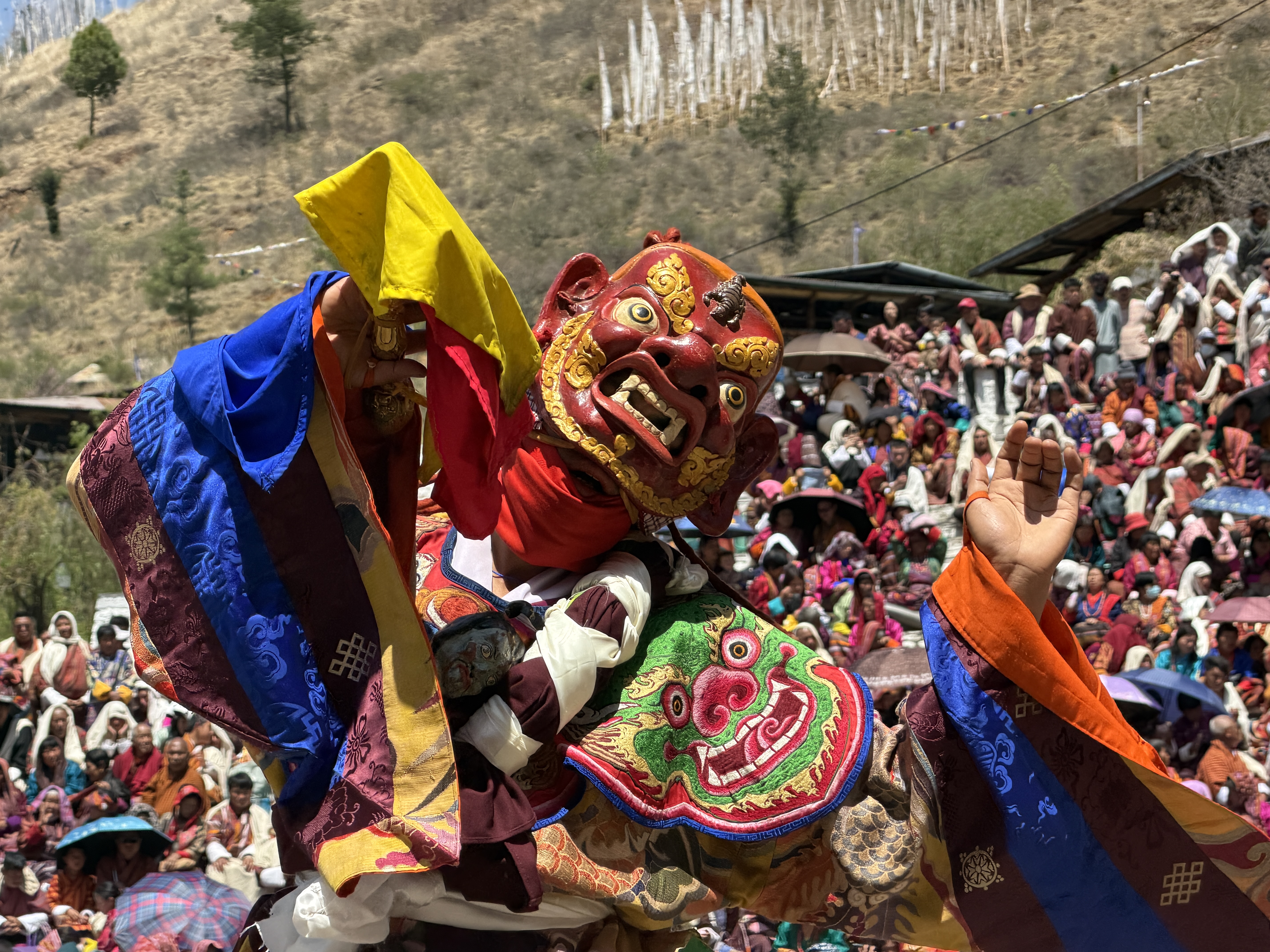
The Cham Dances
The festival's core is a rigorous program of Cham—sacred masked dances performed by monks and trained laypeople in elaborate silk costumes. These aren't folk entertainment. They're theological transmissions: hand drums represent victory over evil spirits, bells awaken beings from ignorance, and swords signify wisdom cutting through delusion. One particularly intense performance, the Raksha Mangcham, dramatizes the judgment of the dead, based on the Bardo Thongdrel—known in the West as The Tibetan Book of the Dead—and visually instructs the audience on how to navigate the terrifying gap between death and rebirth.
The Thongdrel: Liberation on Sight
The climax arrives before sunrise on the final day. At approximately 3 AM, an elaborate state procession called the Chhipdrel—the same ceremonial protocol used to welcome heads of state and the reigning monarch—escorts the massive Guru Thongdrel out of storage. The 20-by-20-meter silk appliqué, depicting Guru Rinpoche flanked by his consorts Mandarava and Yeshe Tsogyal, is unfurled against the dzong's eastern wall.
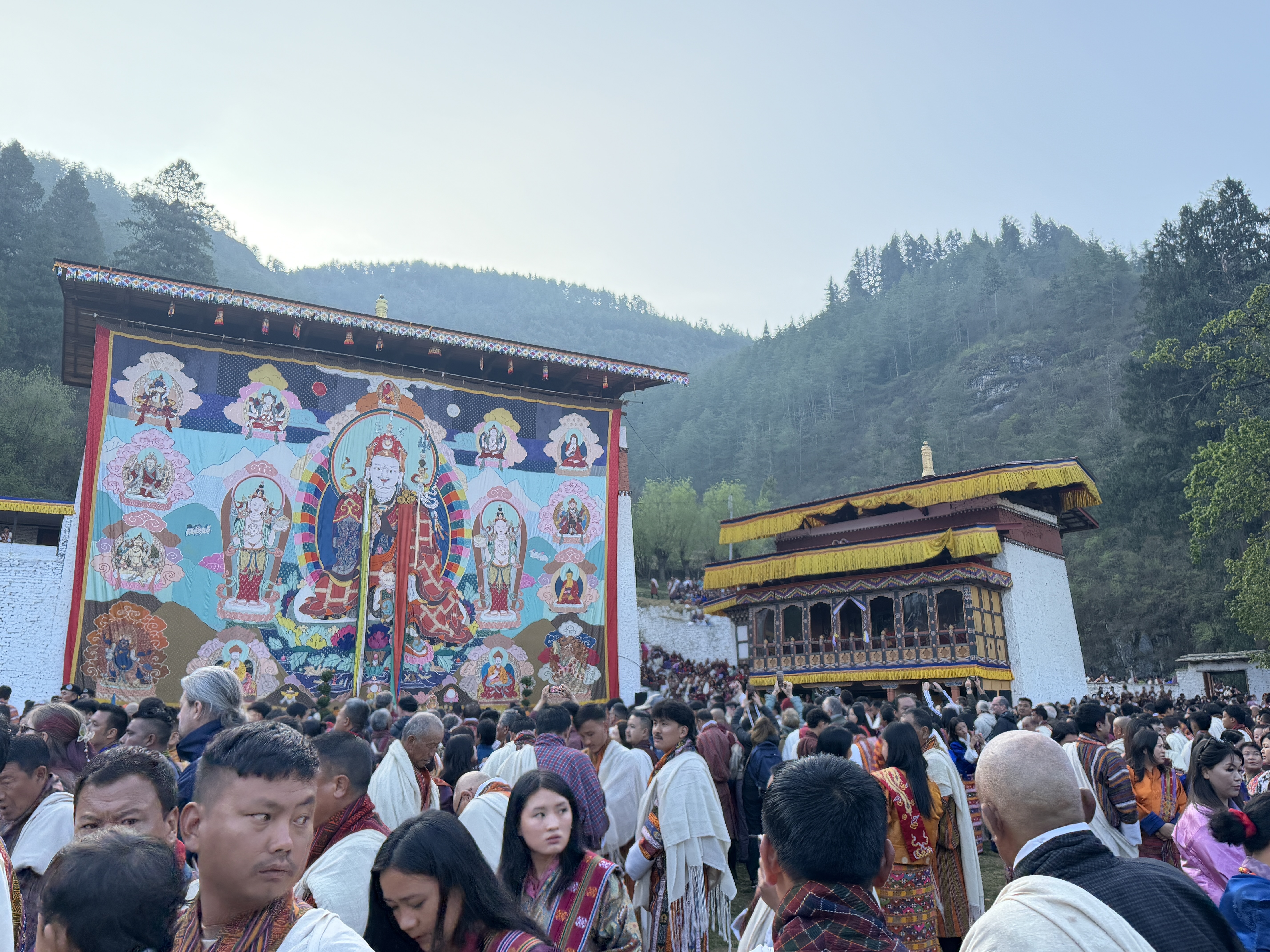
"Thongdrel" translates to "liberation on sight." Bhutanese Buddhists believe that simply witnessing this enormous artwork in the pre-dawn light cleanses lifetimes of negative karma. To protect the centuries-old silk from UV damage, the Thongdrel is rolled up and stored away before the first direct sunlight hits the courtyard. If you blink, you miss the most sacred moment of the Bhutanese religious calendar.
The Wider Valley
Beyond the Dzong: Paro's Heritage Ecosystem
Ta Dzong — The National Museum
Directly above the dzong stands a conch-shell-shaped watchtower built in 1649 to defend the fortress from the air. Its walls are 2.5 meters thick—engineered for artillery sieges. Since 1968, it's served as the National Museum, spiraling visitors down through seven levels and over 3,000 artifacts spanning 1,500 years. Highlights include the Thangka Gallery, bronze statues of the wealth deity Kubera, fifteen original iron chain links from Thangtong Gyalpo's 15th-century suspension bridge, and Bhutan's natural history collection featuring the rare Bhutan Glory butterfly. The museum reopened in 2019 after earthquake damage in 2011 forced a multi-year restoration. Note: the strictest photography policy in the valley applies here—cameras and bags must be placed in lockers before entry.
Kyichu Lhakhang
Built in 629 AD by Tibetan King Songtsen Gampo—a full millennium before Rinpung Dzong—this is one of Bhutan's oldest and holiest temples, anchoring the valley's spiritual geography at a depth most visitors don't expect.
Drukgyel Dzong
Near the Tibetan border, this fortress was built in 1649 to commemorate a decisive victory over Tibetan invaders. A fire in the 1950s left it in ruins; it's currently undergoing meticulous state-sponsored restoration.
The Five Chortens
On the valley floor below the dzong, adjacent to Ugyen Pelri Palace, five traditional stupas honor Bhutan's first hereditary king. They provide a striking foreground to the fortress and symbolize the transition from the fragmented theocratic era to the unified Wangchuck monarchy.
Costs, Rules & How to Get There
The Sustainable Development Fee
Bhutan's tourism operates under a "High Value, Low Impact" model. The Sustainable Development Fee—a daily tariff paid directly to the government—funds universal healthcare, Education, and environmental conservation. It's a visa fee, not a tour cost; everything else (hotels, guides, transport, meals) is separate.
- SDF / adult/night $100 or ₹1,200
- SDF / child 6–12 / night $50 or ₹600
- SDF / child under 6 Free
These rates reflect a 50% discount valid through August 31, 2027. A 5% GST on all tourism services took effect on January 1, 2026, and is calculated separately from the SDF. The visa fee is $40.
Monument Entry Fees (2026)
- Paro Taktsang (Tiger's Nest )Nu. 2,000 or $24–29
- Rinpung Dzong Nu. 1,000 or $12–15
- National Museum (Ta Dzong) Nu. 500 or $6
- Kyichu Lhakhang Nu. 500 or $6
- Dungtse LhakhangNu. 500 or $6
Children 6–18 get a 50% discount on monument entry; those under 5 are free.
Etiquette: What They Will Enforce
Dress Code
- Shoulders, arms, and knees covered. Sleeveless tops, shorts, and short skirts are forbidden. Collarless shirts must be long-sleeved. No flip-flops.
Photography
- Permitted in exterior courtyards only and banned inside all temples, shrines, and caves. The National Museum requires bags and cameras to be placed in lockers.
Movement
- Always walk clockwise around stupas, temples, and prayer walls. Don't step over fallen prayer flags. No smoking anywhere.
Headwear
- Hats, caps, and sunglasses must be removed before entering any dzong precinct or religious courtyard.
Getting to Paro
All international visitors fly into Paro International Airport (PBH)—Bhutan's only international gateway, deep in a valley at 2,225 meters with one of the world's most challenging commercial approaches. Only Drukair and Bhutan Airlines operate here; foreign carriers are prohibited. Independent travel is not permitted—visas, SDF, and logistics must be pre-arranged through a licensed Bhutanese tour operator.
Spring 2026 Flights: Kathmandu → Paro
- Drukair KB401: Departs KTM 09:00, arrives PBH 10:20 — Mon, Wed, Thu, Fri, Sun
- Bhutan Airlines B3774: Departs KTM 14:20, arrives PBH 15:35 — Mon, Wed, Fri, Sun
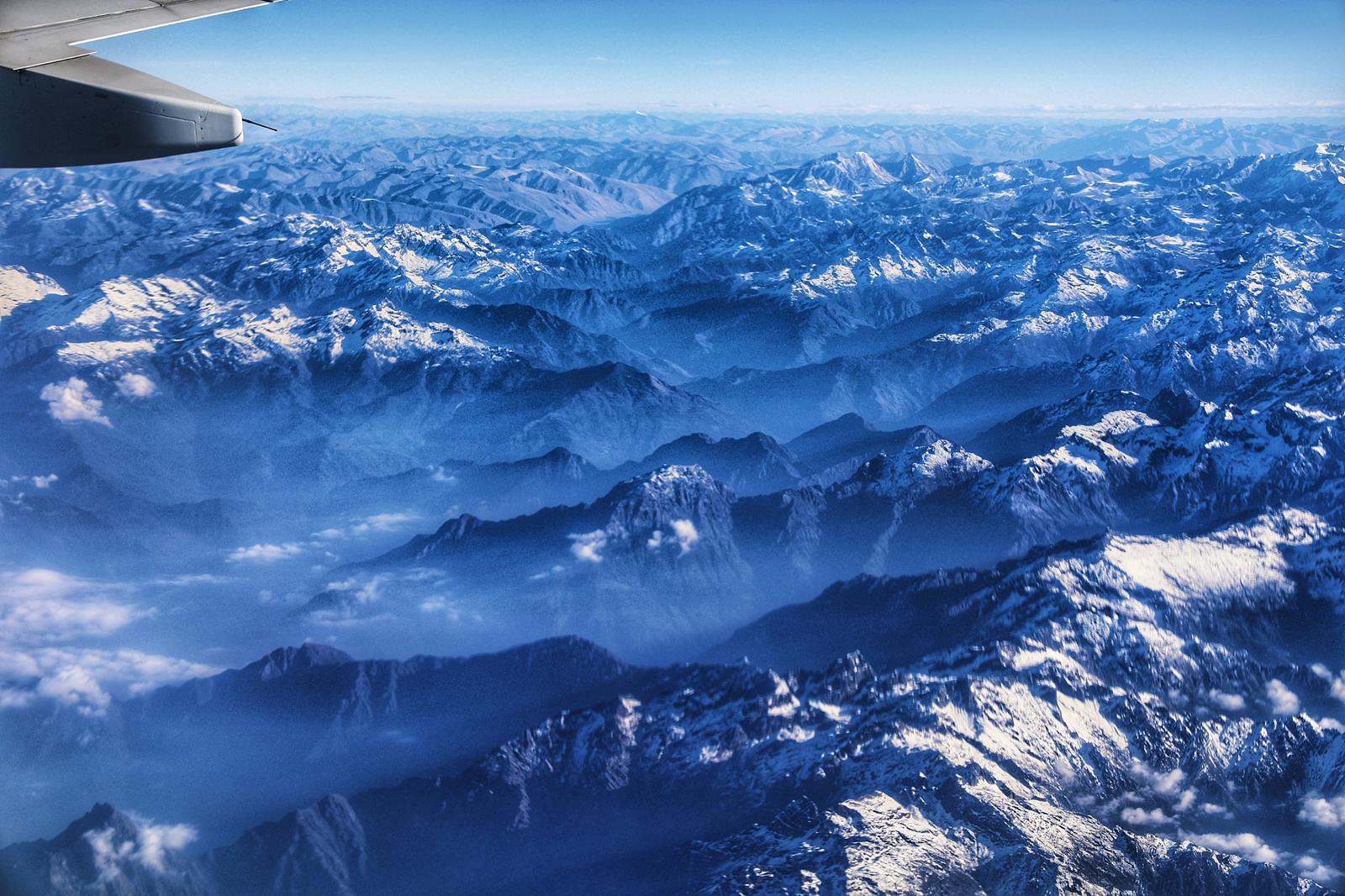
- Round-trip fares range from $500 to $600 USD. The one-hour flight parallels the high Himalayas with views of Everest, Makalu, and Kanchenjunga. A 5% GST applies to all Drukair ticketing from January 2026.
What the Fortress Protects
Bhutan's dzongs were built to defend territory. They still do—but the territory has changed. Rinpung Dzong no longer repels Tibetan armies; it repels the forces that flatten cultures everywhere else: mass tourism, commodification, and the slow erosion of meaning from sacred spaces. The $100 daily fee, the strict dress codes, the photography bans, the pre-arranged itineraries—these aren't inconveniences. They're walls, as deliberately constructed as the ones holding up the Utse.
I stood in the courtyard on a quiet Wednesday afternoon, watching a monk cross the flagstones with a stack of ledgers—headed, presumably, from prayer to paperwork. That image stayed with me longer than any shrine. A building that refuses to choose between the sacred and the bureaucratic, that insists governance and devotion share not just a philosophy but a roof—that's something worth protecting. Bhutan seems to agree.
Need Help? Call Us+977 9851013196orChat with us on WhatsApp
Need Help? Call Us+977 9851013196