The Everest Base Camp trek used to mean frozen bathrooms, plywood walls, and yak-dung stoves. Not anymore. A quiet revolution in high-altitude hospitality has produced a handful of luxury lodges where you can watch Everest from your bed, take a hot shower at 4,250 meters, and sleep under an electric blanket while the temperature outside drops to -15°C. This is the definitive guide to the top five luxury lodges on the EBC trail — what makes each extraordinary, what you’ll pay, and where the “luxury ceiling” actually ends.
Top 5 Luxury Lodges on the Everest Base Camp Trek

For decades after Hillary and Norgay summited Everest in 1953, trekking in the Khumbu meant one thing: endurance. Freezing nights in unheated plywood rooms, squat toilets shared with a dozen strangers, and dinners of dal bhat eaten by the warmth of a yak-dung stove. That was the deal — the mountain gave you its majesty, and you gave it your physical comfort in exchange.
Then, slowly, things changed. A Japanese architect built a hotel at 3,880 meters in 1971, importing glass doors from Calcutta by porter. Fifty years later, a handful of properties followed — engineered into improbable cliffsides, heated by solar arrays, stocked by helicopters. A new generation of trekker arrived with them: the high-net-worth adventurer who wanted Everest at dawn but also wanted a hot shower that evening and a bed that didn’t require three sleeping bags. The luxury EBC lodge was born.
Today, five properties define the pinnacle of Himalayan hospitality. Each occupies a strategic altitude on the Everest Base Camp trail. Each solves the physics of comfort at altitude differently — through architecture, engineering, location, or service philosophy. This guide profiles all five in depth, explains where the “luxury ceiling” ends (above 4,200 meters, it effectively does), and lays out exactly how to build a modern luxury itinerary around these lodges in 2026.
THE SCIENCE
Why Luxury Lodges Matter at Altitude: The Physiological Case
The demand for luxury in the Himalayas isn’t hedonism. It’s physiology. At 4,000 meters, barometric pressure drops to roughly 60% of sea level, which means significantly less oxygen is reaching your bloodstream with every breath. Your body compensates by working harder — elevated heart rate, increased ventilation, and, over time, the production of additional red blood cells to carry more oxygen. This is acclimatization, and it happens primarily at night, while you sleep.
Here’s the problem. In a sub-freezing teahouse room, your body isn’t spending its metabolic energy on acclimatization. It’s spending it on thermoregulation — shunting blood from your extremities to your core, activating the sympathetic nervous system, and preventing the deep REM sleep that altitude recovery depends on.
Poor sleep directly increases your risk of Acute Mountain Sickness (AMS), High Altitude Pulmonary Edema (HAPE), and High Altitude Cerebral Edema (HACE). The three most dangerous conditions on the trail are all worsened by the one variable that luxury lodges fix: cold.
Heated rooms with insulated walls, electric blankets, and ambient heaters eliminate thermal stress. Your body stops shivering and starts acclimatizing. En-suite hot showers promote vasodilation and flush lactic acid from exhausted muscles. Proper nutrition — fresh produce from high-altitude greenhouses, lean proteins stored safely via helicopter-maintained cold chains — counters the appetite suppression that altitude imposes and keeps your calorie intake at the 4,000+ per day the trek demands. The luxury lodge isn’t a comfort upgrade. It’s a medical investment in reaching base camp in a state capable of appreciating it.
1. Hotel Everest View (Syangboche)
The historic pioneer of Himalayan luxury — Everest from your bed, since 1971.
|
Altitude |
3,880 m (12,730 ft) |
|
Location |
Syangboche, above Namche Bazaar |
|
Built |
1971 by Japanese architect Takashi Miyahara |
|
Rooms |
12 (10 standard + 2 suites) |
|
Signature Feature |
360° views of Everest, Lhotse, and Ama Dablam from every room |
|
Key Amenity |
In-room oxygen outlets for altitude emergencies |
The Impossible Construction
Hotel Everest View holds the Guinness World Record as the highest-placed hotel in the world. The title was confirmed in 2004, more than three decades after it opened. Japanese architect and entrepreneur Takashi Miyahara conceived it in 1968 with a simple, audacious premise: a place where guests could witness Everest without technical mountaineering skills. In the late 1960s, the Khumbu had no roads, no reliable aviation, and no construction infrastructure.
Every structural element — the expansive sliding glass doors, the solarium glass, the Japanese linens, the premium cutlery — was shipped from Japan to Calcutta, transported through Nepal, and finally either airlifted by early helicopters or carried by porters on a two-week march from Lamusangu, 80 kilometers outside Kathmandu. The hotel opened in 1971. It has been operating, largely unchanged, for over fifty years.
Architecture That Respects the Mountain
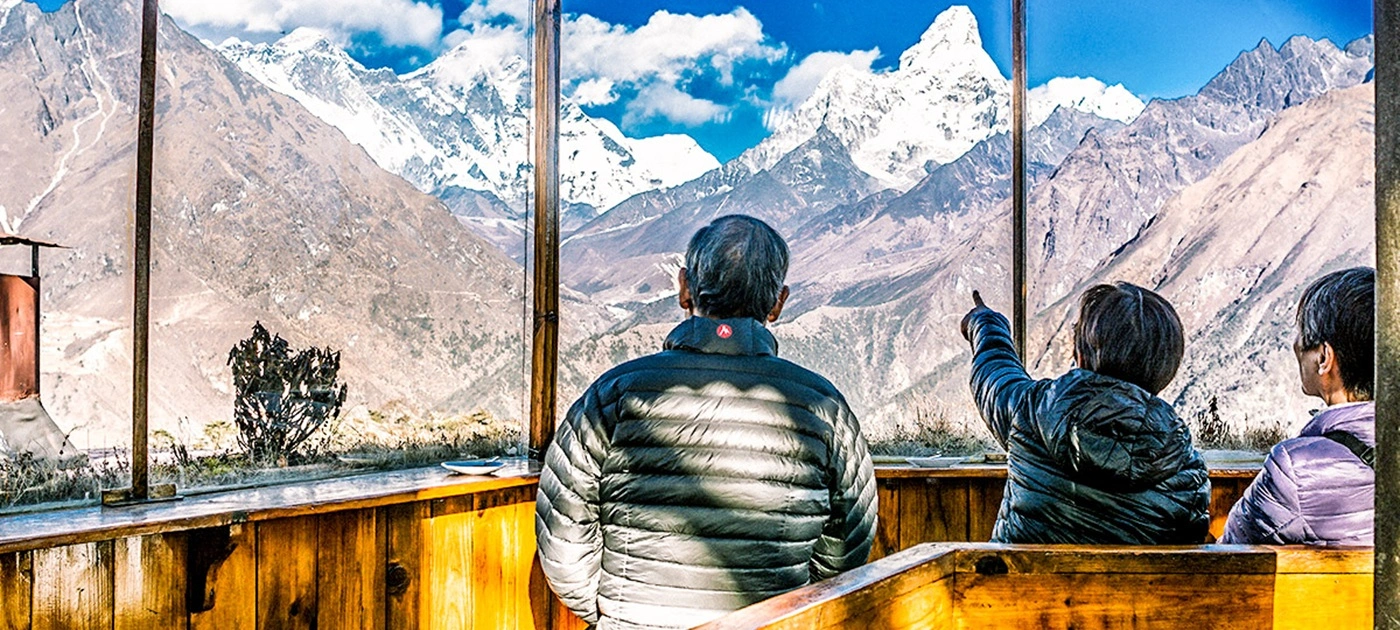
Designed by Yoshinobu Kumagaya, the hotel is a masterclass in minimalist alpine aesthetic. Hand-carved local stones form the exterior and interior walls. The spectacular dining room is built around an ancient natural boulder inscribed with the Tibetan Buddhist mantra “Om mani padme hum” — preserved exactly as it was found on the ridge. The twelve rooms are oriented to deliver an unobstructed 360° view of the Himalayan crest. Guests literally watch the summit of Everest from bed.
Each room features an en-suite bathroom, a sitting area, a private balcony with stone walls, room heaters, thermoses, and electric blankets. The oxygen outlets installed in every room are the single most important luxury feature in the entire Khumbu — a direct safety net for altitude emergencies that no other lodge on the trail offers.
Japanese Precision Meets Sherpa Hospitality
The hospitality reflects its Japanese founding — the main dining room seats 30, the terrace accommodates 50, and the menu defies the altitude. Signature dishes include Japanese oyakodon, fillet mignon, club sandwiches, yak momos, and premium dal bhat.
The hotel maintains its own private helipad for direct charters from Kathmandu, making it a popular stop for same-day Everest helicopter tours — arrive for breakfast at 3,880 meters, fly back to Kathmandu by lunch. The hotel operates primarily on solar power and flies all waste back to Kathmandu to protect the Sagarmatha National Park ecosystem. Fifty years after opening, Hotel Everest View remains the reference point for what high-altitude luxury actually means.
2. Kongde Lodge (Mountain Lodges of Nepal)
The highest-starred hotel in the world, the most isolated luxury experience in the Khumbu.
|
Altitude |
4,250 m (13,944 ft) |
|
Location |
Kongde Ri, above the main Khumbu valley |
|
Affiliation |
Mountain Lodges of Nepal (MLN) |
|
Rooms |
10 en-suite rooms with electric heated mattresses |
|
Signature Feature |
Views of 5 peaks over 8,000m: Everest, Lhotse, Makalu, Cho Oyu, Gyajung Khang |
|
Access |
Via the ancient Yeti Trail or private helicopter |
The Eagle’s Nest at 4,250 Meters
Kongde Lodge is the most extreme luxury position in the Khumbu. Perched on the frigid lap of Kongde Ri at 4,250 meters, it claims the title of the highest-starred hotel in the world, higher even than Hotel Everest View, and vastly more isolated. Unlike lodges on the main EBC trail, Kongde sits hours away from the nearest commercial bazaar, several thousand feet above the valley floor. Access comes via the ancient Yeti Trail, a route used by Khumbu Sherpas for centuries, or by direct private helicopter. The isolation isn’t a drawback — it’s the entire point. Guests experience the Khumbu without mule trains, porter crowds, or the commercial congestion that defines Namche and beyond.
The Best Views in the Himalayas, Period
The geographic positioning gives Kongde Lodge arguably the most spectacular views on the planet. The northern panorama layers through the Khumbu valley to the unmistakable black pyramid of Everest. From the property, guests see five peaks over 8,000 meters simultaneously: Everest, Lhotse, Makalu, Cho Oyu, and Gyajung Khang, with the jagged spire of Thamserku looming directly across the valley. Because of the isolation and the complete absence of light pollution, Kongde has become a globally recognized destination for high-altitude night photography and sunrise viewings over the Mahalangur Himalayan range.
Engineering Comfort in a Frozen Cliffside
Running a luxury facility at 4,250 meters requires extraordinary resource management. Each of the ten rooms features an attached bathroom with hot showers — a plumbing feat at an altitude where standing water freezes almost instantaneously. Rooms are meticulously insulated and outfitted with full bedding, heavy blankets, and electrically heated mattresses to counter the brutal outdoor temperatures.
Common areas include a sunroom, a library, and a dining hall serving full-board meals and hot drinks. For helicopter-assisted luxury tours, Kongde functions as a single-day breakfast destination — fly from Kathmandu, watch the sun hit Everest, and return to the capital by afternoon.
3. Namche Lodge (Mountain Lodges of Nepal)
The wellness-focused heart of the trek — where the Khumbu’s best spa meets the Sherpa capital.
|
Altitude |
3,440 m (11,286 ft) |
|
Location |
Upper Namche Bazaar, overlooking the amphitheater |
|
Affiliation |
Mountain Lodges of Nepal (MLN) |
|
Signature Feature |
Full holistic wellness spa with professional massage |
|
Key Amenity |
Premium electric blankets in every room |
|
Best For |
Mandatory 2-night acclimatization stop |
The Capital of the Sherpa World
Namche Bazaar sits at 3,440 meters and is the undisputed capital of the Sherpa people — the central nervous system of the Khumbu. It’s also the most critical acclimatization stop on the EBC trail. Altitude medicine protocols strictly require a minimum two-night stay in Namche for the body to adjust before pushing higher. Namche Lodge is purpose-built for exactly this function: a restorative haven engineered for multi-night stays rather than a one-night pass-through.
Design That Honors the Bazaar
The lodge is a picture-perfect two-story pitched-roof structure on the upper slopes of Namche, with commanding panoramic views of the town’s iconic C-shaped layout and the towering Kongde range across the valley. The interior blends traditional Sherpa heritage with contemporary luxury — authentic Tibetan rugs, high-quality English linens, and rooms that are expansive, dry, and warm, avoiding the damp cold that plagues lesser accommodations in the valley. Electric blankets, which guests consistently describe in reviews as “a godsend,” counter the absence of central heating in the village. En-suite bathrooms deliver reliable, high-pressure hot water.
The Spa That Changes Everything
What elevates Namche Lodge into true global luxury is its dedicated wellness spa — the only one of its kind on the EBC trail. After three days of rigorous ascent from Lukla through Phakding and Monjo, your legs are lactic-acid fatigued, and your hip flexors are protesting every step.
A professional massage at Namche Lodge isn’t a spa-day indulgence; it’s muscle therapy that materially accelerates your recovery for the harder days ahead. The lodge also features a curated library and hosts a daily happy hour, transforming the mandatory two-night acclimatization stay from a physiological requirement into a genuine leisure experience.
WHY NAMCHE LODGE MATTERS FOR THE REST OF THE TREK
The two nights you spend at Namche set the physiological baseline for everything that follows. Quality sleep here, combined with spa-accelerated muscle recovery, means you arrive at Dingboche and Lobuche in a state capable of continuing. Skip this recovery investment, and the final push to Gorak Shep becomes significantly harder.
4. Everest Summit Lodge (Pangboche)
The defiant outpost of luxury in the upper Khumbu — where architecture meets altitude.
|
Altitude |
3,980 m (13,057 ft) |
|
Location |
Pangboche village, upper Khumbu |
|
Affiliation |
Everest Summit Lodges |
|
Rooms |
10 en-suite rooms with attached hot showers |
|
Signature Feature |
Green-roof design blending with high-altitude scrubland |
|
Best For |
Midway comfort stop between Tengboche and Dingboche |
Architecture Designed to Disappear
Past Tengboche, the tree line vanishes, the landscape turns barren, and the logistics of luxury become exponentially harder. Everest Summit Lodge in Pangboche is the highest property in the Everest Summit Lodges chain and a critical comfort stop between Tengboche and the severe altitudes of Dingboche.
Its architecture is the most visually intentional on the EBC trail: a green roof and exterior color palette deliberately chosen to blend with the surrounding high-altitude scrubland and distant snow-capped peaks. Large expansive glass windows run through the property, flooding interiors with natural light and maximizing passive solar heating — a clever, quiet piece of engineering that keeps communal spaces naturally warm during daylight hours.
En-Suite Hot Showers at 3,980 Meters
The ten rooms, predominantly twin-bedded, each feature an attached bathroom with hot and cold showers — a technically difficult feat at nearly 4,000 meters, where plumbing is constantly battling freeze cycles. Rooms are actively heated, providing the thermal comfort that enables quality sleep. The dining room centers on a crackling fireplace. It serves a sophisticated mix of local Sherpa cuisine and international dishes: freshly baked bread, warm, hydration-supporting soups, and hot drinks served throughout the evening.
Sustainability as a Core Value
The Everest Summit Lodge brand places uncompromising emphasis on ecological sustainability. The Pangboche property relies on robust solar energy systems for water heating and lighting, with electrical backup for device charging when sunlight is limited.
Staff are exclusively local Sherpa, trained to international hospitality standards and grounded in mountain safety credentials. The location offers direct views of the iconic Ama Dablam peak and provides easy access to the ancient Pangboche Monastery and side trails toward Ama Dablam Base Camp — making the lodge both a destination and a launch pad for further exploration.
5. Rivendell Lodge (Deboche)
The mystical forest sanctuary — Tolkien’s Elvish haven reimagined at 3,730 meters.
|
Altitude |
3,730 m (12,238 ft) |
|
Location |
Deboche, sheltered forest valley below Tengboche |
|
Ownership |
Local Sherpa family, 30-year hospitality legacy |
|
Signature Offering |
Maha Sukha Devi Kotha (Deluxe Rooms) |
|
Unique Feature |
Protected beyul (sacred valley) surrounded by rhododendron forest |
|
Safety Asset |
Heli-rescue helipad 20 meters from the property |
The Alternative to Windswept Tengboche
Tengboche is globally famous for its massive monastery — but the settlement itself is notorious among experienced trekkers for being exposed, windswept, congested, and bitterly cold. Just a short descent away lies Deboche, a quiet village nestled in a sheltered valley that Tibetan Buddhists recognize as a beyul — a sacred, protected landscape. Surrounded by ancient, towering rhododendron and birch forests, Deboche is measurably warmer and wind-protected than Tengboche, making it more conducive to acclimatization. Rivendell Lodge occupies the heart of this protected valley.
Tolkien’s Vision, Sherpa Execution
The lodge draws its conceptual inspiration explicitly from J.R.R. Tolkien’s Rivendell — the Elvish haven in The Lord of the Rings — aiming to provide a tranquil refuge amid enchanted peaks. Owned and operated by a local Sherpa family with a thirty-year hospitality legacy, the architecture is designed to blend seamlessly into the fragile forest biome rather than impose on it.
In winter, the lodge is blanketed in snow. In spring, the surrounding area explodes with vibrant rhododendron and wildflower blooms. The soundscape is defined entirely by the forest: rustling leaves, the distant roar of the river, the occasional birdcall — a dramatic contrast to the acoustic congestion of Namche or Lukla.
The Maha Sukha Devi Kotha
Rivendell’s flagship accommodation tier is the Maha Sukha Devi Kotha — the Deluxe Room — whose Sino-Tibetan name translates to “a place to relax.” The designation is earned. These premium rooms feature private en-suite bathrooms, advanced heating pads, electric blankets, and modern amenities that stand in sharp contrast to the wild seclusion immediately outside.
The expansive dining area faces the mountains through large glass windows, delivering immersive meals with visual context. Prioritizing elite safety standards, the lodge maintains a dedicated heli-rescue helipad location just 20 meters from the property — a piece of infrastructure that can be decisive in an altitude emergency.
COMPARE AT A GLANCE
The Top 5 Luxury EBC Lodges: Side-by-Side Comparison
Choosing among these five properties depends on where they fit in your itinerary and what you need from them — acclimatization, recovery, architectural beauty, isolation, or historical pedigree. Here’s how they compare across the factors that matter.
|
Lodge |
Altitude |
Location |
Signature Strength |
|
Hotel Everest View |
3,880 m |
Syangboche |
Historic pedigree; in-room oxygen; Everest from bed |
|
Kongde Lodge |
4,250 m |
Kongde Ri |
The highest-starred hotel in the world, the World Trade Center, has over 8,000m visible |
|
Namche Lodge |
3,440 m |
Namche Bazaar |
Full wellness spa; ideal 2-night acclimatization base |
|
Everest Summit Lodge |
3,980 m |
Pangboche |
Solar-powered architecture; Ama Dablam views |
|
Rivendell Lodge |
3,730 m |
Deboche |
Sheltered forest sanctuary; on-site heli-rescue pad |
THE REALITY ABOVE 4,200M
The Luxury Ceiling: Where Five-Star Ends on the EBC Trail
Here’s a nuance most trekking websites don’t explain clearly: true five-star luxury has a geographic ceiling on the EBC trail. Above roughly 4,200 meters — past Pangboche and Dingboche — permafrost, the complete absence of agriculture, and the exorbitant cost of helicopter-delivered building materials make genuine luxury economically and physically unsustainable. Every trekking agency selling “luxury EBC packages,” regardless of price tier, must use standard teahouses in Lobuche and Gorak Shep. There are no exceptions.
Dingboche: Premium Comfort, Not Luxury
In Dingboche at 4,410 meters, the standard shifts from luxury to what the industry calls premium comfort. A handful of lodges have pushed this category to its limits. Hotel Bright Star is the most distinguished — against significant odds, it offers private rooms with attached bathrooms and hot showers (rare at this altitude, where pipes burst constantly), heated beds, a communal lounge, and spectacular views of Ama Dablam and Lhotse. Tashi Delek Lodge and Hotel Countryside round out the premium-comfort tier with beautifully maintained rooms and warm Sherpa hospitality, though they lack the continuous ambient heating of lower-valley properties.
Lobuche and Gorak Shep: Survival, Not Comfort
At Lobuche (4,940 m) and the final outpost of Gorak Shep (5,164 m), the paradigm breaks entirely. Lodges like Buddha Lodge and Hotel Everest Inn provide essential warmth via electric blankets and communal stove-heated dining rooms, but trekkers must mentally prepare for basic conditions, shared sanitation, and extreme ambient cold.
At Gorak Shep — a frozen glacial moraine that serves as base camp for your push to Kala Patthar and EBC itself — luxury is redefined not as amenities but as the sheer fact of survival in one of the most inhospitable commercial lodging environments on earth. The views, however, compensate: the Khumbu Icefall, the surrounding peaks, the raw glacial landscape. It’s a contract the trail makes with you. Two nights of discomfort for access to something no amount of money can otherwise buy.
HOW TO USE THEM
Building a Modern Luxury EBC Itinerary Around These Lodges
The existence of these five lodges, combined with advances in helicopter aviation, has made it possible to create a highly curated 11- to 15-day luxury itinerary that didn’t exist a decade ago. Here’s how a premium 2026 program typically uses them.
Arrival and the Helicopter into Lukla
The trip begins with a stay at a five-star Kathmandu property — Marriott Kathmandu, Hyatt Regency, or similar — for a welcome dinner and briefings. Luxury packages now bypass the notoriously unreliable fixed-wing flights from Ramechhap entirely, using direct 45-minute helicopter charters from Kathmandu to Lukla instead. This single logistical upgrade eliminates the most common point of trip failure for standard EBC treks.
The Ascent: Lodge-to-Lodge
From Lukla, a gentle three-to-four-hour descent leads to Phakding and the MLN Phakding Lodge or the Himalayan Lodge. Day three is a rigorous five-to-six-hour climb over dramatic suspension bridges to Namche Bazaar, checking into Namche Lodge for the mandatory two-night acclimatization stay — used for a hike to Khumjung village, a visit to the Sir Edmund Hillary school, and spa services back at the lodge.
The route then proceeds either to Hotel Everest View in Syangboche for a night of unparalleled panoramas, or directly down to Rivendell Lodge in Deboche. From Deboche, trekkers move to Dingboche for another two-night acclimatization halt at Hotel Bright Star. Throughout the ascent, elite agencies maintain a 1:3 guide-to-client ratio, daily oximeter checks, and supplementary oxygen in every support vehicle.
The Apex and the Helicopter Extraction
The final push traverses Lobuche to Gorak Shep, with clients spending two nights in standard teahouses at 4,940 m and 5,164 m respectively. From Gorak Shep, the ultimate hike reaches Everest Base Camp (5,364 m) to witness the Khumbu Icefall, followed by an ascent of Kala Patthar (5,550 m) for the definitive sunrise view of Everest. And this is where modern luxury itineraries deploy their most significant logistical asset: the helicopter return.
Following Kala Patthar, trekkers board a private helicopter at Gorak Shep and fly directly back to Kathmandu, eliminating three to four days of punishing, knee-grinding descent and offering a spectacular aerial retrospective of the entire Khumbu Glacier and trekking route.
THE LUXURY ITINERARY LOGIC
Helicopter in. Lodge-to-lodge ascent through the best properties at each altitude. Standard teahouses only at Gorak Shep and Lobuche — because nothing else exists there. Helicopter out from Gorak Shep. Total trip: 11–15 days, versus 14+ for standard treks. Zero unnecessary descent days. Every night of recovery is optimized.
THE ECOLOGICAL FOOTPRINT
Sustainability in the Khumbu: How Luxury Lodges Protect the Mountain
Operating five-star hospitality at altitude carries an obvious environmental cost, which is why sustainability isn’t optional for these properties — it’s structural. Transportation is the largest hurdle: with no road access to the upper Khumbu, everything from mattresses to vegetables to wine bottles must be flown in by helicopter or carried by yaks and porters. To reduce this dependency, MLN Phakding and MLN Monjo have pioneered high-altitude organic farming, using greenhouse technologies to grow fresh produce directly on-site.
Wood burning is strictly regulated in Sagarmatha National Park to prevent deforestation, so properties like Hotel Everest View, Everest Summit Lodge Pangboche, and the newer Summit Lodge Experiences rely heavily on large solar arrays, solar water heating, and passive-solar architectural designs.
The human sustainability story is equally important. These lodges employ exclusively local Sherpa staff, train them to international hospitality standards, fund regional schools, and use local supply chains where possible — ensuring that the capital generated by luxury tourism stays in the Khumbu community that sustains it. The authentic warmth of Sherpa hospitality, which remains the defining quality of the Everest experience regardless of lodge tier, isn’t a performance. It’s the cultural DNA of the region showing through even the most polished international luxury framework.
THE BOTTOM LINE
Which Luxury EBC Lodge Is Right for Your Trek?
These five lodges don’t compete with each other — they complement each other. A well-designed luxury EBC itinerary uses all five (or most of them) across a single ascent, leveraging each property’s specific strength at its specific altitude. Namche Lodge for spa-accelerated acclimatization recovery. Hotel Everest View for the historic panorama and in-room oxygen safety. Rivendell Lodge for sheltered forest rest. Everest Summit Lodge for solar-heated comfort in the upper Khumbu. Kongde Lodge for the view, no other property on earth can match.
The luxury EBC trek isn’t about opulence. It’s about arriving at base camp in a physiological state capable of appreciating what you came to see — and these five lodges are the architecture that makes that possible. The Khumbu hasn’t gotten easier. The infrastructure supporting it has gotten extraordinary.
Ready to experience Everest from a heated suite at 3,880 meters?
Inquire about our Signature Luxury Everest Base Camp Trek — lodge-to-lodge, helicopter-assisted, and calibrated to deliver the mountain in uncompromised comfort.
Need Help? Call Us+977 9851013196orChat with us on WhatsApp
Need Help? Call Us+977 9851013196