Most Nepali festivals follow the lunar calendar. Biska Jatra does not. It follows the sun. Specifically, it marks the moment the sun crosses into Aries — Mesha Sankranti — which initiates the Nepali solar New Year (Bikram Sambat). In 2026, the festival runs from April 10 to April 18, with New Year’s Day itself falling on April 14.
The festival is centered in Bhaktapur, the third of the Kathmandu Valley’s three medieval kingdoms and a UNESCO World Heritage Site. But it extends into the neighboring municipalities of Madhyapur Thimi and Bode, each of which contributes its own distinct rituals — the Sindoor Jatra color explosion and the tongue-piercing ceremony, respectively.
What makes Biska Jatra different from every other festival in the valley is its aggression. This is not a contemplative ritual. It is physical, competitive, and genuinely dangerous. The chariot tug-of-war between Bhaktapur’s eastern and western halves is a sanctioned street battle. The Yosin pole is a 25-meter timber column that must be hauled upright by raw human force and then crashed to earth. The tongue-piercing is exactly what it sounds like. The entire festival operates on the principle that cosmic renewal requires physical intensity — that the new year begins only when the old year has been properly destroyed.
At Alpine Luxury Treks, Bhaktapur is 13 kilometers from our Kathmandu base. Our cultural guides include Bhaktapur locals who grew up in the Thane and Kwone neighborhoods that wage the annual chariot war. This guide draws on their firsthand knowledge.
In This Guide
- The mythology: a cursed princess, two dead serpents, and a severed god
- The cosmology: sky meets earth through the chariot and the pole
- The tug-of-war: Thane vs Kwone
- The nine-day schedule (2026 dates)
- The Sindoor Jatra in Thimi
- The tongue-piercing in Bode
- The Mahakali Dance
- How to experience Biska Jatra as a visitor
- Frequently asked questions
The Mythology: A Cursed Princess, Two Dead Serpents, and a Severed God
The Cosmology: Sky Meets Earth Through the Chariot and the Pole
The theology driving Biska Jatra is not abstract. It is mechanical. The festival enacts the mating of two cosmic forces: Bhairav, who represents the sky and the active male principle, and Bhadrakali (Nakinju Ajima), who represents the earth and the receptive female principle. Their union — sky sending rain, earth receiving and producing crops — is what makes agricultural life possible.
The chariot procession distributes its combined energy through the city’s streets. Every neighborhood the chariot passes through receives a darsana — a physical manifestation of the deity “showing himself” to the people. The tug-of-war is not merely competitive. Whichever half of the city holds the chariot at the end of the day receives Bhairav’s favor for the coming year.
The Yosin Pole as Cosmic Symbol
The 25-meter Yosin pole is the festival’s most symbolically concentrated object. It functions as a monumental Shiva Linga — a representation of regenerative cosmic power. The act of erecting the pole into a hole in the ground is an explicit symbolic representation of the union of the male and female creative principles.
The pole is raised using exactly eight heavy ropes, representing the Astamatrika — the eight mother goddesses who serve as the esoteric protectors of the Kathmandu Valley. The twin flags (Vishwadhvaja) flown from its peak represent Bhairav and Bhadrakali in cosmic union.
On New Year’s Day, the pole crashes back to earth. This act is the Satruhanta — “the destruction of the enemy.” The belief is deeply literal: anyone who witnesses the pole’s fall will see the ruin of their personal adversaries in the coming year. The communal catharsis is immense. The old year’s enemies are symbolically destroyed. The new year begins clean.
The Tug-of-War: Thane vs Kwone
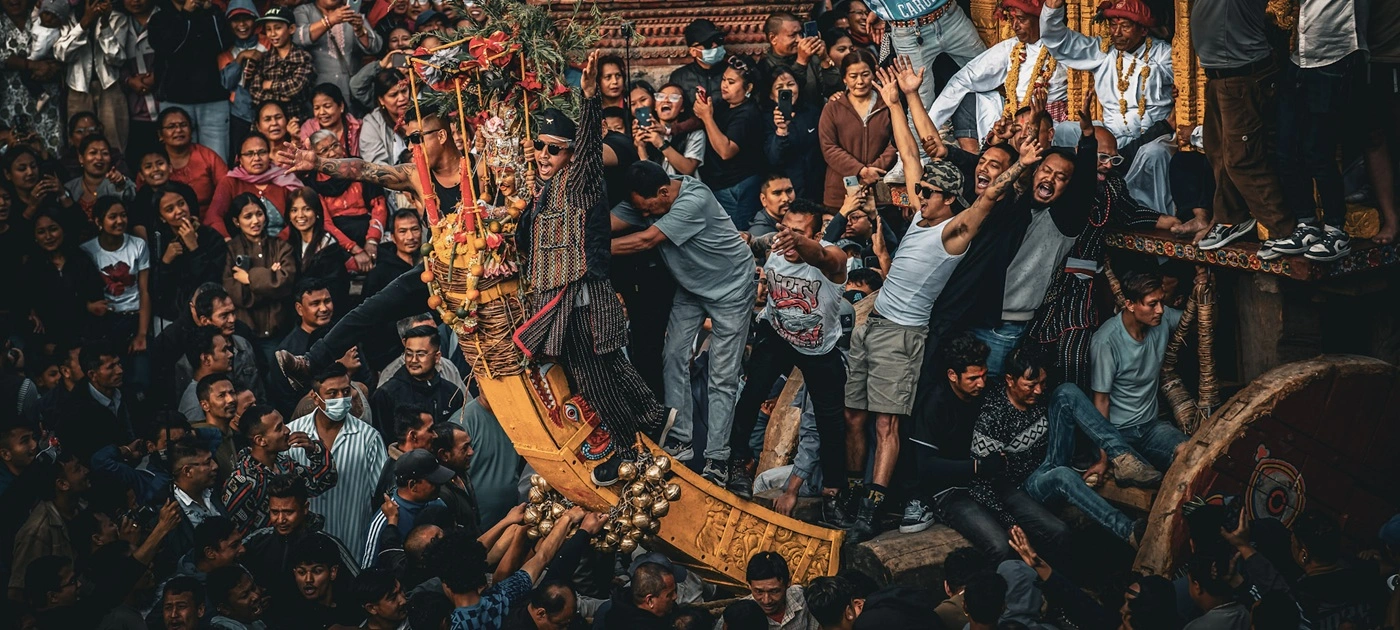
Bhaktapur is divided into two halves: Thane (upper/eastern) and Kwone (lower/western). The annual tug-of-war over the Bhairavnath chariot is the most dangerous and emotionally charged event of the entire festival.
Thousands of young men from both sectors converge on Taumadhi Square. The 35-foot, three-story pagoda chariot sits in the middle, with thick ropes attached to the front and rear axles. Six ropes pull from the front; four from the rear. At the signal, both sides pull. The chariot lurches. The side that overpowers the other drags the chariot through their neighborhood — securing Bhairav’s divine favor for the year.
The Two Routes
If Kwone wins, the chariot is dragged south and west through Taumadhi, Buluncha, Gha-kha, Nasmana, Mulakhu, Banshagopal, and finally to Tekhapukhu. If Thane wins, the chariot goes north and east through Kwache, Sakotha, Sukuldhoka, Gomari, Inacho, and terminates at Dattatreya Square.
The chariot has no steering mechanism. No brakes. It navigates entirely through raw human force and the physical barriers of the medieval streets. Corners are taken by crashing the 35-foot structure into the buildings at the turn. The stone-paved alleys are barely wider than the chariot itself. The sound is extraordinary — wood grinding against brick, thousands of voices chanting “Hoste, Hanse...” in synchronized rhythm, the Dhimay drums pounding underneath.
The tug-of-war is genuinely dangerous. Stone-pelting and bottle-throwing between rival factions are chronic issues. The 2026 festival will deploy 1,000-1,400 security personnel, including Nepal Police, Armed Police Force, riot control units, and 200 plainclothes officers. CCTV and drone surveillance monitor the crowds. A total alcohol ban is enforced for the entire nine days. Hospitals are on high alert. We position our guests at safe vantage points — typically elevated locations arranged through local families — well clear of the rope lines and the densest part of the crowd.
The Nine-Day Schedule: April 10–18, 2026
|
Day
|
Date
|
What Happens
|
|
Day 1
|
Apr 10
|
Festival opens. Royal sword arrives from Kathmandu. Bhairavnath was installed in a chariot at Taumadhi. First tug-of-war between Thane and Kwone. Chariot ends the day at Gahiti.
|
|
Day 2–3
|
Apr 11–12
|
Chariots rest at Gahiti. Bhadrakali’s chariot moved to the Azima Dyochen temple. Continuous public worship. Day 3: buffalo sacrifice at Gahiti; sanctified meat distributed to the Lakulache neighborhood (Syahko Tyahko).
|
|
Day 4
|
Apr 13
|
Last day of the old year. A smaller pole was erected at Pottery Square. Evening: the massive 25-meter Yosin pole was raised at Lyasinkhel using eight ropes. Chariots pulled to Yonshikhel to witness. Torch-bearing procession at Khauma.
|
|
Day 5
|
Apr 14
|
NEPALI NEW YEAR. Morning calm — family pujas, kite-flying, juju dhau feasts. Evening: the Yosin pole is crashed to earth (Satruhanta — “destruction of the enemy”). Chariots of Bhairav, Bhadrakali, and Dumaju deliberately collided at Khalna Tole.
|
|
Day 6
|
Apr 15
|
Sindoor Jatra in Thimi: 32 miniature shrines paraded, entire town covered in orange vermilion. Tongue-piercing in Bode: an iron spike through the volunteer’s tongue, a flaming torch carried barefoot through the streets.
|
|
Day 7–8
|
Apr 16–17
|
Goddess processions (Brahmayani, Maheshwari). Day 8: all deities brought out of temples and displayed publicly across the entire city (Dyo Sogan Biyegu). Bhaktapur becomes an open-air temple complex.
|
|
Day 9
|
Apr 18
|
Final tug-of-war. The smaller pole at Pottery Square was pulled down. Chariots returned to Taumadhi Square. Taleju priest circumambulates Bhairavnath chariot with royal sword, sealing the divine energy until next year.
|
The Sindoor Jatra in Thimi: A Town Turns Orange
On Day 6 (April 15), the action shifts seven kilometers west to Madhyapur Thimi. If Bhaktapur’s chariot war is about controlled violence, Thimi’s Sindoor Jatra is about controlled color.
The morning begins at the Balkumari temple. Over the course of the day, 32 khats — miniature wooden shrines containing local deities — are hoisted onto the shoulders of men and paraded through the streets. The atmosphere is defined by a single material: sindoor. Bright orange and red vermilion powder is thrown by the kilogram, coating the carriers, the shrines, the streets, and every spectator within throwing distance. The traditional Newari instruments pound underneath. By mid-afternoon, the town is unrecognizable — every surface, every person, every building façade a vivid orange.
For photographers, the Sindoor Jatra is the single most photogenic event of the entire Biska Jatra cycle. The color density, the movement of 32 simultaneous processions through narrow streets, and the sheer energy of the crowd produce images that are genuinely impossible to capture at any other festival in Nepal.
The Tongue-Piercing in Bode
On the same day, the neighboring village of Bode hosts one of the most intense acts of physical devotion in the Himalayas. A volunteer from the local Shrestha clan undergoes rigorous preparation: complete fasting, no contact with women or animals. Then, in a public ceremony at the Balkumari temple, a 10-inch iron spike is driven directly through his tongue.
The pierced volunteer hoists a massive flaming torch (Mahadip) onto his shoulder and parades barefoot through the streets for the entire day. He does not speak. He does not eat. He endures.
The purpose is proxy suffering. The piercer takes the community’s collective vulnerability — its susceptibility to drought, disease, and misfortune — into his own body. His pain protects the village. Historical records show the ritual was canceled during the third plague pandemic in 1855, underscoring the direct connection between the piercing and the community’s physical health. Practitioners like Juju Bhai Shrestha, who have undergone the ritual multiple times, hold immense social standing.
Tongue-piercing is a genuine act of religious devotion performed by a member of the community to protect their neighbors. It is not a performance staged for tourists. International visitors are welcome to observe, but should do so with the same respectful distance they would bring to any deeply felt religious ritual. Photography is generally acceptable, but not during the piercing itself — your guide will advise you in real time.
The Mahakali Dance: War of the Goddesses and Demons
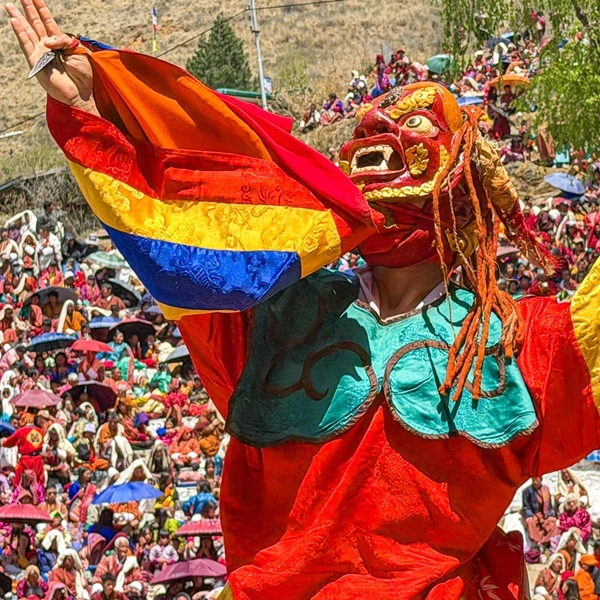
Among the many performances staged during Biska Jatra, the Mahakali Dance at Bhaktapur is the most theatrically elaborate. The dance dramatizes a battle between three goddesses — Mahakali, Mahalaxmi, and Kumari — and a horde of demons who threaten to consume the sacred barley sprouts (jamara) that symbolize agricultural fertility.
The choreography begins with Mahalaxmi purifying the stage where the jamara grows. Demons leap onto the dabali (stage) to consume it. The Kumari dancer enters, performs a self-beautification routine, then leads an entourage of dancers depicting 55 animals, two skeletal figures, and two khyaks (spirits). She offers liquor to the spirits and drinks it herself, trembling with divine fury. A complex, serpentine dance follows. Mahalaxmi steps forward and engages the demons in a war-dance that traditionally continues until midnight.
The dance is performative theology — not entertainment. It enacts the cosmic victory of fertility over destruction, ensuring that the agricultural cycle can begin. King Pratap Malla commissioned the performance after reportedly witnessing the battle in a dream.
How to Experience Biska Jatra as a Visitor
The Three Essential Days
If you can attend only one day, make it Day 6 (April 15) — the Sindoor Jatra in Thimi combined with the tongue-piercing in Bode. Both happen simultaneously in adjacent villages. The visual intensity, the cultural depth, and the emotional range (color-drenched joy in Thimi, solemn endurance in Bode) make this the single most concentrated day of the entire festival.
For the full experience, attend Day 1 (April 10) for the opening tug-of-war in Taumadhi Square, Day 5 (April 14) for the Yosin pole crash on New Year’s Day, and Day 6 (April 15) for Sindoor Jatra and the tongue-piercing. These three days capture the festival’s full emotional spectrum.
Where to Watch the Chariot War
Taumadhi Square is the epicenter. The Nyatapola Temple’s stepped platform provides the best elevated viewing position. We arrange rooftop access through local families in the surrounding buildings. Stay well clear of the rope lines — the chariot is unsteered and genuinely unpredictable.
Where to Stay
Bhaktapur itself has limited luxury accommodation. Most of our Biska Jatra guests stay at Dwarika’s Hotel in Kathmandu (25 minutes by car) and drive to Bhaktapur each day with our guide and driver. For guests who want to be inside the action, we arrange heritage guesthouse stays within Bhaktapur’s old city — modest but atmospheric, and within walking distance of every major festival site.
“In April 2025, we took Ingrid and Lars Johansson from Uppsala to the opening tug-of-war at Taumadhi Square. Lars, a retired structural engineer, spent twenty minutes watching the 35-foot chariot absorb lateral forces as it was dragged around a corner with no steering mechanism and no brakes. He turned to our guide and said, ‘I have designed bridges and high-rises for forty years. I would not have believed this structure could survive the forces it is absorbing right now if I were not watching it happen. The wood is talking to the ropes. They built a tensegrity system eight hundred years ago.’ The next day, at the Sindoor Jatra in Thimi, Ingrid — an art teacher — shot 400 photographs in two hours. She told us at dinner: ‘Every photo I took today is the best photo I have ever taken. The color does the work.’”
Wear clothes you do not mind destroying — the sindoor stains permanently. Waterproof your camera gear. Carry water. The festival takes place in mid-April, which is warm in the valley (25–30°C). Wear comfortable shoes suitable for cobblestone streets. Alcohol is banned in Bhaktapur during the festival; respect this rule. Our guides carry first-aid kits and maintain direct communication with our Kathmandu operations team.
Frequently Asked Questions
What is Biska Jatra?
Biska Jatra (also called Bisket Jatra) is a nine-day festival centered in Bhaktapur, Nepal, marking the Nepali solar New Year. It features a violent chariot tug-of-war between the city’s eastern and western halves, the erection and felling of a 25-meter ceremonial pole (Yosin), color-throwing (Sindoor Jatra) in Thimi, tongue-piercing in Bode, and elaborate masked dances. It is one of the most intense and structurally complex festivals in the Kathmandu Valley.
When is Biska Jatra in 2026?
April 10 to April 18, 2026. The Nepali New Year falls on April 14. The Sindoor Jatra in Thimi and the tongue-piercing in Bode take place on April 15. The festival follows the Hindu solar calendar, not the lunar calendar.
Is Biska Jatra the same as Bisket Jatra?
Yes. “Biska Jatra” and “Bisket Jatra” are the same festival. The name derives from the Newari “Bi-syaku” (festival of killing the serpent) or from the Sanskrit “Vishwa Ketu” (world flag). Both spellings are used interchangeably.
What is the chariot tug-of-war?
Bhaktapur is divided into Thane (upper/east) and Kwone (lower/west). Thousands of men from each side pull ropes attached to a 35-foot chariot carrying Bhairavnath, trying to drag it into their neighborhood. Whichever side wins secures the deity’s divine favour for the coming year. The chariot has no steering or brakes — it navigates by crashing into buildings at turns. It is genuinely dangerous and one of the most intense festival events globally.
What is the Sindoor Jatra in Thimi?
The Sindoor Jatra takes place on April 15 in Madhyapur Thimi, seven kilometers west of Bhaktapur. Thirty-two miniature shrines (khats) are paraded through the streets while thousands of participants throw bright orange and red sindoor (vermilion powder), completely covering the town. It is the most photogenic event of the entire Biska Jatra cycle.
What is the tongue-piercing ceremony in Bode?
On the same day as the Sindoor Jatra, a volunteer from the Shrestha clan in Bode has a 10-inch iron spike driven through his tongue. He then carries a flaming torch barefoot through the streets for the entire day. The ritual is an act of proxy suffering — the piercer takes the community’s vulnerability into his body to protect the village from drought, disease, and misfortune. International visitors may observe respectfully.
What is the Yosin pole?
The Yosin (also called Lingo) is a 25-meter wooden pole erected on the last day of the old year (April 13) and crashed to earth on New Year’s Day (April 14). It functions as a monumental Shiva Linga symbolizing cosmic regenerative power. The twin flags at its peak represent Bhairav and Bhadrakali. Witnessing the pole’s fall is believed to destroy the observer’s personal enemies for the coming year.
Is Biska Jatra safe for international visitors?
The festival deploys 1,000-1,400 security personnel, including Nepal Police, the Armed Police Force, and riot-control units. CCTV and drone surveillance monitor the crowds. Alcohol is banned throughout the nine days. That said, the chariot tug-of-war is genuinely dangerous, and we position our guests at safe elevated vantage points, well clear of the rope lines. The Sindoor Jatra in Thimi and the tongue-piercing in Bode are safer to attend at ground level.
Where should I stay during Biska Jatra?
Most luxury travelers stay at Dwarika’s Hotel in Kathmandu (25 minutes from Bhaktapur by car) and drive to the festival each day. For guests who want to sleep inside Bhaktapur’s old city, we arrange heritage guesthouse stays within walking distance of Taumadhi Square. These are atmospheric but modest — Bhaktapur does not have luxury hotel-tier accommodation.
Can I combine Biska Jatra with other Nepal experiences?
Yes. Biska Jatra (April 10-18) falls at the start of the spring trekking season. A common framework: attend the festival’s key days, then fly to Lukla or Pokhara to begin a luxury trek. The festival also pairs naturally with Kathmandu Valley cultural touring, Chitwan safari (Chitwan is warm and excellent in April), or a Bhutan extension via the Kathmandu-Paro flight.
The Final Word
Biska Jatra is not a festival you watch. It is a festival that happens to you. The chariot crashes past. The sindoor covers you. The Dhimay drums enter your chest. The pole rises, holds the sky for a day, and falls. The new year begins in the wreckage of the old one.
If you are in Nepal in mid-April and you have any tolerance for intensity, controlled chaos, and the kind of cultural depth that takes a lifetime to fully understand, tell us. We will place you in Taumadhi Square with a guide who grew up there, on a rooftop where the chariot passes close enough to hear the wood groaning against the ropes.
Planning a trip during Biska Jatra?
Tell us your April dates. We will identify the most meaningful festival days for your visit, arrange safe viewing positions, and build a broader Nepal itinerary around them.