The Exorcism at the Roof of the World
Upper Mustang is a region of Nepal that resembles Tibet. Sitting in the rain shadow of the Annapurna and Dhaulagiri ranges at 3,840 meters, the landscape is arid desert: red-orange canyons, wind-carved cliffs, barren hills, and the Kali Gandaki gorge cutting through the center. Lo Manthang, the walled capital of the former Kingdom of Lo, has existed since 1380 AD. Its population is Loba — ethnically and linguistically Tibetan. The religion is Vajrayana Buddhism, administered by the Sakya sect through the Choedhe Monastery.
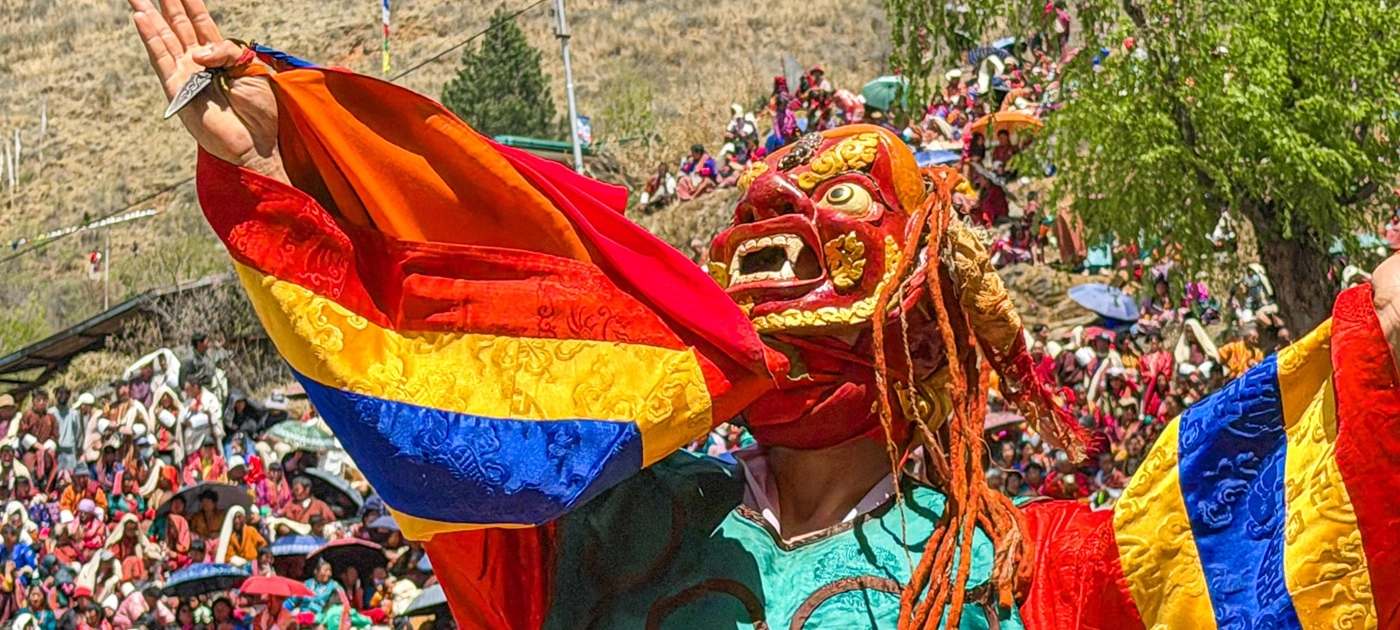
The Tiji Festival is the region’s spiritual centerpiece. It is not a celebration. It is a three-day exorcism — a choreographed expulsion of the demon who steals the valley’s water, performed by monks who have spent months in preparation and led by a single dancer who has spent three months in solitary confinement achieving mystical union with the deity he will embody.
At Alpine Luxury Treks, we run Tiji Festival itineraries annually. We cover this festival in our Top 7 Nepal Festivals guide and our Nepal Helicopter Experiences blog (charter flights to Upper Mustang are the fastest access). This is the dedicated deep-dive.
In This Guide
- The mythology: a son kills his demon father to bring back the rain
- The Tsowo: three months of solitary meditation for three days of dance
- The three-day festival: Tsa Chham, Nga Chham, Rha Chham
- The dual Tiji: one for the public, one for the monks
- The walled city: Lo Manthang at 3,840 meters
- Getting there: trekking, jeep, and helicopter
- The 2026 dates and booking logistics
- Frequently asked questions
Mythology: A Son Kills His Demon Father to Bring Back the Rain
The demon Ma Tam Ru Ta was the personification of everything that can go wrong in a high-altitude desert. He stole water. He caused droughts. He brought storms. He spread disease. In some versions of the myth, he ate human flesh. In a valley entirely dependent on glacial meltwater and precise seasonal cycles, Ma Tam Ru Ta was not an abstract evil. He was the specific, named threat to survival.
The hero is Dorje Jono — also known as Dorje Phurba or Vajrakila — a wrathful incarnation of the Buddha. What makes this myth theologically unusual is the family relationship: Dorje Jono is the demon’s own son. He is enlightenment born from the heart of ego and destruction. His mission, guided by the 8th-century Buddhist master Padmasambhava, is not to annihilate his father but to subjugate and transform him. In Vajrayana philosophy, negative forces are not destroyed — they are transmuted into protective energies.
Dorje Jono fights Ma Tam Ru Ta for three days. On the final day, he pierces the demon’s effigy with a phurba (a three-sided ritual dagger), binds the demonic energy through unbreakable spiritual vows, and forces it back into the Buddha realm as a sworn protector. The water returns. The fields turn green. The valley survives another year.
The Tiji Festival re-enacts this battle annually. The monks are the celestial army. The Tsowo is Dorje Jono. The straw effigy is Ma Tam Ru Ta. The musket fire is the final expulsion. And the crowd’s shout of “Lha Gyalo!” is the community’s declaration that they are, for another year, safe.
The Tsowo: Three Months Alone for Three Days of Dance
The Tsowo is the principal dancer of the Tiji Festival. He is a monk from the Choedhe Monastery selected for his knowledge of the complex ritual procedures and his mastery of the 52 dance steps. But mastery of choreography is not sufficient. The Tsowo must undergo a profound spiritual transformation before he can step into the courtyard.
Three months before the festival, the Tsowo enters a solitary meditation retreat within the monastery. He is forbidden to speak to, meet, or otherwise interact with anyone except a single designated assistant. For three months, in silence, he meditates continuously, recites Dorje Shunu mantras, and purifies himself physically and spiritually. By the end of the retreat, the community believes he has assumed the deity's psychic mantle. He is no longer a monk performing a role. He is Dorje Jono, inhabiting a human body.
The physical demands of the festival itself are extreme. The 52 dance steps must be performed with absolute precision over three consecutive days at an altitude of 3,840 meters. Each step traces a portion of a celestial mandala — a sacred geometric diagram — onto the courtyard floor. The Tsowo issues subtle verbal commands to guide the surrounding monks’ positioning. To the untrained eye, the movements appear seamless. To the Tsowo, they are a three-day act of sustained supernatural concentration performed in an oxygen-thin atmosphere after three months of near-total isolation.
THE 65 MONKS OF CHOEDHE MONASTERY
The Choedhe (Dzongkar Choede) Monastery houses approximately 65 monks drawn from Lo Manthang, Nhenyul, and Chhosyer. It belongs to the Sakya sect of Tibetan Buddhism and serves as the spiritual epicenter of Upper Mustang. The monastery preserves Tibetan monastic chanting, ancient Cham mask-dance traditions, and the art of butter sculpture. The entire Tiji Festival is organized, funded, and executed by this single monastic institution, with logistical support from the seven traditional Lo villages (Lo Tho Dun) and the ongoing patronage of the Mustang royal family.
The Three-Day Festival
|
Day
|
Name
|
What Happens
|
|
Day 1
|
Tsa Chham
|
Slow, solemn. The 400-year-old Padmasambhava thangka unfurled on the palace wall. Black Hat Dancers execute the 52 steps — slow, deliberate, each step tracing part of a celestial mandala. The demon’s harassment of the land is enacted. The spiritual perimeter is established.
|
|
Day 2
|
Nga Chham
|
Fierce, chaotic. Dorje Jono is born from the demon’s own lineage. 20-24 animal masks appear: tigers, deer, yaks, horses, crows, vultures, wolves wielding wooden swords. Skeleton dancers receive the dead. A dog-masked performer distributes pieces of the demon’s essence. Monkey boy entertainers provide comic relief. The demonic energy is captured and bound.
|
|
Day 3
|
Rha Chham
|
Triumphant, explosive. The Dhakey: the Tsowo pierces the straw effigy of Ma Tam Ru Ta with a phurba dagger. Ancient muskets fired into the sky. The crowd shouts “Lha Gyalo!” Procession outside the city walls to Jhiwa Chhorten and Solang. Khataks (white silk scarves) are offered. Evening: folk songs and dancing in the square.
|
Day 1: The Mandala Is Drawn
The first day is slow and solemn. Inside the monastery, monks conduct Vajrakila prayers. In the afternoon, the ceremony moves to the royal courtyard. The massive Padmasambhava thangka — a sacred scroll painting over 400 years old, depicting Guru Rinpoche flanked by two dakinis — is unfurled across the entire southern wall of the palace. The Black Hat Dancers, led by the Tsowo, execute the 52 steps at a pace so deliberate that each movement can take minutes. The courtyard is being transformed into a mandala. The perimeter is being sealed. The deity is being invoked.
Day 2: The Demons and the Animals
The tempo shifts violently. The graceful movements of Day 1 are replaced by fierce, physically exhausting sequences. Monks wearing 20-24 different animal masks — tigers, deer, yaks, crows, wolves with wooden swords — fill the courtyard. Skeleton dancers shiver and move through the crowd. A monk in a dog mask distributes pieces of the demon’s essence to the surrounding deities — the demonic force is being folded into the Buddhist dharma, forcibly converted from destructive energy into protective energy. The day ends with the demon’s power captured but not yet destroyed.
Day 3: The Dagger, the Muskets, and the Victory Cry
The climax. The Rha Chham dances are fast, triumphant, and relentless. The Tsowo approaches the red straw effigy of Ma Tam Ru Ta — the physical scapegoat for the community’s accumulated negative karma. He pierces it with the phurba dagger. The remnants are thrown into the air and cast to the ground. The demon is destroyed.
Ancient muzzle-loading muskets — relics of Mustang’s martial history — are fired repeatedly into the sky by the Gyalpo (king) and local participants. The white smoke rises. The crowd erupts: “Lha Gyalo! Lha Gyalo! Lha Gyalo!” — “May God be victorious.” A procession moves outside the city walls to the Jhiwa Chhorten and Solang, performing dances and prayers to ensure the banished spirits cannot re-enter. As night falls, the exorcism gives way to folk songs and communal dancing in the square. The water will come. The fields will be green.
“In May 2025, we took Hiroshi and Keiko Tanaka from Kyoto on a 14-day Upper Mustang trek timed for the Tiji Festival. Hiroshi is a professor of comparative religion at Doshisha University, specialising in Vajrayana Buddhism. He had studied the Cham dance tradition for decades in academic texts. On Day 1, standing in the royal courtyard while the Tsowo executed the 52 steps against the backdrop of the 400-year-old Padmasambhava thangka, Hiroshi was quiet for a very long time.
On Day 3, after the muskets fired and the crowd shouted ‘Lha Gyalo’ and the straw effigy lay in pieces on the ground, he told Keiko: ‘I have read about this in manuscripts for thirty years. I taught a seminar on Vajrakila last semester. But standing inside the mandala while the phurba pierces the effigy and the guns fire and the crowd screams that God has won — I understand now that the text is a map. The festival is the territory. They are not the same thing.’”
The Dual Tiji: One for the Public, One for the Monks
This is the detail that most visitors never learn. The Tiji Festival is performed twice each year.
The Main Tiji (sometimes called the Old Tiji) is the public event held in the courtyard of the Tashi Gompa Palace in May, attended by the Gyalpo, international tourists, and the broader Loba community. This is the version promoted by trekking agencies and the one that drives the tourism economy. In 2026: May 13, 14, and 15.
The New Tiji (the Second Tiji or Lho Tso Dhun Tiji) takes place approximately one month later, in June or July. It is conducted entirely within the Choedhe Monastery courtyard. It sees virtually zero international tourists because it falls during the off-season, after the trekking window closes and the monsoon approaches. In 2026: approximately June 21, 22, and 23.
The rituals are identical. The same three-day progression. The same masked dances. The same Tsowo. The difference is the audience — and the absence of cameras.
The existence of the New Tiji is a deliberate preservation strategy. By maintaining a private, undisturbed iteration of the exorcism within the monastery walls, the Choedhe monks ensure that the tantric potency of the Vajrakila practice remains insulated from the commercialization and distraction inherent to global tourism. It is one of the most sophisticated indigenous strategies for balancing economic modernization with religious preservation we have seen anywhere in the Himalayas.
Lo Manthang: The Walled City at 3,840 Meters
Lo Manthang was founded in 1380 AD by Ame Pal, the first king of the Kingdom of Lo. The walled city is approximately 300 meters by 150 meters, enclosed by 7-meter-high mud-brick walls. Inside: the Tashi Gephel Palace (the royal residence), the Choedhe Monastery, the Thupchen Gompa, the Jampa Lhakhang, and a dense network of whitewashed traditional houses connected by narrow alleys. The population is approximately 800 permanent residents.
The kingdom’s monarchy was formally abolished in 2008 when Nepal became a republic. The last official raja, Jigme Dorje Palbar Bista, lost his royal title. His son, Jigme Sengye Palbar Bista, holds the traditional title of Gyalpo and remains deeply revered. The Gyalpo’s presence at the Tiji Festival — firing the muskets alongside his subjects, offering khataks to the Tsowo — maintains a continuity of royal patronage that has sustained the festival for centuries.
The ongoing construction of the Kora La highway connecting China’s Tibetan Plateau to the Indian subcontinent via the Kali Gandaki corridor is fundamentally reshaping Upper Mustang. The road brings affordable goods and access to hospitals. It also brings dust, unplanned development, and non-traditional building materials. Many ancient trekking trails have been subsumed by vehicular roads, leading to a surge in 4x4 Jeep tours that replace traditional foot expeditions. The medieval ambiance that makes Lo Manthang a global cultural attraction is under active, visible pressure. Visiting sooner is genuinely better.
Getting There: Trek, Jeep, or Helicopter
The Traditional Trek (14–20 Days)
Fly from Kathmandu to Pokhara, then take the dramatic gorge flight to Jomsom (2,720 meters). Trek north through Kagbeni (2,800m), Chele (3,100m), Syangbochen (3,800m), Ghami (3,510m), and Tsarang (3,630m), arriving at Lo Manthang (3,840m) in time for the festival. The return trek descends via the same or alternate route. Total: 14-20 days depending on exploration and acclimatization.
The Jeep Route (5–7 Days)
Drive from Jomsom to Lo Manthang via the Kali Gandaki corridor. Rough, dusty roads. Multiple river crossings. 4x4 required. This route is increasingly popular but sacrifices the trekking experience for speed. We generally recommend the jeep route for guests returning to Upper Mustang who have already done the trek, or for those with limited time who want to maximize festival attendance.
Helicopter Charter (Same Day)
A charter flight from Pokhara to Lo Manthang takes approximately 45–50 minutes. This is the fastest access and the option we recommend for guests who want to attend the Tiji Festival without a multi-week trekking commitment. We cover helicopter logistics in detail in our Nepal Helicopter Experiences guide.
Permits and Costs
Upper Mustang is classified as a Restricted Area. Independent trekking is prohibited. You must travel with a registered guide and obtain an Annapurna Conservation Area Project (ACAP) permit plus a Restricted Area Permit (RAP). Minimum two travelers per group. Comprehensive Tiji Festival trek packages typically range from 2,195 to 4,500 USD per person. We handle all permit processing and logistics.
Frequently Asked Questions
What is the Tiji Festival?
The Tiji Festival (Tenchi or Tempa Chirim) is a three-day Vajrayana Buddhist ritual held annually in the walled city of Lo Manthang, Upper Mustang, at 3,840 meters. It enacts the cosmic battle between the deity Dorje Jono and the demon Ma Tam Ru Ta, who stole the valley’s water. Performed by 65 monks of the Choedhe Monastery, the festival features elaborate Cham masked dances, the piercing of a demon effigy with a ritual dagger, musket fire, and a procession outside the city walls. The purpose is exorcism: the annual banishment of destructive forces to ensure water, peace, and agricultural prosperity for the Kingdom of Lo.
When is the Tiji Festival in 2026?
The Main (public) Tiji Festival is scheduled for May 13, 14, and 15, 2026. The private New Tiji within the monastery is approximately June 21–23. Dates follow the third Tibetan lunar month and may shift slightly. We confirm the exact dates 2–3 months in advance.
What is the Tsowo?
The Tsowo is the principal dancer and spiritual leader of the Tiji Festival. He is a monk from the Choedhe Monastery who enters three months of solitary meditation retreat before the festival, during which he is forbidden from speaking to anyone except one designated assistant. He masters 52 dance steps that trace a celestial mandala onto the courtyard floor. By the end of his retreat, the community believes he has become the physical vessel of the deity Dorje Jono.
What are the three days of the festival?
Day 1 (Tsa Chham): Slow, solemn. The 400-year-old Padmasambhava thangka is unfurled. Black Hat Dancers execute 52 steps. The mandala is established. Day 2 (Nga Chham): Fierce, chaotic. 20-24 animal masks (tigers, wolves, yaks). Skeleton dancers. The demon’s energy is captured. Day 3 (Rha Chham): Triumphant. The Dhakey — the Tsowo pierces the demon effigy with a phurba dagger. Ancient muskets fire. The crowd shouts ‘Lha Gyalo!’ Procession outside the city walls.
Is there a private version of the festival?
Yes. The festival is performed twice: the Main Tiji in the royal courtyard (May, public, tourist-attended) and the New Tiji within the Choedhe Monastery courtyard (June/July, private, virtually no tourists). The rituals are identical. The New Tiji exists as a preservation strategy to protect the tantric purity of the practice from the distractions of commercial tourism.
How do I get to Lo Manthang?
Three options: (1) Traditional trek from Jomsom, 14–20 days. (2) 4x4 Jeep drive from Jomsom, 5–7 days. (3) Helicopter charter from Pokhara, approximately 45–50 minutes. Upper Mustang is a Restricted Area; you must travel with a registered guide and obtain ACAP and RAP permits. We handle all logistics.
How much does a Tiji Festival trip cost?
Comprehensive trek packages to the Tiji Festival range from 2,195 to 4,500 USD per person, covering permits, guide, accommodation, meals, and ground transport. Helicopter charter access is additional. We provide detailed pricing based on your group size, duration, and access method.
What is the altitude at Lo Manthang?
Lo Manthang sits at approximately 3,840 meters (12,600 feet). The trek to reach it passes through 2,800m (Kagbeni) to 3,800m (Syangbochen). Altitude sickness is a genuine consideration. We build acclimatization days into all Upper Mustang itineraries. The helicopter option requires no acclimatization for the brief festival attendance, though guests should be aware of the altitude during the 2–3 days they spend in Lo Manthang.
What should I bring?
Warm layers — temperatures at 3,840m can drop below freezing at night, even in May. Sun protection (hat, sunscreen, sunglasses) — UV is intense at altitude. Dust protection (bandana or buff) for the jeep route. Camera with a zoom lens (70–200mm) for the masked dances — the courtyard is relatively small, but positioning varies. Comfortable shoes for cobblestone streets. We provide a detailed packing list for all Tiji itineraries.
How far in advance should I book?
Six to nine months ahead. Accommodation in Lo Manthang is extremely limited (a handful of guesthouses, no luxury properties inside the walls). Charter flight capacity to Jomsom is constrained during the festival period. We typically begin taking Tiji Festival bookings in October-November for the following May. This is the one Nepal festival where the urgency of booking genuinely rivals Bhutan’s Tshechu festivals.
The Final Word
The Tiji Festival is the rarest, most geographically remote, and most theologically concentrated festival experience available in Nepal. Three days. Sixty-five monks. One man who spent three months alone becoming a god. A 400-year-old painting unfurled against a palace wall. Wolves with wooden swords. Skeleton dancers. A straw demon pierced with a ritual dagger. Ancient muskets fired into the sky. And the collective voice of a 600-year-old walled city at the roof of the world, declaring that God has won.
If you want to see it, tell us now. Lo Manthang’s guesthouses sell out. The charter flights are full. The permits take time. And the Kora La highway is changing the landscape faster than anyone expected. The festival will survive — the monks have ensured that with the private New Tiji. But the medieval context in which it takes place is finite. This is a trip you take sooner rather than later.
Planning a Tiji Festival trip?
Tell us your May dates. We will confirm the festival calendar, arrange permits, book accommodation in Lo Manthang, and coordinate your access by trek, jeep, or helicopter.