Nepal’s Fifteen Days of Blessing, Sacrifice, and Contested Identity
Dashain runs for fifteen days, from the first day of the bright lunar fortnight in the Nepali month of Aswin to the full moon of Kojagrat Purnima. In 2026: October 12 to October 26. The festival celebrates the victory of Goddess Durga over the buffalo demon Mahishasura after nine nights of battle, and the parallel victory of Lord Rama over the demon king Ravana. Both myths converge on the same theological point: cosmic order is restored through divine martial intervention.
For the orthodox Hindu majority, Dashain is the most important event of the year. For the Kirat communities, it is a reminder of forced assimilation. For economists, it is an NPR 200 billion spending surge that accounts for 40 percent of the nation’s annual trade. For ethnographers, it is a case study in how a single festival can mean completely different things to the communities that observe it and the communities that refuse to.
At Alpine Luxury Treks, our team includes staff from Khas Arya, Newar, Tharu, and Kirat backgrounds. Some celebrate Dashain with a red tika. Some apply black tika. Some use a white tika. Some do not apply tika at all. This guide reflects that diversity honestly.
In This Guide
- The mythology: nine nights of battle and the goddess who won
- The fifteen-day calendar (2026 dates)
- The four key days: Ghatasthapana, Phulpati, Maha Ashtami, Vijaya Dashami
- Four communities, four Dashains: Khas Arya, Newar, Tharu, Kirat
- The sacrifice debate
- The sensory landscape: Malshree Dhun, Linge Ping, Mutton Pakku
- How to experience Dashain as a visitor
- Frequently asked questions
Mythology: Nine Nights of Battle
The buffalo demon Mahishasura earned a divine boon that made him invincible to all male deities and mortal men. He used it to conquer heaven. The gods were powerless. In response, the three supreme gods — Brahma, Vishnu, and Shiva — merged their energies to create a being that was none of them: the goddess Durga. She rode a celestial lion. She carried the weapons each male god had surrendered to her. And she fought Mahishasura for nine nights while the demon shapeshifted through every form he could think of — buffalo, lion, elephant, and back to buffalo. On the tenth morning (Vijaya Dashami), she drove her trident through his heart.
The nine nights of battle are the Navaratri. Each night corresponds to a different form of Durga, each more ferocious than the last. The first nine days of Dashain mirror this sequence. The tenth day celebrates the victory.
The parallel myth: Lord Rama, the seventh incarnation of Vishnu, could not defeat the ten-headed demon king Ravana until he prayed to Durga and received her blessing. He slew Ravana on the same tenth day. The convergence of these two myths is the festival’s theological foundation: martial victory requires the divine feminine. Power without the goddess is incomplete.
WHY THIS MYTHOLOGY MATTERS POLITICALLY
By linking military victory to divine feminine blessing, Dashain historically sacralized the Nepali monarchy. Every Shah and Rana king positioned himself as a contemporary Rama, deriving his mandate to rule from Durga’s grace. The Phulpati military procession from the ancestral Gorkha palace, the cannon fire at Tundikhel, and the state-sanctioned animal sacrifices at the old royal palace are all remnants of this fusion of religion and statecraft. The Head of State still receives tika during the festival. Theology and politics are structurally inseparable.
The Fifteen-Day Calendar: October 12–26, 2026
|
Day
|
Date
|
Name
|
What Happens
|
|
1
|
Oct 12
|
Ghatasthapana
|
Barley seeds sown in a dark room (Dashain Ghar). Sacred Kalash installed. The seeds grow into pale Jamara shoots over nine days.
|
|
2–6
|
Oct 13–17
|
Navaratri
|
Sequential worship of nine forms of Durga. Temple visits. Recitation of the Saptashati scriptures. Private domestic devotion.
|
|
7
|
Oct 18
|
Phulpati
|
Sacred flora arrives from Gorkha after a 169km journey. Military parade and cannon fire at Tundikhel. Public holiday begins. Mass migration to ancestral villages.
|
|
8
|
Oct 19
|
Maha Ashtami
|
Midnight Kot Puja. Mass animal sacrifice at temples and military garrisons nationwide. The fierce forms of Durga are worshipped.
|
|
9
|
Oct 20
|
Maha Navami
|
State sacrifices at Hanuman Dhoka (historically 54 buffaloes, 54 goats). Vehicles, tools, and machinery are blessed. Taleju Temple opens to the public — the only day of the year.
|
|
10
|
Oct 21
|
Vijaya Dashami
|
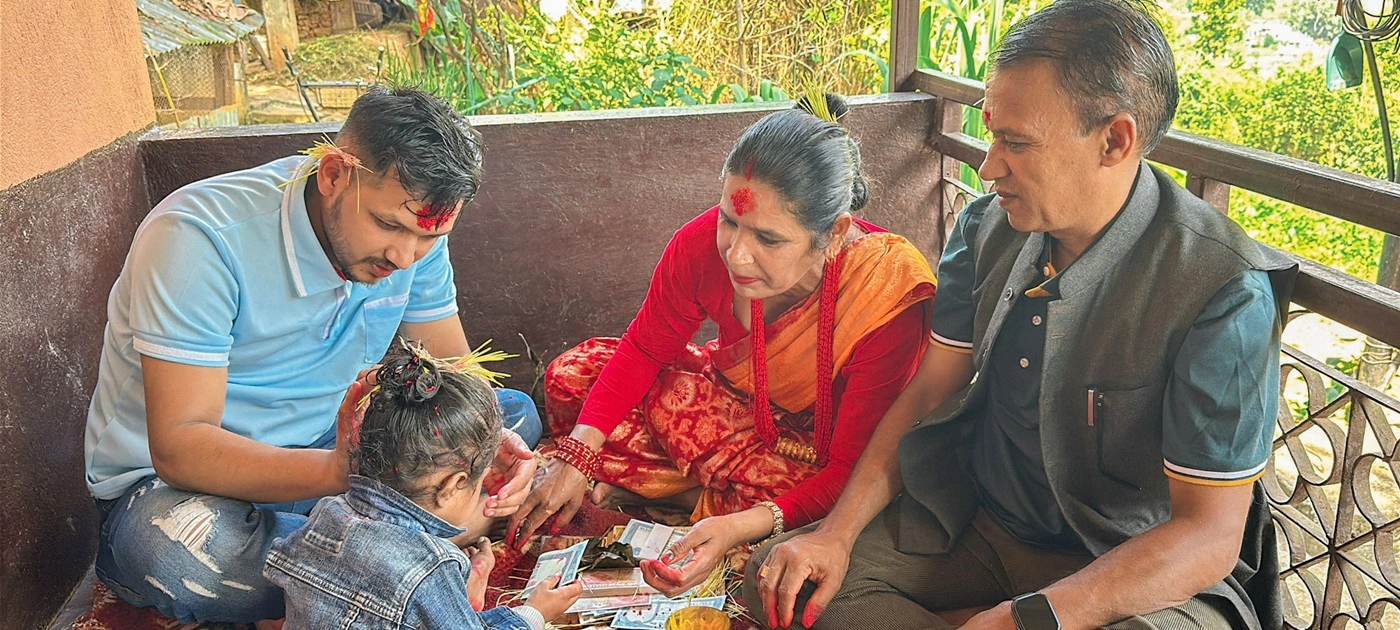
THE TIKA DAY. Elders apply red tika (made with rice, yogurt, and vermillion) and Jamara to the foreheads of younger family members. Dakshina (cash gifts). New clothes. The country visits its relatives.
|
|
11–14
|
Oct 22–25
|
Nakhtya
|
Extended visits to maternal homes, in-laws, and distant relatives. Grand feasts. Tika ceremonies continue.
|
|
15
|
Oct 26
|
Kojagrat Purnima
|
Full moon. Goddess Laxmi descends at midnight to bless whoever is awake. Families play cards through the night. Remaining tika and dried Jamara were offered to the rivers. The festival formally closes.
|
The Four Days That Define Dashain
Ghatasthapana: Seeds in the Dark (Day 1)
A room in the house is sealed from sunlight. A brass vessel (Kalash) is filled with holy water and placed on a bed of sand. Barley seeds are sown into the soil. Over nine days, they germinate in darkness, producing pale yellowish-green shoots — Jamara. These shoots are the living, physical manifestation of Durga’s blessing. On Vijaya Dashami, elders place them on the heads and behind the ears of the family’s younger members. The Jamara is not decorative. It is the goddess’s gift made visible.
Phulpati: The Military Procession (Day 7)
Phulpati (“sacred flowers”) is the day Dashain becomes a state spectacle. An assortment of ritually pure flora — banana stalks, sugarcane, and auspicious leaves — is dispatched from the ancestral Dashain Ghar in Gorkha. The procession covers 169 kilometers and is carried by Brahman priests. In Kathmandu, the arrival is met with a heavily militarised pageant: the Gurujyuko platoon, the Nepal Army, the Nepal Police, Panchebaja musicians, and cannon fire at Tundikhel. This is the day the national public holiday begins. The urban population mobilizes for mass migration back to their villages.
Maha Ashtami: The Night of Sacrifice (Day 8)
The eighth night is the violent climax. Thousands of goats, buffaloes, sheep, and poultry are sacrificed at temples, military garrisons, and private homes across the country. The blood is offered to the fierce manifestations of Durga. The meat becomes prasad — blessed food — and the beginning of intensive familial feasting.
On Maha Navami (Day 9), the state conducts its own official sacrifices at the old royal palace in Hanuman Dhoka. Vehicles, tools, and machinery are blessed with red vermillion and animal blood to prevent accidents in the coming year. And the Taleju Temple — one of the most sacred and heavily restricted temples in Kathmandu — opens its gates to the general public for the only day of the year.
Vijaya Dashami: The Tika (Day 10)
The tenth day is the emotional center of the entire festival. At an astrologically determined hour, the eldest member of the family prepares the tika — a paste of uncooked rice, yogurt, and red vermillion powder. Younger family members kneel before the elder. The tika is applied to the forehead. The Jamara shoots are placed behind the ears. Ancient Sanskrit mantras are chanted to invoke longevity, prosperity, and cosmic protection. Cash gifts (Dakshina) and new clothes are given.
Because it is physically impossible to visit all extended relatives in a single day, the tika ceremony inaugurates a period of domestic travel that lasts five more days. The entire country is in motion, visiting maternal uncles, in-laws, and distant cousins. The festival does not end until the tika has been received from every elder who matters.
Four Communities, Four Dashains
Dashain is promoted as a unifying national institution. But Nepal has over a hundred ethnic groups, and not all of them celebrate the same festival. The differences are not cosmetic. They are theological, historical, and in some cases political.
|
Community
|
Tika Colour
|
Key Ritual Difference
|
What the Tika Symbolizes
|
|
Khas Arya
|
Red (rice, yogurt, vermillion)
|
Mass animal sacrifice, Phulpati military procession
|
Martial victory, blood, Durga’s fierce protective grace
|
|
Newar
|
Black (Mohani Sina — oil lamp soot)
|
Wax gourd (Bhui Phasi) struck with a scimitar instead of an animal; Kuchhi Bhwey feast
|
Spiritual protection from malevolent forces
|
|
Tharu
|
White (rice and yogurt, no vermillion)
|
Pittari Puja (ancestor worship), Sakhiya dance, Lathi Nach
|
Agricultural purity, distance from bloodshed
|
|
Kirat
|
White or none (active boycott)
|
Focus on indigenous festivals: Udhauli, Ubhauli, Chasok Tangnam
|
Rejection of Aryan/Hindu cultural dominance
|
The Newar Tradition: Mohani
For the Newari community, the autumn festival is Mohani. It predates the intensive Hinduisation brought by later dynasties and emphasizes family deities and agrarian bonds over the Durga-Mahishasura narrative. On the day corresponding to Vijaya Dashami (locally known as Chaalan), the male head of the household venerates a traditional scimitar and then decorates a wax gourd (Bhui Phasi) to represent Mahishasura.
Family members take turns striking the gourd with the sword, hacking it to pieces, and discarding the pieces outside the home. The tika is black — Mohani Sina, made from the soot of a sacred oil lamp — believed to provide protection from evil spirits.
The Tharu Tradition: White Tika and the Sakhiya Dance
The Tharu people of the Terai observe Dashain through an animistic lens, emphasizing ancestral spirits. The ninth day is devoted to Pittari Puja (ancestor worship) rather than the fierce forms of Durga. The tika is white rice and yogurt without red vermillion — deliberately stripping away the color associated with martial bloodshed. The festival period features the Sakhiya dance (at least 5 male and 25 female performers), narrating Krishna legends and reinforcing communal bonds under the spiritual guardianship of the Guruwa (village chief priest).
The Kirat Resistance
The Kirat communities (Rai, Limbu, Yakkha, Sunuwar) of eastern Nepal do not view Dashain as their festival. They view it as a tool of state-imposed cultural assimilation, forcibly mandated by the Shah and Rana dynasties during the 18th-century unification campaigns.
The historical record is specific. The Limbu community began observing Dashain around 1842 BS, only after violent state retaliation for refusal. Rulers demanded that indigenous households display the blood of sacrificed goats on their doorways as proof of compliance. Civilians in police clothing were deployed to verify. In 1942 BS, two Aathpahariya leaders — Ridama and Ramlihang — were executed by the state for actively rebelling against forced Dashain observance.
The modern boycott was catalyzed in 2035 BS (1978/79), when the state abolished the Kipat system — the communal landholding system central to Limbu identity. Five Limbu leaders initiated a formal boycott, recognizing Dashain as the symbol of the feudal state’s subjugation. Today, many Kirat people use the holiday period for family reunions but actively refuse the red tika. In indigenous discourse, red is the color of Aryan victory over non-Aryan peoples. Accepting it is viewed as a concession of historical defeat.
WHY THIS MATTERS FOR VISITORS
If you attend Dashain in Nepal and receive a tika from a local family (which our guides sometimes arrange), you should understand that the tika's color is not arbitrary. Red is the mainstream Hindu marker. Black is the Newari alternative. White is the Tharu and some Kirat version. And some families do not apply tika at all. Asking about the color and what it means to the specific family is a mark of genuine cultural interest, not intrusion.
The Sacrifice Debate
An estimated one million animals are sacrificed nationwide during Dashain. The theological justification: by offering blood to the fierce forms of Durga, devotees metaphorically sever their own internal malice and ego, offering their “animal instincts” to the goddess. The meat becomes prasad.
The counter-argument, growing among urban Youth, celebrities, and Buddhist communities: witnessing mass decapitations normalizes violence, particularly in children. Critics also note the historical irony that sacrifices are performed to prevent human bloodshed, yet Nepal’s history includes the Bhandarkhal Massacre (1806), the Kot Massacre (1846), and the Royal Massacre (2001) — each of which was followed by further animal slaughter.
A growing urban trend replaces sentient animals with botanical substitutes: wax gourds, squash, or coconuts. The Newar tradition already does this with the Bhui Phasi ceremony. Whether animal sacrifice will gradually be replaced remains one of the most active cultural debates in contemporary Nepal.
The Sensory Landscape: Music, Swings, and Mutton Pakku
The Malshree Dhun
The acoustic hallmark of Dashain is the Malshree Dhun — a 17th-century instrumental raga that permeates television, public squares, and domestic spaces the moment the festival period begins. Originally a Newar court composition, it was later adopted by the Shah dynasty. The melody is associated with the goddesses Kalika and Lakshmi (“Shree” denotes the blessing of wealth). Modern interpretations by ensembles like Sur Sudha have transformed it into the definitive pan-Nepali anthem of festive nostalgia. Hearing the Malshree Dhun is how every Nepali abroad knows: Dashain is here.
The Linge Ping
The most iconic visual of Dashain, aside from the tika ceremony, is the Linge Ping — a massive bamboo swing erected in village squares and community spaces. Nepalese folklore mandates that every person must leave the surface of the earth at least once during the fifteen days. Swinging is believed to absolve one of terrestrial attachments and ensure a safe spiritual passage to heaven. Building the swing requires intergenerational collaboration and temporarily erases socio-economic boundaries.
Mutton Pakku: The Fifteen-Day Meat
Dashain gastronomy is synonymous with goat meat. Mutton Pakku is the quintessential dish: bone-in mutton marinated with cumin, coriander, turmeric, chili, ginger, garlic, cinnamon, cloves, bay leaves, and cardamom, then slow-cooked in mustard oil until all water evaporates and the meat is effectively preserved in its own rendered fat. A properly cooked Pakku stores at room temperature for fifteen days, deepening in flavor with each reheating. The dish was engineered for a two-week festival in a country that historically had no refrigeration.
“In October 2025, we hosted Marguerite and Jean-Luc Perrin from Lyon on a 14-day Nepal cultural itinerary that included four days of Dashain. On Phulpati, they watched the military procession at Tundikhel — cannon fire, Panchebaja musicians, and the sacred flora arriving from Gorkha. On Vijaya Dashami, our guide Suresh invited them to his family home in Kirtipur. Marguerite, a retired sociology professor, sat in the family room while Suresh’s grandmother applied red tika to the foreheads of fourteen family members in descending order of age, chanting different mantras for each — martial qualities for the men, resilience for the women.
Each person received cash, new clothes, and a Jamara behind their ears. The process took two hours. Marguerite told us at the airport: ‘I have studied kinship systems for thirty years. I have never seen one operate in real time with this precision. The tika is not a blessing. It is a data transfer — a grandmother transmitting specific cosmic instructions to each descendant, calibrated by gender and birth order. Every family in this country is doing this simultaneously. It is the most sophisticated kinship technology I have ever witnessed.”
How to Experience Dashain as a Visitor
The Essential Days
If you attend only one day, make it Vijaya Dashami (October 21). The tika ceremony is the emotional core of the entire festival. We arrange home visits with local families for guests who want to witness (and sometimes receive) tika. If you can attend two days, add Phulpati (October 18) for the military procession and cannon fire at Tundikhel.
What to Expect Logistically
Dashain is the one time of year when Nepal genuinely shuts down. Shops close. Restaurants operate reduced hours. Domestic flights run reduced schedules. Expect logistical adjustments. We build buffer days into Dashain-period itineraries and brief all guests on the specific disruptions. The compensating reward: you see Nepal at its most familial, most emotional, and most culturally honest.
Combining Dashain with Other Experiences
Dashain (October 12-26) overlaps with the peak autumn trekking season. The most popular framework: begin a trek (EBC, Annapurna, Upper Mustang) before Dashain, descend to Kathmandu for the Tika days, and fly home afterward. Tea houses along the major routes remain open during Dashain, though some have reduced menus. We cover trekking options in our dedicated Luxury Trekking guide.
THE KITE-FLYING TRADITION
During Dashain, the Kathmandu Valley fills with kites. The tradition is linked to a folk belief that flying kites sends a message to Indra, the rain god, asking him to stop the monsoon rains. By mid-October, the monsoon is ending. The kites are a communal signal to the sky: enough rain, we need the sun for the harvest. Watching the sky above the valley fill with hundreds of kites on a Dashain afternoon is one of the most peaceful, unexpected pleasures of the festival.
Frequently Asked Questions
What is Dashain?
Dashain is Nepal’s longest and most important Hindu festival, spanning fifteen days in October. It celebrates the victory of Goddess Durga over the buffalo demon Mahishasura and the parallel victory of Lord Rama over the demon king Ravana. The festival is characterized by the sowing and growing of Jamara (barley shoots), mass animal sacrifice, the Phulpati military procession, and the Vijaya Dashami tika ceremony, where elders bless younger family members with a paste of rice, yogurt, and red vermillion.
When is Dashain in 2026?
October 12 to October 26, 2026. Ghatasthapana: October 12. Phulpati: October 18. Maha Ashtami: October 19. Vijaya Dashami (main tika day): October 21. Kojagrat Purnima: October 26. The public holiday begins on Phulpati.
What is the Dashain tika?
The tika is a paste of uncooked rice, yogurt, and red vermillion powder applied to the forehead by an elder family member. It is accompanied by Jamara (pale barley shoots) placed behind the ears, Sanskrit mantras invoking protection and prosperity, and gifts of cash (Dakshina) and new clothes. The color varies: red for mainstream Hindu, black for Newar (Mohani Sina, from oil lamp soot), and white for Tharu and some Kirat families (rice and yogurt without vermillion).
Do all Nepali communities celebrate Dashain?
No. The Kirat communities (Rai, Limbu, Yakkha, Sunuwar) of eastern Nepal have a documented history of resisting Dashain as a symbol of forced cultural assimilation by the Shah and Rana dynasties. Two community leaders were executed in 1942 BS for refusing to observe the festival. A formal boycott began in 1978/79. Today, many Kirat people use the holiday period for family reunions but decline the red tika, focusing instead on indigenous festivals such as Udhauli, Ubhauli, and Chasok Tangnam.
What is the Phulpati procession?
Phulpati (‘sacred flowers’) is a ritually pure assortment of flora dispatched from the ancestral Gorkha palace and carried 169 kilometers to Kathmandu by Brahman priests. In Kathmandu, it is received with a heavily militarised state pageant featuring the Nepal Army, cannon fire at Tundikhel, and traditional Panchebaja musicians. Phulpati marks the beginning of the public holiday and triggers the mass migration of urban workers back to their ancestral villages.
What happens on Maha Ashtami?
Maha Ashtami (Day 8) is the night of mass animal sacrifice. Goats, buffaloes, sheep, and poultry are offered at temples and military garrisons across Nepal to appease the fierce forms of Durga. The meat becomes prasad (blessed food). The following day (Maha Navami), the state conducts official sacrifices at Hanuman Dhoka, vehicles and tools are blessed, and the Taleju Temple opens to the public for the only day of the year.
What is the Malshree Dhun?
The Malshree Dhun is a 17th-century instrumental raga that serves as the acoustic signature of Dashain. Originally a Newar court composition, it is now the pan-Nepali anthem of festive nostalgia. It is broadcast continuously on television and radio during the festival period and played in public squares. For the Nepali diaspora, hearing the Malshree Dhun is the emotional trigger that signals Dashain has arrived.
What is Mutton Pakku?
Mutton Pakku is the quintessential Dashain dish: bone-in goat meat slow-cooked in mustard oil with cumin, coriander, turmeric, chili, ginger, garlic, cinnamon, cloves, bay leaves, and cardamom until all water evaporates and the meat is preserved in its own rendered fat. It stores at room temperature for fifteen days and deepens in flavor with each reheating. The dish was engineered for a two-week festival in a country with no history of refrigeration.
How does Dashain affect tourism logistics?
Significantly. Shops close. Restaurants operate reduced hours. Domestic flights run reduced schedules. Staff at hotels work modified shifts. Tea houses along major trekking routes remain open but may have limited menus. We build buffer days into all Dashain-period itineraries and brief guests on specific disruptions. The cultural reward of witnessing Dashain compensates for the logistical inconvenience.
Can international visitors receive a tika?
Yes. Our guides sometimes invite guests to their own family homes for the tika ceremony on Vijaya Dashami. This is one of the most meaningful cultural experiences available during Dashain — sitting in a Nepali family’s home while an elder applies tika to your forehead alongside their own children. We arrange this on a guest-by-guest basis with guides whose families are comfortable welcoming outside visitors.
The Final Word
Dashain is the festival where Nepal shows you everything at once. The grandmother chants specific cosmic instructions as she transfers the tika to each descendant. The cannon fire at Tundikhel. The barley is growing in a dark room for nine days. The kites are filling the valley sky. The goat’s blood was offered to the goddess. The black tika, the white tika, and the families that refuse tika altogether. The NPR 200 billion is flowing through the economy in two weeks. The Malshree Dhun is playing from every window in the country.
It is not one thing. It is the entire country’s identity compressed into fifteen days. If you are in Nepal in October, you will experience it whether you plan to or not. The question is whether you experience it as a logistical disruption or as a window into how 30 million people relate to their gods, their dead, their ancestors, and each other. We can make it the second one. Tell us your October dates.
Planning a trip during Dashain?
Tell us your October dates. We will identify the most meaningful festival days for your visit, arrange family tika ceremonies, and build a broader Nepal itinerary around the fifteen days.