EBC Permits and TIMS: What We Handle on Your Behalf
|
|
|
|
Permits required for EBC
|
Sagarmatha National Park + Khumbu Rural Municipality
|
|
TIMS card needed
|
No — TIMS removed for Khumbu route in 2018
|
|
Sagarmatha Park fee
|
NPR 3,000 (~USD 22) for foreigners
|
|
Khumbu Municipality fee
|
NPR 2,000 (~USD 15) per person
|
|
Where the Sagarmatha permit is checked
|
Monjo entry checkpoint
|
|
Where the Khumbu permit is checked
|
Lukla on arrival
|
|
Helicopter arrival
|
Same permits required as fixed-wing
|
|
Issue point in Kathmandu
|
Nepal Tourism Board, Bhrikuti Mandap
|
|
Photos required per permit
|
2 passport-sized per permit
|
|
Validity
|
Single entry, duration of trek
|
|
What we do for you
|
Arrange, pay, carry, and present at every checkpoint
|
Trekking to Everest Base Camp requires permits. Two of them, on the current standard route. The TIMS card is no longer required for the Khumbu region — that changed in 2018, and most articles you'll read online still haven't caught up. On every Luxury EBC departure with us, you don't deal with any of this.
We arrange permits in advance, pay the fees as part of your trek package, carry the documentation on the trail, and present it at every checkpoint. You walk through. The system works because we run it as a managed end-to-end process, not a guest task.
This guide exists for guests who want to understand what's happening behind the scenes — what permits exist, what each one funds, why the rules changed, and how the process actually works. If you've read older trekking blogs that mention three permits including TIMS, this clears up the confusion.
What Permits Actually Exist for the EBC Trek in 2026
Two permits, one fee, no TIMS. That's the current reality on the standard EBC route via Lukla. Here's exactly what each is, what it costs, and what it covers.
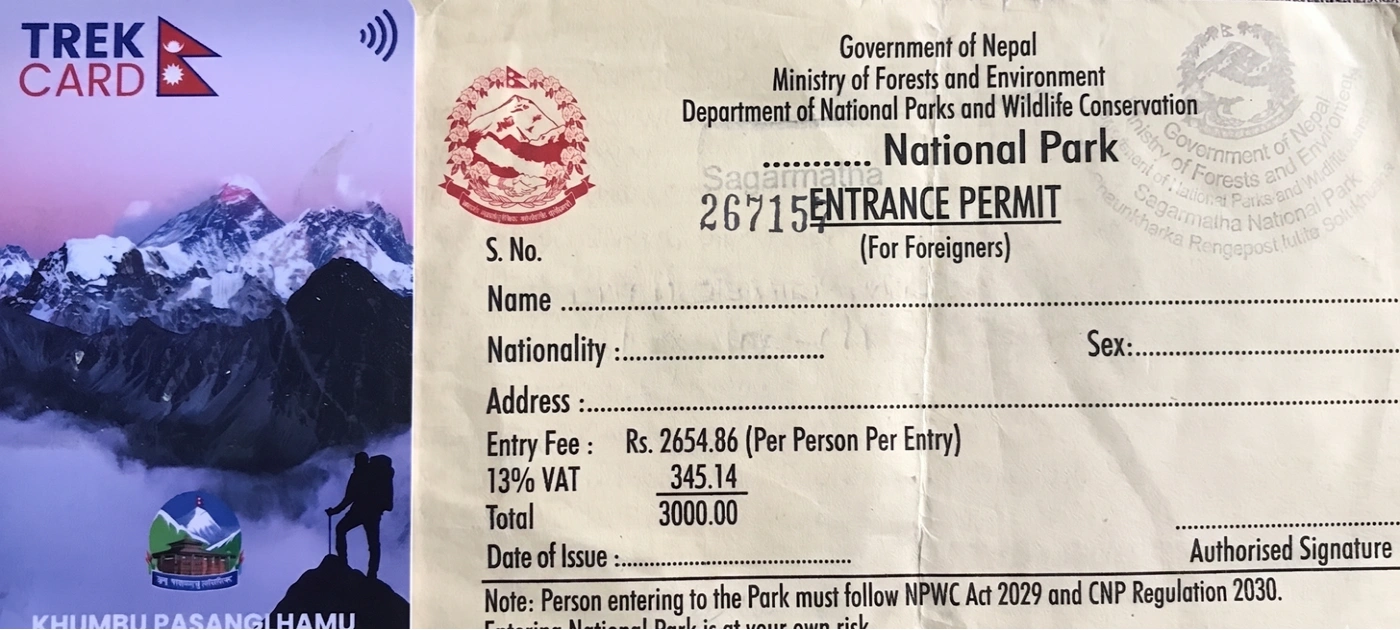
Sagarmatha National Park Entry Permit
This is the foundational permit for everyone entering Sagarmatha National Park, which encompasses the entire Everest region from Lukla up to the Tibetan border. Issued by the Department of National Parks and Wildlife Conservation (DNPWC). The permit funds park infrastructure, ranger patrols, conservation work, waste management at higher elevations, and the long-running effort to manage the human impact of trekking and climbing on the upper Khumbu environment.
What it costs
- Foreign nationals: NPR 3,000 (approximately USD 22)
- SAARC nationals (India, Pakistan, Bangladesh, Sri Lanka, Bhutan, Maldives, Afghanistan): NPR 1,500
- Nepali nationals: NPR 100
- Children under 10: free
Where it's checked
The permit is verified at the Monjo checkpoint, the entry gate to Sagarmatha National Park on Day 2 of the trek between Phakding and Namche Bazaar. There is also a checkpoint at Jorsalle. Without this permit, you cannot proceed. Rangers are courteous, the queue moves quickly when permits are properly arranged, and our guides hand-carry the documentation for the entire group.
Khumbu Pasang Lhamu Rural Municipality Permit
This is the local permit introduced in October 2018 by the Khumbu Pasang Lhamu Rural Municipality (KPLRM) — the local government body covering Lukla and the Khumbu region. The Khumbu Municipality permit replaced TIMS for trekkers entering the Everest region by air via Lukla. It funds local infrastructure, trail maintenance, school support, and emergency response within the rural municipality boundaries.
What it costs
- All foreign trekkers: NPR 2,000 (approximately USD 15) per person
- Children: same fee structure as adults; no separate children's rate
Where it's checked
This permit is issued and verified at Lukla — typically at a desk near the airstrip on arrival, or at the municipality office in Lukla town. Without it, you cannot continue beyond Lukla. We arrange this in advance through our local team and handle the paperwork before guests walk from the airstrip to the lodge.
Why TIMS Is No Longer Required for Khumbu
Until October 2018, trekkers in Nepal were required to carry a TIMS (Trekkers' Information Management System) card — a tracking document jointly issued by the Nepal Tourism Board and the Trekking Agencies' Association of Nepal (TAAN). The TIMS card was designed to centrally register every trekker for safety, search-and-rescue coordination, and statistical tracking.
In October 2018, the Khumbu Pasang Lhamu Rural Municipality formally withdrew from the TIMS system. The municipality argued that TIMS fees were collected centrally in Kathmandu and didn't return sufficient funding to the regions where trekking took place. They replaced it with the local Khumbu Municipality permit, which goes directly to local infrastructure and services.
The result: TIMS is no longer required for trekkers entering the Everest region. The Khumbu Municipality permit took its place. Anyone telling you otherwise — including a number of widely-read travel blogs — is working from outdated information.
TIMS still applies to other Nepal trekking routes — Annapurna, Manaslu (in addition to restricted-area permits), Langtang, and others. But not for the standard EBC route via Lukla.
EBC Permit Requirements: Then and Now
|
Permit
|
Pre-October 2018
|
Current (2026)
|
|
TIMS Card
|
Required (NPR 1,000-2,000)
|
NOT required for Khumbu
|
|
Sagarmatha National Park
|
Required (NPR 3,000)
|
Required (NPR 3,000)
|
|
Khumbu Rural Municipality
|
Did not exist
|
Required (NPR 2,000)
|
|
Total foreign trekker fee
|
~NPR 5,000 (3 permits)
|
NPR 5,000 (2 permits)
|
|
Issuing authority
|
DNPWC + TAAN/NTB
|
DNPWC + KPLRM
|
Permit Rules for Helicopter vs Fixed-Wing Arrival into Lukla
Many guests assume that flying into Lukla by helicopter — as we do on every Luxury EBC departure — changes the permit requirements. It does not. The same two permits apply regardless of how you arrive at Lukla.
The practical difference is timing. On a fixed-wing flight, you typically arrive at Lukla, walk into town, and the Khumbu Municipality permit office is open and accessible. On a helicopter charter, the timing is similar — we land, the ground crew handles bags, and our guide presents the permit documentation at the same office. The Sagarmatha permit is checked later, at Monjo on Day 2 of the trek.
If you've started the trek by walking in from Jiri (a route few luxury guests choose anymore), you'll cross into the national park before reaching any of the standard checkpoints. The permit is still required and is checked further up the trail — typically at Monjo as well.
For operational reasons, we fly a helicopter in both directions; see our Lukla-to-Kathmandu helicopter logistics guide.
What Alpine Luxury Treks Handles on Your Behalf
Permits are part of every Luxury EBC Trek package. Here's the actual end-to-end process we run for every departure.
Before You Arrive in Kathmandu
- We collect a copy of your passport at booking — required for permit applications
- We request 4 passport-sized photos in advance (2 per permit) — but if you arrive without them, we have a photo studio next to our office that produces compliant photos in 15 minutes
- Our office begins the Sagarmatha National Park permit application before your arrival to avoid same-day delays
On Arrival Day in Kathmandu
- We complete any final paperwork during your hotel check-in or welcome dinner
- Permits are typically issued and ready 24 hours before your Lukla departure
- All documentation is gathered into a permit folder carried by your trekking guide
On the Trek
- Your guide presents the Khumbu Municipality permit at Lukla on arrival
- The Sagarmatha permit is presented at Monjo on Day 2
- If there's a secondary check at Jorsalle, your guide handles it
- You walk through every checkpoint without queueing, paying, or producing documents personally
After the Trek
- Permits are single-entry documents — they don't need to be returned
- We retain a copy of all permit documentation in our records for compliance and any post-trek queries
What Documents Are Required for EBC Permit Applications
Even though we handle the application end-to-end, here's what we collect from you to make it possible:
- Passport scan or clear photo of the identity page (collected at booking)
- Your passport must be valid for at least 6 months beyond your trek end date
- 4 passport-sized photographs (2 for each permit)
- Nepal entry visa (issued on arrival at Tribhuvan International Airport — we can advise on the on-arrival process)
- Travel insurance certificate covering trekking to 5,500 meters and helicopter evacuation — required by us, though not technically by the permit office
- Emergency contact information (next of kin)
If you're arriving in Kathmandu without passport photos, the photo studio at the corner of our office produces 4 compliant photos for under USD 5 in 15 minutes. This is genuinely common — at least one guest in three arrives without spare photos.
Restricted Area Permits — When They Apply
The standard EBC route through Lukla, Namche, Tengboche, Pheriche, Lobuche, Gorak Shep, and Kala Patthar does not require a restricted-area permit. The same is true for the standard Three Passes Trek (Renjo La, Cho La, Kongma La) and the Gokyo Lakes route — these all sit within the Sagarmatha National Park and the Khumbu Municipality boundaries, so the standard two-permit setup applies.
Restricted area permits become relevant if your itinerary extends to:
- Makalu region — via the Makalu-Barun National Park; requires a separate park permit and restricted area permit
- Rolwaling region — via the Rolwaling Valley and Tashi Lapcha pass; requires a restricted area permit
- Crossing into Tibet from the Khumbu — requires a Tibet Travel Permit and group visa, processed separately and at significantly more lead time — see our Tibet Permits and Entry Guide
None of these applies to the standard Luxury EBC Trek. We mention them for completeness in case you're planning an extension or a multi-region itinerary.
What Changes If Your Itinerary Extends Beyond Standard EBC
If your trek includes Gokyo Lakes, Three Passes, or an Island Peak / Mera Peak summit, here's what's different on the permit side:
Gokyo Lakes / Three Passes Routes
Same two permits as standard EBC. No additional documentation required. The route remains within the boundaries of Sagarmatha National Park and Khumbu Municipality throughout.
Island Peak / Mera Peak
Both peaks require a Nepal Mountaineering Association (NMA) climbing permit on top of the standard EBC permits. Climbing permit fees vary by season and group size. We arrange these for guests adding a peak to their trek, with at least 30 days lead time required for the NMA paperwork.
Helicopter Tours Only (No Trek)
If you're flying a helicopter scenic tour to EBC and not trekking, permit requirements are minimal — typically only the Sagarmatha National Park permit is required for landing within park boundaries, and this is arranged by the helicopter operator. The Khumbu Municipality permit may also apply, depending on the landing location. For the difference between trek and helicopter tour formats, see our luxury vs standard EBC trek guide.
EBC Permit Costs in the Context of a Luxury Trek
Looking at the total trip cost, the permits are a small line item — but it's worth understanding what the fee structure covers and where the money goes.
Sagarmatha National Park Permit (NPR 3,000)
Goes to the Central Park budget administered by DNPWC. Funds: ranger salaries, anti-poaching patrols, conservation infrastructure, waste management programs, trail maintenance at higher elevations, the Sherpa Cultural Museum at Namche, and environmental impact mitigation.
Khumbu Municipality Permit (NPR 2,000)
Goes to the Khumbu Pasang Lhamu Rural Municipality. Funds: trail maintenance within the municipality, community schools, health posts, local emergency response, infrastructure projects in Sherpa villages, scholarships, and skill development for Sherpa Youth.
On a USD 8,000–14,000 Luxury EBC Trek, the combined NPR 5,000 (~USD 37) in permit fees represents a fraction of one percent of the total cost. The fees themselves are not the operational complexity — the time, queueing, and processing are. That's what we absorb on your behalf.
What Could Change in 2026 and Beyond
Permit rules and fees in Nepal evolve. We track changes through direct relationships with DNPWC, the Khumbu Municipality office, and the Nepal Tourism Board, and update guests if anything shifts before their departure. Recent and possible developments:
- Fee adjustments — the Sagarmatha National Park fee was last adjusted upward several years ago; another adjustment is periodically discussed, but not currently confirmed
- Digital permit systems — Nepal Tourism Board has piloted online permit issuance for some routes; broader rollout is expected, but not yet implemented for Khumbu permits
- Climbing permit reforms — discussions ongoing about Nepal Mountaineering Association climbing fees and procedures, particularly for high-altitude expeditions
- Reintroduction of TIMS for Khumbu — discussed periodically but not currently planned
We notify confirmed guests of any changes that affect their trek, with any adjustments absorbed into the existing package pricing where reasonable.
For independent reference on Nepal trekking permits, the official source is the Nepal Tourism Board. For Sagarmatha National Park specifically, see the Department of National Parks and Wildlife Conservation.
What You Don't Need to Do as Our Guest
This is genuinely the simpler list. On every Luxury EBC departure with us, you don't need to:
- Visit the Nepal Tourism Board office in Kathmandu
- The queue at the Khumbu Municipality permit desk in Lukla
- Carry physical permit documents on the trek (your guide carries them)
- Photocopy your passport for permit applications
- Pay permit fees separately — they're built into your package
- Track changes to permit rules — we do that for you
- Worry about expired or invalid permit copies — we maintain records
This is what "luxury" actually means in the operational sense. The visible parts are the lodges, the helicopter, the food, and the wine on arrival. The invisible parts are the permits, porter coordination, lodge bookings, helicopter weather windows, Manthali drive logistics, and contingency planning. Both sets exist. Only one is supposed to be visible.
People Also Ask: Quick Answers
These are the questions guests most commonly ask us, along with the related queries Google surfaces for this topic.
Is the TIMS card required for the Everest Base Camp in 2026?
No. TIMS was removed for the Khumbu region in October 2018 and replaced with the Khumbu Pasang Lhamu Rural Municipality permit. The two permits required for the standard EBC trek today are the Sagarmatha National Park entry permit and the Khumbu Municipality permit. TIMS still applies to other Nepal trekking routes, such as Annapurna and Langtang, but not for EBC via Lukla.
How much do EBC permits cost in total?
For foreign nationals, the total EBC permit cost is NPR 5,000 — approximately USD 37. This breaks down as NPR 3,000 for the Sagarmatha National Park entry permit and NPR 2,000 for the Khumbu Pasang Lhamu Rural Municipality permit. SAARC nationals pay reduced rates. Children under 10 are typically free from the park permit.
Can I get my own EBC permits on my own?
Yes, in theory. The Sagarmatha permit is issued at the Nepal Tourism Board in Kathmandu, and the Khumbu Municipality permit is issued at Lukla on arrival. In practice, almost all luxury and most standard trekkers have permits arranged by their operator. On every Luxury EBC departure with Alpine Luxury Treks, we handle this end-to-end as part of the trek package.
Where do I show my EBC permit on the trek?
The Khumbu Municipality permit is checked at Lukla on arrival. The Sagarmatha National Park permit is checked at Monjo (Day 2 between Phakding and Namche), with a secondary checkpoint at Jorsalle. On a guided trek, your guide carries permits and presents them at every checkpoint — guests do not personally handle the documents.
Do children need EBC permits?
Yes, for the Khumbu Municipality permit (same fee as adults), but children under 10 are free for the Sagarmatha National Park entry permit. Older children pay reduced rates depending on age and nationality. For family trekking, we confirm the exact fee structure for each child at the time of booking.
What documents do I need to send to apply for EBC permits?
We need a clear scan or photo of your passport identity page (passport must be valid for at least 6 months beyond your trek end date), 4 passport-sized photographs (2 per permit), and your travel insurance certificate confirming coverage for trekking to 5,500 meters and helicopter evacuation. Most of this is collected during the booking process.
Key Takeaways
- The standard EBC trek requires two permits: Sagarmatha National Park (NPR 3,000) and Khumbu Pasang Lhamu Rural Municipality (NPR 2,000).
- TIMS is no longer required for the Khumbu region — it was replaced by the Khumbu Municipality permit in October 2018.
- The total cost of a foreign trekker permit is NPR 5,000 (approximately USD 37) — a small fraction of luxury trek pricing.
- Helicopter and fixed-wing arrivals into Lukla require the same permits.
- Permits are checked at Lukla (Khumbu Municipality), Monjo, and Jorsalle (Sagarmatha National Park).
- On every Luxury EBC departure with us, permits are arranged, paid for, and carried on your behalf — you walk through every checkpoint without queueing.
- Permit rules and fees can change. We track changes directly with the issuing authorities and update confirmed guests.
- Restricted area permits do not apply on the standard EBC, Three Passes, or Gokyo routes.
Final Notes from the Office
The permit conversation is one of those questions that often comes up on inquiry calls but almost never on the actual trek. Guests want to understand the structure before they book, and they want it to disappear once they arrive. That's the goal.
If you're researching multiple operators, permit handling is one question worth asking about. A serious luxury operator absorbs this entirely. A budget operator will sometimes ask you to bring photos, queue at the Tourism Board, or pay fees separately. Ask the question — the answer tells you something about how the rest of the trip will be run.
If you'd like to discuss how permits, helicopter logistics, and trek operations work together on your specific Luxury EBC departure, contact us directly. To plan the trek itself, see our full Luxury Everest Base Camp Trek package.