The Festival Where Nepal Mourns, Mocks, and Marches
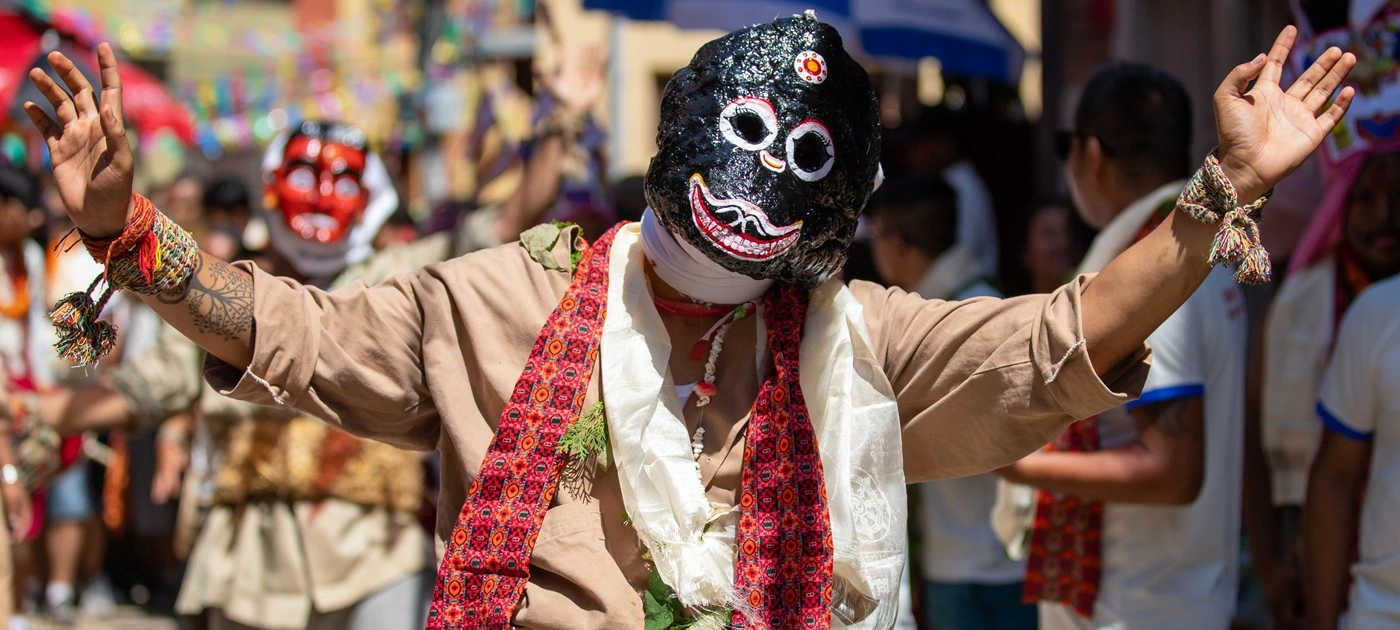
Gai Jatra is three festivals in one. It is a memorial procession for the dead. It is Nepal’s annual day of political satire, where mocking the powerful is not just permitted but religiously mandated. And since 2001, it has become the host day for Nepal’s LGBTQ+ Pride Parade — a movement that rooted itself in the festival’s centuries-old tradition of cross-dressing and norm-subversion rather than importing a Western model of Pride. The result is a day that holds grief, comedy, and civil rights in the same procession.
At Alpine Luxury Treks, several of our team members are Newari. They grew up inside these processions. This guide draws on that lived experience.
In This Guide
- Mythology: Why the cow guides the dead
- The origin: King Pratap Malla and the grieving queen
- The deeper history: monsoon culture and pre-Vedic cattle rites
- Three cities, three festivals: Kathmandu, Bhaktapur, Patan
- The satire: Nepal’s annual day of political mockery
- The Pride March: LGBTQ+ rights rooted in Newari tradition
- The feast: Samay Baji during the procession
- Frequently asked questions
Why the Cow Guides the Dead
When someone dies, their soul must reach the kingdom of Yama, the God of Death and Justice. The path crosses the Vaitarna River — not water but burning liquid, blood, and suffering. The entrance to Yama’s realm is guarded by fierce black crows. The soul cannot navigate this alone.
The cow is the psychopomp — the spiritual guide. If the soul grasps the tail of a sacred cow, the animal will lead it safely across the river, past the crows, and through the gates of heaven. This is why Newari families bathe their cows on the morning of Gai Jatra with particular attention to cleaning the tail: they are purifying the spiritual conduit that their departed relative will hold.
In the Newari understanding specific to the Kathmandu Valley, the gates of heaven open for only one day each year: the day of Gai Jatra. The souls of everyone who died during the previous year are waiting in limbo. The procession is not a memorial. It is an active spiritual intervention — a mechanism for getting the dead where they need to go.
King Pratap Malla and the Grieving Queen
The most widely told origin story places the festival’s formalization in the 17th century. King Pratap Malla ruled Kantipur (Kathmandu) from 1641 to approximately 1674. He was a prolific builder: the Hanuman statue at the palace gate, the Kal Bhairab statue, and the Rani Pokhari (Queen’s Pond). His son Chakrabartendra was killed when he was trampled by an elephant.
The queen fell into a depression so total that nothing the king did — not even constructing a lake filled with water from every sacred river in the kingdom — could reach her. So he tried something different. He issued a royal decree: every family in Kantipur that had lost someone in the past year must join a public procession through the city. And they must make it funny. Cross-dressing. Mockery. Buffoonery. Ridiculous costumes.
Watching the procession from the palace, the queen saw what the king wanted her to see: grief was not her private burden. It was the universal human condition. Everyone was grieving. And the absurdity of the costumes and the satire eventually made her laugh. The king institutionalized the procession as an annual tradition. The satirical license became permanent.
The historian Gautama Vajra Vajracharya argues that the Malla dynasty formalized an existing tradition rather than inventing it. His research traces the festival to pre-Vedic cattle rites (brishotsarga — the ritual release of a bull) tied to monsoon agriculture: cows impregnated during Tihar naturally give birth around the time of Gai Jatra, linking the festival to bovine fertility and the monsoonal life cycle. The transition from agricultural marker to grief ritual may have been catalyzed by pandemics and community trauma. When Pratap Malla used the festival to console his queen, he was tapping into something ancient.
Three Cities, Three Festivals
|
City
|
What Happens
|
|
Kathmandu
|
Boys dressed in yellow silk with paper cow-crowns process through Basantapur Durbar Square. Street theatre and political satire at every stop. Spectators offer packets of milk, sweets, beaten rice, and money to the participants. The atmosphere is loud, theatrical, and deeply irreverent.
|
|
Bhaktapur
|
EIGHT DAYS. Families build Taha-Macha — bamboo effigies of the dead, draped in Hakupatasi (black and red Newari cloth). Four people carry each effigy along the Pradakshina Patha, the circumambulatory route. The Ghintang Ghisi stick dance: parallel columns of men rhythmically clashing sticks for hours in a trance-inducing three-step pattern. Night: Khicha Pyakhan (dog dance) and Makha Pyakhan theatre in courtyards.
|
|
Patan
|
Deeply syncretic: Hindu and Buddhist traditions merge. Quieter, more devotional. Often coincides with Mataya — devotees illuminate thousands of small shrines across the city, creating a literal network of light to guide souls through the darkness.
|
|
Kirtipur
|
Men cross-dressed in women’s Hakupatasi and went house to house demanding that homeowners come down and join a communal feast. The practice deliberately breaks the private walls of grief, forcing the bereaved back into community life.
|
Bhaktapur is the deepest experience. Eight days. The Ghintang Ghisi stick dance runs almost continuously from Gai Jatra through Krishna Janmashtami. The sound of sticks clashing in rhythm for hours is unlike anything else in the Kathmandu Valley — a collective trance mechanism where participants physicalize their grief until they are physically exhausted. The Taha-Macha effigies, draped in the same cloth their mothers and grandmothers wore, turn the procession into a moving gallery of individual loss.
Nepal’s Annual Day of Political Mockery
The satirical license that Pratap Malla granted to soothe his queen became something far larger: Nepal’s annual day of freedom. During Gai Jatra, ordinary citizens can openly mock political leaders, expose corruption, and lampoon the powerful through effigies, caricatures, and street theatre. No other day in the Nepali calendar provides this level of impunity.
The state has not always tolerated it. After the royal coup of 1960 that established the autocratic Panchayat system, the government banned the satirical elements of Gai Jatra for sixteen years. The state feared the festival would be used to mobilize political opposition. It was revived in 1976 when the Nepal Royal Academy recognized that suppressing the cultural pressure valve was creating more instability than permitting it.
The Maha Jodi Phenomenon
In the modern era, the satirical tradition has been carried into mainstream media by the Maha Jodi — the legendary comedy duo of Madan Krishna Shrestha and Hari Bansha Acharya. Their televised Gai Jatra stage shows have set the national benchmark for political commentary for decades. Their performances tackle geopolitical issues, bureaucratic corruption, and the gap between constitutional promises and lived reality. A ritual designed to soothe a 17th-century queen now functions as a vital organ of Nepal’s democratic discourse.
The Pride March: LGBTQ+ Rights Rooted in Newari Tradition
Because Gai Jatra has always involved cross-dressing and the deliberate subversion of gender norms, gender-nonconforming individuals found a space within the festival long before the language of LGBTQ+ rights existed in Nepal.
In 2001, the Blue Diamond Society — Nepal’s pioneering LGBTQ+ rights organization — inaugurated the Gai Jatra Third Gender March. Only 49 people participated. Many wore the traditional demon and deity masks of the Jatra to conceal their identities. The strategic brilliance was rooted in Nepali tradition rather than importing a Western Pride model. The message: we are not new here. We have always had a place in Nepali culture.
By 2011, over 1,500 people marched. The parade expanded to Biratnagar and Pokhara. The visibility contributed to Nepal’s 2015 Constitution, which legally recognizes a third gender, criminalizes discrimination based on gender identity, and permits people of all genders to serve in the military. Same-sex marriage remains unrecognized, and systemic discrimination persists — but the Gai Jatra Pride Parade functions as both a celebration of constitutional victories and a persistent protest against continuing exclusion.
Traditionalists accuse the Pride march of commercializing a sacred memorial rite. Critics argue that cisgender men cross-dressing for comic effect is fundamentally different from transgender women marching to affirm their authentic identity. This is a real debate. The festival absorbs it. That capacity to hold contradiction — grief and comedy, tradition and modernity, memorial and protest — is precisely what makes Gai Jatra what it is.
The Feast: Samay Baji During the Procession
The culinary centerpiece is the Samay Baji platter — the same Newari feast architecture that appears during Fagu Purnima, Dashain, and every major Newari celebration. Beaten rice (chiura), smoked buffalo meat (choila), boiled eggs, roasted black soybeans, and Ayla (traditional rice wine poured from elevated brass jugs in an unbroken stream into clay bowls). The food grounds the participants during the day-long procession. It equalises the community: every family, regardless of economic status, eats the same platter.
WHERE TO EXPERIENCE GAI JATRA AS A VISITOR
Bhaktapur for the deepest, most immersive experience: eight days, Taha-Macha effigies, the Ghintang Ghisi stick dance, and courtyard theatre at night. Basantapur Durbar Square for the Kathmandu satirical street procession and the paper cow-crown boys. Patan for the quieter, syncretic observance alongside the Mataya light festival. 2026 date: August 29. We arrange guided Gai Jatra experiences in all three cities.
“In August 2025, we brought Claudine and Henri Moreau from Paris to Bhaktapur for the first day of Gai Jatra. Henri, a retired theatre director, had spent forty years staging productions. He stood in Taumadhi Square watching the Ghintang Ghisi for two hours without speaking. When the stick rhythm broke for the Taha-Macha procession, he watched a family carry a bamboo effigy draped in their grandmother’s Hakupatasi cloth through the square.
Claudine photographed his face. He was crying and smiling at the same time. Later, at dinner, Henri said, ‘I have staged grief on a thousand stages. I have never seen a society that processes grief with this structural intelligence. The stick dance exhausts the body so the mind can release. The satire gives the community permission to laugh while they are still mourning. And the cow — the idea that the animal you washed this morning is now guiding your mother’s soul across a burning river — is the most beautiful piece of theatrical staging I have encountered in my life. It was not staged. It was real.’”
Frequently Asked Questions
What is Gai Jatra?
Gai Jatra (the Festival of Cows, known as Saa-Paaru in Nepal Bhasa) is a Newari festival in which families who lost a relative during the past year lead a decorated cow — or a boy dressed as a cow — through the streets. The cow serves as a psychopomp, guiding the departed soul across the Vaitarna River to the afterlife. The festival simultaneously functions as a memorial procession, a day of political satire, and the host day for Nepal’s LGBTQ+ Pride March.
When is Gai Jatra in 2026?
August 29, 2026 (Saturday). The festival falls on Bhadra Krishna Pratipada — the first day of the waning moon in the month of Bhadra. It always follows Janai Purnima (August 28 in 2026) by one day. In Bhaktapur, the celebrations extend for eight consecutive days.
Why is it called the Festival of Cows?
The cow is the spiritual guide (psychopomp) that leads the souls of the dead across the Vaitarna River to the afterlife. Families bathe their cow on the morning of Gai Jatra with special attention to cleaning the tail, which the departed soul is believed to grasp. In Kathmandu, where live cows are impractical, young boys in paper cow-crowns serve as symbolic substitutes.
What is the Taha-Macha?
A bamboo carriage or effigy built by bereaved families in Bhaktapur to represent the deceased. It is draped in Hakupatasi (black-and-red Newari handwoven cloth) and carried through the city by four people along the traditional Pradakshina Patha circumambulatory route. The Taha-Macha is unique to Bhaktapur and is the visual centerpiece of its eight-day Gai Jatra.
What is the Ghintang Ghisi?
A traditional stick dance performed in Bhaktapur during Gai Jatra. Dancers form parallel columns and rhythmically clash sticks in a hypnotic three-step pattern maintained for hours. The repetitive physical exertion functions as a collective trance mechanism — participants physicalize their grief through exhaustion. The Ghintang Ghisi runs almost continuously from Gai Jatra through Krishna Janmashtami.
Why is there political satire at Gai Jatra?
King Pratap Malla (17th century) mandated humor to console his grieving queen. The satirical license expanded over centuries into an annual day of political mockery. During Gai Jatra, citizens can openly mock politicians, expose corruption, and lampoon the powerful through effigies and street theatre. The satirical tradition was banned for sixteen years during the Panchayat era (1960-1976), but was revived because suppressing it created more instability than permitting it.
What is the connection between Gai Jatra and LGBTQ+ Pride?
Gai Jatra’s centuries-old tradition of cross-dressing and norm-subversion provided a culturally safe space for gender-nonconforming individuals. In 2001, the Blue Diamond Society launched the Gai Jatra Third Gender March with 49 participants. By 2011, over 1,500 marched. The movement contributed to Nepal’s 2015 Constitution, which recognizes a third gender and criminalizes gender-identity discrimination. The Pride March is now a permanent component of the festival.
Where is the best place to experience Gai Jatra?
Bhaktapur for the most immersive experience: eight days, Taha-Macha effigies, the Ghintang Ghisi stick dance, and courtyard theatre at night. Basantapur Durbar Square (Kathmandu) for the satirical street procession and paper cow-crown boys. Patan for the quieter, syncretic observance alongside the Mataya light festival. We arrange guided experiences in all three cities.
What is Samay Baji?
The traditional Newari feast platter is served during Gai Jatra and other major Newari festivals. Beaten rice, smoked buffalo meat (choila), boiled eggs, roasted black soybeans, and Ayla (rice wine poured from brass jugs). It serves as physical sustenance during the procession, a communal equalizer across economic classes, and a preservation of indigenous Newari gastronomy.
Can visitors attend Gai Jatra?
Yes. The public processions in Kathmandu, Bhaktapur, and Patan are open to all. Visitors should dress modestly and be respectful of the memorial dimension of the festival — behind the satire and the costumes, families are genuinely processing the loss of loved ones. Photography of the public processions is welcome. We provide cultural context that helps guests understand what they are seeing beyond the surface spectacle.
The Final Word
Gai Jatra is the festival that holds contradictions together. It is a memorial and a comedy show. It is an ancient cattle rite and a modern Pride march. It is a family washing a cow’s tail at dawn to prepare a spiritual conduit for their dead mother, and, by dinnertime, a comedian on national television mocking the prime minister. It is a bamboo effigy draped in a grandmother’s cloth, carried through a medieval city by four people while hundreds of men beat sticks in a rhythm that induces collective trance.
No other festival in Nepal does this. The dead are guided. The living are permitted to laugh. The powerful are mocked. The marginalized march. And the cow — bathed, decorated, sacred — walks through the middle of all of it, pulling a soul across a burning river toward an open gate. If you are in the Kathmandu Valley in late August, this is the day.
Planning a visit during Gai Jatra?
Tell us your August dates. We will arrange guided experiences in Bhaktapur (8-day), Kathmandu (satirical procession), or Patan (syncretic observance). We paired the festival with Kathmandu Valley cultural touring.