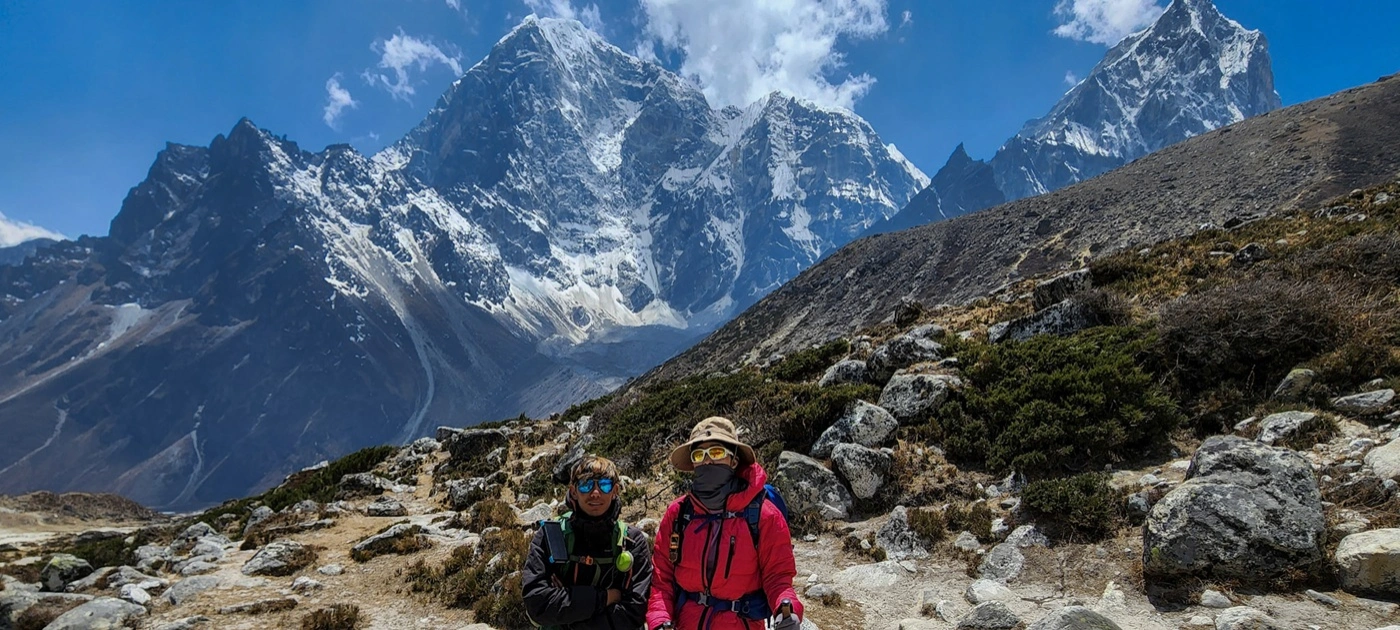
The Everest Base Camp trek has a problem. Everyone knows about it now.
In the peak autumn weeks of October, nearly 1,000 trekkers a day funnel through the same narrow Khumbu trail. The suspension bridge bottleneck. The best teahouses fill up by mid-afternoon. Late-arriving groups sleep on dining room benches or in outdoor tents at 4,400 meters. This is the reality of the modern Everest trail.
For our guests, this is a non-starter. You are not paying for a luxury experience to queue behind twelve other groups at a photo spot or share an unheated room with strangers. You want quiet mornings. Empty viewpoints. A genuine sense of wilderness at the foot of the world’s highest mountain.
The good news is that the crowds are beatable. Not by wishing them away, but through smart timing, better lodges, and strategic logistics. Here is the full playbook we use at Alpine Luxury Treks.
Just How Crowded Is the Everest Trek?
Let us start with the data so you know what we are actually dealing with.
Sagarmatha National Park recorded 52,499 foreign visitors in 2023 and 49,372 in 2024. Those numbers are close to the all-time peak of 58,030 set in 2019. The park is busy again, and booking volume keeps climbing.
Here is what makes it worse. The Everest trail is a linear, out-and-back route through a single river valley. Unlike a sprawling park where hikers spread across hundreds of kilometers of trails, every EBC trekker funnels through the same entry at Lukla, the same bridges, the same villages. Geography forces the concentration.
|
Year
|
Foreign Visitors
|
Context
|
|
2019
|
58,030
|
All-time historical peak
|
|
2021
|
2,461
|
Pandemic low
|
|
2023
|
52,499
|
Full post-pandemic recovery
|
|
2024
|
49,372
|
Sustained high volume
|
Now the critical part. More than 70 percent of those visitors arrive in just five months of the year. Spring (March to May) pulls 31 percent. Autumn (late September to November) pulls 42 percent. The other seven months carry almost nothing. That concentration is the real problem and the real opportunity.
The Teahouse Race: What Budget Trekkers Deal With Every Day
If you have read about the EBC trek online, you have probably seen the phrase "teahouse race." It is real. It is exhausting. And it is something our guests never experience.
Here is how it works for budget trekkers in October. Teahouses operate first-come, first-served. There are not enough beds for the number of trekkers on the trail. So groups leave before sunrise, walking at an unsustainable pace, just to reach the next village before the rooms fill up.
Those who arrive late sleep wherever they can find space. Dining room benches. Hallway floors. Overflow tents pitched outside in sub-zero cold. The plywood walls of standard teahouses offer no heat, so bedroom temperatures mirror the outdoor temperature by midnight. Minus 15 Celsius inside the room.
We find this unacceptable for any of our guests. Solving it is the foundation of everything we do.
Strategy 1: Trek in December for Near-Empty Trails
This is the single biggest crowd-avoidance tool we have. And almost nobody uses it.
December was historically dismissed as too cold for commercial trekking. That assumption is outdated. Modern luxury lodge heating has changed what is possible.
Why December Works
The massive autumn crowds leave at the end of November. The trail empties. The teahouse race evaporates. By early December, the Khumbu feels like a private reserve.
Meanwhile, the weather stays beautiful. Precipitation drops below 15mm for the entire month. The air holds almost no moisture, which means visibility is actually sharper than in October. The skies are deep, clear blue. Photography is phenomenal. Lukla flights are more reliable because cloud cover is rare.
|
Factor
|
October (Peak)
|
December (Off-Peak)
|
|
Trail Traffic
|
Extremely high — up to 1,000/day
|
Very low — near solitude
|
|
Visibility
|
Crystal clear
|
Crystal clear (lowest humidity)
|
|
Daytime Temp (Namche)
|
10°C to 15°C
|
5°C to 8°C
|
|
Night Temp (Gorak Shep)
|
-5°C to -10°C
|
-15°C to -20°C
|
|
Precipitation
|
Low
|
Very low (occasional dry snow)
|
How We Handle the Cold
The only real downside to December is the night temperature. At Gorak Shep, it drops to minus 20 Celsius. In a standard teahouse, that is miserable.
In our luxury lodges, it is a non-issue. Our properties have insulated walls, heated dining rooms, electric blankets, and heated mattresses in every bedroom. You hike all day in solitude under brilliant blue skies, then return to a warm, comfortable room that night. The cold stays outside, where it belongs.
For guests who prioritize solitude above everything else, December is our top recommendation.
Strategy 2: Book Luxury Lodges Months in Advance
Even in peak season, the right lodge network eliminates the teahouse race entirely.
Who We Book With
We work with a small network of premium properties that have transformed high-altitude hospitality in the Khumbu.
- Mountain Lodges of Nepal (MLN). Formerly Yeti Mountain Home and Ker & Downey. Properties in Lukla, Phakding, Monjo, Namche, Thame, Kongde, and Deboche.
- Everest Summit Lodges. Premium accommodation in Lukla, Monjo, Mende, and Pangboche.
- Hotel Everest View. The Guinness World Record holder for the highest luxury hotel in the world at 3,880 meters. Every room has an unobstructed view of Everest from the bed.
Our relationships with these properties mean we secure rooms up to a year in advance. Your bed is booked before you even leave home. There is no race. No anxiety.
What Changes Inside the Room
|
Feature
|
Standard Teahouse
|
Our Luxury Lodges
|
|
Room Heat
|
None — matches outdoor temp
|
Electric blankets, room heaters
|
|
Bathroom
|
Shared squat toilet, bucket shower
|
Private en-suite, 24-hour hot water
|
|
Walls
|
Thin plywood, zero insulation
|
Stone and timber, fully insulated
|
|
Dining
|
Crowded bench, yak-dung stove
|
Heated lounge, fresh organic menu
|
|
Bed
|
Thin foam pad
|
Spring mattress, down duvet
|
|
Booking
|
First-come, first-served
|
Secured months in advance
|
WHY THIS IS MORE THAN COMFORT
Luxury lodges are not just about your evening. They are a medical strategy. When your body is not fighting a cold all night, it can focus on making red blood cells and adapting to altitude. Guests who sleep warm and deep acclimatize faster and have significantly lower rates of altitude sickness. Comfort at altitude is science, not indulgence.
Strategy 3: Counter-Cyclical Pacing with a Private Guide
Even with guaranteed lodge rooms, you still share the trail with other trekkers during the day. This is where our guides earn their keep.
Real-Time Intelligence
Our senior Sherpa guides are embedded in the Khumbu communication network. They know where every major group is, in real time. Which trail sections have a backlog? Which bridges are clogged? Which teahouses are about to release their crowds onto the next stretch?
We use that intelligence to place our guests in the gaps between the waves.
Delayed Starts and Strategic Breaks
Most groups leave around 7:30 AM. We do not.
By starting an hour later, or sometimes pushing to 9:00 AM, we let the bulk of the trekking traffic get well ahead of us. The stretch between Tengboche and Pangboche, which was packed at 8 AM, is nearly empty by 10. The photo stops you would have fought for are now yours alone.
We also use strategic breaks. A longer lunch at a view that most groups skip. An unplanned stop at a local monastery, our guide knows the abbot of. These pauses naturally separate us from the pack without rushing anyone.
Access You Cannot Buy
This is the part that makes private guides worth it.
Our senior guides grew up in these villages. They know the families. They know the monks at Tengboche, Pangboche, and Thame. Occasionally, that opens doors no guidebook can. A private prayer session in a side chapel is normally closed to tourists. An invitation into a Sherpa family home for butter tea. A view from a private rooftop.
These moments are not scheduled. They happen because of relationships. Relationships we have built over the years, not transactions we arranged for this trip.
Strategy 4: The 4 AM Kala Patthar Summit
Here is a small secret. Everest Base Camp itself does not actually give you a clear view of the summit of Everest. The mountain is hidden from the camp behind Nuptse and the West Ridge.
The real visual climax is Kala Patthar. A rocky ridge above Gorak Shep at 5,545 meters. It offers an unobstructed panoramic view of Everest, Pumori, Lhotse, and Ama Dablam. Reaching the summit is the hardest part of the whole trek.
Most groups climb Kala Patthar around 9 or 10 AM. The summit is packed. The views are washed out by midday haze.
We do it differently.
Why 4 AM
Our guides start the Kala Patthar climb at 4 AM in full darkness. Three reasons.
The view. Reaching the top just before sunrise lets you watch the first light strike the summit of Everest. The peak ignites in gold while the valleys below stay in deep shadow. It is the most extraordinary photographic moment of the entire trip.
The solitude. Most trekkers do not have the gear, the headlamps, or the guide support for a pre-dawn climb. By the time they start moving around 8, you are already descending back to the lodge for breakfast. The summit is yours, in silence.
The weather. Himalayan clouds build through the morning. By 11 AM, the peaks are often hidden. An early start guarantees the clearest possible view.
WHAT WE BRING FOR THE 4 AM SUMMIT
Our guides hand you a proper headlamp, heavy down gloves, and a thermos of hot tea before you leave the lodge. The climb is cold and steep. But two hours of effort earn you a 30-minute window at the top with nobody else in sight. We think it is the single most memorable moment of the entire trek.
Strategy 5: Skip the Main Trail Where We Can
Some bottlenecks on the main EBC route are avoidable if you know alternative paths. We build these into our itineraries whenever the weather and your interests allow.
The Phortse Bypass
The standard trail descends from Namche, crosses the river at Phunki Thanga, then makes a long, crowded climb up to Tengboche monastery. This section is a bottleneck.
We often divert guests onto a higher traversing trail to the village of Phortse. Phortse is a traditional Sherpa farming village sitting on an isolated shelf above the main route. Almost nobody goes there. Continuing from Phortse to Dingboche skips the Tengboche crowd entirely.
What you trade is a slightly longer day of walking. What you gain is traversing views of Ama Dablam, a real chance of spotting Himalayan tahr or musk deer, and a look at Sherpa life that the main trail has long since lost.
The Gokyo Lakes Detour
For guests who want genuine wilderness and can afford an extra 3 to 4 days, Gokyo is the ultimate way to avoid crowds.
Instead of the standard path up the Khumbu valley, this route heads west into the Gokyo valley. Massive glaciers. A chain of brilliant turquoise alpine lakes. Maybe one-fifth the traffic of the main trail.
The summit of Gokyo Ri at 5,360 meters offers a panorama many mountaineers consider visually superior to that of Kala Patthar. You can see four 8,000-meter peaks from one spot: Everest, Lhotse, Makalu, and Cho Oyu. All four, in a single sweep.
We combine both routes for guests who want the full picture. Up via Gokyo for solitude. Down via the main trail to visit base camp. Helicopter out from Gorak Shep.
Strategy 6: Skip the Descent with a Helicopter Return
The traditional EBC itinerary forces you to walk back down the same trail you came up. A 65-kilometer descent over 3 to 4 days. Congested, repetitive, and hard on your knees.
We skip it. Every one of our EBC trips includes a helicopter extraction from Gorak Shep.
What Changes with a Heli Return
You finish the trek at peak triumph, not in depletion. After Kala Patthar at sunrise, you board a private helicopter at Gorak Shep and fly to Kathmandu. An hour later, you are showered and eating lunch at a five-star hotel.
The total trip length drops from 14-16 days to 9-11 days. Viable for time-poor professionals who cannot afford three weeks off.
Your knees and hips are spared. Descending steep rocky trails for days causes more joint damage than the ascent. Skipping it matters a lot for our older guests.
You get an aerial perspective of the Khumbu that ground trekkers never see. The icefall, the glaciers, the entire route you just walked, all from above. It is the single best photographic moment of the flight out.
THE HELICOPTER ALSO BEATS THE LUKLA BOTTLENECK
Lukla airport is notorious for flight cancellations. Bad weather can strand budget trekkers in the mountains for days. Our helicopter service can bypass Lukla entirely and fly directly to Kathmandu when conditions allow. One more friction point, removed.
The Bottom Line: Crowds Are a Choice
The Everest Base Camp trek is crowded because most trekkers travel the same way. Same peak months. Same standard teahouses. Same trail on the same schedule.
Break just a few of those patterns and the crowds disappear. Choose December or early November instead of mid-October. Book luxury lodges months out. Walk with a private guide who knows when to slow down and when to push ahead. Do Kala Patthar at 4 AM instead of 9. Skip the descent with a helicopter.
Do all six of these, and the busiest trek in the Himalayas becomes your private expedition. That is what we deliver at Alpine Luxury Treks. Not the same trek everyone else takes, but one carefully engineered so that the only footsteps ahead of you are your guide’s.
Ready to trek to Everest Base Camp without the crowds?
Talk to our team about a 2026 private departure. We will match you with the right season, lodges, and guide for your trek.