Lukla to Kathmandu Helicopter: How It Actually Works on a Luxury EBC Trek
|
|
|
|
Flight time Lukla–Kathmandu (direct)
|
Roughly 35–45 minutes
|
|
Best weather window
|
6:00 a.m. to roughly 10:00 a.m.
|
|
Standard helicopter capacity
|
5 passengers + pilot (AS350 / Bell 407 class)
|
|
Baggage allowance per passenger
|
10 kg duffel + small daypack
|
|
Private charter rate
|
USD 3,500–5,500 per leg (varies by operator and season)
|
|
Shared seat rate
|
USD 500–1,100 per person (peak season, varies)
|
|
Peak season departure point
|
Manthali / Ramechhap (Oct–Nov, Apr–May)
|
|
Helicopter weather minimum
|
Visibility above 1,500m, no significant cloud below the ridgeline
|
|
What we do on Luxury EBC
|
Private charter both directions, every departure, no exceptions
|
The Lukla-to-Kathmandu helicopter is the single most decisive logistical factor on any Luxury EBC itinerary. Get this right, and the trek finishes the way it should — a 40-minute flight over the Khumbu glaciers, lunch in Kathmandu, and the spa at your hotel by mid-afternoon. Get it wrong and you're looking at multi-day weather holds in Lukla, missed international flights, and a cascade of consequences across a tightly built itinerary.
We fly a helicopter in both directions on every Luxury EBC departure. Not just the return leg, both ways. This is the operational case for why, written from within the operation rather than in a marketing pitch.
Why Lukla Is the Hardest Airport in the World to Fly Into
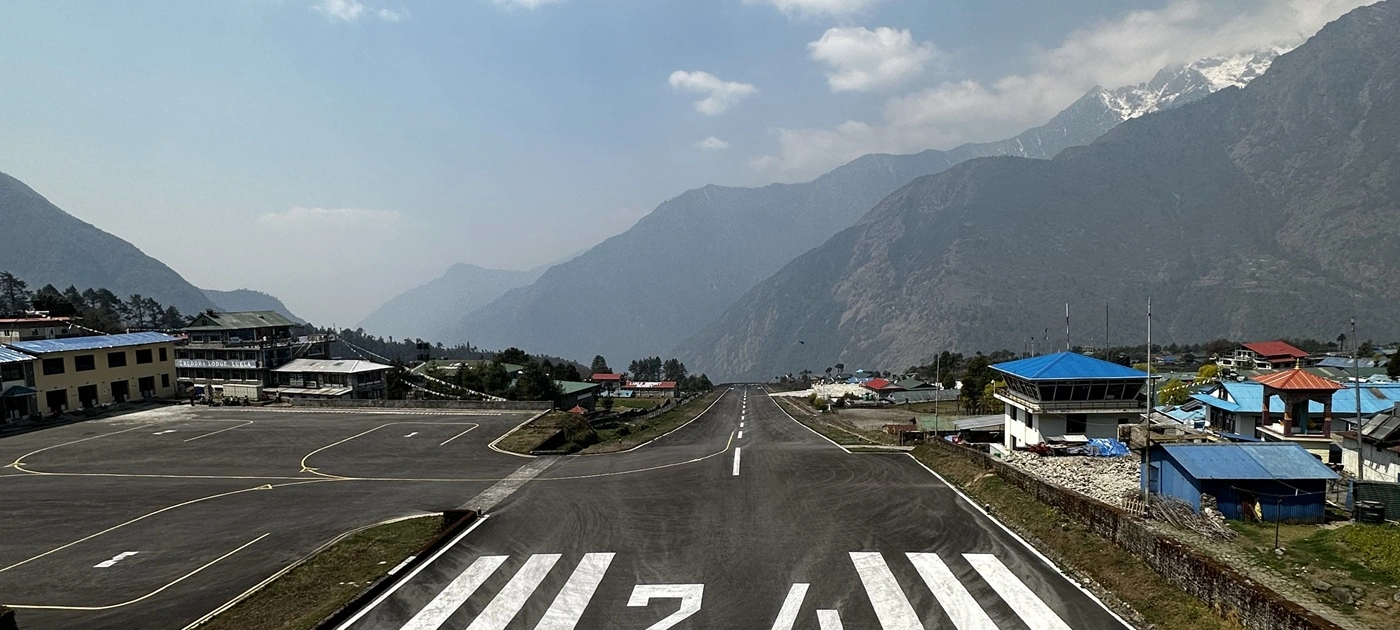
Tenzing-Hillary Airport sits at 2,860 meters on a single runway carved into the side of a mountain. The runway is 527 meters long and slopes upward at 11.7 degrees — landings are uphill, takeoffs are downhill, and there is no go-around procedure. Pilots commit on the final approach. Weather minima are tighter than almost any commercial airport in the world.
This is why fixed-wing Lukla flights are so often canceled. Cloud below ridgeline, crosswinds above 10 knots, or visibility under 5,000 meters grounds the entire fleet. During the autumn and spring peak seasons, cancellation rates range from 15 to 40 percent in any given week. We've seen guests on standard itineraries lose three days in a row to weather, miss their international departures, and end the trek with a logistical mess instead of a celebration.
Helicopter operations have lower weather minima, smaller weather windows, and a fundamentally different risk profile. They still cancel — but they cancel less often, recover faster, and offer charter flexibility that fixed-wing simply doesn't.
For independent guidance on Nepal aviation safety standards, the official source is the Civil Aviation Authority of Nepal.
Fixed-Wing Lukla Flight vs Helicopter: The Operational Comparison
|
Factor
|
Fixed-Wing Lukla Flight
|
Helicopter
|
|
Typical aircraft
|
Dornier 228, Twin Otter
|
AS350, Bell 407, H125
|
|
Capacity
|
14–18 passengers
|
5 passengers + pilot
|
|
Flight time KTM↔Lukla
|
30 minutes
|
35–45 minutes
|
|
Cost per person (peak)
|
USD 200–230
|
USD 500–1,100 shared / 700–1,100 charter share
|
|
Peak season departure
|
Manthali / Ramechhap
|
Manthali / Ramechhap
|
|
Drive KTM to Manthali
|
4–5 hours
|
4–5 hours
|
|
Cancellation rate (peak)
|
15–40% on any given week
|
5–15% on any given week
|
|
Weather minima (visibility)
|
5,000+ metres
|
1,500+ metres
|
|
Wind tolerance
|
Low — under 10 kts crosswind
|
Higher — maneuverable
|
|
Schedule flexibility
|
Fixed slots, batch operations
|
Demand-driven, charter possible
|
|
Weight allowance
|
10 kg checked + 5 kg cabin
|
10 kg duffel + small daypack
|
|
Recovery from cancellation
|
Slow — backlog effect
|
Fast — first weather window
|
This is why luxury operators are willing to absorb the cost difference and fly a helicopter. The reliability gain compounds across a 12–14-day itinerary.
Why We Fly Helicopter Both Directions, Not Just the Return
Most luxury operators in Nepal fly a helicopter only on the return leg from Lukla. The inbound leg uses a fixed-wing aircraft because it's cheaper. We do not. Every Luxury EBC departure flies a helicopter both ways, and the operational reasons are specific.
The inbound risk exceeds the return. Day 1 of your trek is fixed. Lodges are confirmed, the porter is hired, the trekking permit is dated, and the next 12 days depend on starting on schedule. A fixed-wing cancellation on the inbound day pushes the entire itinerary by 24 to 72 hours and risks losing the lodge bookings down the chain.
A helicopter is more flexible on bad mornings. When a fixed-wing aircraft is grounded, helicopter operators can sometimes still fly — the weather window is narrower but more frequent. We've moved guests to Lukla on mornings when every Twin Otter was on the apron.
The acclimatization profile is identical. Inbound by helicopter to Lukla (2,860 m) puts you on the same trail at the same altitude as inbound by fixed-wing. There's no acclimatization cost.
End-to-end timing protects the trek itself. Starting clean on Day 1 means Days 2 through 12 stay aligned. We don't compress acclimatization days to make up for a delayed start. Helicopter both ways protects the integrity of the whole route.
The 6 a.m. Weather Window Explained
Helicopter and fixed-wing operations into Lukla concentrate between approximately 6:00 a.m. and 10:00 a.m. There's a reason.
Mountain weather in the Khumbu follows a predictable diurnal cycle. Cold, stable air sits over the valleys at dawn. The sun warms the valley floors from late morning. Warm air rises against cold ridge air, generating cloud build-up and turbulence. By midday, clouds often close the ridgelines. By 1 p.m. on a typical autumn day, conditions for safe flight have narrowed sharply.
This means departures from Manthali or Ramechhap toward Lukla cluster between 6:00 and 8:00 a.m. Returns from Lukla cluster between 7:00 and 10:00 a.m. By midday, most flying for the day is done.
For guests, this drives a few realities:
- Hotel check-out at 4:00 a.m. on departure day if traveling via Manthali in peak season
- Helicopter charter slots are sold and confirmed by operators based on this window
- Weather holds happen at Lukla — if morning weather doesn't open, the entire day's plan resets to the next morning
- Late afternoon flying is rare and reserved for emergency operations
Manthali and Ramechhap: The Peak-Season Reality
During October–November and April–May, Kathmandu Tribhuvan International Airport restricts STOL (short takeoff and landing) operations to Lukla due to airspace congestion. The Lukla flying operation moves to Manthali Airport (also called Ramechhap) — a small mountain airstrip roughly four to five hours by road from Kathmandu.
This affects every guest on a peak-season departure:
- 4:30 a.m. departure from your Kathmandu hotel to drive to Manthali
- Arrive Manthali around 9:00–10:00 a.m., depending on traffic and road conditions
- Helicopter or fixed-wing departure to Lukla within the morning window
- The reverse on return day — Lukla helicopter to Manthali, then road back to Kathmandu
We handle Manthali logistics on every peak-season departure with a dedicated vehicle, a hot breakfast packed, and a return driver scheduled for the inbound day. This is one of the operational details that determines whether a luxury EBC operation is functioning properly.
For the seasonal reasoning, see our best time for the Luxury EBC Trek guide.
Private Charter vs Shared Seat: The Real Difference
Two ways to buy helicopter seats from Lukla. The economics are very different.
Shared Seat
Five passengers from different parties share the helicopter. The operator fills the aircraft from a manifest of guests waiting at Lukla. Cost per person is significantly lower (USD 500–1,100 in peak season), but the trade-offs are substantial.
- Departure timing depends on the helicopter's load. You may wait at the Lukla airstrip for hours.
- Seat allocation is not guaranteed. Photographers may not get the window seat they need.
- The schedule is not yours. If the helicopter doesn't fill, your flight slips to the next aircraft.
- Service standards vary. Some operators run shared helicopters efficiently; others don't.
Private Charter
Your party books the entire helicopter — typically up to 5 passengers and 50 kg of luggage. The cost is higher per leg (a USD 3,500–5,500 charter rate), but the experience is fundamentally different.
- Departure on your schedule within the morning weather window
- Window seat allocation by request — important for photographers
- No waiting at Lukla for other parties to assemble
- Direct routing without intermediate pickups
- Same operator, same crew, same standard as VVIP charters
For guests on a 12–14 day Luxury EBC Trek with a confirmed international departure 24 hours after Lukla return, private charter is the right answer almost every time. The cost delta against the value of a guaranteed, on-time return is small.
Helicopter Weight and Baggage Limits
Helicopter operations into and out of Lukla are subject to tight weight limits. Lukla sits at 2,860 metres and the air is thin — every kilogram matters for engine performance and safety margin.
Per-passenger weight allowance on Lukla helicopter operations:
- 10 kg duffel (the same one your porter has been carrying)
- Small daypack (5–8 kg) carried in the cabin
- A camera bag may count toward the daypack weight, depending on the operator
Total combined per passenger: approximately 15–18 kg.
If your duffel comes off the trail at 13 or 14 kg — which sometimes happens with souvenirs, prayer flags, or a heavier-than-planned camera kit — it can be repacked at Lukla. We weigh at the airstrip on arrival and rebalance if needed.
For the master packing approach that keeps you under these limits, see our Luxury EBC packing list.
What Happens If the Helicopter Can't Fly
This is the question every guest asks, and it deserves a straight answer.
Scenario 1 — Morning weather hold at Lukla
You wake up to find the helicopter on the apron, but the cloud is below the ridgeline. We wait. If the weather opens by 10:00 a.m., we fly. If it doesn't, we stay one more night at the Lukla luxury lodge and fly the following morning. We carry a buffer day in every Luxury EBC itinerary specifically for this scenario.
Scenario 2 — Multi-day weather hold
Rare, but it happens — typically late autumn fronts or unseasonal storms. We have alternative routes and contingencies built in. Options include: an extended stay in Lukla with the helicopter on standby; relocation to a lower trekking altitude with helicopter pickup from there; in extreme cases, walking down to Tham Danda or Phaplu, where roads exist and helicopter access is easier.
Scenario 3 — International flight conflict
This is why we build a buffer night in Kathmandu before international departure on every Luxury EBC itinerary. If your flight home is the night you fly out of Lukla, you have no margin for weather. We never schedule international departures on the same day as the return flight from Lukla by helicopter.
Scenario 4 — Helicopter mechanical issue
Operators in Nepal run multiple aircraft. If the assigned helicopter is grounded for maintenance, the operator dispatches a replacement from Kathmandu or Manthali. Our partner operators have responded within 4–6 hours in past incidents.
Helicopter Operator Standards in Nepal
Not every helicopter operator in Nepal is the same. The five major commercial operators serving the Khumbu — Simrik Air, Air Dynasty, Heli Everest, Manang Air, and Mountain Helicopters — operate under Civil Aviation Authority of Nepal regulations and IATA-equivalent maintenance standards. They are not equivalent in safety record, fleet age, pilot experience, or service standards.
Things we look at when selecting an operator for a luxury charter:
- Aircraft type and age (we prefer modern AS350 or H125 variants)
- Pilot total hours and Khumbu hours specifically
- Maintenance facility certification
- Insurance coverage and specifics
- Recent safety record over a multi-year window
- Service experience with luxury charters
We work with two operators primarily and have direct relationships with their operations teams. We confirm the specific helicopter and pilot for every Luxury EBC charter at the time of booking. Guests can request a specific operator — most don't, but the option is there.
Helicopter Photography: What to Plan For
The Lukla–Kathmandu flight is one of the most photogenic short flights on earth. Most guests want to make the most of it. A few practical points:
- Window seat allocation — request when you book. On a private charter, this is straightforward.
- Lens choice — 24-70mm or 24-105mm zoom is more useful than a wide-angle lens. Helicopters fly close to ridgelines.
- Settings — fast shutter (1/1000+) to compensate for vibration. Aperture around f/8 for landscape.
- Doors-on vs doors-off — commercial passenger flights are doors-on. Doors-off charters are available with specialist operators for photography but require a separate arrangement.
- Glass reflections — lens hood pressed close to the window helps; polarising filters generally don't work on aircraft glass.
Helicopter Safety in Nepal: The Honest View
Helicopter operations in mountain environments carry a different risk profile than commercial aviation in flat terrain. The Khumbu has had helicopter incidents over the past decades — most involving sightseeing flights or rescue operations, fewer involving scheduled passenger transfer.
What reduces risk:
- Flying in the morning weather window, not pushing into afternoon cloud
- Operating with experienced Khumbu-rated pilots
- Modern aircraft properly maintained
- Conservative weather minima (we cancel and rebook rather than fly marginal weather)
- Direct routing without unnecessary low-altitude maneuvers
We have a standing rule on every Luxury EBC departure: if the weather is marginal in the pilot's judgment, we don't fly. We absorb the cost of an additional night in Lukla before we put a guest in marginal conditions. This has happened a small number of times in our operating history. We've never regretted it.
For independent guidance on Nepal aviation safety, the Civil Aviation Authority of Nepal is the authoritative source.
What Happens on the Day: Lukla Helicopter Return
A typical Luxury EBC helicopter return day, hour by hour.
- 5:30 a.m. — Wake-up call at the Lukla luxury lodge. Hot breakfast in the dining room.
- 6:30 a.m. — Walk to the Lukla airstrip — 5 minutes from the lodge. Bags are weighed and loaded. Pilot briefing on weather and routing.
- 7:00 a.m. — Helicopter departs Lukla. Climb out over the Dudh Kosi valley, southwest along the route flown on the inbound day.
- 7:35–7:45 a.m. — Touchdown at Manthali (peak season) or Kathmandu Tribhuvan domestic terminal (off-peak).
Peak season only: Drive Manthali to Kathmandu, 4–5 hours. Lunch on the road or at a hill town hotel. Arrive in Kathmandu mid to late afternoon.
Off-peak season: Direct Lukla–Kathmandu helicopter, arriving at Tribhuvan domestic terminal by 8:00 a.m. At your Kathmandu hotel by 9:00 a.m. for a hot shower, a late breakfast, and a free day.
We coordinate the receiving end of every helicopter return — vehicle, driver, hotel notification, and, if requested, lunch reservation. This is where the operation either holds together or falls apart.
People Also Ask: Quick Answers
These are the questions guests most commonly ask us, along with the related queries Google surfaces for this topic.
How safe is the Lukla flight?
Lukla is challenging because of its short, sloped runway at 2,860 meters and tight weather minima — but operations are conducted under the oversight of the Civil Aviation Authority of Nepal with experienced mountain-rated pilots. Helicopter operations have a different, generally favorable safety profile compared to fixed-wing operations in marginal weather, primarily because helicopters can return or hold position when fixed-wing aircraft cannot.
How much does a helicopter from Lukla to Kathmandu cost?
Helicopter pricing varies by season, operator, and whether you book a private charter or a shared seat. Shared seats run roughly USD 500–1,100 per person in peak season. Private charters cost USD 3,500–5,500 per leg for the full helicopter, accommodating up to 5 passengers and their luggage.
Why do flights to Lukla cancel so often?
Lukla weather minima are tight because of the airport's location, runway slope, and surrounding terrain. Cloud below ridgeline, crosswinds above 10 knots, or reduced visibility, all ground fixed-wing flights. Cancellation rates of 15–40% on any given week in peak season are normal, not exceptional.
Can you fly a helicopter to Lukla in the monsoon season?
Helicopter operations into Lukla continue during the monsoon (June–September), but with significantly higher cancellation rates. Visibility and afternoon thunderstorms frequently close the route. We don't run Luxury EBC departures during the monsoon, so the question rarely applies to our guests.
What is the difference between Lukla and Manthali airports?
Lukla (Tenzing-Hillary Airport) is the mountain airstrip at 2,860 meters serving the Khumbu region. Manthali (Ramechhap Airport) is a low-altitude regional airstrip 4–5 hours by road from Kathmandu, used as the operating base for Lukla flights during peak seasons (October–November, April–May) when Kathmandu's Tribhuvan airspace is congested.
Is a helicopter the only luxury way out of Lukla?
For a luxury operation, yes. Fixed-wing remains an option, but its cancellation profile makes it unsuitable for tightly scheduled luxury itineraries. Trekking out via Jiri or Phaplu is technically possible but adds 3–5 days to the trek and is rarely chosen by luxury guests.
Key Takeaways
- Lukla fixed-wing flights cancel 15–40% of the time in peak season. Helicopter operations cancel less often and recover faster.
- We fly a helicopter both directions on every Luxury EBC departure — inbound and return.
- The 6:00–10:00 a.m. window drives every Lukla flight operation. Plan early starts.
- During October–November and April–May, helicopter operations move to Manthali/Ramechhap, requiring a 4–5-hour pre-dawn drive each way.
- Private charter (USD 3,500–5,500 per leg) is the right answer for almost every Luxury EBC group. Shared seat works in some cases, but adds wait time and uncertainty.
- Weight allowance: 10 kg duffel + small daypack per passenger.
- We include a buffer day in every itinerary and a buffer night in Kathmandu before international departure to account for weather delays.
- We do not fly in marginal weather, regardless of cost or schedule pressure.
Final Notes from the Operation
The helicopter is not the luxury indulgence — it's the load-bearing logistics that make the rest of the luxury experience possible. The lodges, menus, porter ratios, and wine on arrival in Pheriche all depend on the trek finishing on schedule. Lose the schedule, and the rest unravels.
Most guests on luxury treks don't think about helicopter logistics during the planning phase. They should. It's the single decision that separates a luxury operation that holds together from one that falls apart at the first weather front.
We treat it as the most important detail of the trip because, operationally, it is.
If you'd like to discuss the helicopter logistics for your specific Luxury EBC departure dates, contact us directly. To plan the trek itself, see our full Luxury Everest Base Camp Trek package.