The Sacred Twin of the Himalayas
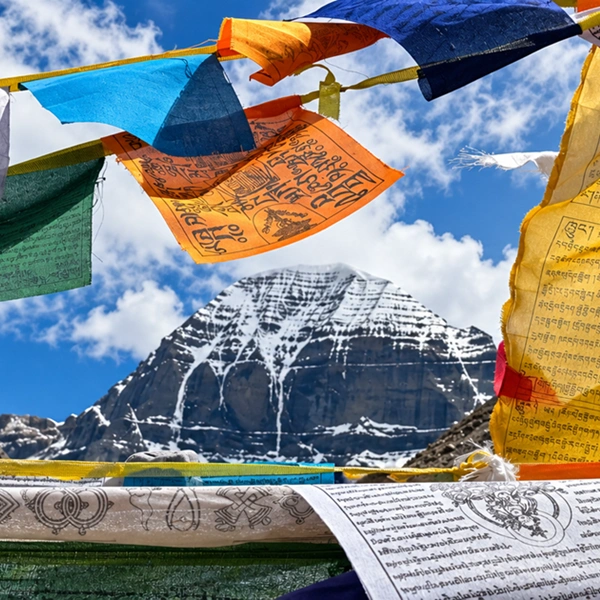
There is a particular place on the western Tibetan plateau where four religions, four major rivers, and several thousand years of continuous pilgrimage tradition all converge on a single mountain and a single lake. Mount Kailash stands at 6,638 meters in the Gangdise range of western Tibet, distinctive among Himalayan peaks for its symmetrical four-sided shape and the dramatic vertical bands of dark rock that run down its sides.
Lake Mansarovar sits at 4,590 meters just south of Kailash, the highest freshwater lake of its size on the planet, a circular body of water roughly 320 square kilometers in area surrounded by an alpine plateau and distant snow peaks. The two are paired in every tradition that holds them sacred.
They are paired in geography because they sit within a single afternoon's walk of each other. They are paired in pilgrimage practice because no traditional journey to the region is considered complete without the parikrama of the mountain and the immersion or circumambulation of the lake. And they are paired in the cultural imagination of nearly a billion people across four faiths because the practice that links them is older than any of the religions that now claim them.
This piece explains who holds them sacred and why, with proper attention to the geography that makes the area unique, the four religious traditions that converge on it, the parikrama practice that all four traditions share in different forms, the seasonal observances that draw the greatest pilgrim numbers, and what travelers contemplating the pilgrimage need to read and consider before they go.
The aim is the cultural and informational depth this place deserves — not a logistics blog or a marketing piece, but the kind of background reading that properly prepares someone for a destination where the encounter matters.
"Mount Kailash is the only mountain on earth that is held sacred by four distinct living religions. The convergence is not coincidental."
The Geography — A Singular Place
Before the mythology, the geography. Kailash and Mansarovar sit together in the Ngari prefecture of western Tibet at the western end of the Trans-Himalaya, in the rain-shadow zone north of the main Himalayan range. The combination of altitude, latitude, geological structure, and hydrological position produces a place that is genuinely without parallel.
The Mountain
Mount Kailash rises to 6,638 meters in the Gangdise range. The peak is not part of the main Himalayan ridge — it sits on the Tibetan plateau north of the high Himalaya, where the average plateau elevation is already 4,500 to 5,000 metres. From the plateau, the mountain rises a further 2,000 meters in dramatic isolation, separated from any neighboring peak by deep valleys on all four sides.
The face profile is unusually symmetrical — four nearly-equal sides of dark rock with distinctive vertical bands that look from a distance as though they have been deliberately carved into the mountain. The summit holds a permanent snow and ice cap that takes the form of a flattened dome rather than a peaked summit.
The mountain has never been climbed and, by the agreement of all four faiths that hold it sacred, plus the Chinese government that administers the region, it will not be. The mountain is closed to mountaineering, and the prohibition is observed.
The Lake
Lake Mansarovar sits at 4,590 meters, approximately 35 kilometers south of Kailash. The lake is roughly circular, with a surface area of around 320 square kilometers, and reaches a maximum depth of approximately 90 meters. The color of the water shifts throughout the day, from turquoise in the morning to deep blue in the afternoon to an almost-black mirror at sunset. The lake is fed by glacial streams from the surrounding mountains and is one of the highest freshwater lakes of its size in the world.
Mansarovar is the spiritual mother-lake of multiple traditions, and the act of immersion in its waters (or, in colder months, when immersion is impractical, touching the water and applying a few drops to the head) is a core element of the pilgrimage.
The Companion Lake
Immediately west of Mansarovar sits a second lake — Rakshastal or Ravan Tal — separated from Mansarovar by a narrow strip of land. The two lakes are paired in geography, but they are presented as opposites in the religious tradition. Mansarovar is the lake of the divine, the lake of pure, clear blue water, the lake associated with the gods.
Rakshastal is the lake of the demonic, the lake of darker water with no visible fish or wildlife, the lake associated with Ravana in Hindu tradition. The geological reality is more prosaic — Rakshastal is a salt lake, and Mansarovar is a freshwater lake, which accounts for the differences in their biological and visual characteristics. But the mythological pairing of paradise and its shadow, side by side, has resonated across the four faiths in different forms for millennia.
The Source of Four Rivers
The most extraordinary geographical fact about the Kailash and Mansarovar region is that four of Asia's great rivers all originate from this single area. The hydrology is not symbolic — the headwaters of four major rivers, each of which has profoundly shaped the human civilizations downstream, all emerge within roughly 100 kilometers of Mount Kailash.
|
River
|
Direction of Flow
|
Civilizations It Shaped
|
Sea It Reaches
|
|
Indus
|
North-west
|
Indus Valley, Punjab, Sindh
|
Arabian Sea
|
|
Sutlej
|
West
|
Punjab plains
|
Joins Indus
|
|
Brahmaputra
|
East then south
|
Tibet, Assam, Bengal
|
Bay of Bengal
|
|
Karnali (Ganges)
|
South
|
Nepal, North India, Bangladesh
|
Bay of Bengal
|
Consider what this means at the level of human civilization. Four rivers, each rising from the slopes of a single 6,638-meter mountain in the rain-shadow of the Himalaya, flow in four different directions to nourish the agricultural plains that have supported a quarter of humanity for several thousand years. The Indus civilization flourished on the Indus water.
The Vedic civilization drank Sutlej water. The Brahmaputra fed the rice cultures of Assam and Bengal. The Ganges fed the Hindu heartland of northern India. From a single point in the western Tibetan plateau, the water that has shaped the largest agricultural civilizations of the Asian continent originates.
The four-rivers geography is the literal foundation of the later mythological framing. The faith traditions that hold Kailash sacred did not invent the four-rivers significance to support their mythology — they observed the four-rivers geography and developed mythological frameworks that explained why a single mountain should be the source of all the great rivers of their world. The mythology followed the geography rather than preceding it.
"From a single point in the western Tibetan plateau, the water that has shaped the largest agricultural civilisations of the Asian continent originates."
The Four Faiths
Mount Kailash is the only mountain on earth that holds primary sacred status in four distinct living religions. The four faiths approach the mountain through different mythological frameworks but the underlying recognition is shared — this place is exceptional, the mountain is the axis of the world, and the parikrama practice connects the pilgrim to something beyond the ordinary topography of the planet.
Hinduism — The Abode of Shiva
In Hindu tradition, Mount Kailash is the earthly home of Lord Shiva, the destroyer and transformer in the Hindu trinity, and his consort Parvati. The mountain is conceived as the central axis of the cosmos — the Meru of cosmological description in many Puranic texts is identified with or symbolically equated to Kailash.
The two are not quite identical in every text, but the conflation is widespread enough that for most Hindu pilgrims the mountain is the actual rather than the metaphorical home of Shiva. The traditional Hindu parikrama is performed clockwise, which is the direction of dharma and of the sun.
The full circumambulation is approximately 52 kilometers and is traditionally completed in three days. The most demanding section is the crossing of the Drolma La pass at approximately 5,630 meters on the second day. The Hindu pilgrimage tradition associated with Kailash is ancient, with references in the Mahabharata, the Skanda Purana, and other early texts. In this tradition, Mansarovar is the lake created by the mind of Lord Brahma — the name Mana-sarovar means 'lake of the mind' in Sanskrit — and the immersion or ritual touch of the lake water is a core element of the pilgrimage.
Buddhism — Mount Meru and Demchok
In Buddhist tradition, particularly Tibetan Buddhism, Mount Kailash is identified with Mount Meru of Buddhist cosmology and is the abode of Demchok (Sanskrit: Chakrasamvara) — a meditational deity central to several Vajrayana lineages and tantric practices. The Buddhist parikrama is also performed clockwise, though for the Bon practitioners (see below), the direction reverses.
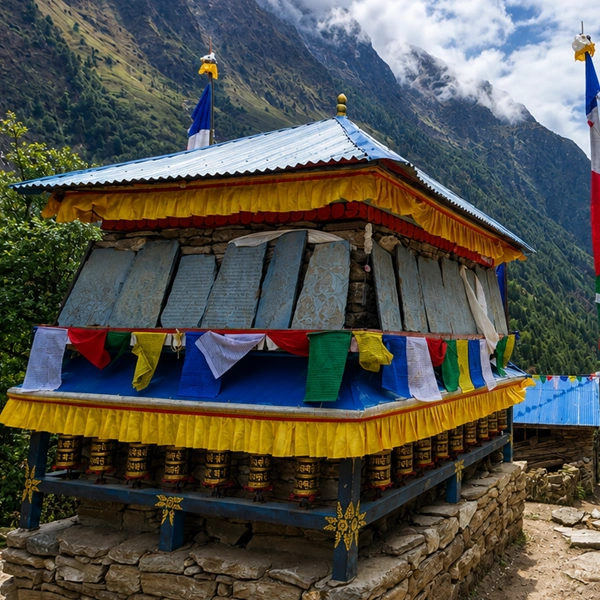
The Buddhist tradition is geographically dominant in the Kailash region because most of the resident pilgrim infrastructure, the monasteries along the parikrama route, and the local cultural texture are Tibetan Buddhist rather than Hindu. The five monasteries along the parikrama trail — Chuku, Drira Phuk, Zutul Phuk, Selung, and Gyangdrak — are all Tibetan Buddhist establishments.
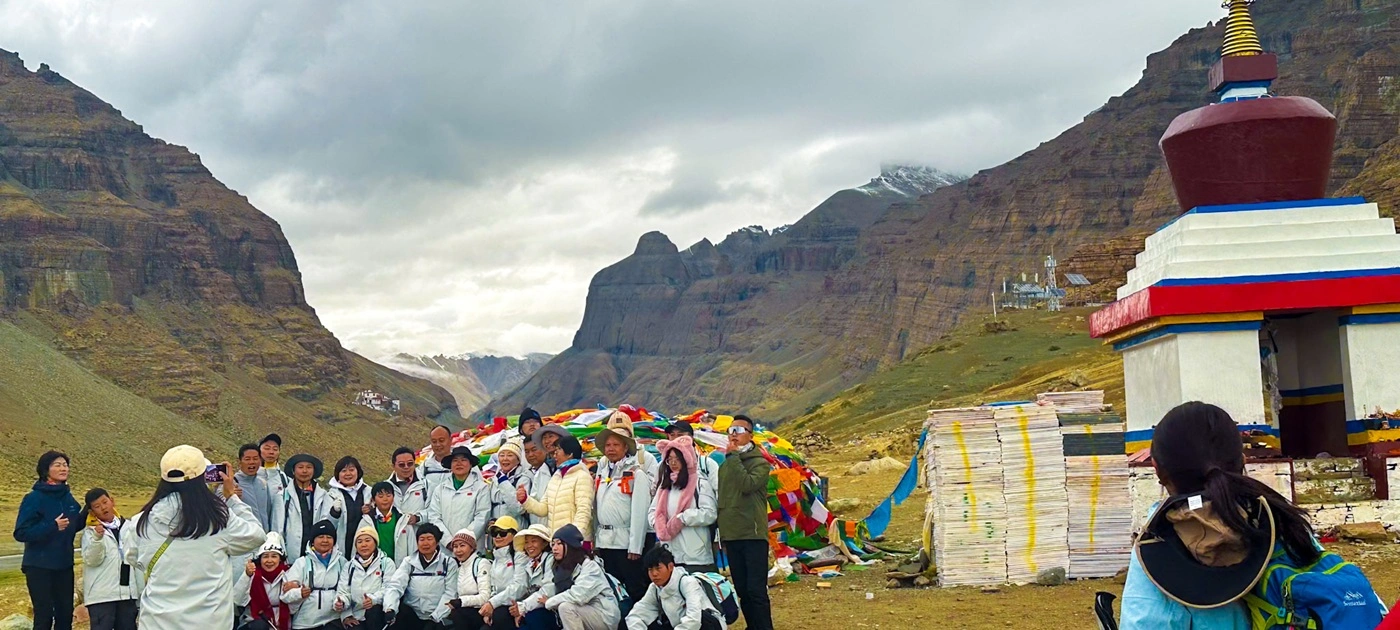
In Buddhist tradition, the mountain holds particular significance during the Saga Dawa festival in May or June, which commemorates the birth, enlightenment, and parinirvana of the Buddha, all on the same lunar date. The tarboche prayer-flag pole near Drira Phuk is ceremonially replaced each year during Saga Dawa, and the pilgrimage activity around the mountain peaks during this period.
Jainism — The Place of Rishabhanatha's Liberation
In the Jain tradition, Mount Kailash is identified with Mount Ashtapada, the site where the first Tirthankara, Rishabhanatha (also called Adinatha), attained moksha — the final liberation from the cycle of birth and death. Jain texts give the eight-stepped sacred mountain a specific place in the Jain cosmological geography, and the identification of Ashtapada with Kailash is held in most Jain traditions.
The Jain pilgrimage to Kailash is significantly smaller in number than the Hindu and Buddhist traditions because the resident Jain population is concentrated in western India, and the journey to western Tibet is operationally demanding, yet the religious significance is no less serious for the practitioners who undertake it.
The Jain parikrama follows the same physical route as the Hindu and Buddhist circuits, but the contemplative framework is distinctively Jain — meditation on the eight stages of liberation, observance of the Jain principles of non-violence in the mountain context, and the connection to the foundational figure of Rishabhanatha rather than to Shiva or Demchok.
Bon — The Soul-Mountain of the Indigenous Tradition
Bon is the indigenous pre-Buddhist religious tradition of Tibet — older than the Buddhist transmission that reached the plateau in the seventh and eighth centuries CE, and still practiced today by a meaningful Bon minority population, particularly in the western Tibetan and Himalayan border regions.
In Bon tradition, Mount Kailash is Yungdrung Gutseg — the Nine-Stacked Swastika Mountain — and the place where the founder of Bon, Tonpa Shenrab Miwoche, is said to have descended from the heavens to teach. The Bon tradition's relationship to Kailash predates the Hindu, Buddhist, and Jain traditions' relationship to the mountain by an uncertain but probably substantial number of centuries.
The Bon parikrama is performed counter-clockwise — the opposite direction from the three other traditions — which reflects the deeper Bon ritual framework that distinguishes the indigenous tradition from the later Buddhist transmission. Bon pilgrims sometimes encounter Buddhist pilgrims traveling in the opposite direction along the same trail; these encounters are observed with mutual respect and are among the distinctive cultural textures of the parikrama experience.
"Four religions, three directions of circumambulation, one mountain. The parikrama itself is the only thing they all share — and the direction they walk it tells you which tradition they hold."
The Parikrama — The Practice That All Four Share
The act that all four faiths share, and the practice that links the pilgrim to Kailash in a way that contemplation alone does not, is the parikrama — the ritual circumambulation of the mountain. The practice predates the religious framing in any of the four faiths that now incorporate it.
It is the residue of a much older Asian sacred geography in which the act of walking around a holy site, on foot, in the prescribed direction, with the right intention, is itself the religious act. Reading about Kailash is not parikrama. Photographing Kailash is not parikrama. Flying over Kailash is not parikrama. The practice requires the feet on the ground, the body in the cold, the breath in the thin air at 5,000 meters, and the three days that the route requires.
The Route
The parikrama route is approximately 52 kilometers long and is traditionally completed over three days, though some particularly determined pilgrims complete it in a single day, and others take longer, with rest days at the monasteries. The route starts and ends at Darchen, the small Tibetan town at the southern base of the mountain that serves as the operational hub for all Kailash pilgrimages.
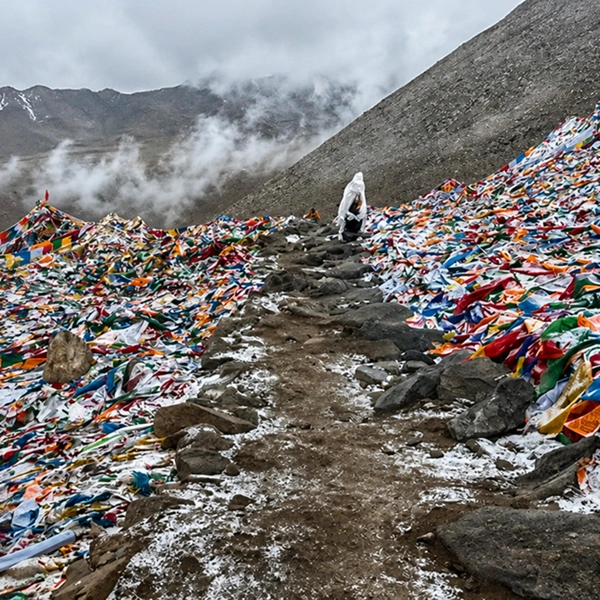
Day one runs from Darchen along the western side of the mountain to Drira Phuk monastery, where most pilgrims spend the first night. Day two is the demanding day — the crossing of the Drolma La pass at approximately 5,630 meters, the highest point of the entire parikrama, and the point at which the spiritual significance of the journey is concentrated in the tradition.
After Drolma La, the route descends to Zutul Phuk monastery for the second night. Day three closes the circuit back to Darchen along the southern face of the mountain.
Drolma La — The Heart of the Journey
Drolma La, at approximately 5,630 meters, is higher than the route's altitude high point. In all four religious traditions, the pass is conceived as the threshold between the ordinary world and the sacred space of the mountain. The Buddhist tradition holds that crossing Drolma La purifies the pilgrim of the karma of one lifetime.
The Hindu tradition holds that the pass is the place where Shiva grants darshan to the prepared pilgrim. The Jain tradition associates the pass with the spiritual ascent that mirrors Rishabhanatha's eight-stage path to liberation. The Bon tradition holds the pass to be the highest point in the Yungdrung sacred geography of the mountain itself.
The physical experience of crossing the pass — the pre-dawn departure, the altitude, the cold, the prayer-flag-draped summit, the descent to Zutul Phuk on the other side — produces something that no other section of the parikrama produces. Most pilgrims who have completed the parikrama describe the Drolma La crossing as the experience that distinguishes the journey.
The Inner Kora
Beyond the standard outer parikrama, there exists an inner circumambulation route — the Inner Kora — that takes the pilgrim closer to the south face of Kailash and to the Selung monastery on the slopes of the mountain itself. The Inner Kora is traditionally restricted to pilgrims who have completed the outer parikrama at least 12 times — a figure that varies slightly by tradition.
The route is shorter than the outer parikrama but more demanding in terms of altitude and terrain. The Inner Kora is rarely walked by non-resident pilgrims, and the cultural protocol around it is strict. We do not arrange Inner Kora access on our pilgrimage packages, and we do not encourage travelers to seek it. The outer parikrama is the appropriate practice for the overwhelming majority of pilgrims and for all travelers approaching the mountain through the operator route.
Lake Mansarovar — The Mother-Lake
If Kailash is the father-mountain in the cosmology of the region, Mansarovar is the mother-lake. The lake is the necessary complement to the mountain in every tradition that holds the area sacred, and the pilgrimage to Kailash is considered incomplete without the corresponding practice at Mansarovar.
The Hindu Tradition at Mansarovar
In Hindu tradition, Mansarovar is the lake created by the mind of Lord Brahma — the name Manasa-sarovar literally translates as 'lake of the mind' or 'lake from consciousness.' The lake is considered to wash away the sins of accumulated lifetimes for the pilgrim who bathes in its waters or, in the colder months when full immersion is impractical, who touches the water and applies the consecrated drops to the head.
Hindu pilgrims complete the lake parikrama (a circumambulation of the lake, approximately 100 kilometers) and bathe in the lake water as core elements of the journey. The lake is associated with the swans that traditionally arrive in summer and depart in winter — the hamsa in Sanskrit, a symbol of the discriminating consciousness that distinguishes the eternal from the impermanent.
The Buddhist Tradition at Mansarovar
In Buddhist tradition, Mansarovar is associated with the lake from which the mother of the Buddha bathed before his birth. The lake is one of the eight sacred lakes in the Buddhist tradition, and circumambulation, offerings, and the ritual touch of the water are core elements of the Buddhist pilgrimage. The eight chortens placed at the cardinal directions around the lake mark the traditional Buddhist parikrama route.
The Jain and Bon Traditions at Mansarovar
In the Jain tradition, Mansarovar is associated with the bathing place of Rishabhanatha after his attainment of moksha at Ashtapada. In Bon tradition, the lake is one of the sacred-water sites of the indigenous Tibetan geography and is associated with specific Bon ritual practices and seasonal observances.
The convergence of all four traditions at the lake — like the convergence at the mountain itself — produces a place where multiple sacred frameworks coexist without conflict, and where the parikrama, the ritual touch of the water, and the contemplation that follows are practices shared across the traditions, even as the specific framings differ.
The Major Observances
Two annual observances draw the largest numbers of pilgrims to Kailash and Mansarovar — Saga Dawa in May or June, and the broader Hindu yatra season from May through September. Travelers contemplating the pilgrimage should understand the seasonal rhythm, as both spiritual concentration and operational logistics vary significantly throughout the year.
Saga Dawa — The Buddhist Festival of the Buddha's Life
Saga Dawa is the most important Buddhist observance of the year and is observed across all the Tibetan Buddhist communities. The festival commemorates the birth, the enlightenment, and the parinirvana of the Buddha — all three events traditionally held to have occurred on the same full-moon day in the fourth lunar month of the Tibetan calendar. The date varies by year in the Western calendar but typically falls in May or early June.
At Kailash, the Saga Dawa observance includes the ceremonial replacement of the tarboche prayer-flag pole at Tarboche flat near Drira Phuk monastery — the old pole is taken down, new prayer flags are attached, and the renewed pole is raised in a ceremony attended by thousands of pilgrims who time their parikrama to coincide with the festival. The Saga Dawa days are the spiritual high point of the Kailash year in the Buddhist tradition, and the period draws the largest single concentration of pilgrims to the mountain.
The Hindu Yatra Season
The Hindu pilgrimage season runs roughly from May through September. Indian government-organized Kailash Mansarovar Yatra programs operate during this window, and the route from India via Nepal or the Chinese-Tibetan border becomes operationally active. The most spiritually significant period in the Hindu tradition is the month of Shravan (typically July or August in the Western calendar), which is sacred to Shiva and when pilgrims concentrate.
Off-Season Reality
From October through April, the region is largely closed to non-resident pilgrimage. The high passes are snow-blocked, Tibetan border crossings reduce operations, and the operational infrastructure supporting pilgrim activity in the summer season is dismantled or scaled back. Travelers planning to visit Kailash and Mansarovar should plan around the May through September window.
Practical Reality for the Traveler
This is an informational piece rather than an operational one, but a brief operational summary helps travelers transition from cultural research to trip planning if the pilgrimage interests them.
Access
Mount Kailash and Lake Mansarovar are located in the Tibet Autonomous Region of China. Foreign travelers require a Tibet Travel Permit, an Alien's Travel Permit, and a Tibet Tourism Bureau permit specifically for the Ngari Prefecture, where Kailash is located. All permits must be arranged through a registered Tibet operator, and the process takes several weeks.
Direct flight access to Lhasa is followed by either a multi-day overland drive across the Tibetan plateau (the dominant route, approximately four to six days from Lhasa to Darchen) or a domestic flight to Ngari Gunsa airport with a shorter onward drive. Most luxury Kailash pilgrimage operators use the overland route because the gradual altitude gain across the plateau drives acclimatization in ways that a direct flight does not.
Altitude
The Kailash and Mansarovar region operates entirely above 4,500 meters, and the parikrama crosses Drolma La at approximately 5,630 meters. This altitude profile is significantly more demanding than the standard Tibet cultural tour and requires proper acclimatization, fitness preparation, and altitude awareness.
Most pilgrimage operators build five to seven days of plateau driving and acclimatization before the parikrama begins. Travelers contemplating Kailash should expect altitude exposure comparable to or exceeding that of the major Himalayan treks.
The Question of Difficulty
The parikrama is physically demanding without being technically challenging. Three days of walking at altitudes between 4,600 and 5,630 meters, in cold weather, over uneven trail, with limited accommodation at the monasteries and significant exposure on the Drolma La crossing day.
Pilgrims with good general fitness and proper preparation complete the parikrama. Pilgrims without preparation or with significant pre-existing health conditions sometimes do not complete it and use the available alternative options — yak or horse support for the harder sections, helicopter to the trailheads where it can be arranged for the appropriate pilgrim profile, or the abbreviated darshan-without-parikrama option for elderly or health-limited pilgrims who wish to receive the sight of the mountain without the full circumambulation.
Why This Place — A Concluding Reflection
Mount Kailash and Lake Mansarovar are extraordinary in every respect. They are extraordinary geologically — a single mountain in dramatic isolation rising above the Tibetan plateau, with the symmetrical four-sided profile and the vertical rock bands that produce a face unlike any other peak in the Himalayan range. They are extraordinary hydrologically — the genuine source point of four of the great rivers of Asia, the geographical hub of the agricultural civilizations that grew along those rivers downstream.
They are extraordinary religiously — the only mountain on the planet that holds primary sacred status in four distinct living religious traditions, and the only sacred mountain where pilgrims from those four traditions encounter each other on the same parikrama trail.
They are extraordinary culturally — a continuous sacred geography that pre-dates any of the religions that now claim it, a parikrama practice that links pilgrims across faith lines, and a residue of an older Asian sacred geography that has survived the religious revolutions of three thousand years.
The convergence of all these elements — geological, hydrological, religious, cultural — produces something that travelers describe in language they do not use about other places. The pilgrimage is not for everyone. The altitude alone excludes some travelers, the operational complexity excludes others, and the religious framing is genuinely strange to travelers without the cultural background to receive it.
But for travelers who can approach the mountain with cultural preparation, who can accept the parikrama as a practice rather than a tourist experience, and who can be rewarded by the place, the encounter with Mount Kailash and Lake Mansarovar is among the most significant journeys available to a modern traveler. We arrange the Kailash pilgrimage for clients who have completed the cultural reading, prepared for altitude, and come to the mountain with the intention the place deserves.
"The pilgrimage is not for everyone. But for travellers who approach the mountain with the cultural preparation that the place rewards, the encounter with Kailash and Mansarovar is among the most significant journeys available."
Further Reading
For travelers wanting a deeper cultural background before the journey, several works repay study.
- Charles Allen's A Mountain in Tibet — a readable narrative history of European encounters with the Kailash region from the early survey period onward
- Lama Anagarika Govinda's The Way of the White Clouds — a classic spiritual travel account from a German Buddhist scholar's encounters with western Tibet and Kailash in the early twentieth century
- Snelling's The Sacred Mountain — a comprehensive scholarly treatment of the religious significance of Kailash across the four traditions
- Robert Thurman and Tad Wise's Circling the Sacred Mountain — a Buddhist-perspective pilgrimage memoir
- Swami Pranavananda's Exploration in Tibet — the early twentieth-century Indian sannyasi-explorer's careful documentation of the geography and the river sources, written from sustained residence at the mountain
Frequently Asked Questions
Why is Mount Kailash sacred to four religions?
The mountain's exceptional geological character — symmetrical four-sided shape, dramatic isolation rising 2,000 meters above the Tibetan plateau, and the unusual vertical rock bands that mark its faces — combined with its position as the source point of four major Asian rivers, produced a place that multiple religious traditions independently recognized as exceptional.
The four-faith status reflects parallel rather than borrowed recognition. The Bon tradition's relationship to the mountain predates those of the Hindu, Buddhist, and Jain traditions. The Hindu, Buddhist, and Jain traditions each developed their own mythological frameworks for Kailash within their broader cosmological systems. The convergence at a single mountain across four distinct living religions is genuinely unusual and is part of what makes the place culturally singular.
Has Mount Kailash been climbed?
No, and by agreement of all four faiths that hold it sacred, plus the Chinese government that administers the region, it will not be. The mountain is closed to mountaineering. Several major expeditions have considered Kailash over the past century, but in each case, the mountain's religious significance and prohibitions by the resident traditions have led to the expeditions being withdrawn or permission being denied.
Reinhold Messner — arguably the most accomplished Himalayan mountaineer of the twentieth century — refused a climbing permission offered to him by the Chinese authorities specifically out of respect for the religious significance of the mountain. The unclimbed status is observed.
What is the parikrama, and why does it matter?
Parikrama is the ritual circumambulation of a sacred site — most often a mountain, a temple, or a lake. At Kailash, the practice consists of walking the approximately 52-kilometer route around the base of the mountain over three days, crossing the high Drolma La pass at approximately 5,630 meters on the second day.
The practice matters because it is the act that all four faith traditions share, even as they differ on the mythological framing. Reading about Kailash, photographing Kailash, and contemplating Kailash from a distance are not parikrama. The practice requires the body in the cold, the feet on the ground, the breath in the thin air. It is the practice that the place itself rewards rather than a practice that any single tradition invented.
Why do Bon pilgrims walk in the opposite direction?
Bon is the indigenous pre-Buddhist religious tradition of Tibet, and the Bon ritual framework distinguishes itself from the later Buddhist transmission in several specific ways, including the direction of circumambulation. Hindu, Buddhist, and Jain parikrama at Kailash is performed clockwise — the direction of the sun and of dharma in those traditions.
Bon parikrama is performed counter-clockwise, reflecting the deeper Bon ritual structure that pre-dates the conventions of the later religions. Pilgrims from the four traditions encounter one another while walking in opposite directions on the same trail, and the encounter is observed with mutual respect. The counter-direction is one of the markers that identifies the Bon practitioner to other pilgrims on the route.
Is Lake Mansarovar the same as Mount Kailash?
No — they are paired but distinct. Mount Kailash is the 6,638-metre sacred mountain. Lake Mansarovar is a 4,590-meter sacred freshwater lake approximately 35 kilometers south of the mountain. The two are paired in every tradition that holds them sacred — the parikrama of the mountain and the immersion or circumambulation of the lake are considered complementary practices.
A complete pilgrimage to the region includes both. The mountain is conceived as the father-element in the region's cosmology, and the lake as the mother-element; the journey to one without the other is considered incomplete in the religious frameworks of all four traditions.
When is the best time to visit?
The operational season runs from May through September. Late May to mid-June (around Saga Dawa) is the spiritual high point of the Buddhist year and draws the largest single concentration of pilgrim numbers. The Hindu yatra season concentrates in July and August, with Shravan as the most spiritually significant month in the Hindu calendar. June and September typically produce the most stable weather for the parikrama crossing. Winter and early spring are not operationally feasible because of snow on the high passes and the closure of supporting infrastructure.
Do I have to be religious to do the parikrama?
No. The mountain receives travelers from many backgrounds, and the parikrama is open to anyone prepared for the altitude and the duration. The cultural and religious significance of the place is real, and the parikrama is more rewarding for travelers who approach it with cultural preparation, but a specific faith commitment is not required.
We arrange Kailash pilgrimages for clients across the spectrum, from devout Hindu and Buddhist practitioners to secular travelers drawn to the place by its exceptional geography and culture. The shared element across all these traveler profiles is the willingness to approach the mountain seriously rather than as a tourist destination.
How does the pilgrimage compare to other Tibet trips?
The Kailash pilgrimage is significantly more demanding than the standard Lhasa cultural tour or the Everest-from-the-north-side trips. The cumulative altitude exposure is greater, the duration is longer, the parikrama itself is a serious three-day high-altitude walk, and the operational complexity is meaningfully higher because of the Ngari permit requirements and the multi-day plateau drive from Lhasa.
Travelers considering Kailash who have not previously done a major Tibet trip should start with a Lhasa-based cultural tour or a Lhasa-to-Everest-north-side trip first, both to acclimatize to the altitude profile of the Tibetan plateau and to develop the cultural familiarity that makes the Kailash experience deeper.
Can elderly or health-limited pilgrims still visit?
Yes, with appropriate options. Pilgrims who cannot complete the full parikrama on foot have several alternatives — yak or horse support for the harder sections of the parikrama trail, helicopter access to the trailheads where it can be arranged for the appropriate pilgrim profile (limited and not always available), and the abbreviated darshan-without-parikrama option for pilgrims who wish to receive the sight of the mountain and complete the lake practice at Mansarovar without the full circumambulation.
We discuss the appropriate option for each pilgrim profile at the booking stage. The mountain is generous to pilgrims who come with the right intention, even when the full parikrama is not operationally possible for them.
Plan Your Kailash and Mansarovar Pilgrimage With Us
Tell us your tradition (or whether you come as a secular traveler drawn to the place), your prior altitude experience, your preferred season, and any cultural reading you have already done. Our team returns a written proposal within 48 hours covering the route, the acclimatization pacing across the plateau drive, the parikrama plan, and the cultural briefing that prepares you properly for one of the most significant journeys available to a modern traveler. We arrange this pilgrimage carefully and only for travelers who come to the mountain with the right intention.