The Complete Guide to the Center of the Universe
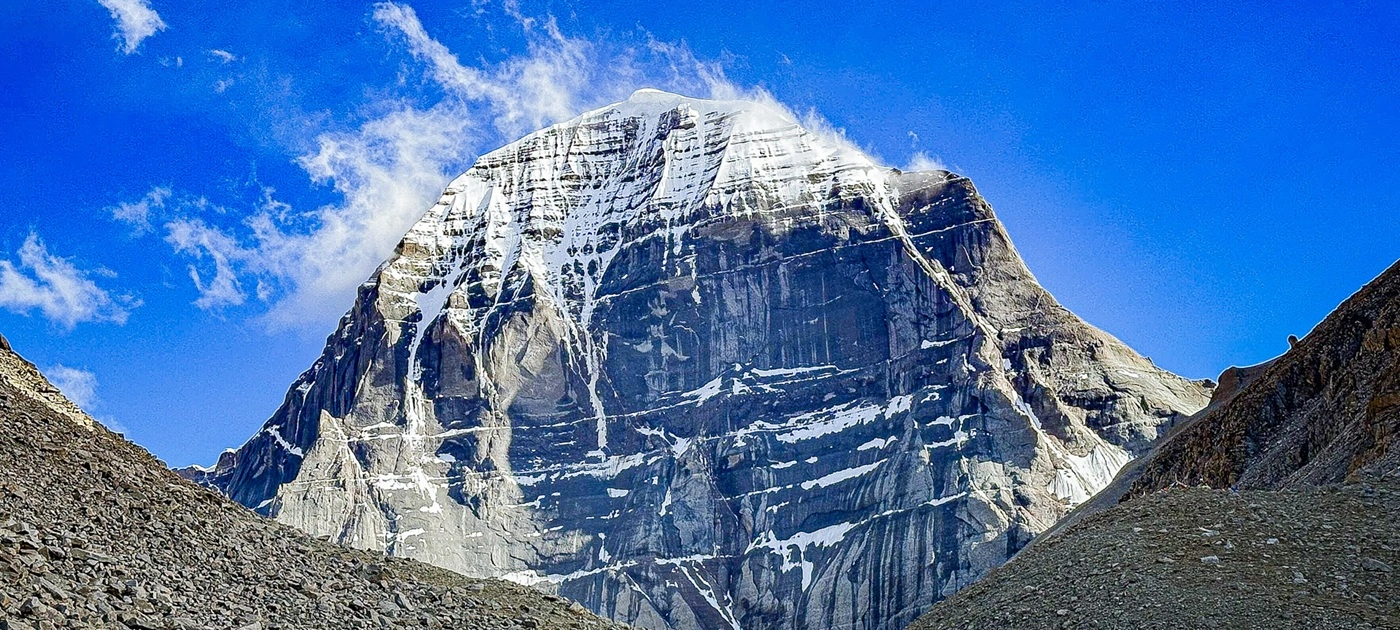
This is the mountain that four religions independently concluded is the center of the universe. The geology supports the claim more than you might expect: four rivers flowing in four cardinal directions from a single 60-kilometer source area, each named after a mythical animal, each sustaining hundreds of millions of lives.
The theology layers on top: Shiva meditating at the summit, Chakrasamvara’s mandala palace, Rishabhdev’s crystal temple, and the Bon founder descending from heaven. The result is the most multiply-sacred peak on earth.
In This Guide
- Geology: What created this mountain
- The four rivers: Asia’s cosmic water tower
- Four religions, one peak
- The legends: Milarepa, Ravana, and the Pandavas
- The Kora: day by day around the mountain
- The explorers: spies, monks, and mystics
- 2026: the Fire Horse Year and Saga Dawa
- Frequently asked questions
What Created This Mountain
Mount Kailash sits in the Gangdise Shan range of the Trans-Himalayas, formed by the collision of the Indian and Eurasian plates. The Kailash flysch zone extends 20 kilometers outward, alternating peridotites, sandy shales, and dolomites.
The mountain itself is composed of immensely thick conglomerate rock on a granite base, with the conglomerate extending from 4,700 meters to the summit. This geological composition gives the mountain its distinctive sheer, striated faces that catch the high-altitude light in ways that have inspired theological awe for millennia.
The symmetry is striking. Four near-perfect faces aligned with the four cardinal directions. Two lakes at the southern base: Mansarovar (freshwater, round, turquoise) and Rakshastal (saltwater, crescent, dark). The mountain as the masculine lingam. The lake is the feminine yoni. The geological reality maps onto the theological claim with uncanny precision.
The Four Rivers: Asia’s Cosmic Water Tower
Four of Asia’s greatest river systems originate within a 60-kilometer stretch of the Gangdise Mountains around Kailash. Tibetan Buddhism assigns each river a mythical animal and a meditation Buddha family.
|
River
|
Tibetan Name
|
Animal
|
Direction
|
Buddha Family
|
|
Indus
|
Senge Tsangpo
|
Lion
|
North
|
Amoghasiddhi
|
|
Sutlej
|
Langchen Tsangpo
|
Elephant
|
West
|
Ratnasambhava
|
|
Brahmaputra
|
Yarlung Tsangpo
|
Horse
|
East
|
Akshobhya
|
|
Karnali
|
Mapcha Tsangpo
|
Peacock
|
South
|
Amitabha
|
Four rivers. Four directions. Four animals. Over a billion people downstream. In the 2026 Fire Horse Year, the Brahmaputra — the Horse River — carries special significance. Pilgrimages during the Horse Year yield thirteen times the standard merit.
Four Religions, One Peak
Hinduism: Shiva’s Eternal Abode
Mount Kailash is the earthly manifestation of Mount Meru — the cosmic pillar at the center of all universes. Lord Shiva resides in perpetual meditation at the summit alongside Goddess Parvati. The mountain is a living Shiva lingam with four faces of crystal, ruby, gold, and lapis lazuli.
The Ganges touches earth here, flowing through Shiva’s matted hair. Kubera, the god of wealth, dwells in the nearby Alaka. Completing one clockwise Kora cleanses a lifetime of karma. Completing 108 guarantees liberation.
Buddhism: The Living Mandala
Tibetan Buddhists call it Kang Rinpoche — Precious Snow Mountain. It is the palace of Chakrasamvara (Demchok), a wrathful deity who represents supreme bliss in union with his consort, Vajravarahi. The mountain is father. Lake Mansarovar is the mother. Guru Rinpoche (Padmasambhava) hid secret scriptures along the pilgrimage routes and meditated in a cave on the northwest shore of the lakes.
Jainism: Ashtapad
Ashtapad — the eight-stepped mountain. The exact site where Rishabhdev, the first Tirthankara, achieved nirvana. His son, King Bharat, built a crystal palace on the summit, with 24 gemstone Tirthankara idols. The eight steps represent the eight categories of karma that must be destroyed for liberation.
Bon: The Nine-Story Swastika
Yungdrung Gutseg. The original spiritual center of the Zhang Zhung empire. Where Tonpa Shenrab descended from heaven. Seat of Sipaimen, the Sky Goddess. On the southern face, geological striations form a natural swastika when snow fills the cracks. Bon practitioners circumambulate counter-clockwise.
The Legends That Shaped the Mountain
Milarepa vs Naro Bonchung
The 11th-century Buddhist yogi Milarepa and the Bon shaman Naro Bonchung contested for spiritual dominion over the mountain. After matching each other in miraculous feats across the shores of Mansarovar, they agreed to a final race to the summit.
Naro Bonchung flew upward on his shamanic drum. Milarepa sat in meditation. At the first ray of dawn, he rode a beam of sunlight to the peak. The victory, recorded in the 1488 biography Mila Namthar, established Buddhism as the dominant spiritual force on the Tibetan plateau.
Ravana Lifts the Mountain
The demon king Ravana, intoxicated by power, thrust his twenty arms under Mount Kailash and tried to uproot it. Shiva pressed it back with his toe. Ravana was trapped for a thousand years. In agony, he composed the Shiva Tandava Stotram. The scene is carved at Ellora, the Hoysala temples, and Banteay Srei in Cambodia.
The Pandavas’ Final Journey
In the Mahabharata’s Mahaprasthanika Parva, the five Pandava brothers and Draupadi renounce their kingdom and walk into the Himalayas toward Mount Meru. One by one, Draupadi and her four brothers fall along the freezing slopes.
Only Yudhishthira, who refuses to abandon a stray dog, reaches the summit. The dog reveals itself as Dharma incarnate. The geographic descriptions in the epic — lakes, rivers, precious gems — align with the Kailash-Mansarovar region.
The Kora: Three Days Around the Mountain
|
Day
|
Start
|
End
|
Km
|
Elevation
|
Sacred Sites
|
|
1
|
Darchen 4,575m
|
Dirapuk 4,900m
|
~20
|
+325m
|
Yam Dwar, Tarboche, North Face
|
|
2
|
Dirapuk 4,900m
|
Zutulpuk 4,790m
|
~22
|
+736/-846m
|
Dolma La 5,636m, Gauri Kund
|
|
3
|
Zutulpuk 4,790m
|
Darchen 4,575m
|
~12
|
-215m
|
Milarepa’s Cave, Darchen Plains
|
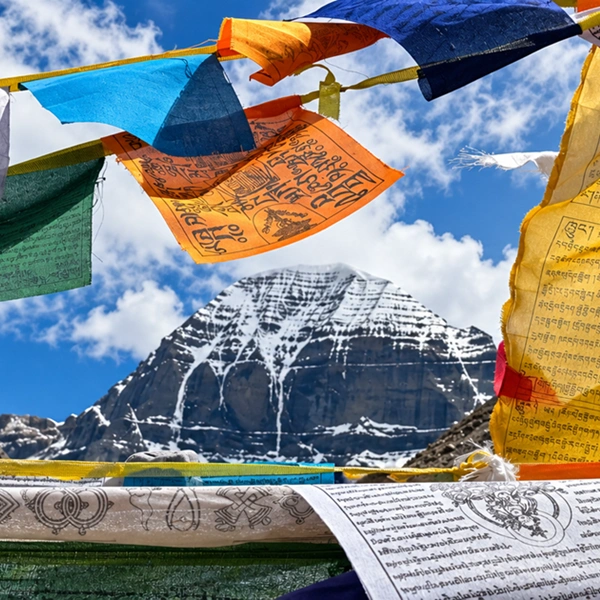
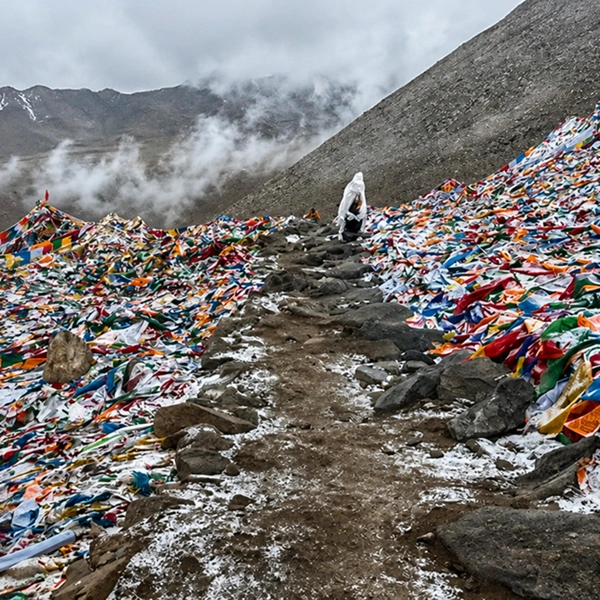
Day 2 is the crucible. A 600-meter climb to 5,636 meters. At the summit of Dolma La, pilgrims leave old clothing and locks of hair — symbolizing the total relinquishment of past karma. The pass is buried in prayer flags.
Buddhist pilgrims sing Nyelu songs: originally sung by the marginalized, they have become anthems of fraternity among all pilgrims enduring the altitude, regardless of faith or origin. Below the pass: Gauri Kund, a turquoise glacial lake at 5,600 meters, where Parvati bathed and created Ganesha.
The Explorers: Spies, Monks, and Mystics
For centuries, Kailash was mapped by indigenous spies. The British Empire’s “Pundits” — Nain Singh Rawat, Kishen Singh, Sarat Chandra Das — used hidden compasses and prayer beads to count strides. In 1900, the Japanese monk Ekai Kawaguchi crossed the Himalayas disguised, providing the first non-Tibetan academic documentation of the mountain in his 1909 text Three Years in Tibet. He described it as a “natural mandala” and the “mansion of a Buddha.”
In the 19th century, Sri Trailanga Swami — the “Walking Shiva of Varanasi,” reported to have lived 280 years — spent extended periods in freezing meditation near Kailash. He later descended to perform miracles so extraordinary that when Sri Ramakrishna asked who he was, the Swami answered simply: “The same as you.”
2026: The Fire Horse Year and Saga Dawa
2026 is the Year of the Fire Horse. It occurs once every sixty years. A single Kora yields the merit of thirteen. The Saga Dawa festival peaks on May 31: the Tarboche flagpole ceremony at the Kora starting point, where a 25-meter pole is raised by the collective strength of the crowd. If it stands straight: prosperity. If it tilts away: disaster.
We operate Kailash Yatra itineraries via the Nepal overland route (14 days), the Lhasa fly-in route (16-17 days), and the helicopter-assisted route via Simikot (13 days). Fixed departures align with the Saga Dawa full moon and the late-summer Purnima windows.
Frequently Asked Questions
Why has Mount Kailash never been climbed?
Four religions consider it the center of the universe. Climbing it would be an act of desecration. Reinhold Messner declined the invitation. The Chinese government permanently banned all climbing attempts in 2001 after international outrage over a Spanish expedition’s request. The spiritual imperative is circumambulation, not summiting.
What is the Kora?
The 52-54 km circumambulation of Mount Kailash is typically completed in three days. Day 1: Darchen to Dirapuk (20 km). Day 2: Dirapuk to Zutulpuk via the Dolma La Pass at 5,636m (22 km). Day 3: Zutulpuk to Darchen (12 km). One Kora cleanses a lifetime of karma. 108 Koras guarantee liberation.
What rivers originate near Kailash?
Four: the Indus (Lion, north), Sutlej (Elephant, west), Brahmaputra (Horse, east), and Karnali (Peacock, south). All originate within 60 km of the peak. Together, they sustain over a billion people.
What does Kailash mean to each religion?
Hinduism: Shiva’s eternal abode, the earthly Mount Meru. Buddhism: Kang Rinpoche, palace of Chakrasamvara, a living mandala. Jainism: Ashtapad, where Rishabhdev achieved nirvana. Bon: Yungdrung Gutseg, the nine-story swastika mountain where Tonpa Shenrab descended from heaven.
What is the Fire Horse Year?
A 60-year cycle in which the Horse zodiac aligns with the Fire element. In 2026 (Feb 17 – Feb 5, 2027), one Kora yields the merit of thirteen. The last Fire Horse Year was 1966. The next will be 2086.
What is Saga Dawa?
The fourth Tibetan lunar month commemorates the Buddha’s birth, Enlightenment, and death. In 2026, the full moon (Saga Dawa Düchen) falls on May 31. The Tarboche flagpole ceremony at the Kora starting point marks the peak of pilgrimage season.
Who were Milarepa and Naro Bonchung?
Milarepa was an 11th-century Buddhist yogi. Naro Bonchung was a Bon shaman. They contested for spiritual dominion over Kailash. After a stalemate of miraculous feats, they raced to the summit. Naro Bonchung flew on a drum. Milarepa rode a beam of sunlight. The victory established Buddhism’s dominance on the Tibetan plateau.
What is Gauri Kund?
A turquoise glacial lake at 5,600m just below the Dolma La Pass. Hindu theology says Parvati bathed here and created Ganesha. Pilgrims collect the freezing water in vials. A Kailash Yatra is considered incomplete without this detour.
What routes do you operate?
Nepal overland via Kerung (14 days, from $3,100). Lhasa fly-in via Shigatse (16-17 days, from $4,200). Helicopter-assisted via Simikot (13 days, from $5,500). All routes converge at Darchen for the Kora. We handle the entire five-tier permit chain.
How do I prepare physically?
The Kora averages 4,500m+ with a pass at 5,636m. Acclimatize at Saga (4,500m) and Darchen (4,575m) before starting. Avoid showers and alcohol for the first 48 hours at altitude. Carry Diamox. Train with endurance cardio beforehand. Medical fitness clearance is mandatory. The in-room oxygen at Darchen’s modern hotels accelerates acclimatization.
The Final Word
Some mountains are climbed. This one is walked around. The walk takes three days. The pass at 5,636 meters tests the absolute limits of the human body. Below the pass, a turquoise lake holds the bathwater of a goddess.
At the starting point, four rivers flow in four directions to sustain a billion lives. And above everything: 6,638 meters of black rock and white snow that four religions independently concluded is the center of the universe.
The mountain has never been climbed. It has never needed to be. The point was never to stand on top of it. The point was to walk around it — and come back different.
Ready to walk around the center of the universe?
Tell us your dates, your route preference, and your faith tradition. We will build the Kailash experience around what matters most to you.