Helicopter experiences in Nepal fall into three categories, and understanding which one matches your trip is the first decision that matters.
The first category is the scenic flight — a 3- to 5-hour round-trip from Kathmandu or Pokhara with a landing at Everest Base Camp, Kala Patthar, or Annapurna Base Camp. You fly out in the morning, spend 10-20 minutes on the ground at altitude, have breakfast at a lower-elevation lodge on the return, and are back at your hotel by lunch. No trekking. No acclimatization days. No gear. This is the category for travelers who want the Himalayan experience in a single morning.
The second category is the heli-trek combination — you trek upward through the iconic trail and helicopter back from the high point rather than descending on foot. This saves 3-5 days of retracing your steps and lets you focus the physical effort on the ascent, where the experience actually happens. This is the category for trekkers who want to make the most of their time.
The third category is the private charter — bespoke aerial itineraries that can reach remote valleys, off-grid monasteries, and destinations like Upper Mustang or Langtang that would otherwise require multi-day ground travel. This is the category for travelers with specific destinations and limited time.
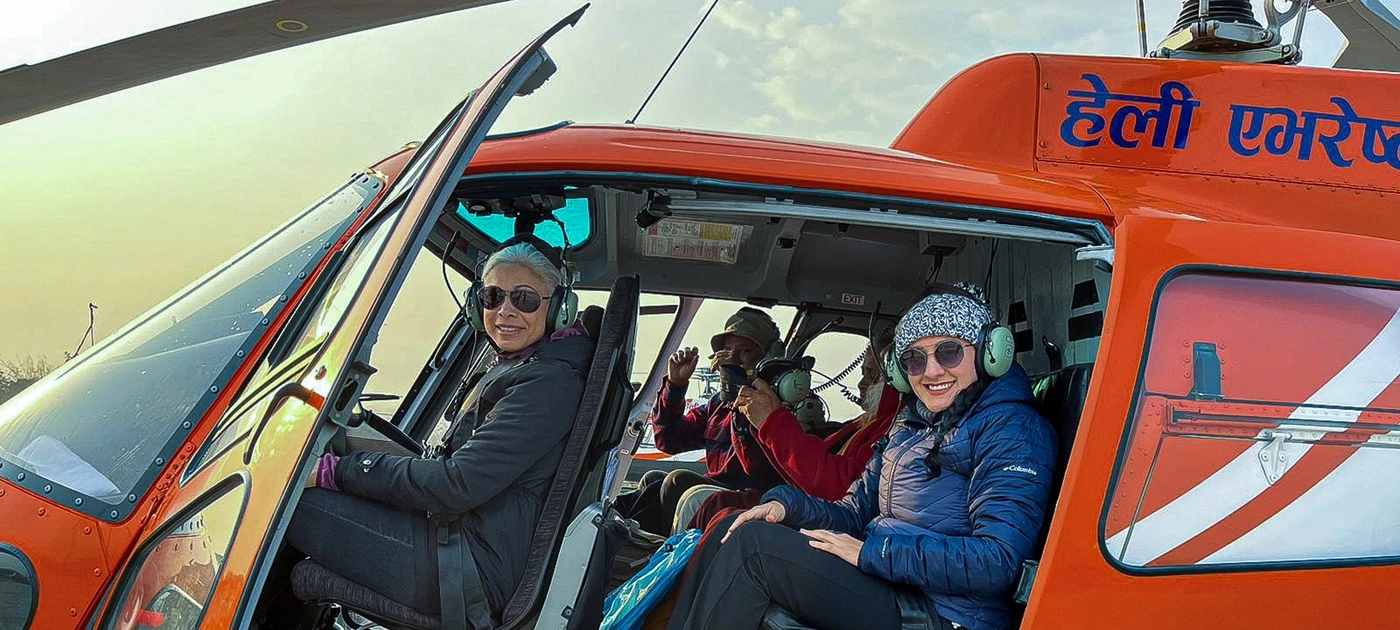
At Alpine Luxury Treks, we coordinate helicopter logistics across all three categories from our Kathmandu base. We work with Nepal’s licensed helicopter operators (the fleet is primarily Airbus H125, formerly AS350 B3e — the standard high-altitude rotary aircraft globally) to build experiences that match your interests, your time, and your budget. This guide covers every major helicopter experience available in Nepal for 2026.
In This Guide
- Everest Base Camp helicopter tour (the signature experience)
- Kala Patthar landing: the sunrise alternative
- Annapurna Base Camp helicopter day trip
- Heli-trek combinations: trek up, fly back
- Multi-valley and bespoke charters
- The complete pricing guide for 2026
- How helicopter logistics actually work in Nepal
- When to fly: seasonal and weather considerations
- Honest expectations: what a helicopter can and cannot deliver
- Frequently asked questions
Everest Base Camp Helicopter Tour: The Signature Experience
The Everest Base Camp helicopter tour is the most popular helicopter experience in Nepal, and the one most of our guests ask about first. Here is exactly what it involves.
The Standard Itinerary
Departure from Kathmandu’s domestic terminal at approximately 6:30-7:00 AM. The early start is essential — mountain weather deteriorates through the day, and morning offers the clearest, most stable flying conditions. The flight to the Everest region takes approximately 45 minutes, tracking northeast over the middle hills toward the Khumbu.
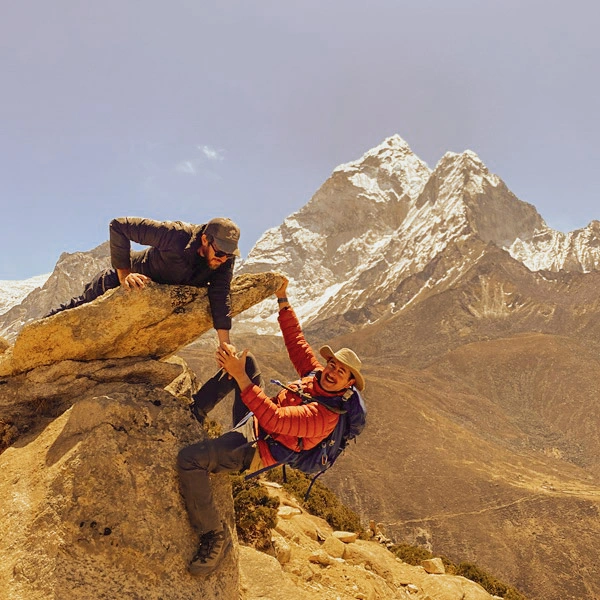
The helicopter crosses the Lukla area and follows the Dudh Koshi valley upstream — the same valley the trekking trail follows, but seen from 3,000 meters above. Within 45 minutes, the aircraft is approaching the Everest massif. On clear days, the visual impact is extraordinary. Everest, Lhotse, Nuptse, Ama Dablam, Makalu, Cho Oyu — the full ring of 8,000-meter peaks arranged around the Khumbu Glacier.
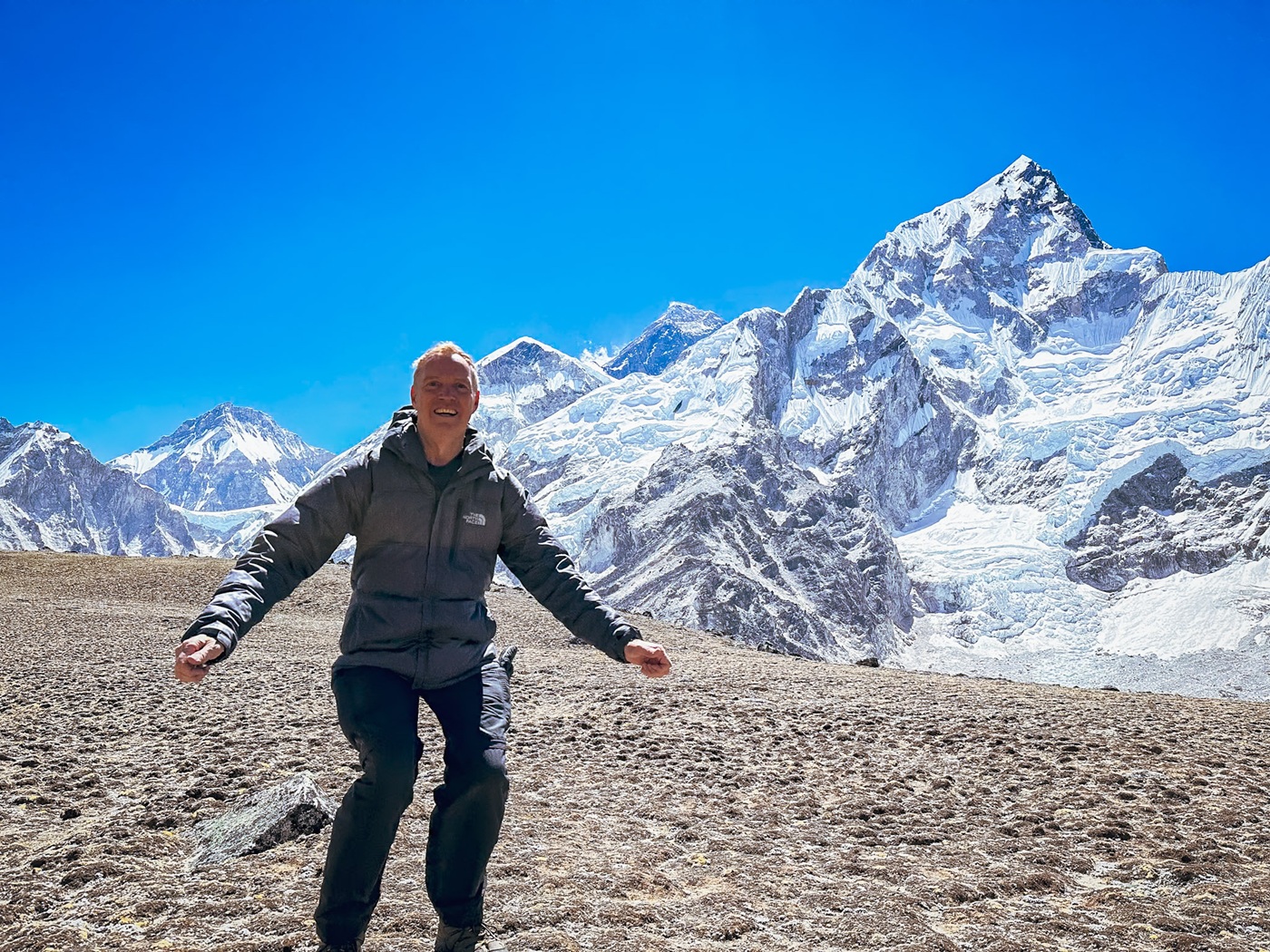
The helicopter lands at either Kala Patthar (5,545 meters) or a designated landing area near Everest Base Camp (5,364 meters) for approximately 10-20 minutes on the ground. This is your window — photographs, video, the physical sensation of standing at extreme altitude with the world’s highest peaks in every direction. The air is thin. The cold is sharp. The silence, between gusts, is total.
On the return, the helicopter descends to either the Hotel Everest View in Syangboche (3,880 meters) or a lodge in Namche Bazaar (3,440 meters) for a hot breakfast with Himalayan views. After breakfast, the helicopter returns to Kathmandu. You are typically back at your hotel by 11:30 AM to noon.
What the Everest Helicopter Tour Actually Feels Like
We need to be honest about this. The helicopter tour is not the same as the trek. It is a different kind of experience — compressed, intense, and aerial rather than earned, gradual, and physical. You see everything. You feel the altitude for 15 minutes. You take the photographs. But you do not earn the view through 12 days of walking. That matters to some travelers and not to others.
What the helicopter does deliver, genuinely: the most dramatic aerial landscape on earth seen from inside the mountain ring rather than from a commercial jet window 30,000 feet above it.
A physical experience of extreme altitude (5,545 meters at Kala Patthar) that is medically safe because the exposure is brief. And a morning that most guests describe as one of the most visually overwhelming experiences of their lives.
The helicopter tour works best for three specific traveler profiles. First: travelers who physically cannot trek due to age, fitness, or medical conditions but deeply want to see Everest. Second: travelers with very limited time in Nepal (3-5 days) who want to maximize their Himalayan exposure. Third: travelers who are adding the helicopter experience to a broader cultural or safari itinerary and want Everest as a single-morning addition rather than a two-week commitment.
“In March 2025, we flew Georg and Ilse Brandt from Munich to Kala Patthar. Georg is 74, a retired architect with a hip replacement. He had wanted to see Everest for forty years but knew the trek was beyond him. At 5,545 meters, standing on the ridge with Everest filling the northern sky, he was quiet for a long time. Then he said to Ilse: ‘I have looked at photographs of this mountain since I was a student. The photographs are wrong. Nothing can prepare you for the scale.’ He shook our pilot’s hand twice before getting back in the aircraft.”
Kala Patthar Landing: The Sunrise Alternative
Kala Patthar at 5,545 meters is a rocky ridge directly opposite the Everest massif. It is the viewpoint that produces the iconic sunrise Everest photograph — the one where the summit catches the first orange light while the Khumbu Glacier remains in deep shadow below.
For trekkers, reaching Kala Patthar requires 12-14 days of walking and acclimatization. For helicopter guests, the flight from Kathmandu takes 45 minutes.
The Kala Patthar landing is a premium option within the standard Everest helicopter tour. Not all operators offer it — the landing site is small, exposed, and weather-dependent. We arrange it when conditions permit, and the guest specifically requests it. The altitude exposure (5,545 meters for approximately 10-15 minutes) is brief enough to be medically safe for most healthy adults, but guests should be aware that at this altitude they may feel breathless, slightly lightheaded, and cold. This is normal. It passes within minutes of descent.
Annapurna Base Camp Helicopter Day Trip
The Annapurna Base Camp helicopter day trip departs from Pokhara rather than Kathmandu, and it offers a fundamentally different visual experience from the Everest tour.
What Makes the Annapurna Trip Different
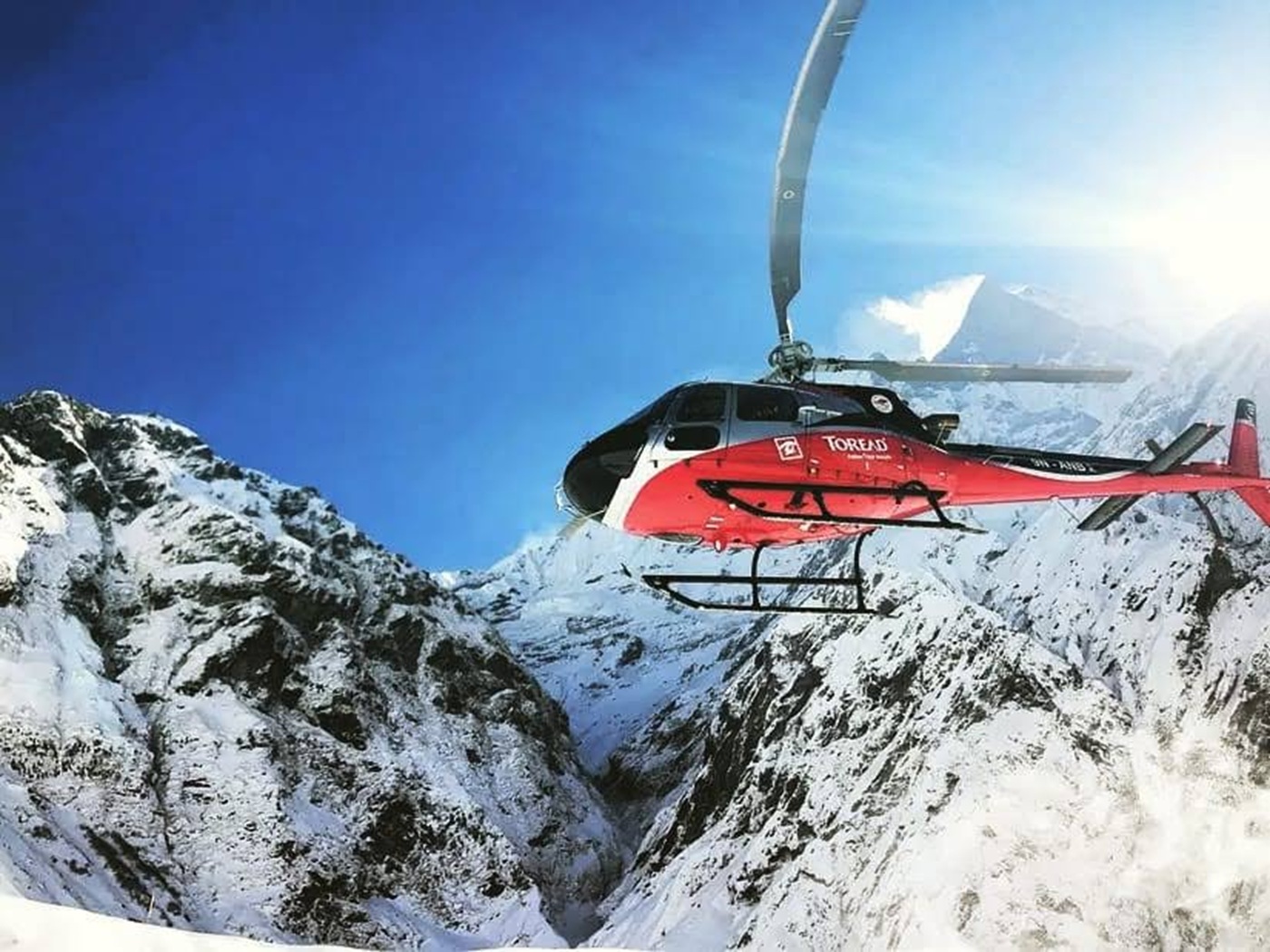
The Annapurna Sanctuary is a glacial amphitheater ringed by ten peaks above 7,000 meters — Annapurna I (8,091 meters), Annapurna South, Machapuchare (Fishtail), Gangapurna, Hiunchuli, and others. The helicopter enters the sanctuary through the narrow Modi Khola gorge, flying between vertical rock walls that open suddenly into the vast amphitheater. The visual transition from gorge to sanctuary is one of the most dramatic moments in Himalayan aviation.
The helicopter lands at or near Annapurna Base Camp (4,130 meters) for approximately 15-20 minutes. The altitude is significantly lower than Kala Patthar, making the ground experience more comfortable — less breathlessness, less cold, more time to absorb the surroundings. You are standing inside the mountain ring, looking up at every wall of the sanctuary simultaneously. It is a 360-degree experience that photographs struggle to capture.
The Typical Itinerary
Departure from Pokhara airport at approximately 7:00 AM. Flight time to ABC is roughly 25-30 minutes. Landing for 15-20 minutes. Return to Pokhara via a scenic route over the Modi Khola valley, with an optional stop at a lodge in the Annapurna foothills for breakfast. Back in Pokhara by 10:00-10:30 AM.
For travelers based in Kathmandu, we add a morning domestic flight from Kathmandu to Pokhara (30 minutes) before the helicopter departure. Alternatively, guests who are already staying in Pokhara as part of a broader itinerary (honeymoon, cultural tour, or pre-trek staging) can simply add the helicopter morning as a single activity.
Who Should Book This
Travelers already spending time in Pokhara who want high-altitude Himalayan exposure without a multi-day trek. Honeymoon couples using the Heritage + Mountain framework. Families with older parents who can see the mountains from Tiger Mountain Pokhara Lodge’s terrace and want to get closer. Photographers who want the aerial approach through the Modi Khola gorge. And trekkers who completed the ABC trail on a previous trip and want to revisit the sanctuary from the air on a return visit.
Heli-Trek Combinations: Trek Up, Fly Back
The heli-trek is neither a helicopter tour nor a standard trek. It is a hybrid that takes the best of both — the earned, gradual, physical experience of trekking upward through the iconic trail, combined with the time efficiency of a helicopter return that eliminates the multi-day descent.
How It Works
You trek the full ascent — Lukla to Namche, Namche to Tengboche, Tengboche to Dingboche, Dingboche to Lobuche, Lobuche to Gorak Shep, Gorak Shep to Everest Base Camp, Kala Patthar sunrise. Every step of the upward trek. Every acclimatization day. Every lodge night. Every mountain view earned on foot.
Then, the morning after your summit at Kala Patthar, instead of beginning the 4-5-day descent back to Lukla on foot, you are picked up by helicopter from Gorak Shep or Pheriche and flown directly back to Kathmandu. Three to four hours of flight replaces three to five days of walking.
Why We Recommend This for Most Luxury Trekkers
The descent is the lowest-value portion of an EBC trek. You are retracing the same trail you climbed; the physical novelty has worn off, your body is fatigued from 10 days at altitude, and the views are the same ones you saw on the way up. The descent exists because there is no road — it is a logistical necessity, not an experiential value.
The helicopter return eliminates the descent and converts those 3-5 saved days into either an earlier return home, additional time in Kathmandu, a Chitwan safari extension, or even a Bhutan add-on. For time-constrained professionals — who comprise the majority of our luxury trekking guests — this is the most impactful itinerary optimization available.
The cost premium is significant (typically 3,500-6,000 USD for the charter), but most guests who have done it describe it as the best money they spent on the entire trip.
The Reverse Configuration: Fly In, Trek Out
Less common but occasionally requested. You fly from Kathmandu to a high starting point (typically Namche Bazaar or Syangboche at 3,800 meters), spend a day or two acclimatizing at altitude, then trek upward to EBC and Kala Patthar before descending on foot to Lukla for a fixed-wing flight back to Kathmandu.
We generally recommend against this configuration for first-time high-altitude trekkers because it compresses acclimatization — you gain 2,000+ meters of altitude in a single helicopter flight rather than gradually over multiple days of walking. Acute mountain sickness risk increases. We only arrange fly-in configurations for guests with documented high-altitude experience.
Multi-Valley and Bespoke Charters
Beyond the standard Everest and Annapurna experiences, private charters open destinations across Nepal that would otherwise require days of road travel or trekking.
Langtang Valley
The Langtang Valley sits north of Kathmandu, approximately 30 minutes by helicopter. The valley was heavily affected by the 2015 earthquake (the village of Langtang was destroyed by an avalanche) and has since been rebuilt as a quieter, less-touristed alternative to the Everest and Annapurna regions. A scenic helicopter tour over the Langtang range offers dramatic glacial views and optional landings at Kyanjin Gompa (3,870 meters) for a brief ground experience in a genuinely remote Himalayan valley.
Upper Mustang
The fastest way to reach Lo Manthang (the walled capital of Upper Mustang at 3,840 meters) is by helicopter from Pokhara. The flight takes approximately 45-50 minutes and crosses the Annapurna and Dhaulagiri ranges before descending into the high-desert rain-shadow zone. This charter is particularly popular for guests attending the Tiji Festival (May 16-18 in 2026) who cannot commit to the 8-10-day overland trek. We cover Upper Mustang in depth in our Luxury Trekking guide.
Gosaikunda and Helambu
The sacred lake of Gosaikunda at 4,380 meters — a Hindu and Buddhist pilgrimage site where Shiva is said to have pierced the earth with his trident to create water — is reachable by helicopter in approximately 25 minutes from Kathmandu. The aerial view of the lake nestled in a glacial cirque is striking. This charter works as a half-day spiritual and scenic experience for guests based in Kathmandu.
Rara Lake
Nepal’s largest lake is located in the remote far-western Mugu district at an elevation of 2,990 meters. Almost no international tourists reach Rara because the overland journey from Kathmandu takes three days of driving plus several days of trekking. A helicopter charter from Nepalgunj (approximately 50 minutes) opens this stunning, pristine alpine lake for day visits. Crystal-clear water. Conifer forests. Zero other visitors. This is the ultimate off-grid helicopter experience in Nepal.
Private Monastery and Estate Landings
For guests seeking genuinely bespoke experiences, we arrange helicopter landings at remote monasteries, private estate clearings, and off-grid viewpoints across the Himalayan range. These are not listed on any tour operator’s standard menu — they require specific landing permits, local coordination, and advance weather assessment. Champagne picnics at 4,000 meters with an unshared Himalayan panorama. Private blessings at a monastery accessible only by air. These are the experiences we build for guests who have already done the standard options and want something genuinely their own.
The Complete Pricing Guide for 2026
Helicopter pricing in Nepal varies based on charter type (private vs shared), route, landing fees, and seasonal demand. These are the current 2026 price ranges based on our operational experience. All prices are per charter, not per person, unless otherwise noted.
|
Experience
|
Price Range
|
Duration
|
Passengers
|
|
Everest Base Camp tour (private)
|
4,200–6,000 USD
|
3–4 hrs
|
Up to 5 pax
|
|
Everest Base Camp tour (shared/group)
|
1,200–1,800 USD/person
|
3–4 hrs
|
4–5 per flight
|
|
Kala Patthar summit landing (private)
|
5,000–7,000 USD
|
3–4 hrs
|
Up to 4 pax
|
|
Annapurna Base Camp from Pokhara (private)
|
2,800–4,500 USD
|
2–3 hrs
|
Up to 5 pax
|
|
EBC heli-trek return (Gorak Shep → Kathmandu)
|
3,500–6,000 USD
|
~1.5 hrs
|
Up to 5 pax
|
|
Heli to Lukla (outbound trek charter)
|
2,500–4,000 USD
|
~35 min
|
Up to 5 pax
|
|
Upper Mustang charter (Pokhara → Lo Manthang)
|
4,500–7,000 USD
|
~50 min
|
Up to 5 pax
|
|
Langtang scenic / Gosaikunda (from Kathmandu)
|
2,500–4,000 USD
|
2–3 hrs
|
Up to 5 pax
|
|
Rara Lake charter (from Nepalgunj)
|
3,500–5,500 USD
|
3–4 hrs
|
Up to 5 pax
|
|
Bespoke full-day multi-valley charter
|
8,000–15,000 USD
|
5–8 hrs
|
Up to 5 pax
|
SHARED VS PRIVATE CHARTERS
The EBC tour is available in both shared (group) and private configurations. Shared flights cost 1,200-1,800 USD per person and seat you with other passengers on a scheduled departure. Private charters cost 4,200-6,000 USD for the entire aircraft and give you control over timing, ground time at altitude, and the return route. For luxury travelers, we almost always recommend private charters because the flexibility in schedules and the difference in experience quality are substantial. The per-person cost of a private charter for 3-4 people is only marginally higher than the shared rate.
How Helicopter Logistics Actually Work in Nepal
The Aircraft
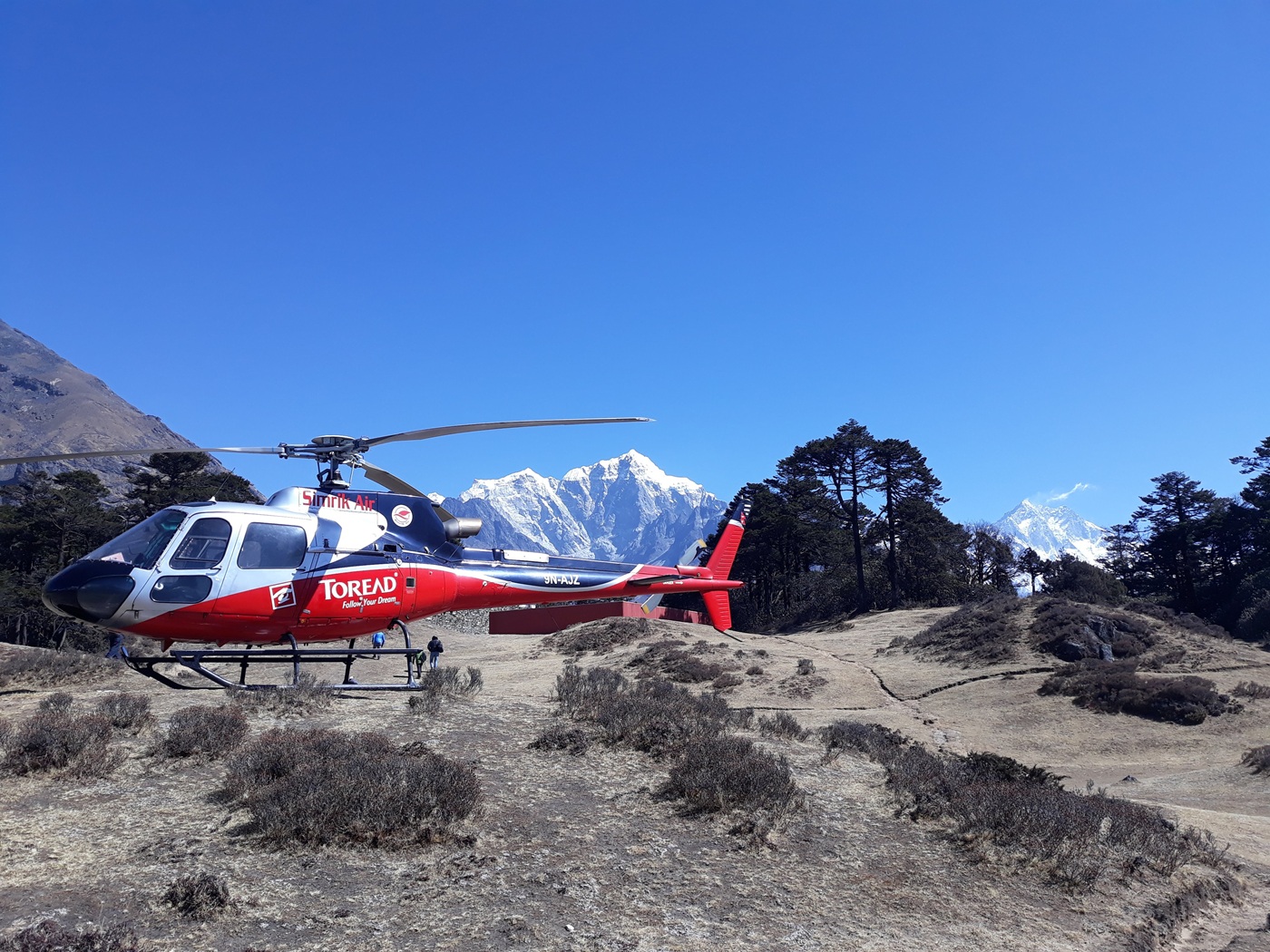
Nepal’s helicopter fleet for tourist and charter operations is primarily composed of the Airbus H125 (formerly the Eurocopter AS350 B3e). This is the standard high-altitude rotary-wing aircraft used worldwide for mountain operations — the same platform used in the Alps, the Andes, and for Himalayan rescue missions. It is certified for operations up to 7,010 meters. Passenger capacity is typically 4-5 persons, depending on altitude, total weight, and weather conditions. Higher altitudes reduce lift capacity, meaning the aircraft carries fewer passengers at extreme elevations such as Kala Patthar.
The Operators
We work with multiple licensed helicopter operators in Nepal. Operator selection depends on availability, specific aircraft certification for the route, and our operational assessment of safety standards. All operators we work with hold current Civil Aviation Authority of Nepal (CAAN) certification and maintain insurance coverage for high-altitude operations.
The Weather Factor
This is the single most important thing to understand about helicopter experiences in Nepal. Mountain weather is unpredictable. A flight scheduled for 6:30 AM can be delayed by cloud cover, wind, or reduced visibility. Occasionally, flights are canceled entirely and rescheduled for the following morning.
We build buffer days into every itinerary that includes a helicopter experience. If you are booking a single-morning Everest helicopter tour as part of a 5-day Nepal trip, we schedule it for Day 2 or Day 3 — never the last day. This gives us a backup window if weather forces a reschedule. Guests who schedule their helicopter experience on their final morning and lose it to weather have no recourse. We will not let that happen.
Altitude and Safety
The brief exposure to altitude on a helicopter tour (10-20 minutes at 5,000-5,545 meters) is generally safe for healthy adults. However, guests with uncontrolled high blood pressure, recent cardiac events, severe respiratory conditions, or pregnancy should consult a physician before booking. We include a health advisory in all helicopter booking confirmations.
Supplemental oxygen is available on all high-altitude flights. Guests who feel uncomfortable at extreme altitude can use the onboard supply during the ground stop.
When to Fly: Seasonal and Weather Considerations
Helicopter operations in Nepal follow the same seasonal logic as the rest of the country, but with one additional layer: flying weather is more restrictive than ground travel weather.
|
Season
|
Flying Conditions
|
Recommendation
|
|
Oct – Nov
|
Best. Post-monsoon clarity, stable mornings, light winds.
|
Peak season. Book 6+ months ahead for private charters.
|
|
Dec – Feb
|
Very good. Crystal-clear skies but cold at altitude. Occasional jet-stream wind.
|
Excellent visibility. Dress warmly for ground stops.
|
|
Mar – May
|
Good. Morning clarity. Afternoon cloud build-up increases through the season.
|
Early morning departures essential. April-May haze in Kathmandu Valley.
|
|
Jun – Sep
|
Poor. Monsoon cloud, reduced visibility, frequent cancellations.
|
Not recommended for scenic flights. Heli-trek returns still operate when the weather allows.
|
The single best month for helicopter scenic flights is **October**. The post-monsoon atmosphere is scrubbed clean, morning visibility is consistently at its annual best, and wind conditions are the most stable of the year. If you have flexibility on timing, target October.
Honest Expectations: What a Helicopter Can and Cannot Deliver
We are honest with every guest who books a helicopter experience. Here is what we tell them.
What a Helicopter Tour Delivers
The most dramatic aerial landscape on earth is seen from inside the mountain ring. A physical experience of extreme altitude that is medically safe because the exposure is brief. Photographs from vantage points that trekkers cannot reach. A morning that most guests describe as one of the most visually overwhelming experiences of their lives. Access to Everest, Annapurna, or remote valleys for guests who cannot or choose not to trek.
What a Helicopter Tour Does Not Deliver
The earned, gradual, physical experience of trekking through the mountains over 10-14 days. The cultural immersion of staying in Sherpa villages and lodges. The altitude acclimatization process changes how your body functions. The sense of personal achievement that comes from walking 130 kilometers at elevation. The silence of a mountain trail.
A helicopter tour and a trek are not competing products. They are different products for different purposes. We are comfortable recommending either, depending on the guest. We do not pretend one is a substitute for the other.
“In October 2025, we arranged a private Annapurna Base Camp helicopter day trip for Kwame and Adaeze Osei from Accra — both in their mid-30s, visiting Nepal for 6 days as part of a broader Asia trip. They did not have time for a trek but wanted to see the Himalayas up close. The helicopter entered the Annapurna Sanctuary through the Modi Khola gorge at 7:15 AM. Adaeze, watching through the cockpit window, grabbed Kwame’s arm when the gorge opened into the amphitheater. She told us afterward: ‘I have seen a lot of beautiful places. I have never been inside one before. The mountains were not in front of me. They were around me.’ They are now planning a full Annapurna Base Camp trek for 2027.”
Frequently Asked Questions
How much does an Everest helicopter tour cost in Nepal?
A private Everest Base Camp helicopter tour costs 4,200-6,000 USD for the entire aircraft (up to 5 passengers). A shared/group flight costs 1,200-1,800 USD per person. A private Kala Patthar summit landing costs 5,000-7,000 USD. Prices include the flight, the landing at altitude, and a breakfast stop at a lodge on the return. All prices are for the charter; international and domestic flights to Kathmandu are additional.
How long is the Everest helicopter tour?
The total experience runs approximately 3-4 hours from departure at Kathmandu’s domestic terminal to return. Flight time to the Everest region is approximately 45 minutes each way. Ground time at Kala Patthar or Everest Base Camp is approximately 10-20 minutes. The breakfast stop at Hotel Everest View or Namche adds approximately 30-45 minutes. You are typically back at your hotel by 11:30 AM.
Is the Everest helicopter tour safe?
Yes, when operated by licensed operators using certified high-altitude aircraft (the standard platform is the Airbus H125, certified to 7,010 meters). The brief altitude exposure (10-20 minutes at 5,000-5,545 meters) is generally safe for healthy adults. Supplemental oxygen is available onboard. Guests with uncontrolled high blood pressure, recent cardiac events, severe respiratory conditions, or pregnancy should consult a physician before booking. All operators we work with hold current CAAN certification and maintain high-altitude insurance coverage.
Do I need to be fit for a helicopter tour?
No physical fitness is required for a scenic helicopter tour. You sit in the aircraft for the flight and stand on level ground for 10-20 minutes at altitude. The only physical requirement is the ability to climb in and out of the helicopter. The altitude may cause mild breathlessness and lightheadedness during the ground stop, which is normal and passes within minutes of descent. This is genuinely accessible to guests of all ages and fitness levels, including those with mobility limitations.
What is a heli-trek combination?
A heli-trek is a hybrid itinerary where you trek the full ascent on foot (earning the views and the altitude adaptation) and then helicopter back from the high point rather than descending on foot. For EBC, this means trekking from Lukla to Gorak Shep over 10-12 days, then helicoptering from Gorak Shep directly back to Kathmandu, saving 3-5 days of descent. The helicopter return costs approximately 3,500-6,000 USD for a private charter. Most luxury trekkers find this to be the optimal balance between earned experience and time efficiency.
Can I do the Annapurna Base Camp helicopter trip from Kathmandu?
Yes, but it requires a staging stop. The ABC helicopter departs from Pokhara, not Kathmandu. We either fly you commercially from Kathmandu to Pokhara (30 minutes) the day before, or arrange a same-morning connection with a very early departure from Kathmandu. Most guests stay one or two nights in Pokhara and add the helicopter trip as a morning activity during their Pokhara stay — this is the smoothest logistical approach.
When is the best time for a helicopter tour in Nepal?
October is the single best month — post-monsoon atmospheric clarity is at its annual peak, and morning flying conditions are the most stable. November through February also offer excellent visibility. March through May have good mornings but increasing afternoon cloud. June through September (monsoon) is not recommended for scenic flights due to cloud cover and reduced visibility.
Should I do a private or shared Everest helicopter tour?
For luxury travelers, we recommend private charters. The cost difference per person when sharing among 3-4 guests is modest (roughly 1,400 USD per person for private vs 1,400 USD per person for shared), but the experience difference is substantial: you control the departure time, the ground time at altitude, the return route, and the breakfast stop. Shared flights run on fixed schedules with fixed ground time and no flexibility for weather delays or personal preferences.
Can I combine a helicopter experience with a trek?
Yes — this is one of our most popular itinerary structures. The two main combinations are: (1) helicopter to Lukla outbound, then trek to EBC and helicopter return from Gorak Shep (saves time on both ends); (2) full trek to EBC on foot, then helicopter return only (the most popular luxury option, saving 3-5 days of descent). We cover both configurations in detail in our Luxury Trekking in Nepal guide.
What happens if the weather cancels my helicopter flight?
We rescheduled for the next available morning. This is why we always build buffer days into itineraries that include helicopter experiences. If you are booking a single-morning Everest tour as part of a 5-day Nepal trip, we schedule it for Day 2 or 3 — never the last day. In peak season (October-November), weather-related cancellation rates are low (roughly 10-15% of scheduled flights). In shoulder seasons, the rate increases. We do not charge our guests for weather cancellations — rescheduling is included.
How far in advance should I book?
Six months ahead for peak-season private charters (October-November). Three to six months for other seasons. Shared/group EBC flights can often be arranged on short notice (1-2 months) because they operate on scheduled departures with available seats. Heli-trek return charters for EBC should be booked at the same time as the trek booking (9-12 months in advance for peak autumn).
The Final Word
A helicopter in Nepal is not a shortcut. It is a different way of seeing the same mountains — from above, from inside, from angles that no trail reaches. For some travelers, it replaces the trek. For others, it enhances it. For a few, it is the beginning of a relationship with the Himalayas that leads to a full trek the following year.
Tell us what you want from the mountains and how much time you have. We will recommend the right helicopter experience — scenic tour, heli-trek combination, or bespoke charter — and handle every logistical detail from Kathmandu departure to mountain landing to breakfast with a view.
Planning a helicopter experience in Nepal?
Tell us your travel window, your time budget, and whether you want a scenic tour, a heli-trek combination, or something bespoke. We will recommend the right experience and handle every detail.