Why Nepal Is a Photographer’s Country
Three reasons specific to Nepal that do not apply to other Himalayan destinations.
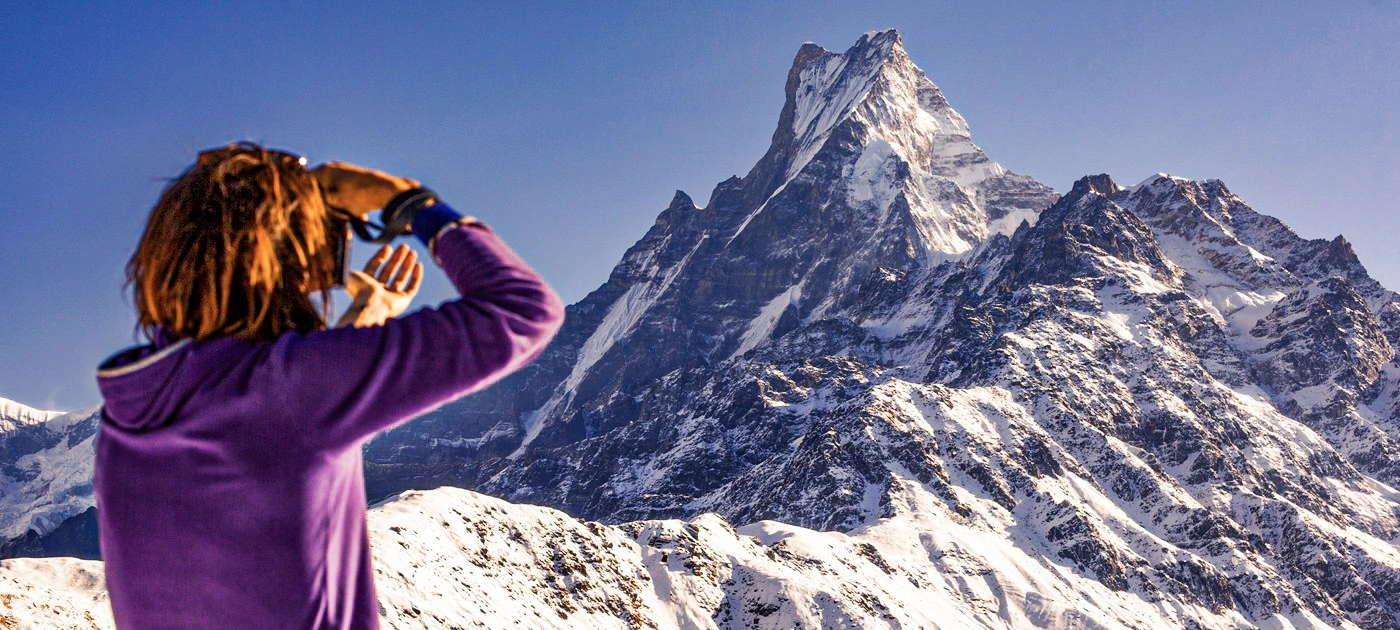
The east-facing orientation. The main Himalayan chain in Nepal runs roughly east-west. The major peaks face east and southeast. This means sunrise light hits the mountain faces directly. Every morning, from October to February, the first light of the day illuminates the world’s highest peaks in alpenglow — a progression from deep pink to orange to white gold that lasts 15-25 minutes. The Himalayas are a sunrise subject. Nepal’s geography makes it a perfect one.
The extended golden hour. At 4,000 meters, the atmosphere is 40% thinner than at sea level. A thinner atmosphere scatters less light. The practical consequence: golden hour lasts longer, and the color temperature is warmer and more saturated. A photographer at Poon Hill (3,210m) gets 20-30 minutes of usable golden light. A photographer at Bondi Beach gets 12-15 minutes. The altitude extends your shooting window.
The compression of biomes. In 200 horizontal kilometers, Nepal transitions from subtropical jungle (200m) through temperate forest, alpine meadow, glacial moraine, and permanent ice (8,849m). A 14-day photography itinerary covers every major biome on Earth except marine and tundra. No other country offers this range within a single trip.
The Gear
|
Category
|
Recommendation
|
Why for Nepal Specifically
|
|
Primary body
|
Sony Alpha 7R V or Canon R5
|
Full-frame sensor. Weather-sealed body (Mustang dust, Khumbu moisture, monsoon humidity). High dynamic range for sunrise shooting. Eye-tracking AF for wildlife and portraits.
|
|
Backup body
|
Sony A7C II or Canon R6 II
|
Compact. Same lens mount. Redundancy if the primary fails in cold or impact. Cold kills batteries — two bodies means twice the battery reserve.
|
|
Wide zoom
|
14-24mm f/2.8
|
Astrophotography at altitude (Milky Way from 4,000m). Sweeping Himalayan panoramas. Monastery interiors. Star trails over prayer flags.
|
|
Standard zoom
|
24-70mm f/2.8 GM II
|
The workhorse. Landscape, portrait, street, architecture. Eliminates 3-4 prime lenses. Fast enough for low-light temple interiors.
|
|
Telephoto zoom
|
100-400mm f/4.5-5.6 or 200-600mm
|
Chitwan wildlife (tiger, rhino, birds). Compressed mountain layers from viewpoints. Monastery details from a distance (respectful shooting).
|
|
Tripod
|
Peak Design Travel Tripod
|
Carbon fiber. Stable in high-altitude wind. Light enough for a porter to carry without complaint. Essential for sunrise, astrophotography, and long-exposure river shots.
|
|
Drone
|
DJI Mini 4 Pro (under 249g)
|
Under 250g aids regulatory compliance. 4K aerial footage. Phewa Lake reflections. Terraced fields. Monastery from above. Check the current regulations of the Nepalese Civil Aviation Authority before flying.
|
|
Protection
|
Sealed dry bags + AirTags
|
Rain protection (monsoon, cloud forest). Dust protection (Mustang, Kali Gandaki wind). AirTags on every bag — gear changes hands between the porter, the vehicle, the lodge, and the helicopter.
|
Lithium-ion batteries lose 30-50% of their capacity at -10°C. At Gokyo (4,790m) in November, pre-dawn temperatures drop below -15°C. If your batteries are in your camera bag, they are dead by sunrise. Carry all batteries in your jacket, against your body, until you mount the camera on the tripod. Bring at least 4 batteries per body. Charge every night at the lodge (carry a multi-port USB charger). On teahouse treks, charging may cost NPR 200-500 per device.
The Seven Photography Zones
Zone 1: Kathmandu — Heritage Architecture and Street
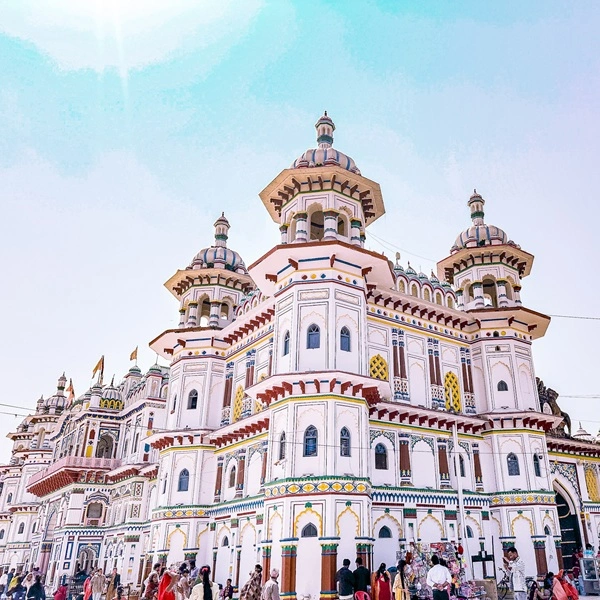
The Kathmandu Valley is a street- and architectural-photography destination of global caliber. The carved windows of Bhaktapur’s 55-Window Palace. The gilded doorway of the Golden Gate. The tiered pagoda rooflines against monsoon clouds.
The Peacock Window in the Dattatreya district — the single most photographed woodcarving in Nepal, and the most difficult to photograph well because the alley is narrow and the light window is 45 minutes long in the morning.
Shooting strategy: arrive in Bhaktapur before 7 AM (before tour buses and harsh light). The eastern facades of the Durbar Square temples catch the first direct light. Shoot architecture with the 24-70mm. Switch to the 14-24mm for interiors (Mul Chowk in Patan, the Golden Temple courtyard). For Boudhanath, arrive for the 5:30 AM kora — the circumambulation of monks in maroon robes against the white dome. The motion blur of spinning prayer wheels at 1/15s with image stabilization is the defining Boudhanath image.
Zone 2: Chitwan — Wildlife Telephoto
Chitwan is a 600mm destination. The one-horned rhinoceros at the Rapti River waterline. The Bengal tiger emerges from the sal forest shadow into a patch of dappled light. The gharial crocodile’s snout breaks the water's surface. The giant hornbill in flight against a green canopy.
The naturalist guides the Jeep into optimal light — we brief the naturalist that you are a photographer, not a casual viewer, and the safari pace adjusts accordingly. Morning safaris (6 AM departure) provide side-lit subjects. Afternoon safaris (3 PM) provide backlit silhouettes at the river.
Dedicated bird photography hides are available at the Bishazari Tal wetlands and the Rapti River sandbanks. We schedule a minimum of 3 nights for serious wildlife photographers — the probability of a tiger sighting increases with each additional safari.
Zone 3: Annapurna Trail — Landscapes and Culture
The Annapurna trail offers a gradient of photographic environments: subtropical forest canopy (Birethanti, 1,097m), terraced rice paddies in golden afternoon light (Ghandruk approach), dense rhododendron forest in bloom (March-April, the trail between Tikhedhunga and Ghorepani becomes a corridor of red, pink, and white), and the glacial amphitheatre at ABC (4,130m) where sunrise illuminates the walls sequentially.
The Gurung villages along the route provide portrait opportunities: elderly women in traditional dress, children carrying firewood, and men weaving bamboo mats. Always ask permission. The word is “photo khichne huncha?” (May I take a photo?) A smile and a nod usually follow.
Zone 4: Everest — High-Altitude Dawn
The defining Everest photograph is taken from Kala Patthar (5,545m) or Gokyo Ri (5,357m) at sunrise. The challenge: you arrive in darkness, set up on a windy ridgeline in -15°C, and have 15-20 minutes of usable light before the sun climbs above the golden-hour window.
Your fingers do not work properly at this temperature. Pre-set your exposure brackets before you leave the lodge. Use a remote shutter release or the camera’s self-timer. Do not change lenses in the wind (sensor dust at 5,000m cannot be cleaned until Kathmandu). The 24-70mm is the Kala Patthar lens — wide enough for the full Everest-Nuptse-Lhotse frame, tight enough to isolate the summit pyramid.
Zone 5: Mustang — Desert Light
Upper Mustang is Nepal’s answer to the American Southwest, but with 800-year-old cave monasteries instead of mesas. The Kali Gandaki valley is a wind tunnel — shoot in the early morning before the daily gale begins (typically 10 AM). The light on the red and ochre cliffs of the Mustang desert is warm, directional, and long-lasting because the valley runs north-south. The medieval mud-brick village of Lo Manthang, the prayer flags against the Nilgiri peaks, the Mustang ponies on the trail — these are images that look like they belong in National Geographic because they do.
Zone 6: Festivals — Movement and Fire
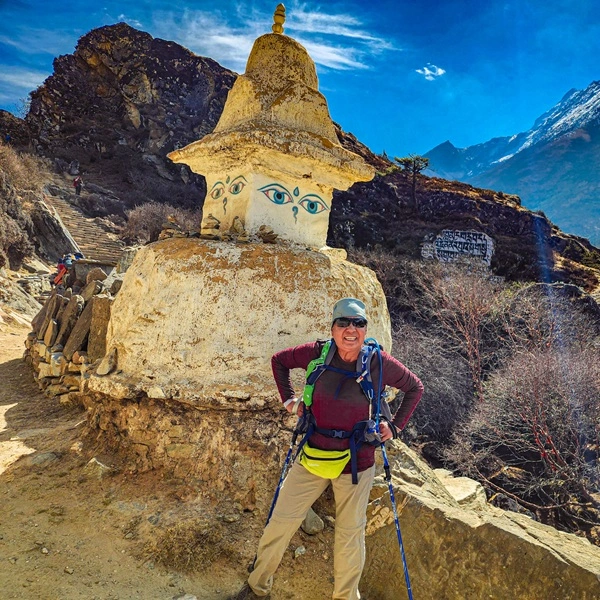
Nepal’s festivals are a photojournalist’s subject. Mani Rimdu at Tengboche (October): masked Chham dancers in ornate costumes against the backdrop of Ama Dablam. Shoot at 1/500s to freeze the spinning fabric, or 1/30s to capture the motion blur of the dance.
Biska Jatra in Bhaktapur (April): the massive chariot pulled through narrow alleys by hundreds of men — the compression of bodies and energy in a 14mm frame. Tihar (November): the entire Kathmandu Valley lit by oil lamps and candles — handheld low-light shooting at ISO 6400, the candlelight portraits of Nepali families in their doorways. We time photography itineraries to coincide with festivals whenever possible. Festival dates require 6-12 months' advance booking.
Zone 7: Night Sky — Astrophotography at Altitude
At 4,000 meters above the cloud layer, the night sky is Bortle class 1-2. The Milky Way core is visible to the naked eye from October to March. The galactic center arcs directly overhead in the pre-dawn hours of late October — the Milky Way core over the summit of Everest is a photograph that requires being in the right place (Gokyo, Kongde, or Kala Patthar) at the right time (2-4 AM, October-November) with the right lens (14-24mm f/2.8, ISO 3200, 15-second exposure).
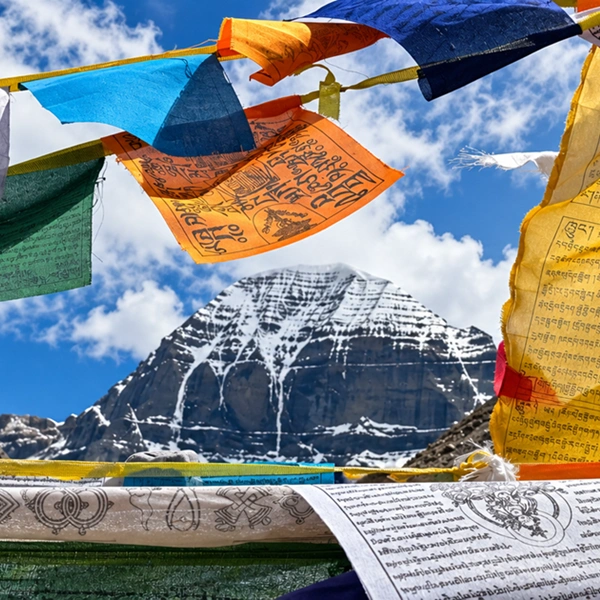
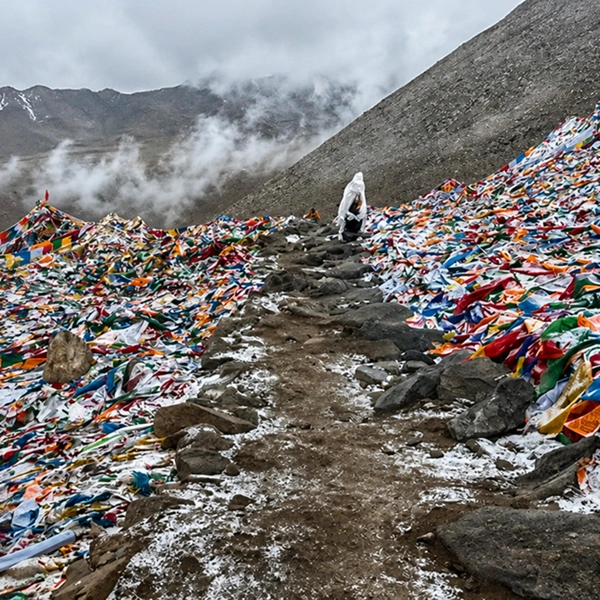
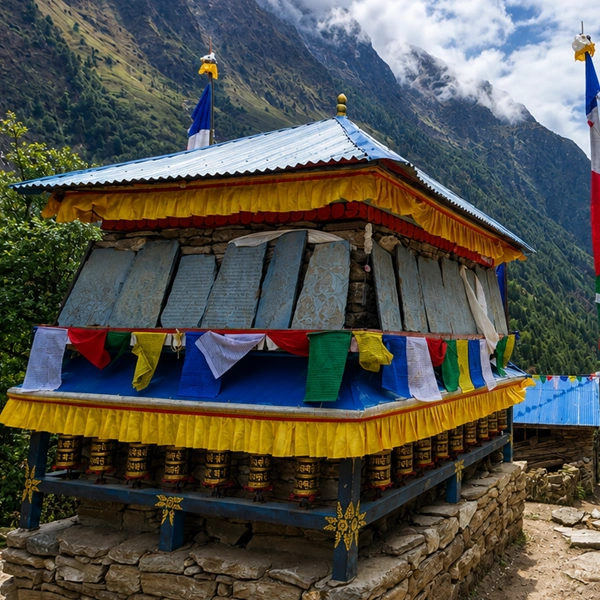
Prayer flags silhouetted against the Milky Way. The Tengboche Monastery with star trails behind the pagoda roof. A single headlamp illuminates a stone mani wall while the galaxy burns above. These images do not exist at sea level.
Helicopter Photography
Helicopter photography in Nepal is constrained by three factors: vibration, window distortion, and time. The AS350 B3e helicopters used for high-altitude charters exhibit a high-frequency vibration that causes motion blur at shutter speeds below 1/1000s. Shoot at 1/1600s or faster. Use vibration reduction if your lens has it, but do not rely on it alone. Press the lens hood gently against the window glass to dampen contact vibration — do not press hard enough to transmit the airframe’s vibration through the glass into the lens.
The windows are curved Plexiglas. Shoot perpendicular to the glass, not at an angle (angles introduce chromatic distortion). The best position is the front-left seat (co-pilot position) — request this when booking. Some operators offer door-off flights for professional photographers (additional cost, harness required, cold exposure, extreme). For the Kala Patthar landing, you have 10-15 minutes on the ground. Pre-visualize your compositions before you land. Do not spend the first 5 minutes deciding what to shoot.
The Private Photography Guide
On a standard luxury trek, the guide knows the trails, the culture, and the altitude. On a photography tour, the guide must also understand light. We assign photography-aware guides who know which viewpoints receive the first light, which temples have the best interior-light windows, where to position for Boudhanath’s kora without blocking pilgrims, and when to wait versus when to move on.
They carry your tripod on the approach and hand it to you at the shooting position. They manage the porter (who carries the rest of the gear in padded bags). They keep non-photographers in the group moving while you take the extra 20 minutes at the viewpoint.
For professional-level photographers, we arrange local photography fixers — Kathmandu-based professionals who know every hidden courtyard, every rooftop angle, and every window where the light enters for exactly 40 minutes per day. These fixers are an additional cost ($150-250/day), but they compress three days of scouting into three hours of shooting.
Ethics: When Not to Shoot
Do not photograph cremation pyres at Pashupatinath without extraordinary sensitivity. The families are grieving. A telephoto lens from the opposite bank is acceptable. Walking up to the pyre platform with a camera is not. Do not photograph the Kumari (Living Goddess) — photography of the current Kumari is strictly prohibited during darshans.
Do not photograph monks in meditation without asking. Do not photograph children without their parents’ consent — the parents are usually proud and happy to say yes, but the question must come first. Do not photograph military installations, border checkpoints, or airport security infrastructure. Your guide briefs you on all cultural and legal restrictions on photography in each zone.
Three Photography Itineraries
- 7-Day Concentrated Shoot: Days 1-2: Kathmandu (Bhaktapur dawn, Boudhanath kora, Patan architecture, street photography with fixer). Day 3: EBC shared helicopter (aerial photography, Kala Patthar 10-min ground shoot). Days 4-5: Pokhara (Poon Hill sunrise if time allows, Phewa Lake reflections, Sarangkot dawn). Days 6-7: Chitwan (3 wildlife safaris, dedicated bird hide session). Budget: $6,000-9,000.
- 10-Day Trek + Culture: Days 1-2: Kathmandu with photography fixer. Days 3-7: Poon Hill trek (rhododendron corridor in March-April, Poon Hill sunrise, Ghandruk golden hour, terraced fields). Days 8-9: Pokhara (lake, ultralight aerial, Sarangkot). Day 10: Return. Budget: $7,000-11,000.
- 14-Day Grand Photography Expedition: Days 1-3: Kathmandu deep (Bhaktapur, Patan, Boudhanath, Pashupatinath, fixer-guided). Days 4-8: Gokyo Lakes trek (turquoise lake reflections, Gokyo Ri sunrise, astrophotography at 4,790m, Ngozumpa Glacier). Days 9-10: Pokhara (Phewa, Sarangkot). Days 11-13: Chitwan (multi-day wildlife photography, dedicated bird hides, sunrise/sunset river sessions). Day 14: Return. Timed for October for Milky Way + clear skies + Mani Rimdu if dates align. Budget: $10,000-15,000.
Frequently Asked Questions
What camera should I bring to Nepal?
- Sony Alpha 7R V or Canon R5. Full-frame, weather-sealed, high dynamic range. Three lenses: 14-24mm f/2.8 (astro, wide landscape), 24-70mm f/2.8 (workhorse), 100-400mm (wildlife, compressed mountains). Peak Design Travel Tripod. DJI Mini 4 Pro drone (check current Nepalese regulations). Minimum 4 batteries per body.
How do I protect batteries in the cold?
- Carry all batteries inside your jacket against your body until you mount the camera. Lithium-ion loses 30-50% capacity at -10°C. At Gokyo or Kala Patthar, pre-dawn, batteries in your bag are dead. Body heat preserves them. Bring 4+ batteries per body. Charge every night (NPR 200-500/device at teahouses).
Can I fly a drone in Nepal?
- DJI Mini 4 Pro (under 249g) falls into a lighter regulatory category. However, Nepal’s drone regulations are evolving, and permits are difficult for tourists. Check the current Civil Aviation Authority of Nepal rules before departure. Do not fly near airports, military installations, or the interiors of national parks without explicit permission. We advise on the latest regulations during pre-trip briefing.
What is the best time for photography?
- October-November: clearest atmosphere, sharpest mountain views, Milky Way visible, Mani Rimdu festival, Dashain/Tihar festivals. March-April: rhododendron bloom on Annapurna trails, warm light, good wildlife. December-February: spectacular winter clarity, empty trails, but extreme cold at altitude.
Do you provide a photography-specific guide?
- Yes. Photography-aware guides who understand light windows, viewpoint positioning, and the difference between a tourist’s 2-minute photo stop and a photographer’s 30-minute composition. For professional-level work, we arrange Kathmandu-based photography fixers ($150- $ 250/day) who know every hidden angle.
Can I photograph from a helicopter?
- Yes. Shoot at 1/1600s or faster (to reduce vibration). Press the lens hood gently against the window glass. Shoot perpendicular to the glass. Request the front-left seat. Some operators offer door-off flights (at an additional cost; requires a harness; extreme cold conditions). Pre-visualize compositions before the Kala Patthar landing — you have 10-15 minutes.
Is astrophotography possible?
- Yes. Above 4,000m (Gokyo, Kongde, Kala Patthar), the sky is Bortle class 1-2. The Milky Way core is visible to the naked eye from October to March. 14-24mm f/2.8, ISO 3200, 15-second exposure. Prayer flags silhouetted against the galactic core. Star trails over Tengboche Monastery. These images do not exist at sea level.
What are the photography ethics?
- No cremation close-ups at Pashupatinath (telephoto from opposite bank acceptable). No Kumari photography during darshan. Ask monks before shooting meditation. Ask parents before shooting children (“photo khichne huncha?”). No military/airport/border photos. Your guide briefs you before each zone.
How much does a photography tour cost?
- 7-day Concentrated: $6,000-9,000. 10-day Trek + Culture: $7,000-11,000. 14-day Grand Expedition: $10,000-15,000. Photography fixer adds $150-250/day. Dedicated gear porter adds $15-25/day. Helicopter door-off premium varies by operator.
Do you carry my gear on the trek?
- A dedicated gear porter carries your camera bag, tripod, and lenses in padded, weather-sealed bags. You carry a daypack with the body and one lens mounted, plus batteries against your body. The guide carries the tripod on approach and hands it to you at the shooting positions. Your hands stay free for the trail.
The Final Word
Nepal is not a destination that photographs well. It is a destination that photographs differently from every other place on earth. The golden hour is longer because the atmosphere is thinner. Color fidelity is higher because the dynamic range is compressed at altitude.
The Milky Way is visible to the naked eye because the sky is Bortle class 1 above the cloud layer. The Himalayas face east because the tectonic plates that created them collided on a north-south axis. None of these are accidents. They are geology and physics, and they conspire to make Nepal the most photogenically varied country on the planet.
Five climate zones. Seven photography zones. Fourteen days. Every major biome except marine. And the sunrise hits the face of Everest every single morning, whether anyone is there to photograph it or not. The question is whether you are the one standing at 5,357 meters with your lens pointed at it when it does. Tell us your dates and your camera system. We will build the itinerary around the light.
Planning a photography expedition to Nepal?
Tell us your camera system, your primary subject interest (landscape, wildlife, street, astro), and your dates. We build around the light.