Sita’s Birthplace, the Janaki Mandir, and Mithila Art
The Janaki Mandir
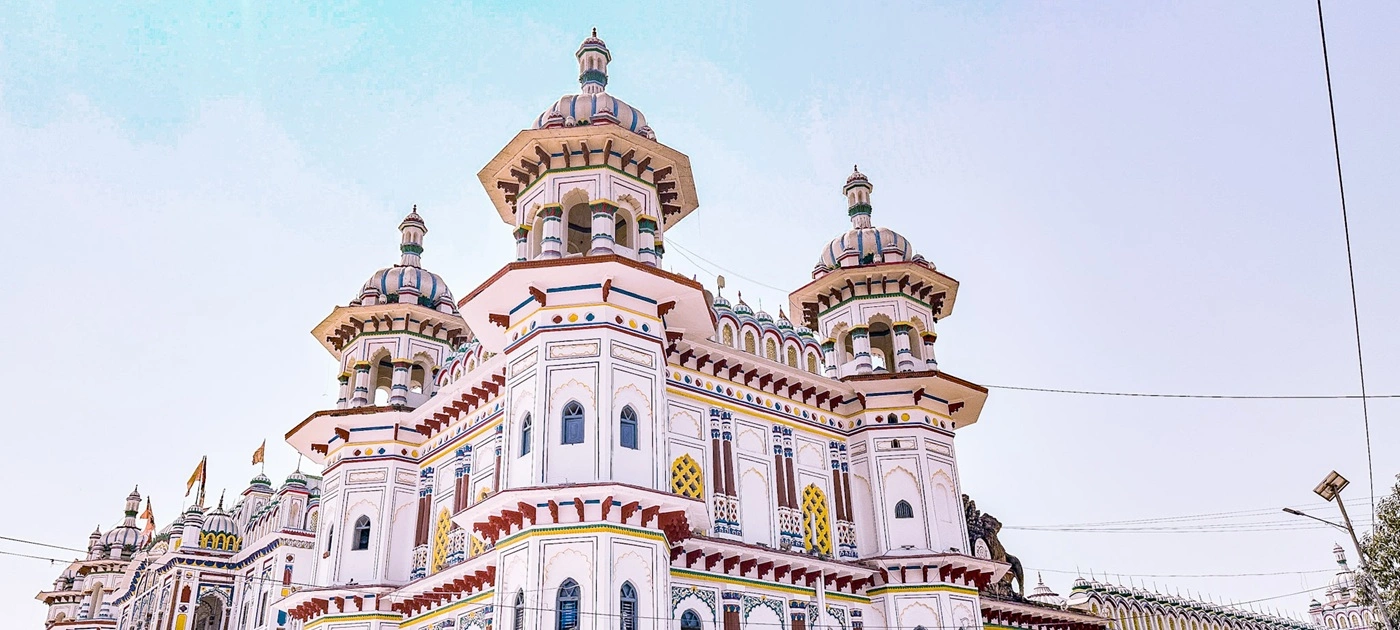
The Janaki Mandir is Nepal’s most architecturally unusual temple. Built in 1910 by Queen Vrisha Bhanu of Tikamgarh (present-day Madhya Pradesh, India), it stands 50 meters tall, combining Mughal and Rajput architectural traditions — a style found nowhere else in Nepal. The building is white plaster over stone, with latticed windows, arched colonnades, and 60 interior rooms arranged around a central sanctum containing an image of Sita.
The temple marks the spot where Sita is believed to have been born — or, in some versions of the mythology, where she emerged from a furrow in the earth plowed by her father King Janak (the name Sita means “furrow”). The Ramayana locates Janak’s kingdom in this precise region. Archaeological evidence and inscriptions support Janakpur’s historical identity as Mithila, the capital of the Videha kingdom.
The interior is richly painted with scenes from the Ramayana. The central sanctum houses an image of Sita, decorated with gold ornaments and fresh flowers, and is attended by priests who maintain a continuous cycle of pujas throughout the day. The marble floors are cool underfoot. The arched corridors create acoustic effects that amplify the chanting. In the mornings and evenings, the aarti (lamp ceremony) draws hundreds of devotees. The atmosphere is devotional, musical, and deeply feminine — Sita is the primary deity here, not Ram.
The Sacred Ponds
Janakpur is defined by water. Over 70 sacred ponds (kunds and sagars) surround the temple complex. Each is associated with a specific episode from the Ramayana or a specific ritual purpose. The two most important are Dhanush Sagar and Ganga Sagar.
|
Pond
|
Significance
|
|
Dhanush Sagar
|
The largest sacred pond in Janakpur. Named after the divine bow (dhanush) that Ram broke to win Sita’s hand in marriage.
Pilgrims bathe here before entering the Janaki Mandir. The ghats (stone steps) are used for morning rituals. The water reflects the temple at sunrise.
|
|
Ganga Sagar
|
Believed to be connected to the Ganges through an underground channel.
Sacred bathing during Chhath Puja (October-November), when devotees stand in waist-deep water at sunrise and sunset, offering prayers to the Sun God. The most visually spectacular ritual in Janakpur.
|
|
Argaja Kund
|
The pool where Sita is said to have bathed. Located near the Janaki Mandir. Smaller, more intimate. Attended by female priests.
|
The sacred pond circuit can be walked in 2-3 hours with a guide. The guide provides the Ramayana narrative for each pond — turning the walk into a moving story rather than a series of water features. Early morning is the best time: the ghats are active with devotees, the light is warm, and the reflections are undisturbed.
Mithila Art: The Women’s Painting Tradition
Mithila painting (also called Madhubani painting) is one of the oldest continuous folk art traditions in the world. It originates in the Mithila region, which spans Janakpur and the adjacent state of Bihar in India. The practice is almost exclusively a woman’s art form — passed from mother to daughter for generations.
The paintings are characterized by bold geometric patterns, dense compositions with no empty space, and a symbolic vocabulary drawn from Hindu mythology, nature, and fertility.
Traditionally, women painted directly on the mud walls of their homes using natural pigments (turmeric for yellow, indigo for blue, soot for black, rice paste for white) applied with fingers, bamboo twigs, and matchsticks. Today, the art is also produced on handmade Lokta paper and canvas for sale, but the traditional wall-painting practice continues in villages surrounding Janakpur.
The Janakpur Women’s Development Center has been instrumental in preserving and commercializing the tradition. You visit the center to watch artists at work, learn about the symbolic language of the patterns (each motif — fish, peacock, lotus, sun — carries a specific meaning related to fertility, prosperity, or protection), and purchase authenticated pieces directly from the artists.
For a deeper experience, we arrange village visits to homes where the wall paintings are still maintained as living domestic art — not museum pieces, but the actual walls of the houses where the artists live.
The Festivals
Vivah Panchami — The Divine Wedding
The most spectacular festival in Janakpur. Celebrated in November-December (Margashirsha Shukla Panchami on the Hindu calendar), Vivah Panchami re-enacts the marriage of Ram and Sita. The entire city transforms. A massive wedding procession (baraat) carries an image of Ram from the Ram Mandir to the Janaki Mandir, where a full Hindu wedding ceremony is performed by senior priests.
Hundreds of thousands of pilgrims attend. The streets are decorated with marigold garlands, coloured powder, and lights. Musicians and dancers accompany the procession. The ceremony inside the temple is broadcast on loudspeakers so the crowd outside can follow every mantra. This is not a reenactment. For the devotees, it is the actual wedding happening again.
Ram Nawami — The Birth of Ram
Celebrated in March-April (the ninth day of Chaitra Shukla Navratri). A massive pilgrimage to Janakpur. Continuous chanting and recitation of the Ramayana in the temple courtyards. Processions through the city. The Janaki Mandir is decorated at its most elaborate. Ram Nawami in Janakpur draws devotees from across Nepal and from India.
Chhath Puja — The Sun Worship at the Water
October-November. The most visually arresting ritual in the Terai. Devotees — predominantly women — fast for 36 hours, then stand in waist-deep water in the sacred ponds at sunrise and sunset, offering prayers and fruit to the Sun God.
The sacred ponds of Janakpur become the stage for a spectacle of devotion, color, and water that photographs like nothing else in Nepal. Chhath is not a Janakpur-specific festival (it is observed across the Terai and Bihar), but the density of sacred ponds in Janakpur makes it the most concentrated site for the ritual.
Maithili Culture
Janakpur is the cultural capital of the Maithili-speaking people — Nepal’s second-largest linguistic community. Maithili is a distinct language, not a dialect of Nepali. The food is different: more rice, more fish (freshwater from the Terai rivers), more mustard oil, more sweets (the Mithila sweet tradition rivals Bengal’s). The dress is different: women wear saris in the Bihari style, not the Nepali kurta-suruwal.
The architecture is different: mud-and-thatch houses with painted walls, not the stone-and-timber of the Kathmandu Valley. Janakpur gives you a completely different Nepal — one that is culturally closer to the Gangetic plain of India than to the Himalayan highlands.
How to Get There
|
Option
|
Duration / Cost
|
Notes
|
|
Flight KTM-Janakpur
|
35 min / $80-120
|
Buddha Air or Yeti Airlines. The fastest option. Small airport, no VIP lounge. Private vehicle meets you.
|
|
Drive from Chitwan
|
5-6 hours / $115-150
|
Through the Terai plains. Flat highway. Can be combined: Chitwan safari, then Janakpur pilgrimage. Private SUV.
|
|
Drive from Lumbini
|
7-8 hours / $130-160
|
Long but creates the Ramayana-to-Buddhism arc: Sita’s birthplace then Buddha’s birthplace (or reverse).
|
|
Drive from KTM
|
8-10 hours / $150-180
|
Long. Better to fly. Only for overland enthusiasts or those combining with Chitwan en route.
|
Where to Stay
Janakpur does not have luxury hotels. The best available properties are mid-range: clean, air-conditioned, functional, with attached bathrooms and restaurant service. Hotel Manaki, Hotel Rama, and Hotel Welcome are the most reliable options. They are comfortable. They are not Dwarika’s.
The luxury at Janakpur is not in the room. It is in the private guide who walks you through the Ramayana at every pond, the Mithila painting village visit that no group tour includes, the aarti at sunset when the Janaki Mandir glows in lamp light, and the access to the Vivah Panchami ceremony that we arrange months in advance.
For travelers who require luxury accommodation, we recommend flying in from Kathmandu for a full day to experience the temple, the ponds, and Mithila art, then flying back the same evening — a day-trip format that eliminates the overnight. Or we pair Janakpur with Chitwan (5-6 hours drive): two nights at Meghauli Serai, bracketing one night in Janakpur.
Sample Schedules
Day Trip from Kathmandu
Morning flight KTM-Janakpur (35 min). Private guide meets you. Janaki Mandir interior tour with Ramayana narration. Sacred pond circuit (Dhanush Sagar, Ganga Sagar, Argaja Kund). Lunch at a local restaurant (Maithili thali: rice, fish curry, mustard greens, curd, sweets). Afternoon:
Janakpur Women’s Development Center (Mithila art, meet the artists, purchase authenticated pieces). Or: village visit to see wall paintings on actual homes. Evening flight back to Kathmandu. You sleep at Dwarika’s. Janakpur gets 8 hours of your focused attention.
2-Night Pilgrimage: Chitwan + Janakpur
Day 1: Arrive in Chitwan. Meghauli Serai. Afternoon canoe safari. Evening Tharu performance. Day 2: Dawn Jeep safari. Midday drive to Janakpur (5-6 hours). Arrive evening. Attend the aarti at the Janaki Mandir at sunset — lamp flames, chanting, the marble temple glowing in warm light.
Overnight in Janakpur. Day 3: Morning sacred pond circuit. Mithila art village visit. Afternoon flight Janakpur-KTM (35 min). This pairing gives you the subtropical wildlife and the Ramayana pilgrimage in a single Terai arc.
Festival Timing
Vivah Panchami (November-December): book 6 months in advance. The city is packed. The procession and wedding ceremony are extraordinary. You need a local fixer to secure viewing positions.
Ram Nawami (March-April): large pilgrimage, continuous Ramayana recitation. Chhath Puja (October-November): the sunrise water ritual at the sacred ponds. Timed photography is exceptional. We arrange festival visits with security coordination and private transport.
Frequently Asked Questions
What is Janakpur?
The birthplace of Sita (wife of Lord Ram, central figure of the Ramayana). An ancient city in the Terai plains of southeastern Nepal. Home to the Janaki Mandir — Nepal’s only Mughal-Rajput style temple. Cultural capital of the Maithili-speaking people. Over 70 sacred ponds. Living Mithila painting tradition.
What is the Janaki Mandir?
A 50-meter-tall white marble temple built in 1910 in the Mughal-Rajput architectural style — unique in Nepal. 60 interior rooms. Marks Sita’s birthplace. Richly painted Ramayana scenes. Continuous pujas. The central sanctum houses an image of Sita decorated with gold and flowers. Mornings and evenings: aarti lamp ceremony.
What is Mithila art?
One of the world’s oldest continuous folk art traditions. Women’s art form passed from mother to daughter. Bold geometric patterns using natural pigments (turmeric, indigo, soot, rice paste) on mud walls, Lokta paper, and canvas. Fish, peacock, lotus, and sun motifs carry symbolic meaning. Visit the Janakpur Women’s Development Center or village homes with living wall paintings.
Is there luxury accommodation?
No. Mid-range hotels (clean, air-conditioned, functional). The luxury is in the access: a private guide with Ramayana expertise, a sacred pond circuit, a Mithila art village visit, and aarti attendance. We recommend a day trip from Kathmandu (fly in, fly out) or pairing with Chitwan for overnight comfort.
How do I get to Janakpur?
Flight from Kathmandu: 35 minutes (Buddha Air or Yeti Airlines). Drive from Chitwan: 5-6 hours. Drive from Lumbini: 7-8 hours. Drive from Kathmandu: 8-10 hours (fly instead). The flight is the practical choice.
What is Vivah Panchami?
The re-enactment of the marriage of Ram and Sita. November-December. A massive wedding procession carries Ram’s image to the Janaki Mandir for a full Hindu wedding ceremony. Hundreds of thousands attend. The most spectacular Hindu festival in Nepal. Book 6 months in advance.
What is Chhath Puja?
October-November. Devotees fast for 36 hours, then stand in waist-deep water in the sacred ponds at sunrise and sunset, offering prayers to the Sun God. Predominantly a woman’s ritual. The visual spectacle at Janakpur’s ponds is extraordinary. Photographs like nothing else in Nepal.
Can I combine Janakpur with Lumbini?
Yes. Lumbini (Buddha’s birthplace) to Janakpur (Sita’s birthplace): 7-8 hours by private SUV through the Terai. Creates a pilgrimage arc across the two foundational mythologies of South Asia. We build this as a 4-5 day Terai pilgrimage circuit: Lumbini (2 nights) + Janakpur (1-2 nights).
Is Janakpur suitable for all travelers?
Yes. Flat terrain. Zero altitude. No physical exertion. The Janaki Mandir and the sacred ponds are within walking distance. Air-conditioned vehicle between sites. Suitable for seniors, families, and travelers with mobility limitations. The cultural content is engaging for children 8+ with a good guide. The Mithila art is interactive.
Who should visit Janakpur?
Hindu pilgrims seeking the Ramayana sites. Art lovers (Mithila painting is globally significant). Cultural depth-seekers who have already done Kathmandu, Pokhara, Chitwan, and Lumbini. Repeat visitors want a Nepal that looks, sounds, and tastes completely different from the Himalayan highlands. Photographers during Chhath Puja or Vivah Panchami.
The Final Word
Janakpur is the Nepal that the mountains hide. No peaks. No altitude. No trekking. A flat Terai plain, a white marble temple in a style that belongs to Rajasthan, sacred ponds where women stand in waist-deep water at sunrise offering prayers to the sun, and a painting tradition where every wall of every house tells a story in geometric color.
The food tastes different. The language sounds different. The saris are tied differently. You cross the cultural boundary between the Himalayas and the Gangetic plain without crossing a national border.
If you have been to Kathmandu, Pokhara, Chitwan, Lumbini, and the mountains, Janakpur is the part of Nepal you have not seen. One day. One temple. One art form. One mythology.
And the realization that Nepal is not one country. It is at least three, stacked vertically from the Terai to the ice, and Janakpur belongs to the one at the bottom — the warmest, the flattest, and the most mythologically ancient.