The Tiger's Nest hike climbs 6.4 km round trip and about 520 m to Paro Taktsang, Bhutan's cliffside monastery at 3,120 m. Our luxury guide covers the four trail stages, the roughly 700 gorge steps, the early private slot, monastery etiquette, and how we run the day with your own guide.
Tiger’s Nest Luxury Guide

The Tiger's Nest hike is the one walk every guest of ours in Bhutan asks about, and it earns attention. Paro Taktsang — Taktsang Palphug Monastery — hangs on a granite face at 3,120 m, roughly 900 m above the Paro Valley floor.
Reaching it takes 6.4 km on foot, round trip, with about 520 m of ascent and no cable car, road, or shortcut.
It is neither a ruin nor a museum. Monks live here. A large prayer wheel turns in the courtyard at four in the morning, and the chimes ricochet off the canyon walls before the first hiker has laced a boot.
Every visitor, whatever they have paid for the rest of their journey, walks up the same trail.
That is exactly why the day rewards planning. The difference between a jostled midday climb and a quiet morning inside the temples comes down to timing, pacing, and a guide who knows the mountain — the three things we control for you.
This guide covers it all: the legend, the trail stage by stage, the light, the etiquette, and how we run the day privately.
What Is the Tiger's Nest?
The Tiger's Nest is a working Buddhist monastery built around a meditation cave in the cliffs of Bhutan's upper Paro Valley, at 3,120 m.
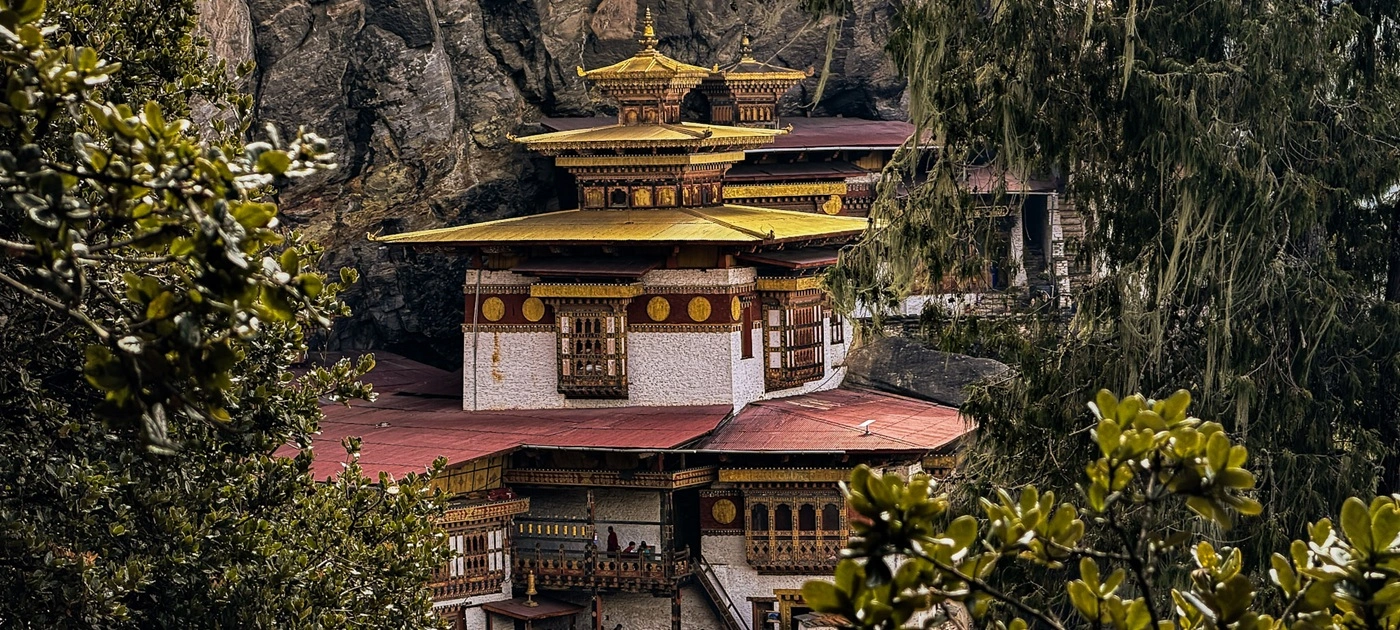
The complex is not a single building but four main temples and residential quarters woven around eight natural caves, linked by stone staircases cut into the rock and short wooden bridges spanning the gaps.
White-washed walls, red timber, gold-plated roofs. From the valley, it looks as if it were painted onto the cliff. The name Taktsang means "tiger's lair," and the reason lies in the legend below.
Bhutan measures the site's importance in access, not signage. The innermost cave opens to the public only once a year, and every phone, camera, and smartwatch is stored in a locker at the security gate. What you carry inside is your attention — which, we would argue, is the point.
The Legend of Guru Rinpoche
Legend holds that in the 8th century, Guru Rinpoche — Padmasambhava, revered in Bhutan as the Second Buddha — flew to this cliff from Tibet on the back of a tigress.
The tigress, most texts say, was his consort Yeshe Tsogyal, transformed through tantric practice.
He arrived in his wrathful manifestation, Dorje Drolo, subdued the spirits obstructing the valley, and meditated in the Pel Phug cave for three years, three months, three weeks, three days, and three hours.
The monastery grew around that cave. Bhutanese pilgrims still treat the walk as devotion first and exercise second, and the story is danced out each spring at the Paro Tshechu, with masked dancers retelling the subjugation in color and drums.
Exact festival dates follow the lunar calendar and shift each year — we confirm them at booking.
From First Temple to Fire and Rebuild
The first temple on the cliff, Ugyen Tsemo, was completed in 1508, after centuries during which meditators—Milarepa and Thangthong Gyalpo among them—used the grottos as retreat caves.
The main complex went up between 1692 and 1694 under Gyalse Tenzin Rabgye, decades after Zhabdrung Ngawang Namgyal, Bhutan's unifier, visited the site in 1646.
On 19 April 1998, a fire, likely from an overturned butter lamp, destroyed most of the buildings; one monk died, and murals and scriptures were lost.
The monastery's remoteness meant help could not arrive in time. Bhutan rebuilt it with traditional methods and historical photographs, and the complex reopened in 2005 — ancient in spirit, remarkably new in timber, with the original cave untouched at its core.
The Tiger's Nest Hike, Stage by Stage
The Tiger's Nest hike is a 6.4 km round trip from the Ramthangkha trailhead at roughly 2,600 m to the monastery gates at 3,120 m — about 520 m of ascent, taking four to six hours door to door, including time inside.
The trail was widened and re-benched in recent years, with shelters added and separate lanes for horses and walkers, but the mountain kept its gradient.
Stage 1 — The Forest Ascent
The opening 2 km climb roughly 300 m through blue pine, and rhododendron hung with old-man's-beard lichen and prayer flags, on switchbacks that pitch past 30 degrees early.
It is the hardest sustained section of the day. Our guides set a pace that feels too slow for the first ten minutes—which is why our guests reach the cafeteria still talking rather than gasping.
Horses can be arranged for this stage only, ending at the prayer wheels below the cafeteria. We book them in advance when a guest wants one, though the horse trail is rough and most people prefer to walk on their own feet.
Stage 2 — The Cafeteria
The gradient relents at the halfway cafeteria, around 2,940 m, where the forest opens to the first clean view of the monastery across the valley. Butter tea is poured here; sweet tea if you prefer. This is where the horses stop; from here, the trail belongs to walkers.
Stage 3 — The Viewpoint Traverse
The next 45 to 60 minutes trace the mountain's contour along a narrower, sunnier line to the prayer-flag viewpoint that sits at eye level with the complex.
This is the photograph — the one on every Bhutan cover — and the last place cameras are allowed to point at the monastery from close range. Your guide will happily steady a tripod; hands shake more than people expect at this altitude.
Stage 4 — The Gorge and the 700 Steps
The final half-kilometer is the hardest of the day. Roughly 700 stone steps drop into a shaded gorge, past a sacred waterfall, over a bridge, and then straight back up a last punishing staircase to the security gate.
The net elevation change is small; the psychological cost of descending after two hours of climbing is not. Knees feel this stretch — poles help, and your guide carries water and something to eat.
Timing the Climb: Season, Start, and Light
Spring and autumn are the best seasons to hike to Tiger's Nest: spring for rhododendron blooms on the lower trail, autumn for glass-clear skies and the sharpest long-distance views.
Winter puts ice on the gorge steps; the monsoon brings mud, clouds, and leeches in the forest. We route most Paro itineraries through the two prime windows and build the hike into your second or third day in-country, never the first.
Start early. The first hours give you cool air on the steep pitch and an emptier trail, and group traffic bunches at the gorge staircase from mid-morning.
We arrange the earliest practical start for the day you walk, around the trailhead's official opening.
Photographers should know one thing the brochures skip: the monastery faces away from the morning sun and sits in deep shadow until late morning.
The classic image of sunlit white walls and gold roofs is a midday shot, not a sunrise one. Since exteriors are the only photographs allowed, we often plan a quiet early entry to the temples and a slower descent past the viewpoint once the light has swung onto the cliff — two objectives, one hike.
Inside the Monastery
Everything electronic goes into a locker at the gate — phones, cameras, smartwatches — and shoes come off at each temple door. What remains is you, your guide, and four temples built around the cave.
The Taktsang Pelphug cave temple is the nucleus, guarded by a statue of Guru Rinpoche in his eight manifestations; the cave itself opens only once a year.
The shrine of the Self-Speaking Guru holds a 12-foot bronze, Guru Sungjonma, said to have declared its own wish to be brought to Taktsang — it survived both the 1951 and 1998 fires unscathed.
Guru Tshengyed Lhakhang, a two-story temple from 1692, honors the eight named forms of Padmasambhava, and Drolo Lhakhang belongs to the fierce tiger-riding manifestation, with its murals the most intense in the complex.
Where circumstances at the monastery allow, we arrange a private blessing ceremony: a monk lights 108 butter lamps and chants for your health and intentions, juniper incense in the air, one voice against stone that has absorbed twelve centuries of the same syllables. It lasts 20 to 30 minutes. No photograph exists of it, which is why guests remember it best.
Altitude, Fitness, and What to Carry
At 3,120 m the air holds roughly 70 percent of sea-level oxygen, so acclimatisation matters more than fitness. Anyone who walks regularly can do this hike; nobody should do it on their first day in Bhutan.
We schedule two nights in the Paro Valley, at around 2,200 m, before your climb, and our guides pace the opening pitch deliberately and check on you at each stage.
Drink more than feels necessary — dehydration at altitude is invisible until it isn't — and go easy on alcohol the night before. If you are altitude-sensitive, talk to your doctor before travel about preventive options.
Carry layers, not bulk: a wicking base, a light warm layer, a shell for mountain squalls.
Broken-in waterproof boots with ankle support handle the mix of dirt, rock, roots, and mule-polished stone; trekking poles pay for themselves on the 700 steps down.
Add high-SPF sunscreen, sunglasses, a brimmed hat, blister care, and two liters of water — your guide carries the rest.
Etiquette at Paro Taktsang
Dress conservatively for the monastery: shoulders and knees covered, nothing sheer or tight, and long trousers rather than shorts — the gate turns people away. Hats come off in the courtyards, shoes at every temple threshold.
Walk clockwise around prayer wheels, chortens, and anything sacred; it follows the cosmological flow of Bhutanese Buddhism and is noticed when done wrong.
The photography ban inside protects light-sensitive pigments as much as sanctity. Guests are frustrated for about five minutes.
Then they realize they are looking at the murals instead of framing them, and the frustration does not come back.
How We Run the Tiger's Nest Day
A private Tiger's Nest day with us means your own licensed Bhutanese guide, an early start timed to the gate, horses pre-arranged if wanted, permits and monastery entry handled before you arrive, and a pace built around you rather than a group.
On our Paro programs, the hike sits mid-itinerary, after your valley acclimatization nights, with the following morning kept gentle on purpose.
The descent takes two to three hours, and that's when the legs give out, and luxury shows up.
Depending on your lodge and preferences, we arrange either a chef's table set privately at the forest base — laid, cooked, and gone by evening — or a direct return to your lodge for a hot-stone bath and an early dinner.
Bhutanese hot-stone baths, river stones fired until they glow and slid into the water, were designed for exactly this kind of tiredness.
We confirm the exact property and the recovery arrangement in your booking proposal.
Getting to Paro
Paro is Bhutan's only international airport, set in a valley at 2,225 m, with an approach flown by specially certified pilots on just two carriers, Drukair and Bhutan Airlines.
From Kathmandu, the flight takes about an hour and parallels the high Himalayas — Everest, Makalu, and Kanchenjunga hold the left-side windows on a clear morning.
Direct services also connect Paro with Delhi, Kolkata, Bagdogra, Bangkok, Singapore, Dhaka, and Dubai, and overland entry is possible through the southern border towns of Phuentsholing and Gelephu.
Bhutan's Sustainable Development Fee — US$100 per adult per night at the time of writing, reduced for children — plus the visa are processed before your flight is even confirmed.
We handle the applications, the SDF transfer, and the seats; you send a passport scan. Current rates, reductions, and validity windows are kept up to date in our Bhutan SDF and visa guide.
Beyond the Day Hike
If one looks at the monastery, it is not enough; the Bumdra trek camps a night on the ridge above Taktsang and descends past the monastery the next morning — the only way to approach it from above.
And the valley itself deserves more than a hiking day: our guide to Paro beyond the Tiger's Nest covers the dzong, the farmhouses, and the quieter temples, while our review of the luxury lodges of Paro walks through where to base yourself.
The Tiger's Nest is also the anchor of most first journeys through western Bhutan — Paro, Thimphu, Punakha — which is how we build luxury travel in the Himalayas around one unmissable morning.
Tiger's Nest FAQs
How hard is the Tiger's Nest hike for an average walker?
Moderate, made harder by altitude. The Tiger's Nest hike covers 6.4 km round trip with about 520 m of ascent, and the steep forest pitch and the roughly 700 gorge steps are the two most challenging sections. Anyone who walks regularly manages it at a slow pace, with two acclimatization nights in the Paro Valley first, and uses trekking poles on the descent.
How long does the hike to Tiger's Nest take, including the monastery visit?
Four to six hours is typical: one to one and a half hours to the cafeteria, another hour to the viewpoint and through the gorge, about an hour inside the temples, and two to three hours down. We start early, so most guests are back at their lodge by mid-afternoon with the evening free.
Can you ride a horse up to the Tiger's Nest trail?
Only on the first stage, from the trailhead to the prayer wheels below the halfway cafeteria. Horses cannot continue past that point, so the viewpoint traverse and the gorge staircases are on foot for everyone. We pre-arrange a horse for guests who want one, though the horse line is rough and many riders dismount early by choice.
Why is photography banned inside Paro Taktsang?
Two reasons: flash and handling damage the centuries-old, light-sensitive murals, and Bhutan refuses to let a functioning monastery become a photo set. All phones, cameras, and smartwatches are locked away at the security gate. Exterior photography from the trail and the viewpoint is unrestricted, and that viewpoint frame is the image everyone knows anyway.
What is the legend of Guru Rinpoche at the Tiger's Nest?
Legend holds that Guru Rinpoche flew from Tibet to the cliff in the 8th century on a tigress — his consort Yeshe Tsogyal transformed — subdued the valley's hostile spirits as Dorje Drolo, and meditated in the Pel Phug cave for three years, three months, three weeks, three days, and three hours. Taktsang means "tiger's lair," and the monastery was built around his cave.
What should I wear to enter Taktsang Monastery?
Covered shoulders and knees, nothing sheer or tight, long trousers rather than shorts, and layers you can shed on the climb. Hats come off in courtyards and shoes at every temple door, so slip-on-friendly boots save fumbling. The gate does enforce the dress standard, and your guide will check you over kindly before you reach it.
When does the Tiger's Nest catch full sunlight for photographs?
Late morning onward. The monastery is built into a cliff that faces away from the morning sun, so the complex sits in shadow until around midday — the famous sunlit image of white walls and gold roofs is a midday photograph. We plan a quiet early temple visit first, then let you pass the viewpoint again on descent once the light has arrived.
Can a helicopter land at the Tiger's Nest?
No. Charter flightseeing over the Paro Valley can overfly the monastery for scale, but nothing lands on the cliff, and entry is on foot for every visitor — that is deliberate. Where a charter fits your wider Bhutan routing, we price it in your proposal; for the Tiger's Nest itself, the trail is the only door.
There is a moment on the viewpoint traverse when the forest opens, and the monastery appears across the gorge, and every guest — the marathoners and the once-a-year walkers alike — stops mid-sentence.
Earning that moment on foot is the whole design. If you want it built into a private journey through western Bhutan, our Best of Bhutan tour puts the Tiger's Nest morning at the center of a week that also covers Thimphu and Punakha.
Tell us your dates, and we will plan the rest around them.
Need Help? Call Us+977 9851013196orChat with us on WhatsApp
Need Help? Call Us+977 9851013196