The Kathmandu Valley has more festivals than most countries have public holidays. But among all of them — Dashain, Tihar, Holi, Indra Jatra, the Tshechus across the border in Bhutan — the Rato Machhindranath Jatra stands apart. Not because it is the most visually dramatic (though it is), but because it is the most structurally complex. It involves more people, more caste groups, more theology, more engineering, more civic negotiation, and more raw physical effort than any other festival in Nepal.
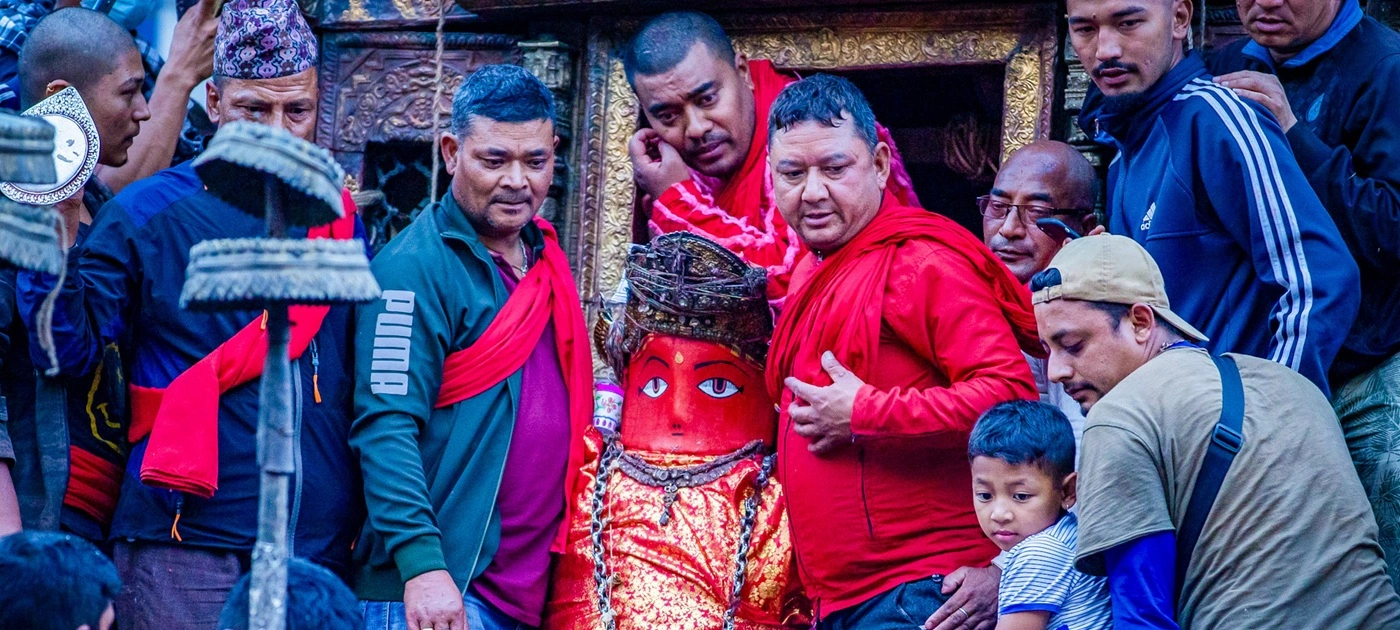
The festival is dedicated to Rato Machhindranath — the “Red God” — whose crimson face is repainted each year with a pigment called Simrik. The deity is the supreme guarantor of the monsoon rains. In a valley whose traditional agrarian economy depends entirely on the timely arrival of the summer monsoon to irrigate the terraced rice paddies, this is not abstract spiritual symbolism. It is a survival infrastructure. The festival exists because, without rain, the valley starves.
At Alpine Luxury Treks, our base is in Kathmandu, seven kilometers from the heart of the procession route. Our team watches the chariot pass through Mangalbazar every year. Several of our guides grew up in the Newari neighborhoods the chariot moves through. This guide draws on that proximity and that generational knowledge to explain what the festival actually is, what it means, and what a visitor needs to understand to appreciate it at depth.
In This Guide
- The origin myth: the twelve-year drought and the journey to Assam
- One god, two religions: the syncretic theology
- The chariot: 60 feet of nail-less engineering
- The 32 guilds: who builds it and how
- The 2026 route through Patan
- The women’s chariot pull
- The Bhoto Jatra: the climax and the stolen vest
- Urban heritage vs modern city: the tension that defines the festival
- How to experience the Jatra as a visitor
- Frequently asked questions
The Origin Myth: A Twelve-Year Drought and a Journey to Assam
The festival's founding story is a political allegory disguised as a rain legend. According to traditional Newari chronicles, during the reign of King Narendra Deva of Bhaktapur (circa 640–683 AD), the Kathmandu Valley endured a catastrophic twelve-year drought. The cause was specific and personal: Guru Gorakhnath, the foundational saint of the Nath Sampradaya, was furious that the people of Patan had failed to offer him proper respect. In response, the sage sat directly on top of the nine Nagas — the serpentine deities responsible for generating rainfall. His yogic meditation pinned them to the ground. The rain stopped. The crops died. The valley began to collapse.
The royal Tantric priest diagnosed the problem and prescribed the only solution: bring Machhindranath — Gorakhnath’s own guru and spiritual superior — from his dwelling in Kamrup Kamakhya, in present-day Assam, India. King Narendra Deva personally led an expedition east, accompanied by the priest Bandhu Dutta and a Newari farmer named Lalit, who represented the suffering agrarian population.
Through Tantric invocations and the summoning of four fierce Bhairabs to assist in the transport, the team brought the deity back to the valley. The moment Machhindranath arrived, Gorakhnath rose from his meditation out of reverence for his teacher. The Nagas were released. The rains came.
The political message embedded in this myth is striking. The king, the priest, and the farmer work together to restore ecological balance. The legitimacy of the state is tied directly to its ability to ensure rainfall and agricultural survival. By instituting the annual chariot procession in gratitude, King Narendra Deva fused the material interests of the farming population with the divine authority of the monarchy. Fourteen centuries later, the procession continues — and the head of the Nepali state still attends.
One God, Two Religions: The Syncretic Theology
The most theologically remarkable feature of the Rato Machhindranath Jatra is that Hindus and Buddhists worship the same deity, in the same chariot, on the same day, and both consider it their own.
The Buddhist Identity: Karunamaya
To the Newar Buddhists of the valley, the deity is Bunga Dyah — a localized manifestation of Avalokiteshvara, the Mahayana Bodhisattva of Compassion. He is called Karunamaya, “The Compassionate One,” a title reflecting the Bodhisattva’s vow to delay personal liberation until all sentient beings are freed from suffering. His role as rain-bringer aligns with this mandate: without rain, people starve. Bringing rain is an act of universal compassion.
The Hindu Identity: Matsyendranath
To Hindus, the deity is Matsyendranath — “The Lord of the Fishes.” In Hindu tradition, he is a foundational yogic saint and an earthly incarnation of Shiva. The legend holds that Matsyendra was swallowed by a giant fish and spent twelve years inside its belly, listening to Shiva’s secret teachings on yoga as they were transmitted to Parvati. He emerged as an enlightened Siddha, bridging the gap between divine knowledge and human practice.
This dual identity is not a marketing convenience. It is a genuine theological structure that has allowed the festival to unify the valley’s religiously diverse population for over a millennium. The Hindus and Buddhists of Patan pull the same ropes attached to the same chariot carrying the same deity. Neither side sees a contradiction.
THE COMPANION DEITY: MINNATH
The Rato Machhindranath chariot never travels alone. It is always accompanied by a smaller, 32-foot chariot carrying Minnath, a deity whose cult predates Machhindranath in Patan by centuries. When King Narendra Deva consolidated the valley’s chariot festivals, Minnath’s older tradition was absorbed into the larger Machhindranath festival. According to legend, Minnath was furious about being overshadowed and struck a chaitya in anger, causing ‘unpleasant occurrences.’ A compromise was codified: Minnath escorts the main chariot through the city. He leads the procession from Pulchowk to Sundhara, then falls slightly behind. Minnath is the ‘giver of life’; Machhindranath is the ‘giver of food.’ Together, they represent the inseparability of biological existence and agricultural sustenance.
The Chariot: 60 Feet of Nail-Less Engineering
The physical centerpiece of the festival is the rath — a 60-foot (roughly 20-meter) wooden tower on four massive wheels, constructed entirely without iron nails, screws, or modern metal fasteners. The structural integrity relies on traditional joinery, mature timber, and an intricate lacing of cane and thick jute rope. The engineering methodology has been unchanged for over a thousand years.
The four massive wheels are carved from Suar wood (Samanea saman) and are not merely functional. They represent the four Bhairabs — Kundi, Harisiddhi, Lubhu, and Tika Bhairav — acting as the deity’s fierce supernatural bodyguards. The three directions of the chariot’s upper deck represent Brahma, Vishnu, and Maheshwar. Every structural element carries symbolic weight.
The prohibition on metal fasteners is a strict religious mandate. Breaking this rule would invalidate the entire chariot’s ritual purity. This means the engineers must ensure structural stability for a 60-foot tower that will be dragged through narrow streets by hundreds of people, while absorbing lateral forces, road vibrations, and the occasional collision with a building's corner — using only wood, rope, and cane. It is a masterclass in tension mechanics and structural balancing that defies modern architectural conventions.
The 32 Guilds: Who Builds It and How
The construction and operation of the Jatra is not managed by a single contractor or government agency. It is distributed among 32 distinct Newari caste groups, each with specific, inherited responsibilities passed down through generations. Two guilds are critical above all others.
The Barahi Guild: Master Carpenters
The Barahi are responsible for the primary woodwork: sourcing timber, carving the massive wheels, constructing the heavy base framework (the Yak Kha), and building the tower's structural skeleton. In 2026, 35 Barahi craftsmen were deployed. These are career artisans whose knowledge is entirely intergenerational — there is no formal school or training program. You learn by watching your father and grandfather build the chariot. If a generation fails to pass on the knowledge, it is lost.
The Yanwal Guild: Rope and Cane Specialists
The Yanwal handle the binding — the cane, rattan, and thick jute ropes that hold the nail-less wooden joints together. They construct the upper floors of the tower and install the 16 long wooden stabilizing pieces known as Lasi. Without the Yanwal’s rope-work, the Barahi’s woodwork would collapse under its own weight.
These artisans receive no modern insurance despite the extreme physical risk of constructing and climbing a 60-foot structure held together by rope. Their participation is driven by devotion and intergenerational obligation, not compensation.
In the weeks before the 2026 festival, fires during political protests destroyed two of the chariot’s completed wooden wheels. Under strict religious tradition, if even a single wheel is damaged, all four must be entirely rebuilt to maintain ritual purity. The Barahi guild worked around the clock in an emergency reconstruction — sourcing new Suar wood, carving four massive wheels, and installing them by mid-March — a process normally undertaken only once every 12 years. The festival proceeded on schedule.
The 2026 Route Through Patan
The chariot’s journey through Lalitpur (Patan) is not a continuous parade. It is a slow, sporadic, month-long passage through the city’s historic core, with stops lasting anywhere from hours to weeks. The route transforms ordinary streets into an active ritual space. When the chariot stops for the day — signaled by three gunshots fired into the air — the surrounding neighborhood erupts into celebration, inviting relatives to feasts of traditional Newari food.
|
Date (2026)
|
Location
|
What Happens
|
|
April 18–19
|
Pulchowk
|
Ratharohana: the restored idol is installed in the completed chariot amid Tantric blessings and traditional Dhimay drumming.
|
|
April 21
|
Pulchowk → Gabahal
|
First major pull. Hundreds of devotees drag the chariot to its first stop at Gabahal.
|
|
April 22
|
Gabahal → Mangalbazar
|
Chariot moves to Patan Durbar Square. Local feasts (Chwayla:bhu) and continuous worship.
|
|
Late Apr – May
|
Urban procession
|
Slow navigation through Hakha, Sundhara, Chakrabahil to Lagankhel. Days between each pull.
|
|
Mid–Late May
|
Lagankhel → Thati
|
Sacred coconut thrown from the chariot’s peak. Women exclusively pull the chariot to Thati (Yakah Misaya Bhujya). Chariot rests for weeks.
|
|
June 1
|
Jawalakhel
|
Bhoto Jatra: the sacred vest is displayed to the crowd and the Head of State. Festival concludes. Chariot dismantled. Deity returns to Bungamati.
|
Every twelve years, the protocol changes dramatically. Instead of building the chariot at Pulchowk, it is constructed in Bungamati — the deity’s winter village, six kilometers south of Patan. From there, the massive structure is pulled through miles of varied terrain, through Bhaisepati, Nakkhu, Bhanimandal, and Jhamsikhel, before reaching Pulchowk. The nocturnal movement of the chariot down the streets of Jhamsikhel during the 12-year cycle is described by devotees as particularly intense. The city’s planned flyovers have been legally mandated to include sufficient vertical clearance for the 60-foot chariot’s 12-year transit — a medieval religious structure literally dictating 21st-century civil engineering.
The Women’s Chariot Pull: Yakah Misaya Bhujya
For the vast majority of the month-long festival, the heavy jute ropes are hauled by throngs of men. But on a specific astrologically designated day during the chariot’s transition from Lagankhel to Thati, the tradition mandates a total gender reversal.
During the Yakah Misaya Bhujya — literally “the women’s chariot pulling” in Nepal Bhasa — the ropes are handed over exclusively to female devotees. Women of all ages, from young girls to grandmothers, gather in the thousands to drag both the main Rato Machhindranath chariot and the smaller Minnath chariot along this stretch of the route.
The ritual serves a function that goes beyond symbolism. By ensuring that the chariot physically cannot complete its journey without the labor of women, the festival enacts a public acknowledgment of women’s indispensable contribution to communal survival. It ties the female life-giving force to the agricultural life-giving force of the rain god. In a deeply patriarchal society, this tradition is one of the most remarkable public expressions of women’s spiritual agency in South Asian religious practice.
The Bhoto Jatra: The Climax and the Stolen Vest
The festival’s climax is the Bhoto Jatra — the Festival of the Vest. Scheduled for June 1 in 2026, it draws hundreds of thousands of spectators and triggers a public holiday across Kathmandu, Lalitpur, and Bhaktapur.
The backstory is a disputed legend. According to tradition, the king of the serpents (Nagaraj) gave a jewel-studded black vest to a Newari farmer as gratitude for curing his wife’s blindness. A Lakhey (a powerful demon figure) stole the vest while the farmer worked in his fields. Years later, the farmer spotted the demon wearing it during the Machhindranath festival. A violent dispute erupted. The presiding king confiscated the vest and placed it in the custody of Rato Machhindranath, decreeing that it would be publicly displayed every year until someone could prove ownership.
Today, in the presence of the President of Nepal, the Prime Minister, the Living Goddess Kumari of Patan, and massive security forces, a Guthi official climbs to the top of the chariot. He holds the vest aloft and displays it in all four cardinal directions, calling out three times: “Yo bhoto kasko ho?” — “Whose vest is this?” Nobody steps forward. The vest returns to the deity’s custody for another year.
The ritual is a public metaphor for divine justice, transparency, and the rule of law. It demonstrates that the deity is the ultimate arbiter of human disputes and validates the state's temporal authority. Following the Bhoto display, the chariot is dismantled, and the idol is carried on a palanquin back to Bungamati for a six-month winter residence.
Urban Heritage vs Modern City: The Tension That Defines the Festival
The Rato Machhindranath Jatra is not a museum exhibit. It is a living system that collides with the 21st century every year. The collision is sometimes beautiful and sometimes violent.
The Pond Restoration
The Saptapatal Pokhari — a Licchavi-era pond in Lalitpur with deep religious ties to the Machhindranath cult — was nearly erased by commercial development. A school built a commercial complex on the pond’s northern bank and paved a road over the western side. After a 15-year legal battle initiated by heritage activist Purna Sthapit in 2004, the Supreme Court ordered restoration. In 2025-2026, the Lalitpur Metropolitan City commenced a Rs. 240 million project to rebuild the pond using traditional bricklaying techniques with sand and sticky black soil.
Smart Traffic and Flyover Design
In April 2026, Lalitpur installed an Intelligent Traffic Control System at six intersections along the chariot route — Kupandol, Harihar Bhawan Chowk, Jhamsikhel, Dhobighat, Jawalakhel, and Lagankhel. The sensor-based system manages vehicle flow around the resting chariot, which can block a major road for weeks. Planned flyovers at Ekantakuna have been legally mandated to use loop designs with enough vertical clearance for the 60-foot chariot. Medieval religious engineering is literally dictating modern highway design.
The 2020 Clash
During the COVID-19 pandemic, government lockdowns repeatedly delayed the procession past its astrological window. Hundreds of locals gathered at Pulchowk with traditional instruments and began pulling the chariot in defiance of state prohibitory orders. Riot police responded with tear gas and water cannons.
A city-wide military curfew was imposed. Eventually, a tense compromise was reached: a kshama puja (forgiveness worship) was performed under police guard, and the chariot was taken directly to Bungamati via a truncated route that bypassed the Bhoto Jatra entirely. The incident demonstrated that the festival carries enough cultural gravity to challenge state mandates.
How to Experience the Jatra as a Visitor
The Rato Machhindranath Jatra is not a single-day event. It unfolds over two months. As a visitor, you need to know when to be where.
The Best Day for First-Time Visitors: Bhoto Jatra (June 1, 2026)
The Bhoto Jatra at Jawalakhel is the most concentrated single-day spectacle of the entire festival. Hundreds of thousands of people. The President and Prime Minister are in attendance. The vest hung from the top of the chariot. The crowd’s collective response when the official calls out “Whose vest is this?” three times. If you can only attend one day, this is the one.
The Best Days for Cultural Depth: The Chariot Pulls
The day-to-day chariot pulls through Patan’s narrow streets are more intimate and arguably more powerful than the Bhoto Jatra. You stand on medieval streets watching hundreds of people drag a 60-foot tower past buildings that are themselves 400 years old. The Dhimay drums. The three gunshots signal the day’s stop. The neighborhood feasts that erupt the moment the chariot rests. Our cultural guides know the route intimately and position you for the best viewing angles without getting caught in the densest crowd surges.
The Women’s Pull
The Yakah Misaya Bhujya is the most emotionally affecting single moment of the festival. Watching thousands of women — from teenage girls to grandmothers — take up the ropes and pull the chariot through the streets is genuinely moving, transcending cultural distance. The date is astrologically determined and shifts year to year. We monitor the Guthi announcements and inform our guests in advance.
“In May 2024, we took Dominique and François Girard from Geneva to the Rato Machhindranath chariot pull at Mangalbazar. Dominique, a retired UNESCO heritage consultant, had spent her career assessing intangible cultural heritage sites across Southeast Asia. She watched the Barahi craftsmen adjusting the cane bindings on the chariot while devotees surged around the wheels. She turned to our guide and said: ‘I have evaluated 200 heritage sites in my career. This is the most complex living heritage I have ever seen. The chariot is an engineering system. The route is a social system. The theology is a political system. And all three systems are running simultaneously, right now, in front of us.’”
The chariot pull routes pass through narrow streets with no formal spectator areas. Wear comfortable shoes suitable for standing on uneven cobblestone for 2-3 hours. Carry water. Protect camera gear from the crowd density. Respect the devotees — this is a religious event, not a parade. Our guides know the safest vantage points (several rooftop locations with arrangements through local families) and will brief you on etiquette before the event.
Frequently Asked Questions
What is the Rato Machhindranath Jatra?
The Rato Machhindranath Jatra is the longest-running chariot festival in Nepal, celebrated annually in Lalitpur (Patan) over approximately two months from April through June. It involves constructing a 60-foot wooden chariot without nails, which is dragged through the city’s medieval streets by thousands of devotees. The festival honors Rato Machhindranath, a deity worshipped simultaneously as a Hindu yogic saint (Matsyendranath) and a Buddhist Bodhisattva of Compassion (Karunamaya/Avalokiteshvara). The culmination is the Bhoto Jatra, during which a sacred, jewel-studded vest is displayed in the presence of the Head of State.
When is the Rato Machhindranath Jatra in 2026?
The chariot installation (Ratharohana) takes place on April 18-19, 2026, at Pulchowk in Patan. The chariot procession moves through the city from late April through May. The climax — the Bhoto Jatra at Jawalakhel — is scheduled for June 1, 2026 (Jestha 18, Nepal Sambat 2083). Dates are determined by the lunar calendar and may shift slightly based on astrological calculations by Guthi astrologers.
Why is the chariot built without nails?
A strict religious mandate dictates that the chariot must be constructed entirely without iron nails, screws, or modern metal fasteners. Using metal would invalidate the chariot’s ritual purity. The 60-foot structure relies on traditional timber joinery, cane, and thick jute rope for its structural integrity. The engineering methodology has been unchanged for over a thousand years and is executed by the Barahi (master carpenters) and Yanwal (rope specialists) guilds of the Newar community.
Why is the same deity worshipped by both Hindus and Buddhists?
The Kathmandu Valley’s religious landscape is deeply syncretic. To Newar Buddhists, the deity is Karunamaya — a manifestation of Avalokiteshvara, the Bodhisattva of Compassion. To Hindus, the deity is Matsyendranath, a foundational yogic saint and incarnation of Shiva. Both traditions pull the same chariot with equal devotion. This dual identity has allowed the festival to unify the valley’s religiously diverse population for over 1,400 years.
What is the Bhoto Jatra?
The Bhoto Jatra (“Festival of the Vest”) is the climax of the festival, held at Jawalakhel in the presence of the President, Prime Minister, and the Living Goddess Kumari of Patan. A Guthi official displays a sacred jewel-studded black vest from the top of the chariot in all four directions, calling out three times: “Whose vest is this?” The legend holds that the vest was given to a farmer by the serpent king and stolen by a demon. Until someone proves ownership, the vest remains in the deity’s custody. The ritual symbolizes divine justice and the rule of law.
Can international visitors attend the festival?
Yes. The festival takes place in public streets and open spaces throughout Lalitpur. There are no tickets or entry restrictions. However, the crowds are massive, and the narrow streets can become intensely congested. We strongly recommend attending with a local guide who knows the route, the safe vantage points, and the cultural etiquette. We arrange festival-focused cultural itineraries so that your stay in Kathmandu overlaps with the key festival days.
What is the women’s chariot pull?
The Yakah Misaya Bhujya is a specific ritual day during which the chariot ropes are handed exclusively to female devotees. Women of all ages pull both the main Machhindranath chariot and the smaller Minnath chariot along a designated stretch of the route. The tradition ties the female life-giving force to the agricultural life-giving force of the rain god, and it is one of the most remarkable expressions of women’s spiritual agency in South Asian religious practice.
Where does the deity live for the rest of the year?
Rato Machhindranath divides his time between two residences. For six months during the monsoon and agricultural season, the idol resides in the Ta Baha temple in Patan’s urban center. Following the Bhoto Jatra, the idol is carried by palanquin to Bungamati, a farming village six kilometers south of Patan, where it resides for the dry winter months. This cyclical movement physically links the urban artisan center of Patan with the rural agrarian periphery of Bungamati.
How does the festival affect traffic and city life in Patan?
Significantly. The 60-foot chariot can block major roads for days or weeks at a time. In 2026, Lalitpur installed an Intelligent Traffic Control System across six intersections along the route. Planned city flyovers have been legally mandated to include vertical clearance for the chariot. If you are visiting Patan during the festival period (April-June), expect road closures and redirected traffic — your guide and driver will navigate around the disruptions.
Is the Rato Machhindranath Jatra the same as the Seto Machhindranath Jatra?
No. They are distinct festivals dedicated to different manifestations of the same deity. The Rato (Red) Machhindranath Jatra takes place in Lalitpur (Patan) over two months from April to June. The Seto (White) Machhindranath Jatra is a shorter, three- to four-day festival in Kathmandu, typically held in March. The two festivals highlight the highly localized civic pride embedded within Newar religious traditions.
The Final Word
The Rato Machhindranath Jatra is not a performance. It is a system — theological, structural, political, and ecological — that has been running continuously for fourteen centuries. The 32 guilds build a 60-foot tower without nails. The Hindus and Buddhists worship the same god in the same chariot. The women take the ropes and pull the deity to his resting place. The head of state attends the vest display. The city redesigns its flyovers to accommodate a medieval wooden structure. And all of it happens because the valley needs the rain, and the red god brings it.
If you are in Nepal between April and June, and you have even a passing interest in understanding how a living civilization actually works — not as a museum exhibit, but as a functioning, sometimes volatile, always extraordinary system — tell us. We will time your itinerary to place you on the right street, with the right guide, on the right day.
Planning a trip during the Rato Machhindranath Jatra?
Tell us your travel window. We will check the festival calendar, identify the most meaningful days for your visit, and build a cultural itinerary around them.