The Village That Rejects Dashain
In a nation where nearly eighty percent of the population celebrates Dashain — the fifteen-day festival honoring Durga’s victory over the buffalo demon Mahishasura — the village of Khokana opts out. Completely. No Jamara. No tika. No goat sacrifices in the Dashain tradition. While the rest of Nepal enters the country’s most widely observed religious period, Khokana turns inward, devoting itself entirely to its own goddess.
The reason is both practical and theological. Centuries ago, Khokana’s agrarian community faced an impossible economic choice: celebrate both Dashain and their own Sikali Jatra simultaneously, or choose one. Two major festivals back-to-back would exhaust the agricultural surplus, require an unsustainable number of animal sacrifices, and physically deplete the community during the critical post-harvest period. They chose Sikali. Their own goddess. Their own protector. Their own children’s guardian. The national incarnation of Durga was important, but Goddess Rudrayani lived in the forest. She was closer. She was theirs.
That pragmatic decision, made centuries ago, solidified into cultural identity. Today, the rejection of Dashain is not a financial calculation. It is a statement of sovereignty. Khokana celebrates what belongs to Khokana.
At Alpine Luxury Treks, we arrange visits to the Sikali Jatra for a small number of guests each October, typically combining it with a visit to Bungmati and a broader cultural itinerary of the Kathmandu Valley. This guide explains what the festival is, what happens during its nine days, and why it matters.
In This Guide
- Khokana and Bungmati: twin villages, different gods
- The mythology: a healed leper, a weeping priest, and a goddess in the forest
- Why Khokana rejects Dashain
- The eight Kumar boys: secret tantric isolation
- The nine-day festival schedule (2026 dates)
- The fourteen Devgan masked dancers
- The Guthi system: how the festival funds itself
- Visiting Khokana: logistics and etiquette
- Frequently asked questions
Khokana and Bungmati: Twin Villages, Different Gods
Khokana and Bungmati sit a few kilometers apart in the Lalitpur district, ten kilometers south of Kathmandu. Travel agencies frequently bundle them as a single day-trip. But while the villages share medieval Newari architecture and agrarian roots, their spiritual centers are radically different.
Bungmati’s identity revolves around Rato Machhindranath — the red-faced rain god we cover in depth in our dedicated Rato Machhindranath Jatra guide. He is a pan-valley deity whose chariot festival draws hundreds of thousands of devotees from across the Kathmandu Valley. His jurisdiction is regional. His function is ecological: bringing the monsoon rains.
Khokana’s identity revolves around Goddess Sikali (Rudrayani) — a fierce mother goddess with a strictly local jurisdiction. She does not bring rain. She protects children. She heals disease. She guards the village from spiritual catastrophe. Her festival draws the people of Khokana and almost nobody else. During the Sikali Jatra, Bungmati residents may visit as observers, but they do not play a ritual role. The ceremonies belong exclusively to Khokana’s own Guthis.
Khokana’s other historical distinction: it was the first settlement in Nepal to receive electricity, in 1911, under Rana Prime Minister Chandra Shamsher. It was also historically the primary supplier of hand-pressed mustard oil to the entire Kathmandu Valley. The traditional wooden presses have mostly given way to industrial production, but the village’s identity remains tied to this agrarian heritage. A town that received electricity before most of Asia and still rejects the country’s biggest festival in favour of its own goddess: Khokana runs on its own logic.
The Mythology: A Healed Leper, a Weeping Priest, and a Goddess in the Forest
The name “Khokana” itself carries its founding trauma. In Newari, “Kho” means “weep” and “Kana” means “tell.” The village of weeping and telling.
The settlement was originally named Jitapur (“City of Victory”) when King Amar Malla of the Malla dynasty relocated farming families from the Pachali Bhairav area of Kathmandu to the hilltop site, assigning them to maintain the newly established Rudrayani Temple and to guard the spiritual border of the kingdom. The name changed after a traumatic founding event.
One legend involves a Maharjan priest who collapsed with a severe fever and was presumed dead. His community took him to the Bagmati River for cremation. As the pyre was being prepared, the priest regained consciousness. He sat up, weeping uncontrollably, telling the story of his journey to the threshold of the afterlife. The village became “the place of weeping and telling.”
The other founding legend is more powerful. A man afflicted with leprosy was expelled from the Kathmandu Valley and buried alive. Goddess Sikali intervened. She brought him back to life and cured his disease entirely. The resurrected man and his wife settled in the area. The worship of Sikali as a protector against disease and pestilence was established in gratitude.
Both myths validate Sikali not as a deity imposed by a distant king, but as a local savior of the marginalized, the sick, and the buried alive. The etymology preserves the emotional core: a community founded on suffering, miraculous intervention, and bearing witness.
THE GEOGRAPHY OF THE SACRED
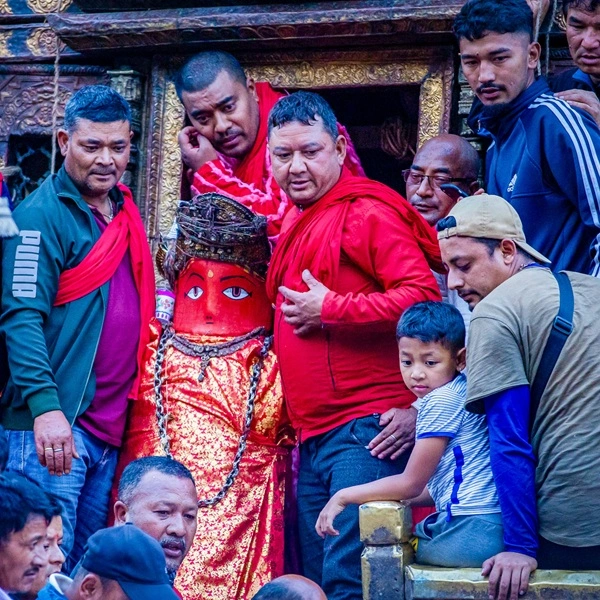
Khokana has two temples, and the distance between them defines the festival’s spatial logic. The main Rudrayani Temple sits in the dense center of the village — a three-tiered pagoda housing the goddess year-round. The Sikali Temple (Sikali Pith) sits fifteen minutes’ walk outside the village, on a grassy hill surrounded by paddy fields with views of the Chandragiri and Champadevi hills. “Sikali” derives from “Si-Kali” — “the Kali of the woods.” The festival requires a physical procession between these two sites: from the ordered human settlement to the wild, untamed periphery where the goddess’s most primal form resides. The journey ritually reclaims the agricultural territory, purifies the fields, and acknowledges the necessary relationship between the village and the wilderness.
Why Khokana Rejects Dashain
This is the detail that makes Khokana unique in all of Nepal.
The Sikali Jatra was originally celebrated during the late-summer Gai Jatra period. When the community relocated from their earlier settlement of Kudesh to escape malevolent spirits, the festival dates were shifted to the autumn period — landing directly on top of Dashain. Faced with two resource-intensive festivals simultaneously, the agrarian community made a strategic choice. They could not afford both. They chose their own goddess over the national one.
|
Element
|
Mainstream Nepal (Dashain)
|
Khokana (Sikali Jatra)
|
|
Deity
|
Goddess Durga (universal)
|
Goddess Sikali/Rudrayani (local)
|
|
Day 1 ritual
|
Sow barley seeds for Jamara
|
8 Kumar boys enter the temple for secret tantric isolation
|
|
Blessing symbol
|
Tika and Jamara from the elders
|
Healing rice prasad from the Guthi leaders
|
|
Public spectacle
|
Family gatherings, kite flying, bamboo swings
|
Chariot procession, Ashwamedha fire ritual, 14 masked Devgan dances, fire-crossing
|
Over centuries, what began as an economic compromise became a defining identity marker. Today, Khokana’s rejection of Dashain is not regretted or explained away. It is celebrated. The village defines itself through what it refuses as much as through what it observes.
The Eight Kumar Boys: Secret Tantric Isolation
Before anything public can happen — before the chariot moves, before the masked dances begin, before the fire is lit — the festival’s spiritual foundation must be established through extreme purification. This is the role of the Kumar boys.
Eight virgin, pre-pubescent boys are selected — four from the Tagu community, four from the Salagu community. The number eight corresponds to the Astamatrikas, the eight mother goddesses who guard the cardinal directions of the Kathmandu Valley.
On Day 1 (Ghatasthapana), the boys enter the secluded Sikali Temple. They remain inside in strict isolation for four days, performing secret tantric pujas. The secrecy is total. Local tradition holds that the atmosphere is so spiritually charged that “not even birds are allowed to fly in the area” during the incantations.
For the duration of the festival — from Ghatasthapana through Kojagrat Purnima — the boys adhere to radical physical discipline. They eat only one ritualized meal per day. They are forbidden from consuming eggs, chicken, garlic, or alcohol. They bathe in the Bagmati River in complete nudity, stripping away all worldly attachment. During worship inside the temple, they wear only a white Daura covering their upper bodies.
The theological logic is precise: the divine, in its rawest and most powerful form, cannot be accessed by ordinary, “polluted” adults. Only through the absolute innocence of pre-pubescent youth, radical fasting, and unflinching ritual purity can the community successfully invoke Sikali’s protective power. The Kumar boys are the key that unlocks the goddess.
The Nine-Day Festival: October 2026
|
Day
|
Date
|
What Happens
|
|
Day 1
|
Oct 11
|
Ghatasthapana: 8 Kumar boys enter the Sikali Temple. Buffalo sacrificed at the main medieval gate. Three boys collect blood for the temple offering. Secret fasts and pujas begin.
|
|
Days 2–4
|
Oct 12–14
|
Secret pujas continue inside the sealed temple. Guthis repairs the chariot, prepares costumes, brews food, and rice beer. Day 3: three buffalo sacrifices at the temple (unblemished, unpierced, with full teeth). Day 4: Choilabu feast for Guthi heads.
|
|
Day 5
|
Oct 15
|
THE MAIN DAY. Idol of Rudrayani brought out. Chariot procession through Khokana to the peripheral Sikali Temple on the grassy hill. Nine sacred copper vessels (Ghampo) were raised. Ashwamedha Yagya fire ritual begins at dusk and continues through the night.
|
|
Day 6
|
Oct 16
|
CLIMAX. 14 Devgan masked dancers perform. Fire-crossing ritual — Devgans walk through flames unharmed. Guthi leaders circumambulate the temple carrying a massive pot of blessed rice. Healing rice prasad was distributed to devotees.
|
|
Day 7
|
Oct 17
|
Fulpati: masked dances continue in village streets. Divine masks are ritually deactivated using tantric procedures and stored inside the Rudrayani temple.
|
|
Days 8–9
|
Oct 18–20
|
Rudrayani’s idol returned to her permanent temple in the village center. Public rituals conclude. Communal feasts through Kojagrat Purnima (Oct 26). Families consume sacrificial meat, drink rice beer, and prepare for the winter harvest.
|
The Fourteen Devgan Masked Dancers
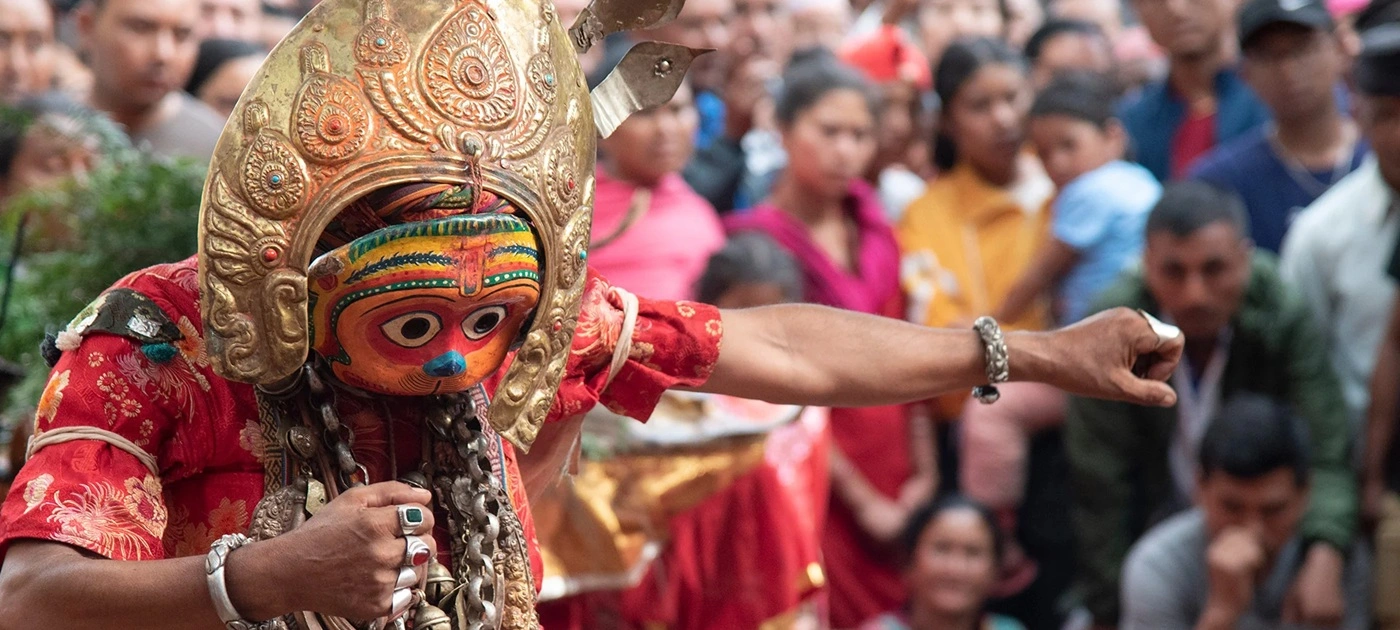
The masked dances on Day 6 are not theatre. When a Guthi member dons a consecrated mask, the community believes the deity's spirit enters his body. His movements are guided by the god. His fatigue is absorbed by divine energy. His blessings are genuine.
Of the 46 designated Devgans in the Rudrayani Guthi, 32 handle logistics — carrying holy vessels, burning incense, playing instruments, serving food. The remaining 14 become living incarnations of the gods.
The fourteen deities include Rudrayani (Sikali) herself as the fierce patron, Bhairava as Shiva’s terrifying guardian form, Kumari as the pure virgin goddess, Ganesha as the obstacle-remover, the three gods of the Hindu trinity (Brahma, Vishnu, Mahadeva), four of the Astamatrikas (Indrayani, Barahi, Kali/Chamunda, Mahalakshmi), Kumar and Shakti Kumar as the war gods, and Hanuman as the symbol of absolute devotion.
What the Dances Depict
The choreographies draw from regional folklore and classical scripture. One central sequence features Rudrayani battling imaginary demons — the goddess defending her village against invisible spiritual threats. Another sequence re-enacts the story of Sati’s death from the Skanda Purana: Sati throws herself into the sacrificial fire after her father Daksha insults Shiva. The grief-stricken Shiva unleashes Virabhadra and Mahakali from his matted hair to destroy the sacrifice. In the Khokana rendition, this mythological destruction is physically linked to the real Ashwamedha Yagya fire burning simultaneously on the Sikali Temple grounds.
The Fire-Crossing
During the Day 6 ceremonies, several Devgans walk directly through a large fire lit on the Sikali Temple grounds. They emerge unharmed. The community attributes this to the protective power of divine possession—the god within the dancer’s body shields him from the flames. For visitors, this is the most viscerally striking moment of the entire festival. It happens without announcement, without theatrical staging, without explanation. A masked figure walks into the fire and walks out.
The Guthi System: How the Festival Funds Itself
The Sikali Jatra receives no state funding. It is funded and managed entirely through the Guthi system — the ancient Newari cooperative institution that forms the bedrock of communal life in the Kathmandu Valley.
Three Guthis share the responsibility: the Ta Guthi, the Shree Khanda Sala Guthi, and the Jha Guthi. Together, they manage the communal agricultural lands whose yields fund the festival, procure the animals for sacrifice (buffaloes must be unblemished, unpierced, with full teeth), organize the massive feasts, maintain the chariot, and enforce the purity standards for the Kumar boys and the Devgans.
The system is entirely self-sustaining within its traditional parameters. The Guthi leaders (Guthiyaars) serve as both secular administrators and sacred custodians. Knowledge transfers through strict patrilineal descent. If the chain breaks, the festival breaks.
THE THREAT TO GUTHI LANDS
Khokana is currently at the centre of several major national infrastructure projects: the Kathmandu-Terai Fast Track highway, the Outer Ring Road, Smart City initiatives, high-tension electrical lines, and the Bagmati Corridor Project. These projects threaten to appropriate the ancestral Guthi farmlands whose yields fund the Sikali Jatra. If the land is taken, the festival’s financial base collapses. Local activists describe this as a direct assault on cultural survival — not merely an economic loss but the destruction of the mechanism that has sustained the festival since 1217 CE. The Sikali Jatra has become a symbol of indigenous resistance against uncontrolled urban encroachment.
Visiting Khokana: Logistics and Etiquette
Getting There
Khokana is 10 kilometers south of central Kathmandu. By private car, the drive takes approximately 15 minutes past the Ring Road at Nakhu. Public bus Line 7 (Sajha Yatayat) runs from the Nepal Airlines Corporation building or Tripureshwor, taking 20–30 minutes to the Dholahiti or Sunakothi stops near the Khokana turn-off. We provide private vehicle transfers for all festival visits.
Combining with Bungmati
The standard cultural day-trip combines Khokana and Bungmati — a fifteen-minute walk between the two. In Bungmati, you see the Rato Machhindranath temple and the wood-carving workshops. In Khokana, you see the Rudrayani temple and the remnants of the traditional mustard-oil presses. During the Sikali Jatra period, we time the visit so you experience the festival’s public ceremonies in Khokana and the quieter heritage atmosphere of Bungmati on the same day.
Etiquette During the Sikali Jatra
This is an active tantric ritual, not a performance. Dress conservatively — shoulders and knees covered at all times in the temple precincts. Remove shoes before entering any temple structure or sacred courtyard. Ask permission before photographing individuals, particularly during intense moments of devotion, sacrifice, or the masked dances. Photography of the secret Kumar boy rituals and the inner temple sanctums is strictly forbidden.
Leather goods (belts, bags, shoes made from cowhide) should be kept away from temple thresholds. Traditional menstruation taboos exist strongly in Khokana, while rarely enforced explicitly on foreign visitors, awareness and sensitivity are appreciated.
“In October 2024, we took Marta and Andrzej Wozniak from Kraków to the Sikali Jatra. Marta, a museum curator specializing in European medieval religious art, had spent her career studying the intersection of community governance and ritual practice. She watched the fourteen Devgans emerge from the temple, masked, and begin dancing. She watched one walk through fire. She watched the Guthi leaders distribute healing rice from a pot they had carried around the temple three times. She was silent for a long time. Then she said: ‘In Europe, we study how communities used religious festivals to hold themselves together. Here, you are watching it happen. The Guthi is the treasury. The masks are the theology. The rice is the medicine. And the fire is the proof that the gods are actually present. Nothing I have curated in twenty years comes close to this.’”
Frequently Asked Questions
What is the Sikali Jatra?
The Sikali Jatra is a nine-day festival in Khokana, a Newari farming village 10 kilometers south of Kathmandu. Dedicated to Goddess Sikali (Rudrayani), the festival features eight boys performing secret tantric rituals in isolation, a chariot procession from the village center to the peripheral Sikali Temple, an Ashwamedha fire ritual, fourteen masked dancers who become living incarnations of gods, a fire-crossing ceremony, and the distribution of healing rice prasad. The festival has been celebrated continuously since approximately 1217 CE.
When is the Sikali Jatra in 2026?
October 11 to approximately October 26, 2026. The main procession day is October 15 (Panchami). The masked dances and fire-crossing are on October 16 (Maha Sasthi). The festival follows the lunar calendar and exact dates shift slightly each year.
Why does Khokana reject Dashain?
When the Sikali Jatra dates were historically shifted to coincide with the Dashain period, the agrarian community could not afford to celebrate both festivals simultaneously. They chose their own local goddess, Rudrayani/Sikali, over the national incarnation of Durga. Over centuries, this economic decision became a defining marker of cultural identity. Today, Khokana’s rejection of Dashain is a celebrated act of cultural sovereignty, not merely a historical compromise.
What are the Kumar boys?
Eight pre-pubescent virgin boys (four from the Tagu community, four from Salagu) were selected to perform secret tantric pujas inside the Sikali Temple for four days at the start of the festival. They eat one meal per day, bathe naked in the Bagmati River, are forbidden from consuming eggs, chicken, garlic, or alcohol, and wear only a white Daura. They serve as pure, uncorrupted vessels through which the community invokes the goddess’s protective power.
What are the Devgan masked dances?
Fourteen members of the Rudrayani Guthi put on ritually consecrated masks and become living incarnations of specific deities — including Rudrayani, Bhairava, Kumari, Ganesha, the Hindu trinity, and several Astamatrikas. The dances are not theatrical performances; the community believes the gods genuinely possess the dancers. One central sequence features Rudrayani battling demons. Another re-enacts the myth of Sati’s self-immolation from the Skanda Purana.
What is the fire-crossing ritual?
During the Day 6 ceremonies, several Devgans walk directly through a large fire on the Sikali Temple grounds and emerge unharmed. The community attributes this to divine possession — the god inside the dancer’s body shields him from the flames. There is no theatrical staging. The fire-crossing happens as part of the ritual sequence, not as a separate performance for observers.
What is the healing rice prasad?
On Day 6, the Guthi leaders of the year carry a large pot of rice around the Sikali Temple during the Ashwamedha Yagya and the masked dances. The rice, blessed by the presence of the deities and the smoke of the sacred fire, is distributed to devotees as prasad. Local belief holds that this rice has potent medicinal properties, specifically the ability to cure stomach ailments.
How is the festival funded?
The Sikali Jatra receives no state funding. It is funded entirely through the Guthi system — three autonomous communal organizations (Ta Guthi, Sala Guthi, Jha Guthi) that manage ancestral agricultural lands. The yields from these lands fund the animal sacrifices, feasts, chariot maintenance, and ritual materials. The Guthi lands are currently threatened by major infrastructure projects, including the Kathmandu-Terai Fast Track highway.
Can international visitors attend?
Yes. The public procession (Day 5) and the masked dances (Day 6) are observable by visitors. However, this is an active tantric ritual, not a tourist event. Dress conservatively. Remove shoes at temple thresholds. Ask permission before photographing. Photography of the Kumar boys’ secret rituals and inner temple sanctums is strictly forbidden. We provide cultural guides who know the community personally and position visitors respectfully.
How do I get to Khokana?
Khokana is 10 kilometers south of central Kathmandu. By private car, the drive takes approximately 15 minutes past the Ring Road. Public bus Line 7 (Sajha Yatayat) runs from Tripureshwor or the Nepal Airlines building, taking 20–30 minutes. We provide private vehicle transfers and typically combine the visit with a stop in neighboring Bungmati for the Rato Machhindranath temple and wood-carving workshops.
The Final Word
The Sikali Jatra of Khokana is not a provincial substitute for Dashain. It is the opposite of Dashain — a conscious, centuries-old refusal to participate in national religious homogeneity in favor of a goddess who lives in the village’s own forest. Eight boys fast in darkness. Fourteen men become gods. One walks through fire. Rice becomes medicine. And the whole thing is funded by farmland that a highway might soon take away.
If you want to understand how a Newari village actually holds itself together — not as theory but as practice, happening in real time, ten kilometers from your Kathmandu hotel — tell us. We will take you to Khokana in October.
Interested in the Sikali Jatra?
We arrange visits for a small number of guests each October. Tell us your travel dates, and we will confirm the festival calendar, arrange transport, and pair you with a guide who knows the Khokana community personally.