The Annapurna Base Camp Trek: A Complete Guide
The Annapurna Base Camp Trek is the answer when travelers ask us for their first real Himalayan high-altitude trek. The route delivers everything that brings people to Nepal — the dramatic mountain amphitheater, the village culture along the way, the lodge-tier accommodation that gets progressively basic as the trek climbs, the genuine sense of having walked into the Himalaya rather than flown over them — without the duration of the Annapurna Circuit, the prerequisite experience of the Three Passes, or the technical character of any pass crossing.
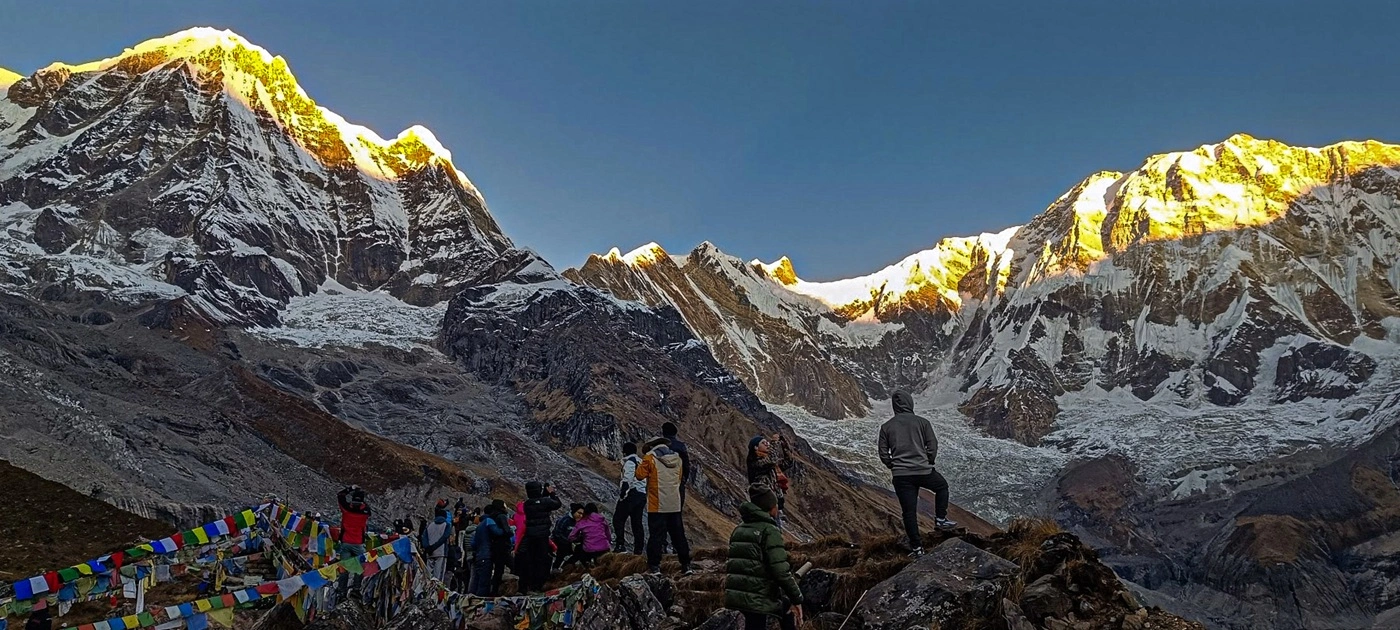
The high point at the Annapurna Base Camp itself sits at around 4,130 meters in a glacial amphitheater surrounded on three sides by peaks rising over 7,000 meters. Most travelers describe arriving at ABC as the single most memorable experience of their first trip to Nepal.
After years of running ABC departures, our team has watched the rhythm of these trips settle into a clear pattern. The travelers who choose ABC are typically not first-time multi-day hikers, but they are usually first-time Himalayan trekkers — people who hike regularly at home, have reasonable cardio fitness, and want a genuine high-altitude experience without committing to the duration or difficulty of the harder routes in Nepal. The reward is significant.
The trek delivers what people imagine when they imagine Himalayan trekking — terraced fields, stone-paved village trails, suspension bridges over rushing rivers, traditional Gurung and Magar villages, dramatic forest transitions, and the high amphitheater itself. The cost is genuine but moderate — proper preparation matters, the lodge tier in the upper sections is honest rather than luxurious, and altitude is a real consideration above Deurali.
This guide covers the route honestly. We give the typical day-by-day shape across the 7-12 day standard itinerary, name the specific sections that test most trekkers, address the seasonal timing windows that determine whether the trek is rewarding or grinding, compare ABC against the other Nepal options for travelers deciding between them, and explain how our team operates these departures at the luxury tier.
Important: ABC is a moderate-difficulty trek but not an easy one. The route involves 5-7 hours of walking per day for 7-10 consecutive days, significant ascents and descents on stone-paved village trails (which are harder on the knees than dirt paths), and exposure to altitudes above 3,000 meters in the upper sections. Travelers in good general fitness with three months of focused preparation handle the trek well. Travelers who have not walked multi-day routes before or who arrive without preparation find the steeper sections significantly harder than expected. We send a structured pre-trek training program to every confirmed guest.
Why ABC Is the Right Answer for Most First-Time Himalayan Trekkers
ABC sits in a specific operational sweet spot among Nepal's major trekking routes. Understanding why it works for so many first-time Himalayan travelers requires comparing what it delivers against what it asks for.
What ABC Delivers
- A genuine high-altitude experience with a high point at around 4,130 meters in a dramatic glacial amphitheater
- Continuous mountain views from day three onwards, including Machapuchare (the Fish Tail), Hiunchuli, Annapurna South, Annapurna I, and several other Annapurna-massif peaks
- Village culture along the entire route — terraced fields, Gurung and Magar communities, stone-paved trails, traditional architecture
- Established teahouse accommodation throughout, with the lower-altitude lodges meaningfully better than the upper-altitude ones (the same pattern as every Nepal trek)
- Shorter total duration than the Annapurna Circuit, EBC, or the harder treks — most travelers can complete the standard ABC trek inside a 14-day total Nepal trip
- Lower altitude maximum than EBC, Three Passes, or the Annapurna Circuit, which reduces (but does not eliminate) altitude sickness risk
What ABC Asks For
- Reasonable cardio fitness — the daily walking time is 5-7 hours, and the cumulative ascent and descent are significant
- Three months of focused preparation, including weighted hiking, stair climbing, and consistent cardio
- Acceptance of the lodge tier in the upper sections (Deurali, MBC, and ABC are basic teahouses with cold rooms)
- Tolerance for the stone-paved trails that dominate the route — harder on the knees than dirt paths
- Willingness to follow proper acclimatization pacing in the upper sections, regardless of how strong the body feels
How ABC Compares to Other Nepal Treks
|
Variable
|
ABC
|
Annapurna Circuit
|
EBC
|
Manaslu
|
|
Duration
|
7-12 days
|
14-18 days
|
12-14 days
|
13-15 days
|
|
Highest point
|
~4,130 m
|
~5,416 m
|
~5,545 m
|
~5,160 m
|
|
Pass crossings
|
None
|
One (Thorong La)
|
None
|
One (Larkya La)
|
|
Difficulty
|
Moderate
|
Demanding
|
Demanding
|
Very demanding
|
|
Best for
|
First Himalayan high trek
|
First high-pass crossing
|
Iconic destination
|
Experienced trekkers
|
|
Permit complexity
|
Standard ACAP
|
Standard ACAP
|
Standard SNP
|
Restricted area
|
The honest framing: ABC is the right answer for travelers who want a genuine Himalayan high-altitude trek but are not ready for or interested in the duration and demands of the harder routes. EBC and ABC are roughly comparable in iconic destination value (Everest Base Camp itself versus the Annapurna Sanctuary).
EBC is at a higher altitude and has a longer total duration. ABC has a more dramatic mountain proximity from the high point and a shorter total commitment. Travelers who want a single Himalayan trek and a meaningful experience that does not consume their entire trip to Nepal often choose ABC for these reasons.
Seasonal Timing
ABC operates in the same two main windows as the other major Nepal treks. The seasonal choice matters because the lower altitude and the village character of the route both produce different experiences in the different seasons.
Pre-Monsoon Spring (Mid-March to Mid-May) — Strongest for Visual Drama
Spring is the visually richest single window for ABC. The rhododendron bloom from late March through April runs right along the lower and middle sections of the route — the forests between Ghandruk and Bamboo turn dramatic with red, pink, and white flowering rhododendron canopies.
The terraced fields in the lowest sections are at their fresh-green peak with the new rice and millet planting. Visibility on the high points is generally good through April. The cost is that pre-monsoon haze can build through May, reducing mountain visibility on the higher days. Mid-April is the operational sweet spot — rhododendron blooming, mountain visibility still clear, temperatures comfortable in the lower sections.
Post-Monsoon Autumn (Mid-October to Mid-December) — Strongest for Stable Weather
Autumn delivers the most stable weather window of the year. Crystal-clear post-monsoon visibility produces the dramatic mountain views ABC is known for. Daytime temperatures are pleasant, the trails are dry, and the pre-monsoon haze has fully cleared. The cost is that autumn produces the highest visitor density on the route — ABC is one of Nepal's most popular treks, and the post-monsoon weeks see meaningful trail traffic, particularly on the lower stages and around the established lodge stops at Chhomrong, Bamboo, Deurali, and ABC itself. October and early November are the strongest weeks; mid-November to early December produces colder temperatures but lower visitor density and equally good visibility.
Winter (Late December to February) — Restricted but Possible
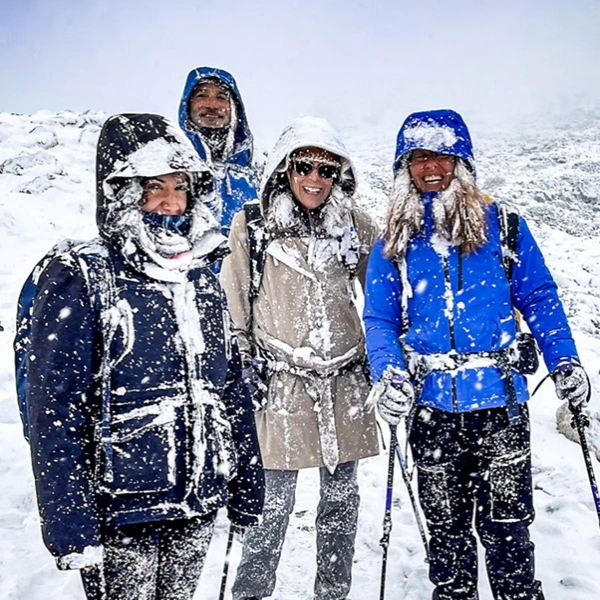
Winter ABC departures are operationally feasible, but the upper sections (Deurali, MBC, ABC) accumulate snow, and the temperatures at the high camps drop significantly. Some lodges in the upper sections close partially or fully through the deepest winter weeks. Trekkers who prefer cold-weather trekking and very low visitor density can do ABC in winter, but the trek is operationally harder than in spring or autumn. We run winter departures on request rather than as standard departures.
Monsoon (Late June to Early September) — Not Recommended
We do not run ABC in the monsoon. The lower stone-paved trail sections become dangerously slippery, leeches infest the forest sections, river crossings rise to dangerous levels, and visibility on the higher sections is consistently obscured by cloud throughout the monsoon weeks. Travelers planning ABC should plan around the spring or autumn windows.
The Standard 9-Day Itinerary
ABC can be done in 7-12 days, depending on the entry point, the inclusion of Poon Hill, and the distribution of rest days. The standard 9-day itinerary below is what we run for most luxury guests, as it provides proper pacing without unnecessarily padding the trek.
Day 1: Pokhara to Nayapul to Tikhedhunga or Ghandruk
The trek typically starts with a road transfer from Pokhara to the trailhead at Nayapul (around 1,070 meters) or alternative trailheads at Phedi or Naya Bridge, depending on the route plan. The first day of walking is gentle by design — the body adjusts to the trekking rhythm, and the heat in the lower valleys can be significant. Most luxury itineraries start at a higher trailhead like Ghandruk to skip the lowest section and arrive at the proper village altitude on day one.
Day 2: Ghandruk to Chhomrong
The trek climbs from Ghandruk at around 1,940 meters, through ridge-line villages and suspension-bridge crossings of the Modi Khola gorge, to Chhomrong at around 2,170 meters. Chhomrong is the operational anchor of the lower trek — the largest village before the route enters the proper Annapurna Sanctuary, and the last point with multiple lodge options before the upper section's accommodation tier drops. Most travelers who have done ABC remember Chhomrong specifically because the village sits on a south-facing ridge with the first close views of Annapurna South and Hiunchuli.
Day 3: Chhomrong to Bamboo
The trail descends steeply from Chhomrong to the Chhomrong Khola crossing — one of the operationally significant descents of the trek because the same descent must be re-climbed on the return — then climbs through Sinuwa to Bamboo at around 2,310 meters. The vegetation transition through this day is dramatic. The lower sections still feel like Nepal village trekking; by Bamboo, the trail has entered the proper bamboo and rhododendron forest of the Annapurna Sanctuary approach, and the trekking character changes.
Day 4: Bamboo to Deurali
The trail climbs through Dovan and continues up the Modi Khola valley to Deurali at around 3,230 meters. The forest opens out to an alpine meadow as the altitude increases. Deurali is a small lodge cluster — basic accommodation and the last stop before the upper sanctuary. The day marks the first meaningful altitude exposure of the trek, and most travelers notice a change in breathing rate and pacing.
Day 5: Deurali to Machapuchare Base Camp to ABC
The climactic day. The trail climbs through the Hinku Cave area into the Annapurna Sanctuary itself, reaching Machapuchare Base Camp at around 3,700 meters around midday. MBC is a small lodge cluster on the south side of the sanctuary with the first full panoramic view of the Annapurna amphitheater.
After lunch, the trail continues through an alpine meadow to Annapurna Base Camp at around 4,130 meters, arriving in mid to late afternoon. ABC itself is a larger lodge cluster on the moraine of the Annapurna South Glacier, surrounded on three sides by Annapurna I, Annapurna South, Hiunchuli, and several other peaks. Arrival at ABC is the moment most travelers describe as the high point of their entire Nepal trip.
Day 6: ABC Sunrise, ABC to Bamboo
Pre-dawn wake for the sunrise on the Annapurna amphitheater — the first light striking Annapurna I and Annapurna South produces the photographic anchor of the entire trek. After a slow breakfast and final walk around the moraine, the descent begins. The trail returns through MBC, Deurali, and Dovan to Bamboo. The descent day is long because of the cumulative descent through the same villages climbed on days three and four, and the knees feel it.
Day 7: Bamboo to Jhinu Danda
The trail descends through Sinuwa and Chhomrong to Jhinu Danda at around 1,780 meters. Jhinu Danda is famous for the natural hot springs at river level — a 20-minute steep walk down from the village to the Modi Khola's hot springs, which are genuinely worth the descent for travelers wanting to soak tired legs. The hot springs are basic stone pools rather than developed spa infrastructure, but the experience is rewarding.
Day 8: Jhinu Danda to Nayapul to Pokhara
The final trekking day descends through Siwai or Birethanti to the road head at Nayapul, then a road transfer back to Pokhara. The descent is gentle, but the final stretches in the heat of the lower valley can feel longer than expected. Most travelers arrive in Pokhara in the late afternoon and have a recovery dinner.
Day 9: Recovery in Pokhara, Onward Travel
Recovery day at the lakeside hotel in Pokhara before onward travel back to Kathmandu or international departure. Pokhara is genuinely worth a recovery day — the lakeside is restorative, the boating on Phewa Tal is gentle, and the Pokhara cultural sites (Bindabasini Temple, World Peace Pagoda, Devi's Falls) are appropriate post-trek pacing.
The Hardest Sections of the ABC Trek
Five sections that genuinely test most trekkers. Travelers who arrive prepared for these specifically have meaningfully better trips than travelers who treat the trek as a uniform difficulty level.
1. The Climb from Tikhedhunga to Ghorepani (if Poon Hill Extension Included)
The famous Ulleri stone staircase — over 3,000 stone steps in a single sustained climb up to Ulleri village and onward to Ghorepani — is the hardest single section of any ABC trip that includes the Poon Hill extension. Most luxury itineraries skip this climb by starting at Ghandruk or Phedi rather than the lowest entry point. Travelers, including those on the Poon Hill extension, specifically should expect this climb and prepare for it.
2. The Descent and Re-Climb at Chhomrong (Day 3 and Day 7)
The Chhomrong Khola descent and re-climb is the operationally significant feature of the ABC route. The trail drops steeply from Chhomrong village to the river bridge and climbs back up to Sinuwa on the way in, then reverses the same elevation on the way out. The total elevation lost and regained is around 600 metres each direction. The cumulative knee toll across the in-and-out is meaningful — trekking poles are essentially mandatory on this section.
3. The Bamboo to Deurali Climb (Day 4)
Day four is the first meaningful day of altitude exposure on the trek. The climb from Bamboo at around 2,310 meters to Deurali at around 3,230 meters covers around 900 meters of vertical gain through forest that becomes increasingly steep as the altitude increases. The combination of the cumulative fatigue from the previous three days and the first thin-air exposure catches some trekkers off guard. The pacing matters.
4. The Final Push from MBC to ABC (Day 5)
The afternoon push from MBC to ABC is the highest-altitude section of the trek and produces the first genuine high-altitude breathing demand. The vertical gain from MBC to ABC is only around 430 meters, but it happens at altitudes above 3,700 meters where every step costs more than at lower altitudes. Trekkers who feel strong at MBC sometimes struggle on this final push. The pace is non-negotiable.
5. The Long Descent on Day 6
Day six is the longest single walking day of the standard itinerary — ABC back through MBC, Deurali, Dovan, and down to Bamboo covers a significant descent and 7-8 hours of total walking time. The cumulative descent on the knees is the operational challenge rather than altitude or pace. Trekking poles are essential and the protein and recovery support at Bamboo the following day matters.
Five Hardest Sections at a Glance
|
Day
|
Section
|
Walking Time
|
Vertical
|
Character
|
|
PH ext
|
Tikhedhunga to Ghorepani — Ulleri stairs
|
5-7 hours
|
~1,400 m up
|
3,000+ stone steps
|
|
3 / 7
|
Chhomrong descent and re-climb
|
3-4 hours each way
|
~600 m each way
|
Knee-intensive
|
|
4
|
Bamboo to Deurali — first altitude day
|
5-6 hours
|
~900 m up
|
Forest then alpine
|
|
5
|
Deurali to MBC to ABC
|
6-7 hours total
|
~900 m up
|
Highest altitude day
|
|
6
|
ABC to Bamboo — long descent
|
7-8 hours
|
~1,800 m down
|
Knee-intensive
|
The Poon Hill Extension
Most travelers researching ABC also ask about Poon Hill — and the two are commonly combined. Understanding the relationship matters for trip planning.
What Poon Hill Is
Poon Hill, at around 3,210 meters, is a viewpoint above Ghorepani village in the Annapurna foothills. The standard Poon Hill experience is a pre-dawn climb from Ghorepani to the Poon Hill summit for sunrise on the Annapurna and Dhaulagiri ranges. The view from Poon Hill is panoramic — Dhaulagiri to the west, Annapurna South and Hiunchuli in the center, the full Annapurna massif extending east — and is widely regarded as one of the great Himalayan sunrise viewpoints. The Poon Hill trek itself can be done as a 4-5-day standalone trip or combined with ABC as an extension.
Combining Poon Hill with ABC
The combined Poon Hill plus ABC itinerary adds 3-4 days to the standard ABC route, typically resulting in a 12-14-day trek. The route begins the trek in Nayapul, climbs to Ghorepani via the Ulleri stone staircase (the hardest section of any Poon Hill itinerary), summits Poon Hill at sunrise, traverses to Tadapani and Ghandruk to rejoin the main ABC route, and continues through Chhomrong to ABC
. The combined trek delivers two distinct mountain panoramas — the Poon Hill panoramic dawn view and the Annapurna Sanctuary close-quarters amphitheater — in a single trip. Most first-time Nepal travelers who can budget the extra days choose the combined trek for the broader experience.
Should You Combine Them?
Travelers with two weeks or more available should generally combine. The extra days add value rather than padding. Travellers with less time available, or travellers prioritising the harder ABC sanctuary experience over the Poon Hill panorama, can do ABC alone and skip the Poon Hill side. Travelers prioritizing the Poon Hill panorama over the harder ABC sanctuary should consider the standalone Poon Hill trek (4-5 days) instead — it captures the same panoramic view without the longer trek's commitment.
Practical Logistics
Permit Structure
ABC requires the standard ACAP (Annapurna Conservation Area Project) permit and the TIMS (Trekkers' Information Management System) card. Both are arranged by our office before the trek as part of the booking. The permit structure is significantly simpler than restricted-area treks like Manaslu — independent trekking is technically permitted on ACAP routes (though we run all our luxury departures with full guide and porter support), and the booking lead time is shorter than restricted-area routes. Last-minute bookings (4-6 weeks before departure) are operationally possible if accommodation and guide team availability allow.
Group Size
Our luxury ABC departures cap at six guests per trip, with most trips running 2-4 guests. Many of our ABC trips are private. The luxury operating tier on ABC pairs well with private departures because the trek's accessibility allows travelers to choose their preferred date rather than fitting into a scheduled departure.
Lead Time
- Spring departures (mid-March to mid-May): book 4-6 months ahead — the rhododendron weeks concentrate demand
- Autumn departures (mid-October to mid-December): book 5-7 months ahead — autumn is the highest-demand window for Nepal trekking, generally
- Last-minute bookings (4-6 weeks before departure) are operationally possible, but inventory at the better lodges is harder to secure
Access Logistics
- Kathmandu to Pokhara — 25-minute domestic flight or 6-7 hour scenic road transfer along the Trishuli river
- Pokhara to trailhead — 1-2 hour private vehicle to Nayapul, Phedi, or Naya Bridge, depending on entry point
- Trailhead back to Pokhara — 1-2 hour private vehicle from Nayapul or alternative end point
- Pokhara to Kathmandu — 25-minute domestic flight or 6-7 hour road transfer
Equipment for ABC Specifically
- Trekking poles non-negotiable — the Chhomrong descent and the day-six descent both punish unsupported knees
- Layering system for the lodge altitude transitions — the lower sections (Ghandruk, Chhomrong) are warm; the upper sections (MBC, ABC) are genuinely cold at night
- Down jacket for the upper sections — even in spring and autumn, the temperatures at MBC and ABC drop below freezing at night
- Waterproof boots broken in well before departure — the stone-paved trails are slippery in any moisture
- Headlamp for the pre-dawn ABC sunrise viewing
- Day pack of around 20-25 liters with rain cover
How Our Team Operates ABC Departures
- Maximum group size of 6 guests, most departures 2-4 or private. We do not run mass-tourism ABC groups.
- Senior guides with multi-year ABC tenure. ABC is a popular route, and many operators rotate junior guides through it. Our lead guides on the route have multi-year tenure and are paid above the local market rate as long-term partners rather than per-trip freelancers.
- Private departures with calibrated pacing. We calibrate the pace to the slowest member of the group rather than to a target schedule. The Chhomrong climb-out and the day-five afternoon push to ABC both work better at proper pacing than at a forced schedule.
- IPPG-standard porter welfare. Maximum 25-kilogram loads, age 18 minimum, full medical evacuation insurance, equipment provision where the route requires it, equal lodge accommodation, equal food rations from the same kitchen as the guest team.
- Better lodges where they exist. The lower-altitude lodges in Ghandruk, Chhomrong, and Sinuwa are meaningfully better than the upper-altitude lodges. We use the best available lodges in each village. The upper-altitude lodges (Deurali, MBC, ABC) are basic teahouses regardless of operator, and we are honest about that.
- Three-month structured pre-trek training program. ABC requires moderate fitness rather than expedition fitness, but proper preparation still matters. Every confirmed guest receives a structured training program covering cardio progression, weighted hiking, and stair climbing.
- Detailed pre-departure briefing. We send a section-by-section briefing covering what each day entails, the lodge-tier expectations, the cold in the upper sections, and realistic worst-case scenarios. The briefing produces a clear mental model before the trip starts.
- Helicopter evacuation infrastructure. Helicopter evacuation is available from most points along the route. Travel insurance with helicopter evacuation cover is mandatory and confirmed at the time of booking. ABC sits at a lower altitude than EBC or the harder treks, but altitude sickness above Deurali is still a real possibility we monitor for.
- Pokhara recovery day is built into every itinerary. The post-trek recovery day in Pokhara is part of the operating model rather than optional padding. Lakeside accommodation, leisurely Pokhara cultural exploration, and a relaxed transfer back to Kathmandu on departure day rather than a rushed dawn return.
Frequently Asked Questions
How hard is the ABC Trek?
Moderate. The trek is harder than most travelers expect for the 'moderate' label, but easier than the demanding routes in Nepal. Daily walking time is 5-7 hours for 7-9 consecutive days at altitude. The hardest sections are the Chhomrong descent and re-climb, the day-four climb to Deurali, and the day-five afternoon push to ABC. Travelers in good general fitness with three months of focused preparation handle the trek well. Travelers without preparation find the steep stone-paved trails meaningfully harder than expected.
Is ABC harder than EBC?
No, EBC is harder. EBC has a higher altitude (5,545 meters at Kala Patthar versus 4,130 meters at ABC), longer total duration (12-14 days versus 7-9 for ABC), and more sustained altitude exposure above 4,000 meters. ABC is the right answer for travelers who want a real Himalayan high-altitude trek but are not ready for the EBC commitment, or who want a shorter trek that fits inside a 14-day total Nepal trip. EBC is the right answer for travelers who specifically want the Everest destination or a longer, multi-week mountain experience.
Is the ABC harder than the Annapurna Circuit?
No, the Circuit is harder. The Annapurna Circuit is longer (14-18 days versus 7-9 for ABC), goes higher (the Thorong La pass at 5,416 meters versus 4,130 meters at ABC), and includes a high-pass crossing that ABC does not. ABC is the right choice for first-time Himalayan trekkers and travelers who prioritize the dramatic Annapurna Sanctuary experience over a high-pass crossing. The Circuit is the right answer for travelers wanting their first high-pass crossing at altitude.
When is the best time for ABC?
Mid-March to mid-May (spring) is the visually richest window because of the rhododendron bloom in the lower forest sections. Mid-October to mid-November (autumn) is the most stable weather window and produces the clearest mountain views. Both windows are excellent, and the choice between them depends on traveler priorities — visual drama (spring) versus weather reliability and clearest visibility (autumn). Winter is restricted but possible. Monsoon is not recommended.
How fit do I need to be?
Reasonable cardio fitness essential. Trekkers should be able to walk 5-7 hours per day for 7-9 consecutive days with a 5-7 kilogram day pack and handle significant ascents and descents on stone-paved trails. We recommend three months of focused preparation, including cardio progression, weighted hiking, and stair climbing. Trekkers who hike regularly at home with elevation gain handle ABC well. Trekkers who do not exercise regularly typically have hard trips even with the best operational support.
Can I do ABC as my first multi-day trek?
Yes, with proper preparation. ABC is genuinely a first-Himalayan-trek appropriate for travelers in good general fitness who follow the preparation program. We recommend that first-time multi-day trekkers do at least two or three weekend hikes with a loaded day pack and elevation gain before booking ABC, but we do not require previous Himalayan or expedition experience. The trek is forgiving of the right kind of preparation.
What about altitude sickness?
Real but manageable. The high point at ABC is 4,130 meters — a meaningful altitude but lower than EBC, the Circuit, Three Passes, or the harder treks. Altitude sickness can develop above Deurali at around 3,230 meters, and we monitor for symptoms from day four onward. Our guides carry the altitude assessment kit and follow a strict protocol — mild symptoms trigger rest and reassessment, moderate symptoms trigger descent to a lower altitude, severe symptoms trigger helicopter evacuation. The trek's lower-altitude maximum and shorter duration above 3,500 meters both reduce the risk of altitude sickness compared to harder routes.
Should I add the Poon Hill extension?
Most travelers with two weeks or more available choose to combine. The Poon Hill extension adds 3-4 days and delivers a panoramic dawn view of the Annapurna and Dhaulagiri ranges that the main ABC route does not include. The combined Poon Hill and ABC trek is a 12-14-day total. Travelers with less time should choose ABC alone or consider the standalone Poon Hill trek (4-5 days) if panoramic views are the priority.
How is the accommodation?
Better in the lower sections than the upper sections — the standard pattern for every Nepal trek. The lodges in Ghandruk, Chhomrong, and Sinuwa range from genuinely good to comfortable teahouses with hot water and en-suite bathrooms. The upper-altitude lodges (Bamboo, Deurali, MBC, ABC) are basic teahouses with shared bathrooms, cold rooms, and only heated dining rooms. We use the best available lodges in each village, but the upper-altitude lodges are basic regardless of operator. Travelers expecting hotel-tier accommodation throughout the trek should reset their expectations or choose an alternative route.
How much should I budget?
Luxury ABC departures (9-day standard route with our operating standards, private guide team, IPPG porter welfare, private vehicles for road sections, Pokhara recovery day) typically run USD 2,500-4,500 per person, depending on group size and date. The Poon Hill extension adds USD 600-1,200 per person. International flights, travel insurance, gratuities, and discretionary purchases are additional. The lead time for booking is 4-7 months ahead for the strongest seasons.
How early should I book?
Four to seven months ahead for the strongest seasons. Spring (mid-March to mid-May) and autumn (mid-October to mid-December) are the two operating windows, and inventory at the better lodges and with the senior guide team tightens earliest. The most popular weeks in autumn (late October through early November) and spring (mid-April for the rhododendron peak) tighten earliest of all.
Can I extend the trek?
Yes, in several productive directions. The Poon Hill extension (4-5-day add-on) is the most common. A Mardi Himal trek extension can be added for travelers seeking a quieter alternative route. Pokhara cultural and lake-time extensions add 2-3 days at the lakeside. We build combined itineraries on request — the right combination depends on the time available and priority weighting between trekking, cultural depth, and recovery time.
Plan Your ABC Trek With Us
Tell us your dates, your trekking experience (if any), your fitness baseline, and any interest in the Poon Hill extension. Our team returns a written proposal within 48 hours, covering the route, the senior guide assignment, the accommodation tier honestly described, the pre-trek training program, and the section-by-section briefing that properly prepares you for the climb to the Annapurna Sanctuary. ABC is the most-loved moderate Himalayan trek for a reason — and one of the most rewarding for travelers who choose it well.