The hardest sections of the Everest Base Camp trek are not the longest sections, not the highest sections, and not even the steepest sections in pure isolation. They are the sections where vertical gain, terrain quality, atmospheric oxygen, and accumulated fatigue compound, requiring the cardiovascular output of a fifteen-kilometer hike at sea level.
The standard EBC marketing material describes the trek as 130 kilometers across 12-14 days at moderate difficulty. That description is technically accurate and operationally misleading. The total distance and the average daily distance are not the variables that produce the suffering. The variables that produce the suffering are five specific topographical and altitudinal chokepoints distributed across the 12-14 days, and understanding them in advance is the difference between a successful trek and a difficult one.
After years of running luxury EBC departures, our team has watched thousands of trekkers move through the same five sections. The pattern is consistent. Travelers who arrive having mentally rehearsed the specific demands of each section handle them well.
Travelers who arrive thinking the trek is essentially a longer version of weekend hiking find each section harder than they expected, and the cumulative effect across the trip is significant. The good news is that the preparation required is straightforward, and the sections themselves are well-known. The honest news is that the preparation has to actually happen — the trek does not reward improvisation.
This guide names the five hardest sections honestly — Namche Hill on day two, Phunki Tenga to Tengboche on day three, Thukla Pass on day six or seven, Lobuche to Gorak Shep to Everest Base Camp on day eight, and the pre-dawn Kala Patthar summit push on day nine. We explain exactly what makes each one hard, the specific physiological and psychological stresses involved, and the section-specific preparation that lets you handle them. It is written for travelers researching the trek seriously, not for casual readers seeking reassurance that everything will be fine.
Important: This guide describes the five hardest sections honestly — including the genuine physical and psychological stresses involved — to help you prepare properly. It is not written to discourage travellers from booking. The EBC trek is genuinely achievable for travelers in good general fitness with three to six months of focused preparation. The right preparation closes the gap between feeling overwhelmed by these sections and feeling ready for them. Our team sends a detailed pre-trek training program to every confirmed guest six months before departure.
The Five Hardest Sections at a Glance
|
Day
|
Section
|
Distance
|
Vertical Gain
|
Max Altitude
|
|
2
|
Monjo to Namche Bazaar (Namche Hill)
|
~9 km
|
640–800 m
|
3,440 m
|
|
3
|
Phunki Tenga to Tengboche
|
~5 km
|
~600 m
|
3,867 m
|
|
6–7
|
Thukla Pass
|
~8 km
|
~530 m
|
4,830 m
|
|
8
|
Lobuche to Gorak Shep to EBC
|
~12 km
|
~424 m
|
5,364 m
|
|
9
|
Gorak Shep to Kala Patthar
|
~1.5 km one-way
|
~400 m
|
5,545 m
|
Section 1 — Namche Hill: The First Real Test (Day 2)
What Happens on the Hill
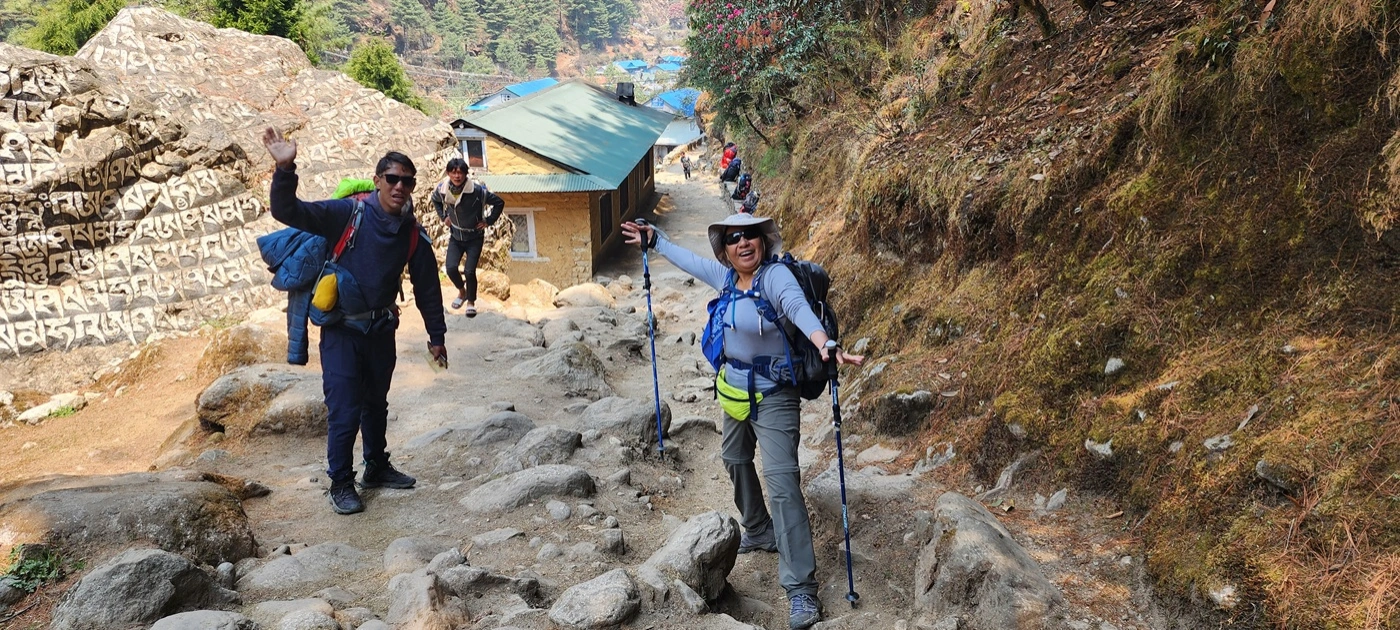
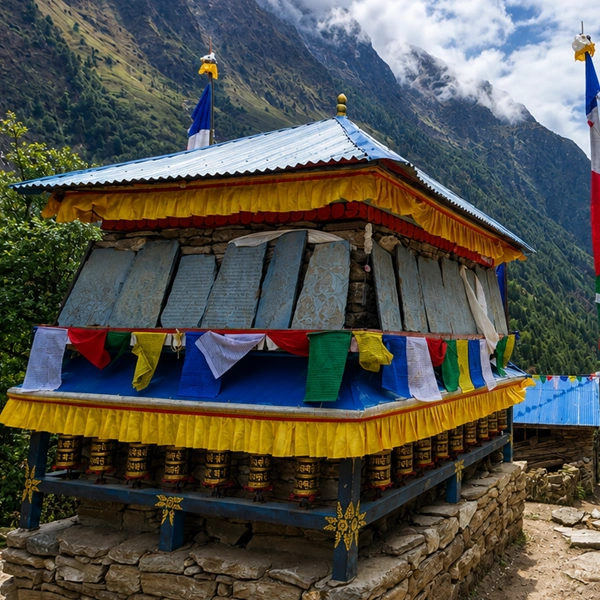
The trek from Phakding or Monjo to Namche Bazaar on day two marks the end of the easy introductory phase. The morning starts gently along the banks of the Dudh Koshi river — an undulating trail, river crossings, prayer wheels in the small villages, the kind of pleasant Himalayan hiking that conditions trekkers to expect the rest of the trek to feel similar. It does not.
Just past the official Sagarmatha National Park entry point at Monjo, the trail crosses the Hillary Suspension Bridge — a steel suspension bridge hung high above the Dudh Koshi gorge, draped with thousands of prayer flags that catch the wind dramatically — and immediately switches gradient.
The next two to four hours are a relentless zig-zagging vertical climb through pine, hemlock, and rhododendron forest, gaining 640 to 800 meters of elevation across roughly nine kilometers of total day distance, with most of that gain compressed into the post-bridge ascent.
Why It Is Hard
The difficulty is not primarily about the gradient — it is about crossing the 3,000-meter threshold for the first time. Below 3,000 meters, the human body adjusts to mild oxygen deprivation with little conscious effort. As the trail climbs through 3,000 meters toward Namche at 3,440 meters, the partial pressure of oxygen drops to roughly 65% of sea-level norms.
Trekkers feel this immediately — a sensation often described as the legs filling with concrete, an accelerated resting heart rate that does not settle when you stop, and the first realization that pace at altitude is not the same animal as pace at sea level. Trekkers who attempt the Namche Hill at the same pace they would walk a comparable hill at home almost universally develop early symptoms of altitude sickness within hours of arrival. The Sherpa philosophy of bistari, bistar — slowly, slowly — is not a politeness; it is a survival protocol.
How to Prepare for It
- Arrive in Nepal with at least three months of consistent cardio in your training history. The Namche Hill is the first session where weekend-only fitness reveals itself
- Practice slow pacing in training. Many trekkers train for speed — the trek requires the opposite. The goal is to walk uphill for hours at a pace you could maintain while holding a conversation
- Walk with poles in training. Trekking poles distribute the effort across the upper body and protect the knees on the descent. Use them on the Namche Hill from the bridge upward
- Plan to arrive at Namche tired but not destroyed. The mandatory acclimatization day in Namche is the recovery, not the goal. Arriving so exhausted that the rest day is spent in bed wastes the day's altitude exposure
Section 2 — Phunki Tenga to Tengboche: The Psychological Reset (Day 3)
What Happens on the Climb
Day three after the Namche acclimatization rest day looks gentler on paper than it actually is. The trail leaves Namche along a beautiful traverse with sweeping views of Ama Dablam, Everest, and Lhotse — the kind of trail that is genuinely enjoyable for the first hour. Then it does something cruel. It descends.
The drop down to Phunki Tenga at 3,250 meters on the Dudh Koshi river costs you 300 vertical meters of elevation that you spent the previous day earning. Once across the suspension bridge at the river, the trail then climbs roughly 600 meters in five horizontal kilometers to Tengboche Monastery at 3,867 meters.
Why It Is Hard
The difficulty is psychological more than physical. Lost elevation on a high-altitude trek is genuinely demoralizing — the brain registers it as wasted effort, and rebuilding the lost height, plus another 600 meters on top, costs more than it would have cost to gain that height in one continuous push.
The trail itself is also exposed to direct high-altitude sun without the forest canopy that shaded the Namche Hill; the surface is dusty and loose, and the corridor is heavily trafficked by porters, yaks, and other trekkers, all moving at different paces, which constantly breaks your respiratory rhythm. The combination of lost elevation, exposed terrain, and broken pacing makes the section feel harder than its 600 meters of vertical gain would suggest.
How to Prepare for It
- Mental preparation specifically. Knowing in advance that day three involves a meaningful descent before the climb to Tengboche prevents the surprise that demoralizes many trekkers
- Practice steady pacing on broken trails in training. Hill repeats with frequent course changes mimic the reality of the Phunki Tenga corridor better than long, uninterrupted climbs
- Hydrate aggressively before and during the climb. The exposed sun and dusty air drive higher fluid loss than the previous days' shaded forest sections
- Plan to arrive at Tengboche with energy in reserve for the monastery itself. The afternoon prayers at the monastery are one of the most rewarding cultural moments on the entire trek, and missing them because you collapsed in your room is a genuine loss
Section 3 — Thukla Pass: The Emotional Wall (Day 6 or 7)
What Happens on the Pass
By day six or seven, the trek has crossed 4,000 meters, and the environment has changed completely. The tree line has disappeared. The lush rhododendron and birch forests of the lower trek are replaced by stark high-altitude alpine desert — grey rock, frozen earth, glacial moraine.
The trail leaves the village of Pheriche or Dingboche, descends gently across the valley floor, and then climbs the steep approach to Thukla Pass at roughly 4,830 meters. The vertical gain is around 530 meters over 8 kilometers, with most of that gain compressed into the final pass approach.
Why It Is Hard
Two reasons. The first is the altitude — at the top of the pass, atmospheric oxygen has dropped to roughly 50% of sea-level pressure, which means basic locomotion now requires substantial cardiovascular effort. Each step costs more than it would at a lower altitude, the terrain is loose, unstable glacial debris, and recovery between steps is meaningfully slower than it was below 4,000 meters. The second reason is what waits at the top of the pass.
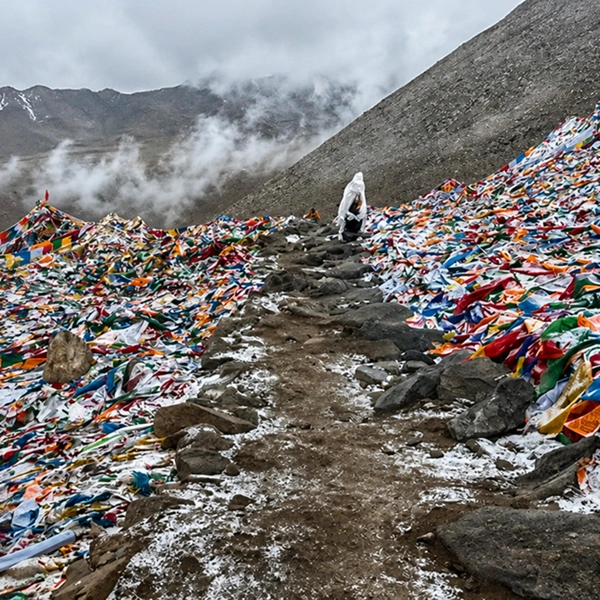
The crest of Thukla is a memorial ridge — a wide, windswept plateau where over a hundred stone chortens have been built across decades to commemorate climbers and Sherpa expedition members who have died on Everest and the surrounding peaks. The memorials are wrapped in prayer flags. The names and dates carved into the stones span from the early days of Himalayan climbing to recent expedition seasons.
For most trekkers, it is the first concrete visual reminder that the mountain they are walking toward has a real cost, and that the cost has been paid by real people, including the Sherpa families who live in the villages they have just walked through. The combination of physical exhaustion, hypoxia, and the visceral encounter with the mountain's history hits trekkers hard. Many describe Thukla as the hardest emotional moment of the trek, even though it is not the hardest physical section.
How to Prepare for It
- Mental preparation specifically. Knowing the memorial ridge is at the pass's crest before you arrive prevents disorientation from an unexpected encounter. Trekkers who pause respectfully and continue tend to handle it better than trekkers who rush through to escape the discomfort
- Implement strict pace discipline. Above 4,500 meters, the bistari protocol becomes non-negotiable. A pace that feels slow at sea level is the right pace here
- Hydrate continuously. The dry alpine air at this altitude pulls moisture from the lungs faster than most trekkers track
- Eat through the section even if your appetite has dropped. Above 4,000 meters, the digestive system slows because oxygenated blood is being prioritized for muscles and the brain. Small, frequent carbohydrate intake (dried fruit, gels, biscuits) maintains energy without overloading digestion
- Pause briefly at the memorials, even if you are not religious. The acknowledgment shifts the section from a physical obstacle to a meaningful passage
Section 4 — Lobuche to Gorak Shep to EBC: The Endurance Day (Day 8)
What Happens on the Day
Day eight is the longest, hardest day on most standard EBC itineraries. The morning departs the lodges at Lobuche (4,910 meters) and follows the lateral moraine of the Khumbu Glacier toward Gorak Shep (5,164 meters) — a small windswept settlement on a frozen lake bed that serves as the highest permanent stopping point on the route.
After dropping heavy gear at Gorak Shep, trekkers continue another 3.5 kilometers each way to Everest Base Camp itself at 5,364 meters before returning to Gorak Shep for the night. The total distance for the day is roughly 12 kilometers, all above 4,900 meters, much of it across unstable glacial moraine.
Why It Is Hard
The terrain is the biggest single factor. The Khumbu Glacier underneath the trail is biologically active — it moves at roughly one meter per day, which means the path itself shifts constantly across seasons. There is no defined packed-dirt trail. There is a route picked out across loose scree, jagged rocks, and boulder fields, and the route changes from year to year as the glacier advances or retreats. Every step requires concentration. Ankle sprains and minor falls are the most common injuries in this section because trekkers fatigue mentally and stop paying full attention to each step.
The altitude is the second factor. At Gorak Shep, atmospheric oxygen has dropped to roughly 50% of sea-level pressure, and the body has been operating in this environment for several days, with poor sleep, reduced appetite, and a steady caloric deficit. The mental fog that develops at this altitude slows basic decision-making. Water bottles freeze inside lodge rooms by midnight. The wind howls through the unheated stone teahouses. Trekkers arrive at Base Camp itself, triumphant but exhausted in a way that is hard to recover from quickly.
There is also a small geographic irony at Base Camp itself worth knowing in advance. Mount Everest is not visible from Base Camp. The summit is hidden behind the towering shoulder of the Nuptse-Lhotse ridge. The famous photograph of Everest, framed by prayer flags that travelers come expecting to take, has to be taken from somewhere else — Kala Patthar the next morning, or Hotel Everest View on another day. Knowing this in advance removes the disappointment that catches some trekkers off guard.
How to Prepare for It
- Build endurance specifically. The EBC trek as a whole requires endurance, but day eight demands an unusual amount of it. Long training hikes in the 6-8 hour range with a loaded backpack build the right base
- Practice on uneven terrain. Glacial moraine is genuinely different from packed trail. Hill repeats on rocky ground or dedicated scree trails are better preparation than flat-ground cardio
- Manage Day 7 sleep. Insomnia at altitude is common. Going to bed early at Lobuche, even if sleep is fragmented, preserves more rest than staying up trying to feel tired
- Eat breakfast even when you do not want to. Day eight on an empty stomach is significantly harder than day eight with 600 calories of porridge in your system
- Keep moving steadily. Long stops on day eight are surprisingly hard to recover from because muscle temperature drops fast at altitude, and restarting feels harder than sustaining
Section 5 — Kala Patthar Summit: The Hypoxic Limit (Day 9)
What Happens on the Climb
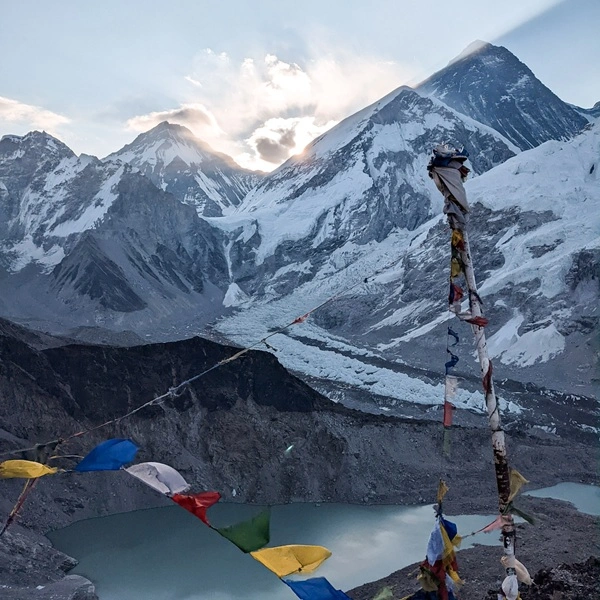
Kala Patthar at 5,545 meters is the highest point on the standard EBC trek and the photographic anchor of the entire trip. The summit ridge offers a direct view of Mount Everest's south-west face that Base Camp itself does not provide.
The climb is short — roughly 1.5 kilometers each way from Gorak Shep with a vertical gain of about 400 meters — but it is the most physically demanding section of the trek per kilometer by a considerable margin. Most trekkers attempt the summit at sunrise, which means a 4:00 AM departure from Gorak Shep in pre-dawn darkness, sub-zero temperatures (-15 Celsius is normal, -20 Celsius is not unusual), and biting wind that cuts through every layer of down clothing.
Why It Is Hard
At the summit, atmospheric oxygen has dropped to 47% of sea-level pressure. The body is operating at the absolute margin of what is possible without supplemental oxygen. Even highly fit trekkers who reached Base Camp the previous day with relative ease often find themselves reduced to a step-and-rest cadence on Kala Patthar — one step forward, two or three breaths, another step.
The heart rate operates near maximum capacity just to facilitate basic locomotion. The cold is genuine — mild frostbite on exposed cheeks is a real risk, lithium-ion batteries die fast in the cold, and water bottles need to be kept inside jackets to remain liquid. Time at the summit is genuinely limited because the conditions are too hostile to remain longer than 15 to 20 minutes before descending becomes urgent.
How to Prepare for It
- This is where the cumulative work of the previous eight days pays off. Kala Patthar is not a section you can prepare for in isolation — it is the test of how well the rest of the trek went
- Sleep with batteries inside the sleeping bag the night before. Camera batteries, phone, headlamp spares, power banks — all in the bag overnight at body temperature
- Layer aggressively. The full alpine kit — base layer, fleece or synthetic mid-layer, expedition-grade down jacket, wind shell, insulated trekking pants, balaclava, neck gaiter, heavy gloves with liners. The layering does not work if any layer is missing
- Hand and toe warmers. Single-use chemical warmers in inner jacket pockets and inside boots are the most useful single comfort item on the climb
- Move at the pace your breathing will sustain. The temptation to push fast in the cold is wrong. Slow, steady cadence with controlled breathing is the only sustainable approach
- Set a turnaround time before you start. If you have not summited by 90 minutes after departure, the descent decision becomes more urgent than the summit decision. Cold exposure compounds with time
- Plan the descent. The summit window is 15-20 minutes maximum. The descent is faster than the ascent, but the cold accumulates, and trekkers sometimes underestimate how quickly they need to be back at Gorak Shep
The Underlying Physiology: Why Altitude Changes Everything
All five sections share a common underlying mechanism — the progressive reduction of atmospheric oxygen as the trek climbs. The table below shows how oxygen pressure affects the body at each major elevation along the route.
|
Location
|
Altitude
|
Oxygen %
|
Body Response
|
|
Lukla
|
2,840 m
|
~70%
|
Mild adjustment
|
|
Namche Bazaar
|
3,440 m
|
~65%
|
Elevated heart rate, sleep disruption
|
|
Tengboche
|
3,867 m
|
~60%
|
Heavy limbs, faster breathing
|
|
Dingboche / Lobuche
|
4,400–4,910 m
|
52–55%
|
Insomnia, reduced appetite
|
|
Gorak Shep / EBC
|
5,164–5,364 m
|
48–50%
|
Mental fog, AMS risk
|
|
Kala Patthar
|
5,545 m
|
~47%
|
Maximum sustained effort
|
The Khumbu Cough
One specific medical reality worth flagging is that it affects most trekkers above 4,000 meters. The combination of hyperventilation (the body inhaling more air to compensate for the thinner air at altitude) and extremely dry, cold air at altitude strips moisture from the throat and bronchi. The result is a persistent dry cough that develops across several days and can become severe enough to crack ribs in extreme cases.
The defense is straightforward — wear a buff or balaclava over the nose and mouth during exertion to trap exhaled moisture, breathe through the nose rather than the mouth where possible, sip warm fluids continuously, and avoid the smoky interiors of poorly ventilated lodge dining rooms. The cough usually resolves within a few days of returning to a lower altitude.
Hydration and Nutrition Specific to These Sections
Why Standard Hiking Hydration Fails
At altitude, the body loses fluid faster than at sea level for two reasons that compound. The first is faster, deeper breathing — every exhalation carries more water vapor out of the lungs than at sea level, and over a full day, this adds up to a meaningful loss the trekker never feels. The second is dry alpine air, which pulls moisture from the skin even at moderate temperatures. Total fluid requirement on the EBC trek is 3-4 liters per day on regular days and up to 5 liters on the Kala Patthar summit day.
Electrolytes Matter
Drinking volume alone is not enough. Heavy water intake without electrolyte replacement can produce hyponatremia — a dangerous reduction in blood sodium that mimics altitude sickness symptoms (headache, nausea, confusion) and can be more dangerous than the altitude itself. Carry electrolyte tablets or powder and dose them as directed by the manufacturer throughout the day. The most common single mistake is drinking large volumes of water at meal stops without electrolytes.
Why Heavy Food Stops Working
Above 4,000 meters, the body shunts oxygenated blood away from the digestive system to prioritize muscles and the brain. Heavy proteins, fats, and dense complex meals can impede digestion — they sit in the stomach and cause nausea. The strategy that works is a small, frequent intake of simple carbohydrates that digest fast and require minimal oxygen.
Dried fruit, energy gels, dark chocolate, and biscuits move through the system at altitude when full meals do not. Local Nepali staples are particularly well-suited — *chiura* (beaten rice), *bhuja* (puffed rice), and *chhurpi* (yak cheese) are all light, portable, and tolerable at altitude when imported energy bars start tasting like sand.
Pacing and Breathing on the Hardest Sections
The Hypoxic Spiral and How to Avoid It
The most common point of failure on the EBC trek is what high-altitude mountaineers call the hypoxic spiral. A trekker hits a steep section, breathes faster, breathes shallower, and falls into rapid panting from the upper chest. Shallow breathing fails to draw air into the lower lungs, where most gas exchange occurs; carbon dioxide builds up, anxiety rises, the heart rate accelerates further, and within minutes, the trekker is genuinely struggling rather than just working hard.
The way out is consciously controlled breathing — specifically, pressure breathing, which means inhaling deeply through the nose and exhaling forcefully through pursed lips, as if blowing out a candle. The pursed-lip exhalation creates backpressure, keeping the alveoli open longer and dramatically improving oxygen transfer.
The Rest Step
The rest step is a foundational mountaineering technique that becomes essential above 4,500 meters. With each step, briefly lock the rear knee for a fraction of a second to transfer the body's weight from the working quadriceps to the skeletal structure.
The micro-pause does not slow you down meaningfully — it adds maybe a tenth of a second per step — but it transfers thousands of small loads off the muscles across an eight-kilometer climb and massively delays muscle fatigue. The technique feels strange at first and natural after an hour. By day six on the trek, most experienced trekkers are doing it without thinking.
Trekking Poles
Trekking poles distribute the cardiovascular load across the upper body and protect the knees on the descent. We recommend trekking poles for every guest on every section of the trek, but particularly on the five hardest sections. Use them on the ascent to push off the upper body, use them on the descent to control the speed of each step, and prevent the impact loading that destroys knees. Synchronize the planting of the poles with the breathing — pole, step, breath, pole, step, breath — and the pace becomes hypnotic and sustainable for hours.
Psychological Preparation for the Hardest Sections
Cognitive Chunking
The mental challenge of the hardest sections is often bigger than the physical one. The brain becomes overwhelmed when it tries to contemplate twelve kilometers of glacial moraine at 5,000 meters or four hundred meters of vertical gain at 47% oxygen.
The technique that works is aggressive chunking — breaking the section into microscopic, achievable goals. The next switchback. The next prominent boulder. Counting fifty steps, then another fifty. The brain handles small, concrete goals well, even when it struggles with the abstract scale of the day. By the end of the trek, most successful trekkers have spent hours counting their own footsteps.
Acceptance Over Resistance
The trekkers who handle the hardest sections best are not the strongest or the most aerobic — they are the ones who accept what is happening rather than fight it. The cold is going to be cold. The lodge will be basic. Sleep is going to be poor. The toilets will be primitive outdoor pit toilets at sub-zero temperatures.
Trekkers who accept these conditions as part of the trip have better trips than trekkers who keep mentally arguing with reality. The acceptance is also part of what makes the trek meaningful in retrospect — the conditions are part of why the experience stays with you.
How Our Team Handles These Sections on Luxury Departures
- Calibrated pacing on every hard section. Our guides set the pace deliberately to match the slowest member of the group on the hardest sections. The pace is non-negotiable. Trekkers who want to push faster are slowed down; trekkers who need to go slower are accommodated without compromise to the rest of the group.
- Hot drinks and sugar at the top of every hard section. Our guides carry hot tea, biscuits, and chocolate to the crest of every major climb. The 30-minute warm break at the top of Namche Hill, Tengboche, Thukla Pass, and Kala Patthar is not optional comfort — it is recovery infrastructure that lets the rest of the day go smoothly.
- Adjusted morning starts for Kala Patthar. We brief Kala Patthar carefully with each guest the evening before the climb. Gear is laid out the night before. Hot drinks are delivered to the room rather than served in the dining room. The pre-departure logistics are handled, so the guest only has to focus on dressing and walking.
- Helicopter return option on the descent. Most of our luxury EBC packages include a helicopter return from Gorak Shep to Kathmandu after the Kala Patthar summit, eliminating the four-day descent that compounds knee damage and accumulated fatigue. The helicopter return is not a luxury feature — it is operational protection for older trekkers and for guests who want to reach Kathmandu fresh enough to enjoy the cultural circuit.
- Honest pre-departure briefing. Every confirmed guest receives a section-by-section briefing that explains exactly what each of the five hardest sections involves and what to expect. We do not pretend the trek is easier or harder than it is. The brief is calibrated to give guests the right mental model so the sections feel familiar when they happen.
- Six-month training program. Every confirmed EBC guest receives a structured six-month pre-trek training program covering cardio progression, weighted hiking, strength work, and altitude familiarisation strategies. Guests who follow the program arrive ready for the hardest sections. Guests who are not honest with us about it, and we adjust pacing accordingly.
Frequently Asked Questions
How hard is the EBC trek really?
Genuinely demanding, not technical. The trek requires no climbing skill, ropes, ice axes, or mountaineering experience — but the combination of altitude, distance, and consecutive long days at thin air pushes most trekkers to a level of physical effort they have not previously experienced.
The difficulty is concentrated in the five sections covered in this guide rather than being evenly distributed across the route. Travelers in good general fitness with three to six months of focused preparation handle the trek well. Travelers without that preparation find each of the five sections harder than expected.
Which is the hardest section of the EBC trek?
Different trekkers say different things, but Kala Patthar at 5,545 meters is the most physically demanding per kilometer — the combination of pre-dawn cold, extreme altitude (47% sea-level oxygen), and accumulated fatigue produces a section that no other compares to.
Day eight (Lobuche to Gorak Shep to Base Camp and back) is the longest and hardest day, combining distance and altitude. Thukla Pass is often cited as the most emotionally challenging because of the memorial ridge at its crest. The Namche Hill on day two is the hardest first encounter with altitude. Each section is hardest for different reasons.
Do I need to be an athlete to do the EBC trek?
No, but you need to be in good general fitness and prepared specifically for the trek. Athletes who arrive without specific preparation often struggle because they ascend too fast and trigger early altitude sickness. Average-fitness trekkers who arrive with three to six months of consistent cardio, weighted hiking, and stair climbing in their training history handle the trek well. Preparation matters more than baseline fitness. Our team sends a structured six-month training program to every confirmed guest.
Can I avoid the hardest sections?
Some of them, but doing so reduces what you see. Travelers who skip the Kala Patthar summit miss the direct view of Everest itself (Base Camp does not provide it). Travelers who skip the Tengboche climb miss the most spiritually important monastery on the trek.
Travelers who skip the Namche Hill cannot reach the upper Khumbu at all. The full luxury heli-trek (the 5-day product that flies you to Hotel Everest View and uses a helicopter for the high-altitude segments) skips much of the hardest physical work but offers a different, shorter experience. Travelers who want the complete EBC experience accept the hardest sections as part of the trip.
What happens if I get altitude sickness on a hard section?
Our guides carry the altitude assessment kit and follow a strict protocol. Mild symptoms (headache, nausea, fatigue) trigger immediate rest and reassessment before continuing. Moderate symptoms trigger descent to the previous overnight altitude until symptoms resolve.
Severe symptoms or any HACE/HAPE indicators trigger immediate helicopter evacuation. Travel insurance with helicopter evacuation cover up to 6,000 meters is mandatory on our EBC departures and confirmed at booking. Most altitude-related issues that develop on our trips resolve with descent, without progressing to severe stages, because we monitor closely and respond early.
Should I take Diamox?
This is a decision between you and your physician, not the operator. Acetazolamide (Diamox) is widely used for altitude prophylaxis on EBC trips, and the medical literature supports its use for travelers without contraindications.
The standard dose is 125mg twice daily, starting one or two days before reaching altitude and continuing through the highest sections of the trek. Side effects include tingling in the hands and feet, increased urination, and, in some cases, altered taste. Diamox is not a substitute for proper acclimatization pacing — it complements it. Our team recommends that every guest discuss Diamox with their physician at the pre-trek consultation.
How fit should I be before booking?
If you can hike for six hours with a 10-kilogram backpack and substantial elevation gain (1,000 meters or more) without exhausting yourself, you have the baseline fitness to start six months of focused EBC preparation. If you cannot, build that baseline first before booking. The training program we send to confirmed guests covers progressive loading, cardio progression, and stair climbing — all of which build on top of an existing baseline rather than starting from sedentary.
How do I prepare for the cold on Kala Patthar?
Layer the full alpine kit and test it before departure. Base layer, fleece or synthetic mid-layer, expedition-grade down jacket, wind shell, insulated trekking pants over thermal long johns, balaclava, neck gaiter, heavy gloves with liners, hand and toe warmers in inner pockets, and inside boots.
Test the layering on cold-weather hikes at home before the trip — discovering that your gloves are not warm enough is something you want to discover in your local hills, not at minus 18 Celsius at 5,500 meters in the dark. We send a detailed gear list to every confirmed EBC guest.
What if I have to turn back?
Sometimes, turning back is the right answer, and our guides support that decision without judgment. The trek is achievable for most travelers in good fitness with proper preparation, but altitude affects different bodies differently, and individual responses cannot be perfectly predicted.
Trekkers who develop altitude sickness symptoms that do not resolve, or who develop other medical issues, can descend with a guide while the rest of the group continues. Helicopter evacuation is available for serious cases. We do not pressure guests to continue against medical advice, and we do not financially penalize weather or medical-related changes to the itinerary.
Is the EBC trek harder for older travelers?
Yes, in the recovery phase rather than the day-of effort. Older trekkers (60+) typically handle individual hard sections about as well as younger trekkers if their cardiovascular fitness is comparable. The difference is recovery — younger trekkers bounce back faster between hard days.
We typically build in extra rest days into older guests' itineraries, and we favor the helicopter return from Gorak Shep to Kathmandu, eliminating the four-day descent that can destroy older knees. The trek is genuinely possible for travelers in their sixties and early seventies in good cardiac health, but the operating profile differs from that of an itinerary built around younger trekkers.
Why do you talk about the hardest sections rather than just the highlights?
Because honest preparation produces better trips. Travelers who arrive with a clear picture of what each section actually involves handle them better than travelers who arrive with marketing-grade expectations. The luxury operating tier is not about pretending the trek is easier than it is — it is about handling the operational logistics, pacing, and support infrastructure so the trekker can focus on the experience itself. Honest information about the hardest sections is part of that infrastructure. We send the same level of detail in our pre-departure brief to every confirmed guest.
How early should I book?
Five to seven months ahead for the strongest seasons. The EBC trek runs in two windows — pre-monsoon spring (mid-March to mid-May) and post-monsoon autumn (mid-October to mid-December). Spring window inventory tightens earliest due to convergence with the peak Everest climbing season.
Autumn window inventory tightens fastest in October. Travelers contacting us in November for an April departure are usually too late to secure the best dates and lodges. The right lead time for spring is the previous summer or autumn. The right lead time for autumn is the previous spring.
Plan Your EBC Trek With Honest Preparation
Tell us your dates, your fitness baseline, and any medical considerations. Our team returns a written proposal within 48 hours covering the route, the accommodation, the helicopter return option, the pre-departure training program, and the section-by-section briefing that prepares you for what each of the five hardest sections actually involves. Honest preparation produces better trips. The right preparation closes the gap between feeling overwhelmed and feeling ready.