7 days in Bhutan is the trip most travelers actually book, and it happens to be the duration the western valleys were made for. Paro, Thimphu, and Punakha sit in a natural chain — one short drive, one mountain pass, one loop back to the airport. A week covers all three without a single rushed morning.
The catch is sequencing. Put Tiger's Nest on the wrong day, or drive the Dochula Pass at the wrong hour, and the same seven days feel like a forced march.
This is the planning version of the private tour we operate on this route: the logic behind each day, and the honest line between what a week holds and what it doesn't.
Is 7 Days in Bhutan Enough?
Seven days in Bhutan is enough for the western valleys and not enough for the center or east. That's the whole answer, and it's worth being blunt about, because plenty of itineraries pretend otherwise.
The western chain — Paro at 2,200 meters, Thimphu at 2,320, Punakha down at 1,242 — packs the country's headline sights into roughly 250 kilometers of driving across the week. Tiger's Nest, Punakha Dzong, the Buddha Dordenma, the Dochula Pass with its 108 chortens: all of it sits inside this loop.
Bumthang and central Bhutan are a different proposition. The road east from Punakha adds a full travel day in each direction, which is why every honest central-Bhutan itinerary runs ten days or longer. Squeeze Bumthang into a week and you spend three of your seven days watching switchbacks through a windscreen.
How a 7-Day Bhutan Itinerary Should Be Built
A good week in Bhutan follows four rules, and each one exists because we've seen itineraries break them.
Fly in and out of Paro. Paro International Airport is the country's only international airport, so the route must loop back to its starting point. Build the loop, don't fight it — the return drive becomes a second pass at the Paro valley rather than dead mileage.
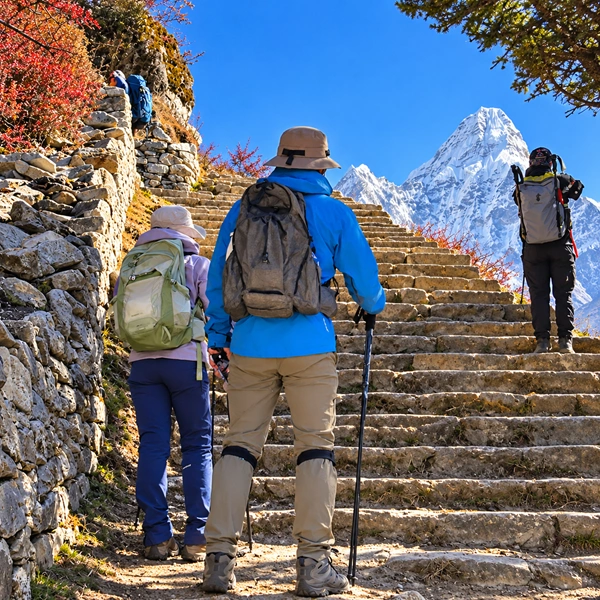
Climb Tiger's Nest on your second morning. Legs are freshest, and the trail is quietest before the day-trip crowds arrive. Our standing practice is to have guests at the trailhead by 7:30; the climb is roughly 500 meters of elevation gain to the monastery at 3,120 meters, four to five hours round trip, with a tea-house stop at the halfway cafeteria.
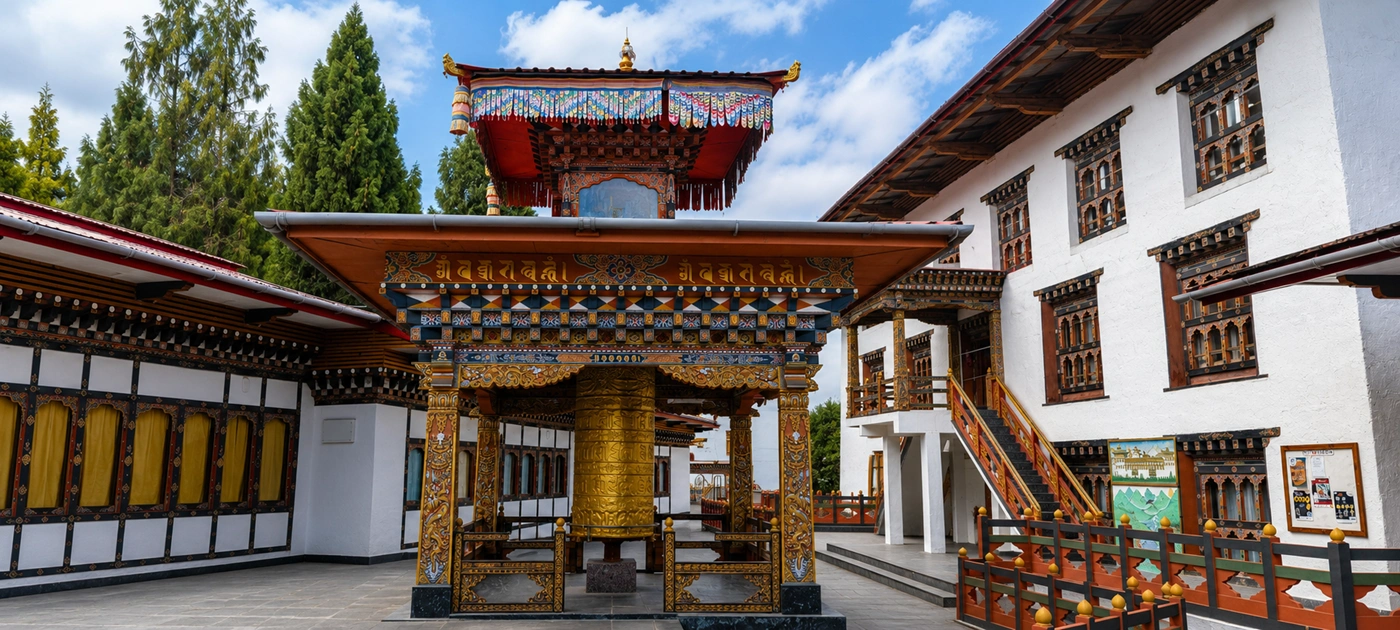
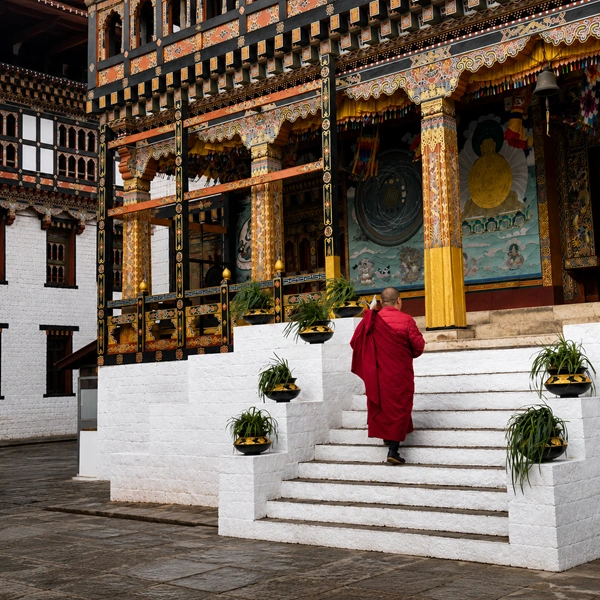
One dzong a day. Bhutan's fortress-monasteries reward slow attention and punish box-ticking. Tashichho Dzong, Punakha Dzong, and Paro's Rinpung Dzong each get their own day in a well-built week, so none of them blurs into the last.
Sleep low mid-week. The itinerary below never sleeps above 2,320 meters, and it drops you to subtropical Punakha at 1,242 meters in the middle of the trip. Warm nights, river air, and a body that recovers while you're busy enjoying banana trees at eyeline with rice terraces.
The Day-by-Day: Paro, Thimphu, and Punakha in Seven Days
The direct answer first: two nights in Paro, one in Thimphu, two in Punakha, and a final night back in Paro before the morning departure. Here's how the week runs, and why.
Day 1 — Arrive in Paro
The flight into Paro is the trip's first sight — on a clear morning from Kathmandu, the Himalaya runs past the left-side windows for most of the hour. Afternoon stays gentle: the airport viewpoint above the runway, a first walk through Paro town, and time to be fitted for a gho or kira if you'd like to wear national dress during the week. Sleep at 2,200 meters, which quietly begins your acclimatization for the next morning's climb.
Day 2 — Tiger's Nest and Kyichu Lhakhang
The climb to Paro Taktsang — the Tiger's Nest — anchors the whole week. Early start, prayer-flag switchbacks, and the monastery clinging to its granite face at 3,120 meters. Back in the valley by early afternoon, Kyichu Lhakhang makes the perfect counterweight: one of Bhutan's two oldest temples, seventh-century, with orange trees fruiting in the courtyard. Big morning, soft afternoon.
Day 3 — Paro to Thimphu
The drive to the capital takes about an hour and a quarter, with a stop at Tamchog Lhakhang to walk its iron-chain bridge across the Paro Chhu. Thimphu days move fast by Bhutanese standards: the Buddha Dordenma gazing over the valley, the Memorial Chorten with its circling elders, the Motithang Takin Preserve, and Tashichho Dzong in the late-afternoon light when the offices empty and the courtyards go quiet.
Day 4 — Over the Dochula Pass to Punakha
This is the day the itinerary earns its shape. The road crests the Dochula Pass at 3,100 meters, where 108 memorial chortens stand against a horizon of eastern-Himalayan snow peaks on a clear day — Gangkhar Puensum among them. Then the long warm descent: 2,000 vertical meters down to the Punakha valley, a walk through mustard fields to Chimi Lhakhang, and Punakha Dzong at the meeting of the Pho Chhu and Mo Chhu rivers.
Day 5 — The Punakha Valley
A full day with no luggage and no transfer, which is exactly the point. The morning hike climbs through rice terraces to the Khamsum Yulley Namgyal Chorten, a four-story temple built by the queens of Bhutan, with the valley unrolled below. Cross the Pho Chhu suspension bridge — one of Bhutan's longest — and end at the hilltop Sangchhen Dorji Lhuendrup Nunnery as the light goes gold.
Day 6 — Punakha to Paro
The return leg re-crosses the Dochula and runs down the Paro valley in three and a half to four hours. Arriving by lunch leaves a real afternoon: Rinpung Dzong, then the round watchtower above it that houses the National Museum, where the orientation you now have makes the thangkas and maps land differently than they would have on arrival. Last night at an altitude you've long since adjusted to.
Day 7 — Depart Paro
Paro flights leave in the morning to beat the valley winds, so this day is the airport and the window seat. Sit on the right side, leaving for Kathmandu and the Himalaya, with the play in reverse.
When 7 Days in Bhutan Is Not Enough
A week is the wrong trip in three specific cases. If Bumthang's temple valleys or the far east are the reason you're coming, you need the drive days — that's ten-to-fourteen-day territory, and our 10-day Bhutan tour
is where that planning starts. If you want to trek rather than tour, the Druk Path and Jomolhari routes each consume five to nine days on their own before any valley time.
And if your dates fall on a major tshechu, the festival deserves two full days in the itinerary, which leaves the rest of the week tight.
The reverse case exists too. If you have five days rather than seven, the honest move is dropping Punakha entirely rather than sprinting all three valleys — Paro and Thimphu alone make a complete short trip.
When to Go for the Week
Late October to mid-December gives a 7-day Bhutan itinerary its clearest mountain views, with the Dochula panorama at its most reliable; March to April trades a little haze for rhododendron bloom and the spring festival season.
Punakha's low altitude keeps it pleasant even in winter, which is one more argument for the western loop. The full month-by-month picture is in our guide to the best time to visit Bhutan.
The Practical Side: Flights, Visa, and the SDF
Every foreign visitor enters on a visa arranged in advance and pays Bhutan's Sustainable Development Fund (SDF) levy per night, which, at the time of writing, stands at US$100 for most nationalities, with the visa fee at US$40. On our trips, both are included in the single trip price, so the figure you're quoted is the figure you pay.
Flights to Paro are operated by Drukair and Bhutan Airlines from Kathmandu, Delhi, Bangkok, and Singapore, among others. Seats in high season sell out months ahead; we hold and ticket them as part of the booking. A guide is required by law for touring in Bhutan — on a private trip, that's your own guide and vehicle for the full seven days, and the pacing above assumes exactly that flexibility.
Frequently Asked Questions
Is 7 days in Bhutan enough to include Tiger's Nest?
Yes — comfortably. Tiger's Nest takes one morning, four to five hours round trip from a trailhead twenty minutes outside Paro town. The mistake is scheduling it on arrival day or departure eve; placed on your second morning, with a night at 2,200 meters behind you, it anchors the week without crowding anything else.
How many valleys can a 7-day Bhutan itinerary cover?
Three, done well: Paro, Thimphu, and Punakha. They form a natural driving chain with no leg longer than four hours. A fourth valley — Gangtey or Bumthang — is physically possible in a week but turns two of your days into pure transit, which is why we hold the line at three.
How much driving does a 7-day trip in Bhutan involve?
Roughly 250 kilometers across the whole week, split into three transfer days: about 75 minutes Paro to Thimphu, around two and a half hours Thimphu to Punakha over the Dochula Pass, and three and a half to four hours back to Paro. No single day is dominated by the road, and every transfer carries stops worth making.
What drives the cost of a 7-day Bhutan itinerary?
Three inputs: the nightly SDF levy multiplied by six nights, the standard of lodge you choose, and the private guiding and vehicle running the full week. Flights into Paro add on top. On our trips, the SDF, visa handling, lodges, guide, vehicle, and meals are included in one stated price, as confirmed in your proposal.
Can a 7-day Bhutan itinerary include a tshechu?
Yes, if your dates align — Paro, Thimphu, and Punakha each host a major festival, and all three sit on this route. A tshechu deserves two full days, so we rebuild the week around it rather than bolting it on. Exact festival dates follow the lunar calendar and are confirmed at the time of booking.
Can you add a trek to 7 days in Bhutan?
A day hike, yes — the Khamsum Yulley chorten trail and Tiger's Nest are both built into the week above, and a Bumdra overnight camp can replace a Paro day. A multi-day route like the Druk Path cannot fit alongside three valleys in seven days; that would make it a ten-day trip, with the valleys compressed.
Do you need a guide for 7 days in Bhutan?
Yes — a licensed Bhutanese guide is a legal requirement for touring the country, not an optional upgrade. The only real choice is a shared group guide versus your own. Privately guided, the sequencing in this itinerary flexes daily: an earlier Tiger's Nest start, a longer Punakha morning, a photography stop held as long as the light deserves.
Seven days is a complete Bhutan trip when the week is structured this way, and this is the exact route we run privately, lodge to lodge, with your own guide throughout.
The full version — pacing, lodges by style, and what's included — is on our 7-day Bhutan luxury tour page, and every one of our Bhutan tours starts from the same principle: the itinerary bends to you, never the reverse.