The Druk Wangyel Tshechu is a one-day December festival at Dochula Pass, about 3,100 metres above Thimphu, where Royal Bhutan Army soldiers dance beside 108 memorial chortens. Unlike lunar-calendar tshechus, it keeps the same date every year. We pair it with Punakha's winter sun and Phobjikha's cranes.
Druk Wangyel Tshechu: Bhutan's Festival at Dochula Pass

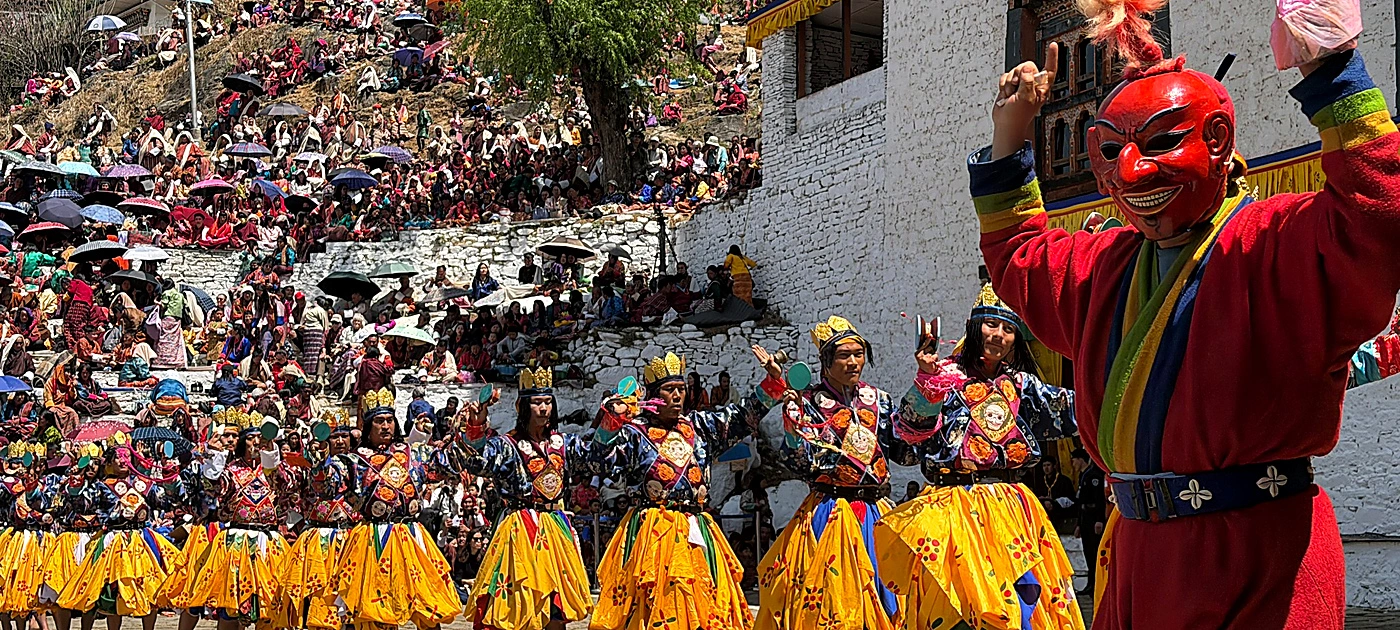
The Druk Wangyel Tshechu is Bhutan's December festival at Dochula Pass, and it breaks almost every rule the other tshechus follow. The dancers are soldiers, not monks. The stage is a mountain saddle at roughly 3,100 metres, ringed by 108 white chortens, with the eastern Himalaya behind it on a clear morning.
It is also young. The first Druk Wangyel Tshechu was held in 2011, so it lacks the centuries of ritual that shape Paro or Thimphu. Instead, it carries recent history, told in dance, on the very ground built to remember it.
This guide covers what the festival is, why its date never moves, what the day feels like on the pass, and how we build a winter week in Bhutan around a single morning at Dochula. For the full calendar of masked festivals across the country, our complete guide to Bhutan festivals holds the season-by-season overview.
Druk Wangyel Tshechu mask dancers on the festival ground at Dochula Pass with the 108 chortens behind
What Is the Druk Wangyel Tshechu?
The Druk Wangyel Tshechu is an annual festival of masked dances that honours Bhutan's Fourth King and the armed forces for a 2003 military operation. That winter, the Royal Bhutan Army moved against insurgent camps set up inside Bhutan's southern forests. Bhutanese soldiers died in the operation, and the country chose to remember them on its most visited road pass.
The memorial came first. Queen Mother Ashi Dorji Wangmo Wangchuck commissioned the 108 chortens at Dochula, consecrated in 2004, and completed the Druk Wangyel Lhakhang beside them in 2008 to mark a century of Bhutan's monarchy. The festival followed in December 2011, staged on the ground below the temple.
The name tells the story. Druk Wangyel roughly translates to "victory of the dragon people", with the dragon representing Bhutan itself.
Why the Druk Wangyel Tshechu Breaks the Tshechu Pattern
The Druk Wangyel Tshechu falls on the same date every December, while almost every other tshechu in Bhutan moves each year with the lunar calendar. Paro, Thimphu and Punakha tie their dances to the tenth day of a lunar month, so their Gregorian dates drift by weeks. Dochula does not drift.
That single fact changes how you plan a December trip. A traveller can lock the festival morning a year out, then build the rest of the week around it without waiting for the monastic body to publish dates. We still confirm the exact date at booking, because any national event can shift, but in practice the mid-December anchor holds.
Three other differences matter on the ground:
- The performers. Soldiers of the Royal Bhutan Army dance the cham, trained for this one event, rather than monks of a dzong.
- The choreography. The dances were composed for this festival, so they depict the Fourth King's campaign and a peaceful victory instead of the older Guru Rinpoche cycles.
- The stage. Every other major tshechu happens in a dzong courtyard. This one happens outdoors, in the open cold, at around 3,100 metres.
The result is a festival built from an old form to tell a modern story, and it feels different from any courtyard tshechu.
Dochula, the 108 Chortens and the Druk Wangyel Lhakhang
Dochula is the road pass between Thimphu and Punakha, roughly an hour's drive east of the capital, and the setting is half the reason to come. The 108 chortens rise in tiers on a small hill above the road. Strings of prayer flags run off every slope around them.
On a clear December morning, the view north opens to the high Himalaya along the Bhutan–Tibet frontier. Masanggang, at about 7,194 metres, and Gangkar Puensum, at about 7,570 metres, the highest mountain in Bhutan and still unclimbed, are the peaks most people try to name. By late morning, clouds often fill the valleys below, so the clearest views come early.
The Druk Wangyel Lhakhang sits above the chortens. Its paintings depict the Fourth King and scenes from the campaign alongside classical Buddhist figures, which is unusual for a Bhutanese temple. Just below the pass, the Royal Botanical Park at Lampelri protects the rhododendron and fir forest on both sides of the road.
Druk Wangyel Lhakhang above the 108 chortens at Dochula Pass, Bhutan, on a clear December morning
108 chortens of the Druk Wangyel memorial at Dochula Pass under winter snow, Bhutan
What the Festival Morning Feels Like at 3,100 Metres
The Druk Wangyel Tshechu is a cold, bright, crowded morning, and planning for all three makes the day. Families from Thimphu drive up early, so the slope around the ground fills fast. We leave Thimphu early to arrive before the first dances, the same timing our festival itinerary is built on.
Expect temperatures near freezing at dawn and single digits by midday, sharper in the wind. The sun reaches the ground mid-morning and turns the dancers' brocade into the brightest thing on the mountain.
Seating is the hillside itself. We bring blankets and hot tea, and your guide shows you where to stand so you can see the dances without blocking a family that arrived first.
The programme runs through the morning and into the early afternoon. Between dances, atsaras, the masked clowns, work the crowd. Leave room in the schedule; the festival keeps its own pace, and the last dance is rarely when a printed plan says.
The honest trade-off
Dochula is a public ground, and the best festival here is a shared one. No grandstands, no heated seating, and no private enclosure. We change everything around those hours: an early start without a scramble, a warm vehicle a short walk away, and a guide who knows the ground.
Building a December Week Around the Druk Wangyel Tshechu
The best use of the festival is as the hinge of a winter loop: Thimphu before, the pass in the morning, Punakha by the same evening. From the festival ground, the road drops about 1,900 metres to Punakha valley, near 1,200 metres. That descent takes roughly ninety minutes and lands you in a valley that runs about ten degrees warmer than the pass you left.
That is the planning trick we use for every winter departure in Bhutan: sleep low, visit high. Punakha in December is mild, sunny, and quiet, with oranges on the trees and the dzong in full light at the river confluence; our guide to a luxury stay in Punakha covers the valley in detail. Plan a full day to see the great dzong at the meeting of the Pho Chhu and Mo Chhu, plus a walk to Chimi Lhakhang.
Two extensions fit the same week:
- Phobjikha and the cranes. Black-necked cranes winter in Phobjikha from late autumn until about February. A detour over the Pele La adds two nights and the quietest valley in western Bhutan; see our Phobjikha Valley guide.
- Paro and Tiger's Nest. The usual close. December mornings on the Taktsang trail are frosty and nearly empty before nine.
Both loops start and end at Paro, Bhutan's only international airport, served by Drukair and Bhutan Airlines.
Punakha Dzong in December sunshine at the confluence of the Pho Chhu and Mo Chhu, a short drive below Dochula
What to Wear at Dochula Pass in December
Dress for a ski-lift queue, then cover up for a temple. The ground is open to wind at around 3,100 metres, and you'll stand or sit for hours. A down jacket, thermal base layers, a warm hat, gloves and insulated boots matter more than anything else on the packing list.
Respect the setting as you would a dzong courtyard. Wear long sleeves and long trousers or a skirt, remove hats inside the Druk Wangyel Lhakhang, and walk clockwise around the chortens. Many visitors rent a gho or kira for the day; your guide can arrange it in Thimphu the evening before.
Photography: you can photograph dancers on the open ground, but not inside the lhakhang. Drones are not allowed. A zoom lens lets you stay in your place and still catch the masks.
Visitor in a borrowed kira watching the Druk Wangyel Tshechu at Dochula Pass with Himalayan peaks in the distance
When to Book a Druk Wangyel Tshechu Trip
Book four to six months ahead for a December festival week, and earlier for the Phobjikha extension. December is Bhutan's quieter season, but the few lodges in Punakha and Phobjikha fill up around the festival and the crane season. Paro flights in December also run fewer departures than in spring and autumn.
Bhutan's Sustainable Development Fee applies per night on every trip, and we include it in our quoted price rather than adding it at the end. We confirm the current rate, along with visa processing, in your booking proposal against the Department of Tourism's published figures.
Druk Wangyel Tshechu FAQs
Who performs the dances at the Druk Wangyel Tshechu?
Soldiers of the Royal Bhutan Army perform the masked dances at the Druk Wangyel Tshechu, not monks. The dances were composed for this festival when it began in 2011, and they honour the Fourth King and the armed forces for the 2003 operation in southern Bhutan. That makes it the country's only major masked festival staged by the military, and the only one held outdoors on a high pass.
Why does the Druk Wangyel Tshechu fall on the same date every December?
The Druk Wangyel Tshechu follows the Gregorian calendar because it's a modern national event, while older tshechus follow the lunar calendar and shift each year. In practice, it keeps a fixed mid-December date, so you can plan a year ahead. We still confirm the exact date when you book, since officials can move any national event.
How cold is Dochula Pass during the Druk Wangyel Tshechu?
Dochula is close to freezing at dawn during the Druk Wangyel Tshechu and usually reaches only single digits Celsius by midday, with wind making it feel colder. Clear December days bring strong sun from mid-morning. Pack a down jacket, thermals, a warm hat, gloves and insulated boots, and expect to sit on the hillside for several hours.
How long does the drive take from Thimphu to the Druk Wangyel Tshechu at Dochula?
The drive from Thimphu up to Dochula takes about an hour on the East–West Highway, longer on festival morning when local traffic heads to the pass. We leave early to arrive before the first dances. From Dochula, Punakha Valley is roughly ninety minutes downhill, so the festival and a warm valley night fit comfortably into one day.
Can the Druk Wangyel Tshechu be combined with the black-necked cranes in Phobjikha?
Yes, you can fit the Druk Wangyel Tshechu and the Phobjikha cranes into the same week in December. The cranes winter in Phobjikha from late autumn to about February, and the valley is a short drive from Punakha over the Pele La. Add two nights in Phobjikha to a Thimphu, Dochula and Punakha loop, then close with Paro.
Is the Druk Wangyel Tshechu worth planning a Bhutan trip around?
The Druk Wangyel Tshechu is worth building a trip around if you want a winter visit anchored by a festival and no lunar-date uncertainty. It lasts one morning, so on its own it is light. As the hinge of a seven-day loop through Thimphu, Punakha and Paro, it gives December a fixed highlight while the rest of the week stays quiet and sunny.
What should visitors wear to the Druk Wangyel Tshechu at Dochula?
Visitors should wear warm, modest clothing to the Druk Wangyel Tshechu: long sleeves, long trousers or a skirt, and layers for high-altitude cold. Remove hats inside the Druk Wangyel Lhakhang and walk clockwise around the 108 chortens. Many guests rent a Bhutanese gho or kira for the day; your guide can arrange this in Thimphu.
Plan Your December at Dochula
The Druk Wangyel Tshechu belongs to a wider way of travelling in the Himalaya: fewer places, longer stays, and one well-chosen moment built into each journey. Our guide to luxury travel in the Himalayas explains how we plan across Nepal, Bhutan and Tibet.
When you are ready to see the festival yourself, our seven-day Druk Wangyel festival tour runs the Thimphu, Dochula, Punakha and Paro loop described here, with a private guide and vehicle throughout. Send us your dates, and we'll get back to you with a proposal built around that December morning.
Need Help? Call Us+977 9851013196orChat with us on WhatsApp
Need Help? Call Us+977 9851013196