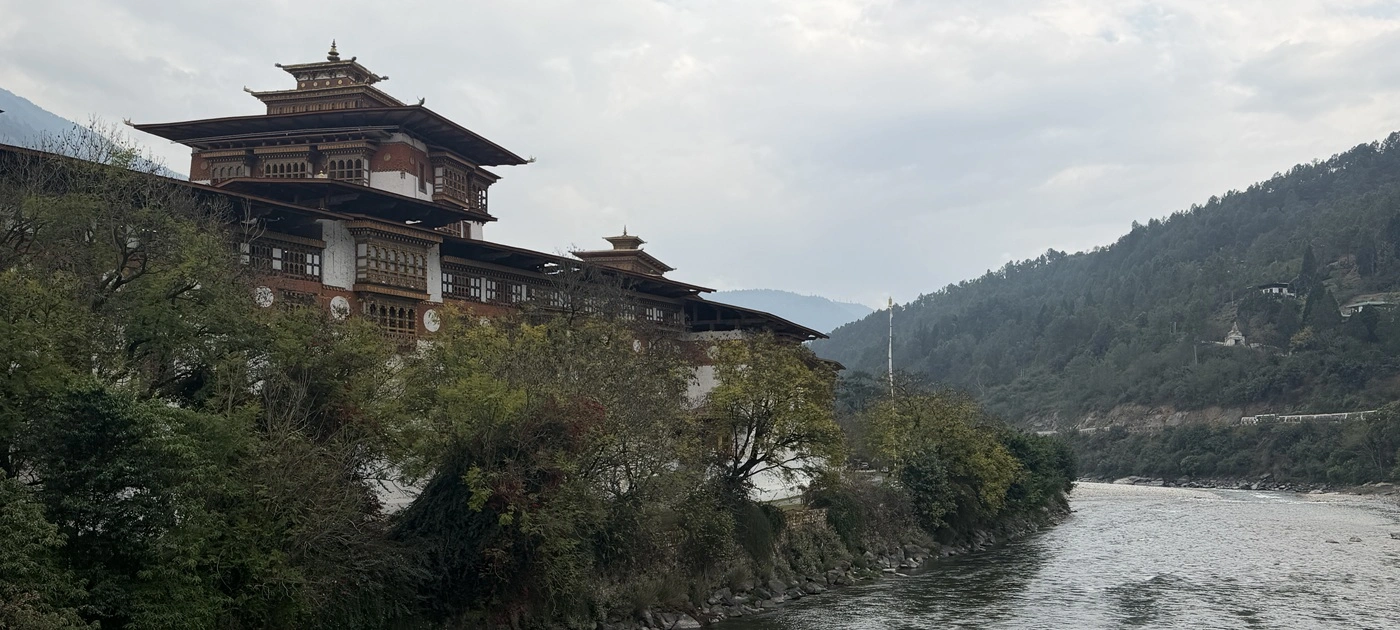
Punakha Dzong is the building every photograph of Bhutan seems to lead back to: a white fortress the length of two football pitches, moored like a ship where two rivers meet.
Bhutanese call it Pungthang Dewa Chhenbi Phodrang, the Palace of Great Happiness. Most visitors just call it the most beautiful thing they have seen in the country.
We take guests through Punakha Dzong on nearly every western Bhutan journey we run. This guide covers what the dzong actually is, why it was built between two rivers, what you'll see inside, and how to time your visit so you can be close to its courtyards.
What Is Punakha Dzong?
Punakha Dzong is a 17th-century fortress-monastery in the Punakha Valley of western Bhutan, and it still serves as a living monastery. It houses district administration on one side and hundreds of monks on the other, exactly as dzongs were designed to do four centuries ago.
The site does most of the explaining. The dzong stands on a spit of land at the confluence of two rivers — the Pho Chhu, the "father" river, and the Mo Chhu, the "mother" river — with water on three sides.
You enter across a covered cantilever bridge of dark timber, then climb a steep wooden stairway built to be hauled up against invaders.
Punakha Dzong sits at roughly 1,200 meters, one of the lowest and warmest dzong locations in western Bhutan. That low altitude is not a detail.
It is the reason the entire central monastic body still migrates here every winter, and the reason the valley grows rice, chilies, and the lilac jacaranda trees that frame the walls each spring.
The History: Bhutan's First Capital
Punakha Dzong is Bhutan's second-oldest and second-largest dzong, and for more than three centuries it was the country's capital. Zhabdrung Ngawang Namgyal, the Tibetan lama who unified Bhutan, built it in 1637–38 at a river junction that prophecy had marked as the site of a palace.
The government sat here until the capital moved to Thimphu in 1955.
Almost every hinge moment in Bhutanese history has passed through these courtyards. The first hereditary king, Ugyen Wangchuck, was crowned here in 1907. The fifth king was married here, in a ceremony the whole country watched.
The Zhabdrung himself died inside the dzong, and his remains are kept in the Machen Lhakhang, a chamber so sacred that only the King and the Je Khenpo — Bhutan's chief abbot — may enter.
The building has also survived a lot. Fires, an earthquake, and a glacial lake outburst flood on the Pho Chhu in 1994 all damaged it; each time, it was rebuilt by hand using traditional methods, without a single architectural drawing.
What you walk through today is both original and continuously renewed — a working answer to the question of how a wooden building lasts 400 years.
Why It's Called Bhutan's Most Beautiful Dzong
Punakha Dzong earns the title through proportion, setting, and timing rather than ornament. The walls are plain lime-washed white, leaning gently inward, six stories of them rising to a central tower called the utse.
Against them: dark timber galleries, gold roof finials, and river water on three sides that doubles the whole structure on a still morning.
Spring is when the famous photographs happen. Jacaranda trees planted along the ramparts flower lilac-purple, usually through April into May, and for a few weeks the white fortress appears to float on a ring of blossom. On our spring departures, we plan the Punakha days around that bloom rather than around the clock.
The approach adds its own drama. You cross the Mo Chhu on the covered wooden bridge — rebuilt after the 1994 flood in the original cantilever style — and the dzong grows until it fills your entire field of view. There's no fence, no ticket hall, no visual clutter.
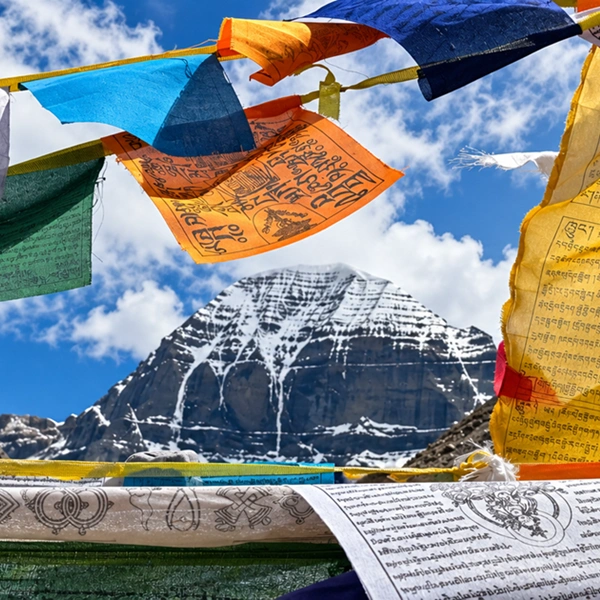
Five hundred meters of fortress, a river, and prayer flags. That restraint is the aesthetic.
Inside Punakha Dzong: What You'll Actually See
Inside, the dzong opens into three successive courtyards, called dochey, each with its own character. The first is the largest and most administrative, dominated by a whitewashed chorten and a magnificent bodhi tree.
The second belongs to the monks; in winter, you'll share it with maroon-robed monks hurrying between prayer sessions. The third holds the temples.
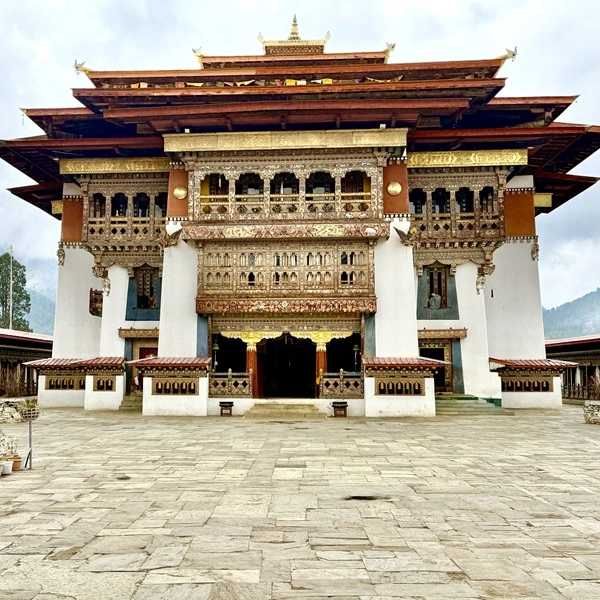
The finale is the kuenrey, the great assembly hall at the far end. Its murals trace the life of the Buddha in mineral pigment and gold, and its statues of the Buddha, Guru Rinpoche, and the Zhabdrung rank among the finest religious art in the kingdom.
Photography is welcome in the courtyards; inside the temples, cameras stay down, and our guides will tell you exactly where the line falls.
You will not enter the Machen Lhakhang, where the Zhabdrung's remains rest, and no visitor does. Knowing it is there, behind its guarded doors, is part of the weight of the place.
A visit through the courtyards and kuenrey takes about 90 minutes at an unhurried pace; we allow two hours so nothing is rushed.
Festivals at Punakha Dzong
Punakha Dzong hosts two back-to-back festivals in late winter: the Punakha Drubchen, followed immediately by the Punakha Tshechu. Exact dates shift each year with the lunar calendar and are confirmed at booking — the anchor is the season, not a fixed week.
The Drubchen is unlike any other festival in Bhutan. Local men dress as pazaps, 17th-century militia, and re-enact the campaign in which the Zhabdrung's forces turned back a Tibetan invasion — a mock battle staged on the riverbank below the walls, ending with a relic ceremonially "cast" into the Mo Chhu to deceive the enemy. It is living history performed by descendants of the villages that fought.
The Tshechu that follows brings masked cham dances to the main courtyard: the black hats, the drum dances, the deities and protectors, danced by monks in silk and carved masks.
Because Punakha's festivals fall in the mild valley winter, mornings are crisp, afternoons warm, and the dzong is fully alive with the monastic body in residence. If you want Bhutanese festival culture at its most rooted, this is our first recommendation.
Getting There, and When to Go
Punakha Dzong is about a three-hour private drive from Thimphu, and the drive itself is an event. You climb to Dochula Pass at 3,100 meters, where 108 memorial chortens stand in rings and, on a clear day, the eastern Himalaya lines the horizon.
From the pass, you descend nearly two vertical kilometers into the subtropical warmth of the Punakha valley, through forests that change species as you drop.
Spring and autumn are the classic windows for western Bhutan — clear skies in autumn, jacarandas and rhododendrons in spring. Winter is the insider's season here.
While Thimphu and Paro turn cold, Punakha stays mild, the monastic body is in residence, and the late-winter festivals fall in this window.
Our standing practice is to reach the dzong when it opens, before day-trip groups arrive over Dochula from Thimphu.
Early on, you'll share the first courtyard with monks and pigeons, not crowds. We also brief every guest on the dress code before leaving the car: long sleeves and long trousers or a skirt, no hats inside the walls, and shoes off in the temples.
Bhutanese visitors wear formal dress and a ceremonial scarf upon entry; matching their respect in our own way is simply good manners.
Around the Dzong: How We Build the Punakha Day
The dzong anchors the valley, but the best Punakha days breathe around it. A 15-minute walk upstream leads to the Punakha Suspension Bridge, one of the longest in Bhutan, strung with prayer flags high above the Pho Chhu — a favorite with every camera we've ever traveled with.
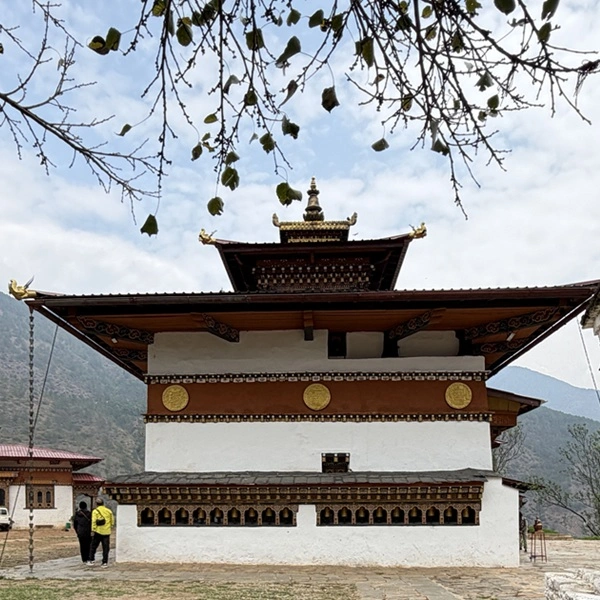
Across the valley, an easy walk through rice terraces reaches Chimi Lhakhang, the fertility temple of the "Divine Madman," Drukpa Kunley, whose irreverent teachings still color village life here. Further up the valley, the hilltop Khamsum Yulley Namgyal Chorten rewards a 45-minute climb with the finest view of the river and paddies in the district.
For something faster-moving, the Mo Chhu offers gentle white-water rafting that ends almost beneath the dzong's walls — the only way to see the fortress from the water it was built to command. We fold any of these into a private itinerary; nothing in Punakha needs to be rushed, and with two nights in the valley, none of it is.
Punakha Dzong FAQs
Can tourists go inside Punakha Dzong?
Yes. Visitors accompanied by a licensed Bhutanese guide can walk the three courtyards and enter the kuenrey, the main assembly hall, outside prayer times. Certain chambers stay closed — above all the Machen Lhakhang, which holds the Zhabdrung's remains and admits only the King and the Je Khenpo. Your guide arranges entry, timing, and any tickets; on our trips, all of this is handled before you arrive.
Why was Punakha Dzong built between two rivers?
Defense and prophecy, in that order. Water on three sides made the fortress nearly unassailable in the 17th century, when it guarded Bhutan against northern invasion. Tradition also holds that Guru Rinpoche foretold a palace rising on a hill shaped like a sleeping elephant at a river meeting — and the dzong stands on the trunk, where the Pho Chhu and Mo Chhu join.
What is the dress code for visiting Punakha Dzong?
Cover shoulders and knees: long sleeves with long trousers or a long skirt. Remove hats and caps inside the walls, and remove shoes before entering any temple. Photography is fine in the courtyards but not inside the lhakhangs. Bhutanese enter in national dress with a ceremonial scarf; visitors aren't expected to match that, only to dress with the same intent.
How long does a visit to Punakha Dzong take?
Plan on 90 minutes to two hours for the courtyards, the bodhi tree, and the kuenrey at a comfortable pace. Add the walk across the cantilever bridge and time by the river, and a relaxed visit fills half a morning. We schedule it first thing after opening, when the light is soft and the day-tour groups from Thimphu are still crossing Dochula.
Is Punakha Dzong worth visiting in winter?
Winter is arguably its best season. The valley sits low enough to stay mild while Thimphu turns cold, which is why the Je Khenpo and the central monastic body move here every winter — the dzong is fullest and most alive then. The late-winter Punakha Drubchen and Tshechu festivals fall in this window, with dates set by the lunar calendar.
When do the jacaranda trees at Punakha Dzong bloom?
The jacarandas around Punakha Dzong typically flower from April into May, in Bhutan's spring season. For a few weeks, the lilac blossoms ring the white walls — the image behind most famous photographs of the dzong. Exact timing shifts a little each year with the weather, so on spring journeys we keep the Punakha days flexible around the bloom.
What happened to Punakha Dzong in the 1994 flood?
A glacial lake on the Pho Chhu burst in 1994, and the flood damaged the dzong and destroyed its wooden approach bridge. The fortress was restored using traditional methods, and the covered cantilever bridge you cross today was rebuilt in the original style. Flood-protection work on the Pho Chhu now shields the site, and the event is part of how guides tell the building's story.
How far is Punakha Dzong from Thimphu?
About 75 kilometers by road, which takes roughly three hours by private car over Dochula Pass at 3,100 meters. The drive is a highlight rather than a transfer: 108 chortens and a Himalayan panorama at the pass, then a long descent into the warm valley. Most guests break the journey at Dochula for tea and the view.
Punakha Dzong is the reason many people choose western Bhutan in the first place, and it deserves more than a lunch stop between Thimphu and the next valley.
If you'd like it woven into a private journey — two unhurried nights in the valley, the dzong at opening time, the bridge, the river — our Bhutan luxury tour is built around exactly that pace.