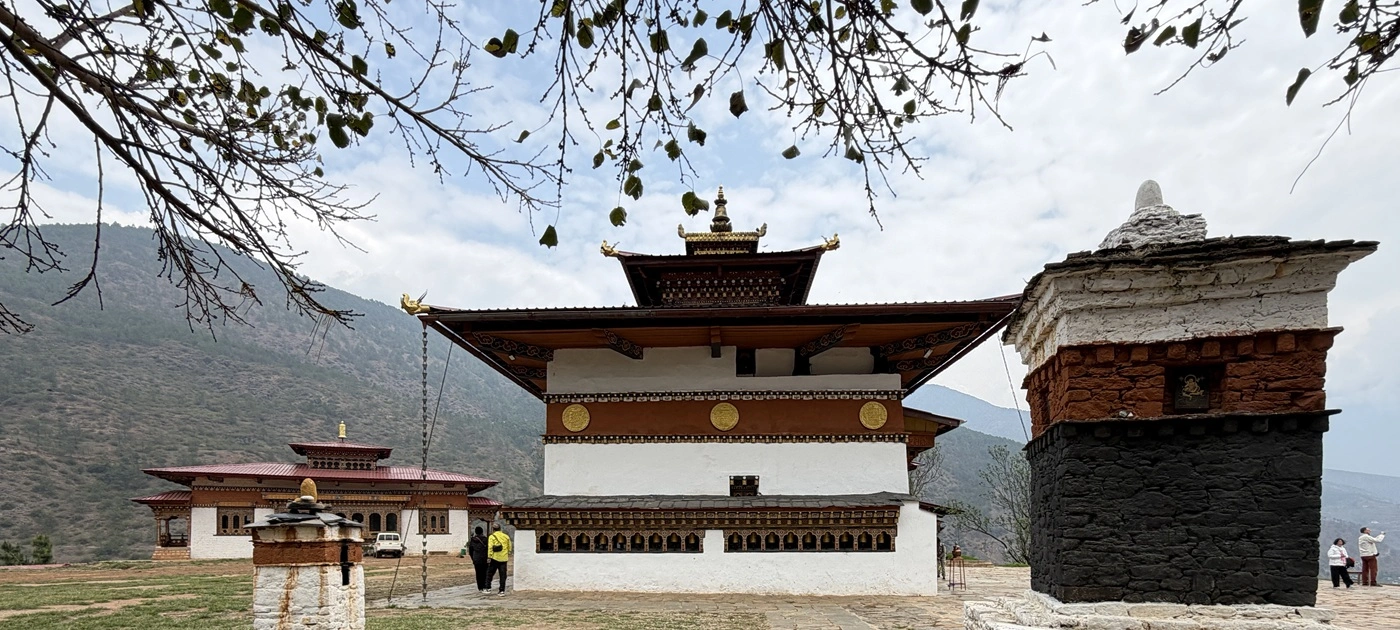
Chimi Lhakhang is the temple most first-time visitors to Bhutan remember longest, and not for its size. It's a modest whitewashed building with a golden spire, standing on a round hillock above the rice terraces of the Punakha valley.
What sets it apart is the man behind it: Drukpa Kunley, the fifteenth-century saint Bhutanese call the Divine Madman, who taught enlightenment through outrage, humor, and behavior no other holy figure would touch.
Couples travel here from across Bhutan, and increasingly from around the world, to seek children. The blessing they receive involves a wooden phallus. This guide explains the temple, the saint, the walk, and where the stop fits on a private Punakha journey.
What is Chimi Lhakhang?
Chimi Lhakhang is a Buddhist temple in Bhutan's Punakha district, built in 1499 by Ngawang Choegyel, the fourteenth Drukpa hierarch, on a site blessed by his cousin Drukpa Kunley.
It stands at roughly 1,350 meters near Sopsokha village, between the Metshina road junction and Lobesa, on the route every traveler drives between Thimphu and Punakha.
The name carries the founding legend. Drukpa Kunley is said to have subdued a demoness who fled the Dochu La pass in the form of a dog, then buried her beneath a black chorten on this hillock and declared "chi mi" — no dog.
The temple rose beside that chorten, and the chorten still stands at the entrance today.
Inside, the shrine holds images of Drukpa Kunley with his bow and arrow, as well as wooden and bone phalluses used for blessings.
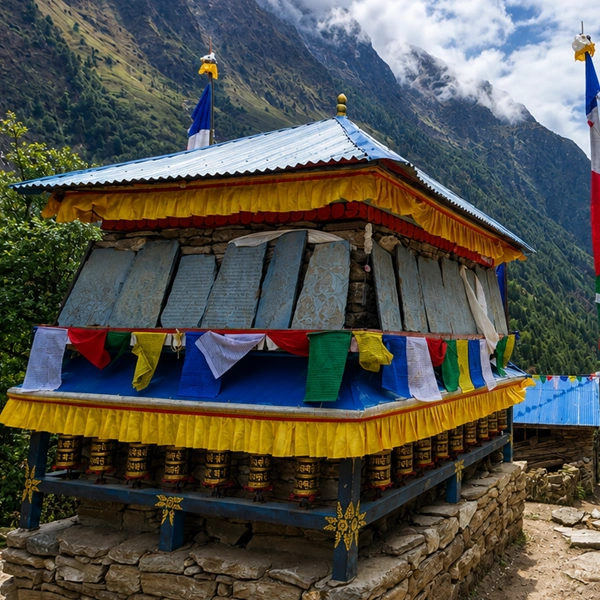
A large bodhi tree shades the courtyard. Monks of all ages live here, and the youngest novices are usually the ones spinning through the prayer-wheel wall when visitors arrive.
Who was Drukpa Kunley, the Divine Madman?
Drukpa Kunley was a Tibetan-born saint of the Drukpa Kagyu lineage who lived from the mid-fifteenth to the early sixteenth century and became Bhutan's most beloved religious figure.
He rejected monastic formality entirely. He taught through songs, jokes, drink, and open sexuality, aiming his sharpest ridicule at religious hypocrisy and social pretense.
Bhutanese tradition calls his method "crazy wisdom." The idea is that shock breaks through ego and convention faster than doctrine does.
His weapon against demons, in the stories, was the "flaming thunderbolt of wisdom" — his own phallus — which is why that symbol, painted and carved, now protects homes across this valley.
His songs and stories still circulate orally in Bhutan, told by grandparents and guides alike. No other figure in the country's religious history is quoted as often, or laughed with as freely.
The walk from Sopsokha through the rice paddies
The walk to Chimi Lhakhang takes about 20 minutes each way from Sopsokha village, along a raised earthen path that crosses working rice terraces.
It's flat to gently rising, manageable in ordinary walking shoes, and one of the easiest walks in Bhutan with a genuine reward at the end.
The path itself is half the visit. You pass farmhouses painted with the protective phallus murals the valley is famous for, and small shops selling carved versions in every size — the local artists take the commissions seriously. In the transplanting season, the paddies stand flooded and mirror-bright; by harvest, they turn deep gold, and farmers thresh grain beside the trail.
We walk our guests in from Sopsokha rather than taking a shortcut from the nearer parking area, and our standard practice is to time it for the late afternoon light when day-tour groups have moved on.
The final approach climbs the hillock in two or three easy switchbacks past the prayer wheels.
What happens at the fertility blessing
Couples hoping to conceive receive a blessing in which a monk touches their heads with a wooden or bone phallus and with Drukpa Kunley's bow and arrow. The ritual is brief, matter-of-fact, and entirely sincere — this is a functioning temple, not a performance for visitors.
Bhutanese couples who later have a child often return to name the baby here. The monk draws a name slip, and children named at Chimi Lhakhang commonly carry Kinley or Chimi in their names as a mark of the temple's blessing.
The walls near the shrine hold photo albums of babies sent by families from Bhutan and abroad, which the monks will happily show you.
You don't need to seek a blessing to visit. Travelers who simply want to see the shrine are welcome, and no one is pressured to participate.
Why are there phallus paintings on the houses?
The phallus in this valley is a protective symbol, not a crude one, and it predates even Drukpa Kunley's arrival before becoming attached to his legend.
Painted beside doorways or carved and hung from roof corners, it wards off malicious gossip and evil spirits — a folk tradition the Divine Madman's stories supercharged.
Sopsokha and Lobesa display the tradition more openly than anywhere else in Bhutan, thanks to the temple next door. Elsewhere in the country, you'll see it more discreetly, on new houses after consecration rituals or in carved form under the eaves.
Our guides brief guests on this before the walk because the natural reaction is to laugh, and that's fine—Bhutanese laugh about it too. The tradition holds humor and sincerity in the same hand, exactly as Drukpa Kunley intended.
Where Chimi Lhakhang fits on a Punakha itinerary
Chimi Lhakhang works best as the mid-journey stop on the drive from Thimphu to Punakha, after crossing the Dochu La pass and before reaching the valley floor.
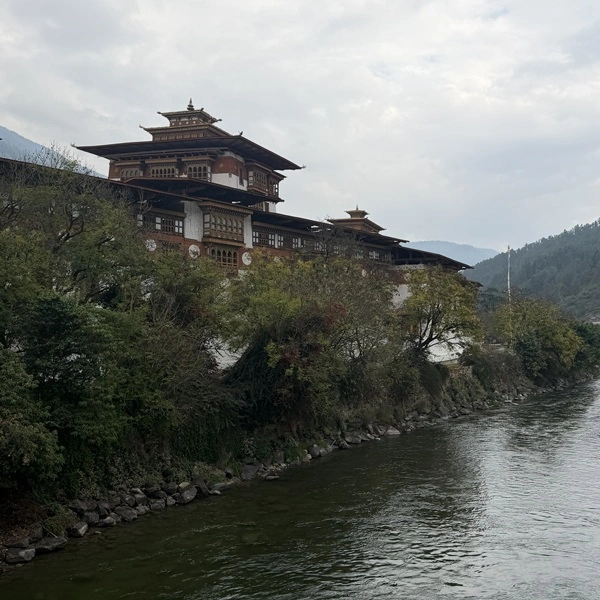
The sequence unfolds: the 108 chortens at Dochu La at 3,100 meters in the morning, the descent through changing forest, the paddy walk and temple around midday or later, then Punakha Dzong at the confluence of the Pho Chhu and Mo Chhu rivers.
The stop takes 60 to 90 minutes, including the walk both ways. Paired with the dzong, it gives Punakha's two poles in one day — the state's grandest building and its most human temple.
For guests staying two nights in the valley, we often hold Chimi Lhakhang on the second day instead and pair it with a village lunch in Lobesa. The valley's low altitude makes the pacing gentle either way.
Best time to visit Chimi Lhakhang
Chimi Lhakhang is comfortable to visit year-round because the Punakha Valley sits at a low elevation, around 1,200 to 1,350 meters, with mild winters and warm springs. Spring brings flooded, sky-mirroring paddies and jacaranda bloom near the dzong; autumn brings golden terraces and harvest activity along the path.
Summer monsoon afternoons can turn the trail muddy, though mornings usually stay walkable. Winter is quiet and clear, and the valley is precisely where Bhutanese travelers themselves go to escape Thimphu's cold.
Timing within the day matters more than season. Large groups cluster in the late morning; the early morning and late afternoon give you the courtyard and often the monks' unhurried attention.
Etiquette inside the temple
Standard Bhutanese temple conduct applies at Chimi Lhakhang: remove shoes and hats before the shrine room, walk clockwise around the building and the black chorten, and photograph only the exterior—never inside the shrine.
Dress with shoulders and knees covered; your guide carries a wrap if you're caught short.
Speak quietly inside, and don't point your feet toward the altar when seated. A small offering at the shrine is customary but never required.
The one etiquette point specific to this temple: treat the blessing objects with the same respect you'd give any relic. The humor lives in the stories and the souvenir shops, not in the shrine room itself.
Chimi Lhakhang FAQs
How long is the walk to Chimi Lhakhang, and is it difficult?
The walk takes about 20 minutes each way from Sopsokha village on a mostly flat earthen path through rice paddies, with a short, gentle climb up the hillock at the end. Ordinary walking shoes are enough. It suits nearly all fitness levels and ages, which is one reason we include it on family and multi-generational Bhutan journeys.
Can couples actually receive the fertility blessing at Chimi Lhakhang?
Yes. Any couple can request the blessing, in which a resident monk touches their heads with a ritual phallus and Drukpa Kunley's bow and arrow. It takes a few minutes and requires no advance booking on a private visit — your guide arranges it on arrival. Many international couples participate, and the monks keep albums of the babies born afterward.
Why is Chimi Lhakhang called the temple of the Divine Madman?
Because it honors Drukpa Kunley, the fifteenth-century saint whose deliberately outrageous teaching style earned him the name. He subdued the demoness of Dochu La at this site, according to legend, and his cousin Ngawang Choegyel built the temple beside the demon-sealing chorten in 1499. His relics, including his bow and arrow, remain in the shrine.
Is Chimi Lhakhang appropriate to visit with children?
Yes, and Bhutanese families visit with children constantly. The phallus imagery in the villages is understood locally as a protective symbol, and guides frame it that way — most kids register the walk, the animals in the paddies, and the young novice monks far more than the murals. The blessing is optional and is given only when requested.
How far is Chimi Lhakhang from Punakha Dzong?
About 30 to 40 minutes by road, roughly 10 kilometers down the valley plus the 20-minute paddy walk. The two sit naturally in a single day: most itineraries visit Chimi Lhakhang on the descent from Dochu La and continue to Punakha Dzong afterward, or reverse the order to catch the dzong in morning light.
What should I wear to visit Chimi Lhakhang?
Cover your shoulders and knees, and wear shoes you can slip off easily at the shrine door. The valley is warm most of the year, so light layers work — add a sun hat for the exposed paddy walk and remove it inside the temple grounds. In monsoon season, shoes with grip help on the earthen path.
The easiest way to stand on that hillock yourself is on a privately guided journey through western Bhutan. Our Best of Bhutan tour crosses Dochu La and settles into the Punakha valley with time built in for the paddy walk, the blessing if you'd like it, and the dzong — at your pace, with a guide who grew up on these stories.