Why Punakha Is Different
Punakha sits at 1,200-1,400 meters — nearly 1,000 meters lower than Paro and Thimphu. This altitude difference creates a subtropical microclimate that exists nowhere else in highland Bhutan. Banana orchards. Jacaranda blooms. Terraced rice paddies fed by glacial rivers. The air is warmer. The vegetation is lush.
And the consequence for luxury travel is transformative: outdoor infinity pools that operate year-round. Open-air dining pavilions. Safari-style tented lodges with river-facing decks. None of this is architecturally feasible in the frozen alpine valleys above 2,000 meters. Punakha’s warmth is its structural advantage, and every major luxury brand has placed its most ambitious property here.
The Punakha Dzong: The Palace of Great Bliss
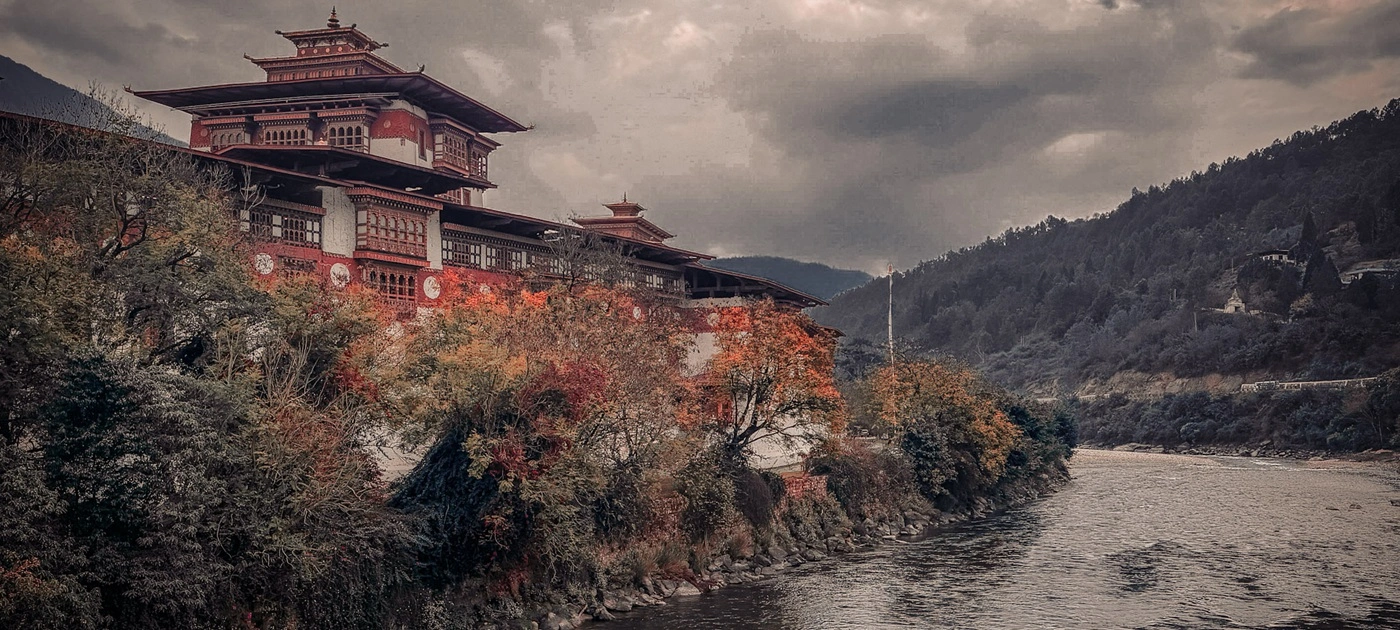
Formally: Pungthang Dewa Chenpoi Phodrang — the Palace of Great Bliss. Built in 1637 by Zhabdrung Ngawang Namgyal, the man who unified Bhutan. It occupies the sliver of land at the exact confluence of the Mo Chhu (Female River) and Pho Chhu (Male River). The dzong houses the sacred preserved remains of the Zhabdrung. Every Bhutanese king has been crowned inside it.
The Central Monastic Body — thousands of monks — winters here because the subtropical climate makes it habitable when the higher dzongs freeze.
Three great courtyards. Monumental woodwork. Towering white walls. Intricate mandalas. You enter via a charming wooden cantilever bridge over the Mo Chhu.
Through our network, we arrange private evening access: the dzong after the crowds leave, bathed in dusk light and localized illumination. The atmospheric conditions are fundamentally different from those on a midday tour. The scale of the architecture registers differently in silence.
Where to Stay: Five Lodges, Five Philosophies
|
Lodge
|
From/Night
|
Rooms
|
What Defines It
|
|
Pemako Punakha
|
$1,690
|
19 villas
|
Tented pool villas on the Mo Chhu riverbank. Private heated plunge pool in every villa. Butler service. Sowa-Rigpa Lotus Realm Spa (Wind/Bile/Phlegm diagnosis).
Arrival: narrow bridge, chanting lama. Alchemy House heritage dining. Sura wine-cellar restaurant (charred river trout). Presidential Villa.
|
|
&Beyond
|
$1,500+
|
8 (20 max)
|
Safari-style suspended tents. The lowest density in the valley. “Star baths”: deep tubs under skylights for nighttime soaking beneath the Himalayan sky.
White-water rafting. Mountain biking. Paddy plowing. All-inclusive (meals + activities + premium beverages). First &Beyond property in Asia.
|
|
Six Senses
|
$1,500
|
16 + 3 villas
|
The Flying Farmhouse. Cantilevered over rice terraces. Crescent infinity pool mirroring the paddy contours. Underground spa village.
Alchemy Bar. Recycled mason-jar light fixtures. GEM (Guest Experience Maker). Eco-chic. Riverside Pomegranate Martinis.
|
|
COMO Uma
|
$400+
|
11
|
The most intimate. On a bend of the Mo Chhu. Floor-to-ceiling Valley View rooms. One-Bedroom Villa. Bukhari restaurant (one of the finest in the kingdom).
COMO Shambhala Retreat: hot stone baths, river views. Supreme privacy through sheer smallness.
|
|
Amankora
|
$1,500
|
8 suites
|
Prayer-flag suspension bridge arrival over the Mo Chhu. Electric buggy to lodge. Built around a 300-year-old farmhouse by a former Chief Abbot.
Terrazzo baths. Bukhari stoves. No televisions. Outdoor infinity pool (the only Amankora with a pool — Punakha’s warmth makes it possible). Circuit logistics.
|
Pemako for privacy and architectural novelty (tented villas, plunge pools, Sowa-Rigpa). &Beyond for adventure (rafting, biking, star baths, safari DNA). Six Senses for wellness and sustainability (crescent pool, spa village, Alchemy Bar). COMO Uma for intimacy and food ($400 entry, 11 rooms, Bukhari). Amankora for circuit continuity and heritage (300-year-old farmhouse, prayer-flag bridge, pool).
What to Eat
Inside the Lodges
Pemako Alchemy House: a restored heritage building. Traditional recipes over clay stoves in terracotta vessels. Thick-skinned momos. Yak curries. Dried pork with mountain turnips. Foraged fiddlehead ferns. You sit on the floor. Pemako Sura: intimate chef’s counter over a wine cellar. Charred green chilies stuffed with river trout. Mushrooms and cheese on buckwheat biscuits. International technique applied to local terroir.
Six Senses: the cantilevered dining room with valley views. Riverside Pomegranate Martinis served from driftwood bars constructed for the occasion. Cowshed Dinner in Gangtey (for circuit travelers). Alchemy Bar botanical cocktails.
COMO Uma Bukhari: the benchmark. Seasonal buckwheat, pumpkin, and wild mushrooms from the organic garden. COMO Shambhala wellness cuisine alongside hearty Bhutanese-international dishes. One of the finest dining rooms in the kingdom.
Amankora: communal dining in the 300-year-old farmhouse. Momos with fiery chili sauces during pre-dinner cocktails — the daily ritual that Amankora guests anticipate across the circuit.
Outside the Lodges
Riverside picnics at Dzomlingthang with the Punakha Dzong as backdrop. Advance teams construct temporary pavilions: plush throws, low tables, fire pits. Tomza: traditional banana-leaf lunch with fragrant rice, ezay chili paste, and dried meats.
Ara sundowners: flights of traditional grain liquor infused with gooseberry, rosemary, saffron, or cardamom, served from driftwood bars beside the river at dusk. Not a drink — a ceremony.
What to Do Beyond the Dzong
Khamsum Yuelley Namgyal Chorten
Commissioned by the Queen Mother in 2004 to ward off negative spiritual forces. A spectacularly ornate three-story stupa. The hike: cross a suspension bridge at Yepaisa Village, ascend through pine forest and terraced fields, reach the roof for sweeping valley panoramas. Pair with a luxury picnic breakfast on the descent.
Chimi Lhakhang — The Fertility Temple
Built for the Divine Madman, Drukpa Kunley — the saint who taught through wine, women, and shock. Phallic murals on the walls. A pilgrimage site for couples worldwide seeking blessings for conception. A 20-minute walk through rice paddies from the Punakha suspension bridge. Culturally fascinating regardless of your intentions.
Sangchhen Dorji Lhuendrup Nunnery
A Buddhist college housing over 120 nuns. Candle-making classes. Evening prayer observation. Overlooking the valley from an elevated ridge. The quietest spiritual site in Punakha.
White-Water Rafting
The Mo Chhu and Pho Chhu offer gentle Class II-III rapids — enough for excitement, not enough for danger. &Beyond includes this in their all-inclusive program. Other lodges arrange it through local operators. Seasonal (best in spring and autumn when water levels are moderate).
The Festivals: Drubchen + Tshechu Back-to-Back
Punakha hosts the only back-to-back Drubchen and Tshechu in Bhutan. Late February / early March. Five consecutive days of ceremony in the dzong courtyard.
Punakha Drubchen (February 24-26, 2026): not a religious festival — a military reenactment. Local militia in antique battle gear recreate the 17th-century defense against Tibetan invasion. Fierce. Proud. Unique in Bhutan.
Punakha Tshechu (February 27-March 1, 2026): pure spiritual celebration. Monks in silk robes and terrifying wooden masks perform hypnotic Cham dances honoring Guru Rinpoche. The climax: the pre-dawn unfurling of a massive Thongdrel — a giant sacred thangka.
Simply seeing it is believed to cleanse your accumulated sins. We arrange VIP seating, private guiding to decode the iconographic program of each dance, and the flexibility to retreat to your lodge when the sensory intensity peaks.
Getting to Punakha
From Paro: 3-4 hour drive over the Dochula Pass (3,100m). The pass is crowned by 108 memorial chortens commissioned by the Queen Mother in 2004, with 360° panoramic views of the eastern Himalayas (peaks above 7,000m visible on clear days). The drive is scenic, winding, and beautiful. It is also 3-4 hours of switchbacks. Motion sickness: carry Dramamine or use the helicopter.
By helicopter: Paro to Punakha, $3,646-3,946. 30-40 minutes. Over the Dochula Pass and directly into the valley. The flight that turns a half-day drive into a half-hour of spectacular aerial immersion in the Himalayas. Strongly recommended for multi-valley circuits.
Frequently Asked Questions
What is the best hotel in Punakha?
Pemako: tented pool villas, Sowa-Rigpa, $1,690+. &Beyond: safari-style, star baths, 20 max, all-inclusive. Six Senses: crescent pool, Flying Farmhouse, eco-chic. COMO Uma: 11 rooms, Bukhari, $400+. Amankora: 300-year-old farmhouse, prayer-flag bridge, pool. Choose by priority: privacy (Pemako), adventure (&Beyond), wellness (Six Senses), food (COMO), circuit (Amankora).
Why is Punakha warmer than the rest of Bhutan?
Altitude. Punakha sits at 1,200-1,400m — nearly 1,000m lower than Paro and Thimphu. This creates a subtropical microclimate: banana orchards, rice terraces, jacaranda blooms. Outdoor pools operate year-round. Tented lodges are viable. The warmth is the reason every major luxury brand has placed its most ambitious property here.
What is the Punakha Dzong?
The Palace of Great Bliss. Built in 1637 by the unifier of Bhutan. At the confluence of the Mo Chhu and Pho Chhu rivers. Houses the Zhabdrung’s preserved remains. The site of all royal coronations. Winter residence of the monastic body. The most beautiful fortress-monastery in Bhutan. Private evening access arranged through our network.
What are the Punakha festivals?
Drubchen (Feb 24-26, 2026): military reenactment of the 17th-century defense against Tibet. Warriors in antique battle gear. Tshechu (Feb 27-Mar 1, 2026): spiritual Cham dances, silk robes, wooden masks, and the pre-dawn Thongdrel unfurling. Five consecutive days. VIP seating arranged. Book lodges 6-12 months in advance.
What is a star bath?
&Beyond’s signature. A deep bathtub positioned under a skylight or on an open-air deck, designed for nighttime soaking beneath the unpolluted Himalayan sky. The valley has virtually zero light pollution. You lie in hot water and watch the Milky Way rotate above you.
What is Pemako’s Sowa-Rigpa spa?
Traditional Bhutanese medicine. The Lotus Realm Spa diagnoses your constitutional balance (Wind, Bile, Phlegm) and prescribes herbal compressions and targeted acupressure. Not a generic spa menu. A diagnostic treatment system rooted in centuries of Himalayan medical practice.
How do I get to Punakha?
Drive from Paro: 3-4 hours over the Dochula Pass (3,100m, 108 chortens, Himalayan panorama). Helicopter from Paro: $3,646-3,946, 30-40 minutes. The helicopter is strongly recommended for comfort and time. We arrange both.
What is the Chimi Lhakhang?
The fertility temple. Built for the Divine Madman (Drukpa Kunley). Phallic murals. Couples worldwide visit for conception blessings. 20-minute walk through rice paddies from the Punakha suspension bridge. Culturally fascinating regardless of your purpose.
How many nights should I spend in Punakha?
Minimum 2: Dzong + one lodge experience + Chimi Lhakhang. Recommended 3: adds Khamsum Chorten hike, riverside picnic, spa day, rafting. Festival timing: 4-5 nights to cover the full Drubchen + Tshechu. Punakha is the restorative midpoint of the Bhutan circuit — do not rush it.
Can I combine Punakha with other valleys?
Yes. Punakha is the midpoint of the standard luxury circuit: Paro → Thimphu → Punakha → (Gangtey) → Paro. 7-10 days. We recommend blending lodge brands: Six Senses in Thimphu for wellness; &Beyond or Pemako in Punakha for adventure or privacy; and Amankora or COMO in Paro for the Tiger’s Nest finale.
The Final Word
Punakha is the valley where the male and female rivers converge beneath a fortress built by the man who unified a kingdom. The monks winter here because it is warm. The luxury brands build here because the warmth allows what the cold cannot: pools, tented villas, open-air decks, star baths, and riverside dinners with the dzong glowing in the background.
You sit on the floor of a restored heritage building and eat yak curry from a terracotta bowl. You soak in a tub under the Milky Way. You watch a monk in a terrifying wooden mask perform a dance that his lineage has performed in this courtyard since 1637. And you cross a prayer-flag bridge over a river named after a woman and check into a lodge built around a farmhouse constructed by a Chief Abbot three hundred years ago.
Punakha is not the starting point of a Bhutan trip. It is the point where the trip becomes something else entirely. Tell us how many nights.