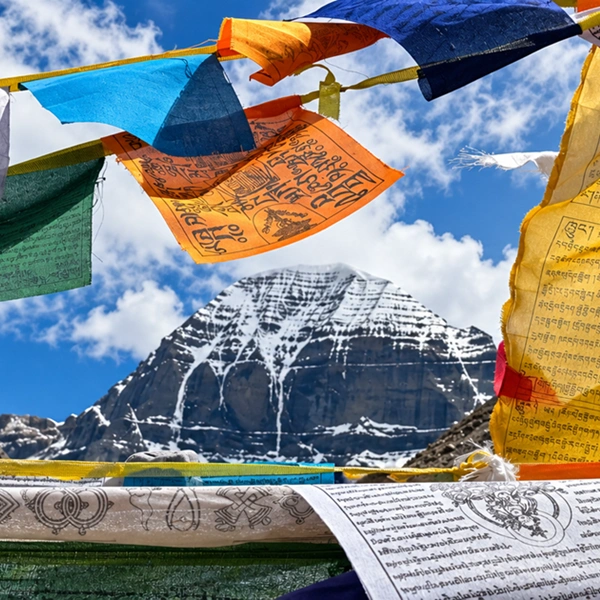
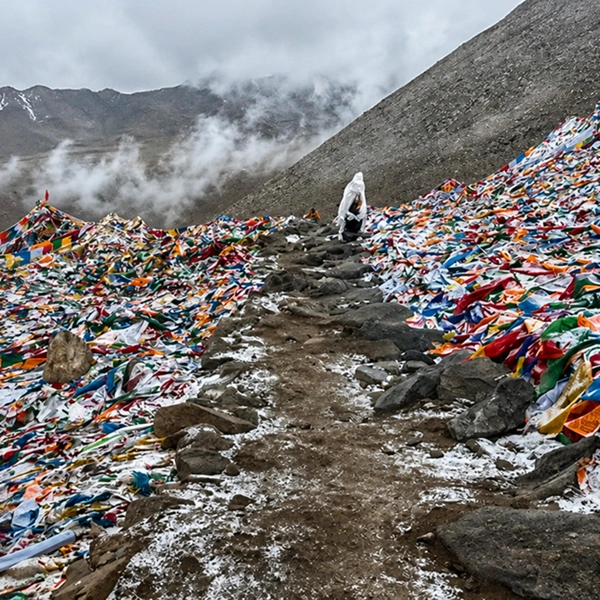
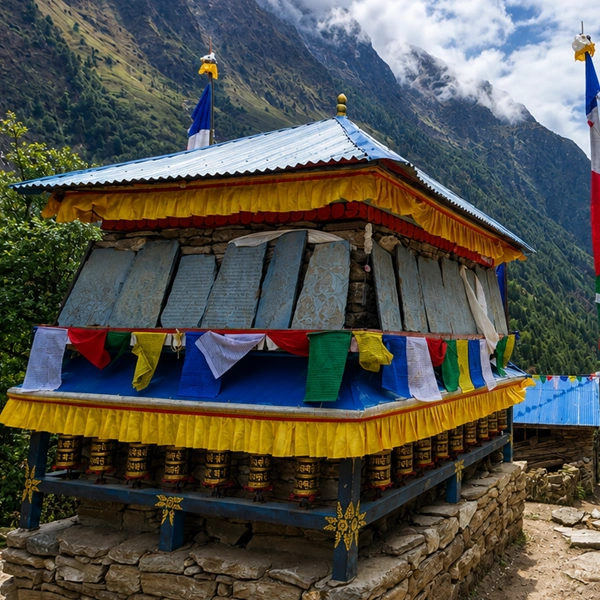
Bhutan festivals are not performances staged for visitors — they are living liturgies, and the tshechus held in the kingdom's fortress-monasteries rank among the most profound cultural experiences anywhere in the Himalaya.
A tshechu, literally "tenth day" in Dzongkha, honors Guru Rinpoche on the tenth day of a lunar month, and every valley in Bhutan celebrates its own.
We have stood in the Paro courtyard before dawn as the giant thongdrel unrolled down the dzong wall, and we have watched sixteen masked men dance by torchlight at midnight in Bumthang.
The two experiences could not be more different. Both are in Bhutan.
This guide is deliberately evergreen. We explain why the dates move each year, what you will actually witness, which festival suits which traveler, and how the kingdom's tourism rules shape the planning.
Exact departure dates are confirmed at booking, according to the lunar calendar used by the monasteries themselves.
Why Bhutan Festival Dates Change Every Year
Bhutan festival dates shift because the kingdom uses a lunisolar calendar rather than the Gregorian calendar. It is a variant of the Tibetan Phukpa system, formalized in the fifteenth century and based on a sixty-year cycle that pairs five elements—wood, fire, earth, iron, and water—with twelve animal signs.
A lunar year runs roughly 354 days. To keep the months aligned with the agricultural seasons, monastic astrologers insert a leap month every two to three years, and individual lunar days stretch or compress with the moon's uneven orbit.
The result: a festival fixed to the tenth day of the second lunar month can land weeks apart in successive Gregorian years.
There is a practical consequence. Final schedules are typically confirmed by the monastic astrologers only two to three months ahead, while flights into Paro and the best lodges sell out four to six months before the great festivals — and nine to twelve months for Paro and Thimphu.
We plan around the lunar month first, then lock in the ground arrangements as soon as the dates are gazetted. That sequencing is the single most important thing to understand about festival travel in Bhutan.
What a Tshechu Actually Is
A tshechu is a religious festival of three to five days honoring Guru Rinpoche — Padmasambhava — who carried Vajrayana Buddhism across the Himalayas in the eighth century. Tradition holds that he performed the first sacred dances to purify the ground at Samye, Tibet's first monastery, and later danced at sites across Bhutan to bind local spirits as protectors of the Dharma.
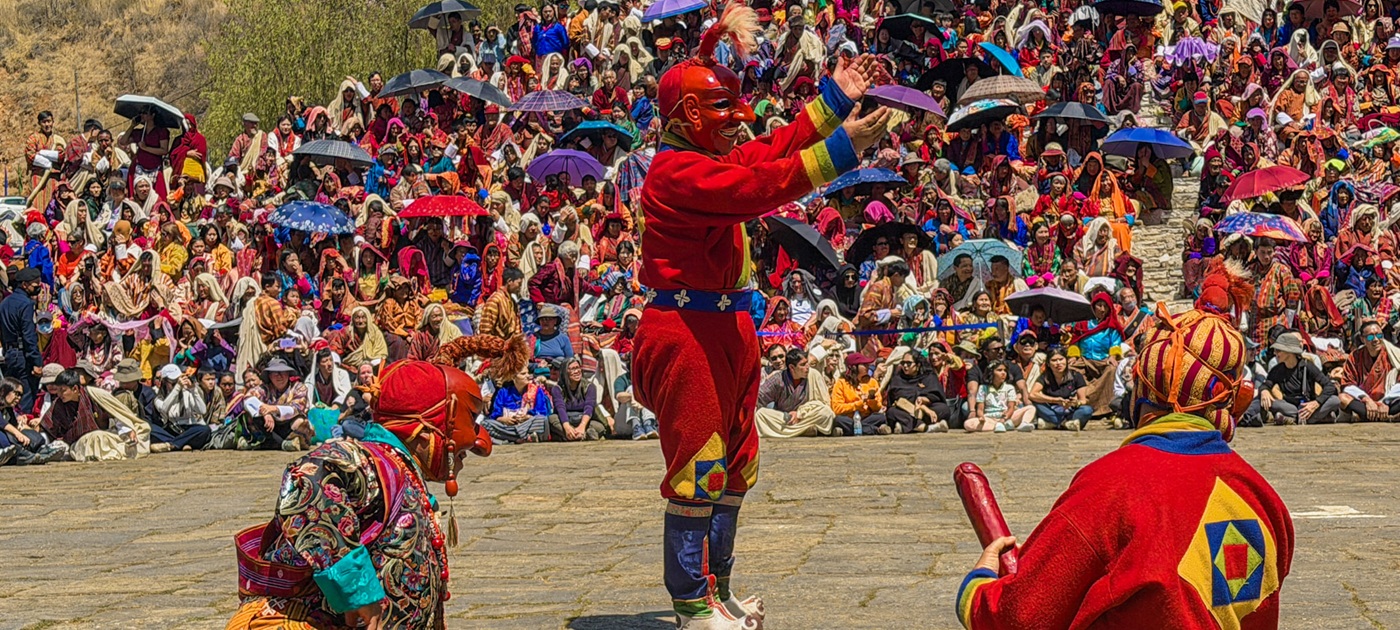
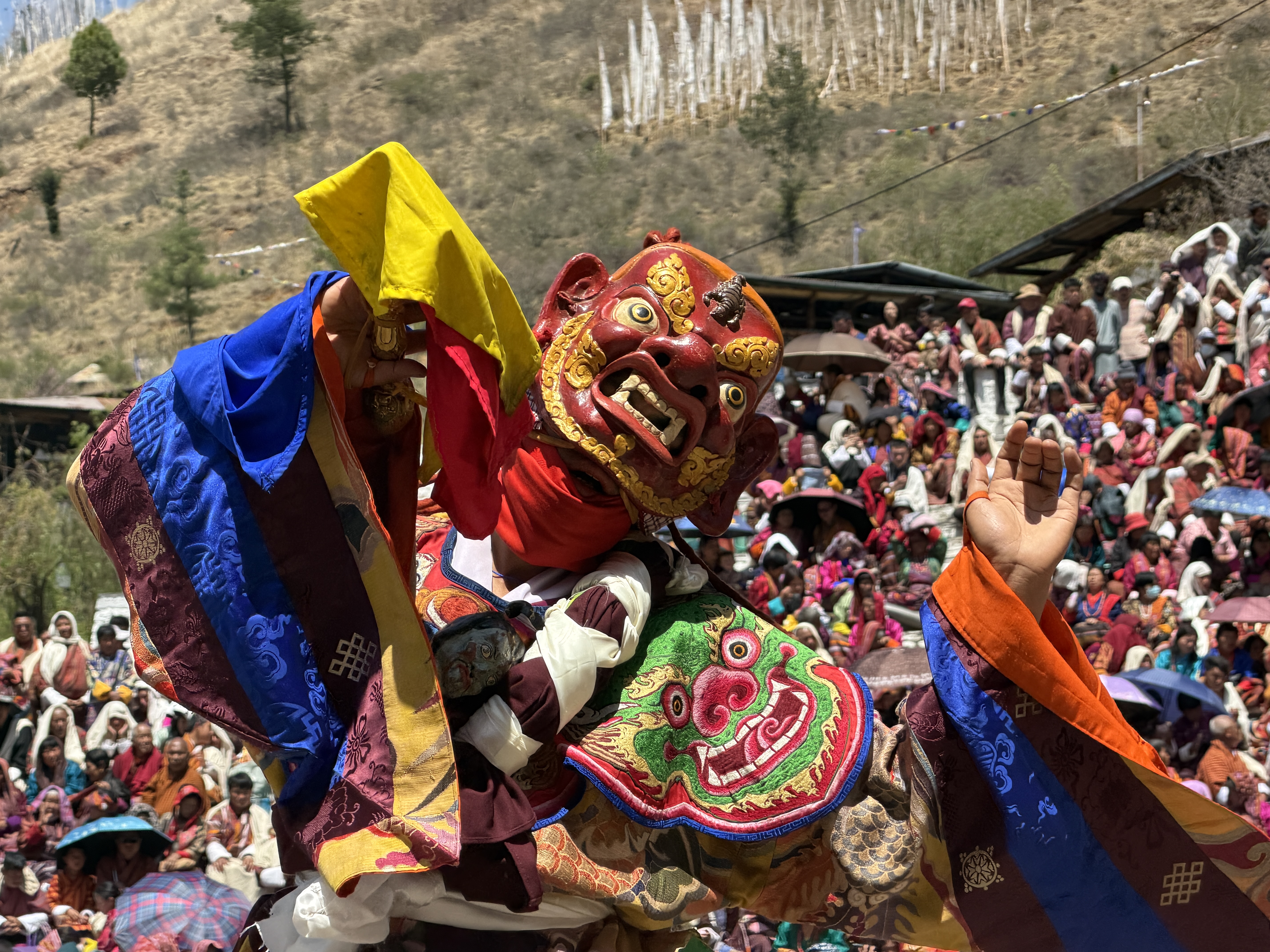
The masked dances at the heart of every tshechu are called Cham. They are not theatre. When a monk dons the heavy wooden mask and silk brocade — vestments kept in the dzong treasury and brought out only for the festival — his ordinary identity is understood to dissolve, and the deity he represents is present in the courtyard.
For Bhutanese families, attending a tshechu earns spiritual merit, and simply witnessing certain dances is believed to plant the seed of liberation.
People arrive in their finest gho and kira, often layered with heirloom turquoise, coral, and dzi-bead jewelry handed down through generations, picnic through the long ceremonies, and treat the days as a reunion, a pilgrimage, and a celebration at once. Visitors who arrive understanding this are welcomed warmly. Visitors who treat it as a photo set are quietly endured. Be the former.
The Great Dzong Festivals of the West
The best-known Bhutan festivals fill the courtyards of the western fortress-monasteries, and each has a distinct character.
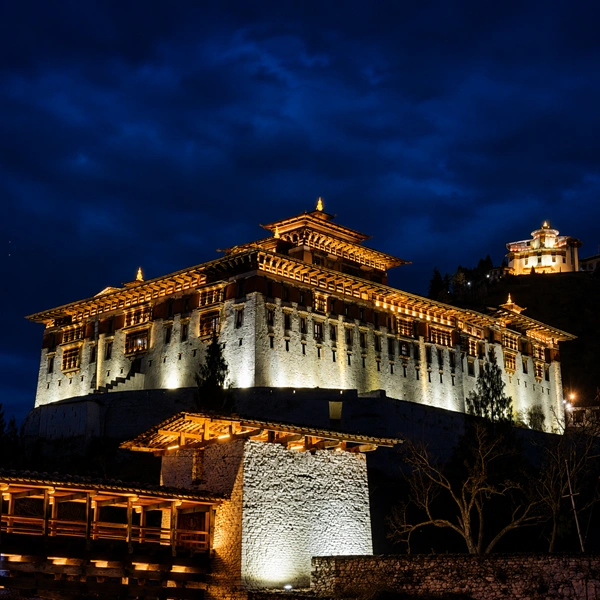
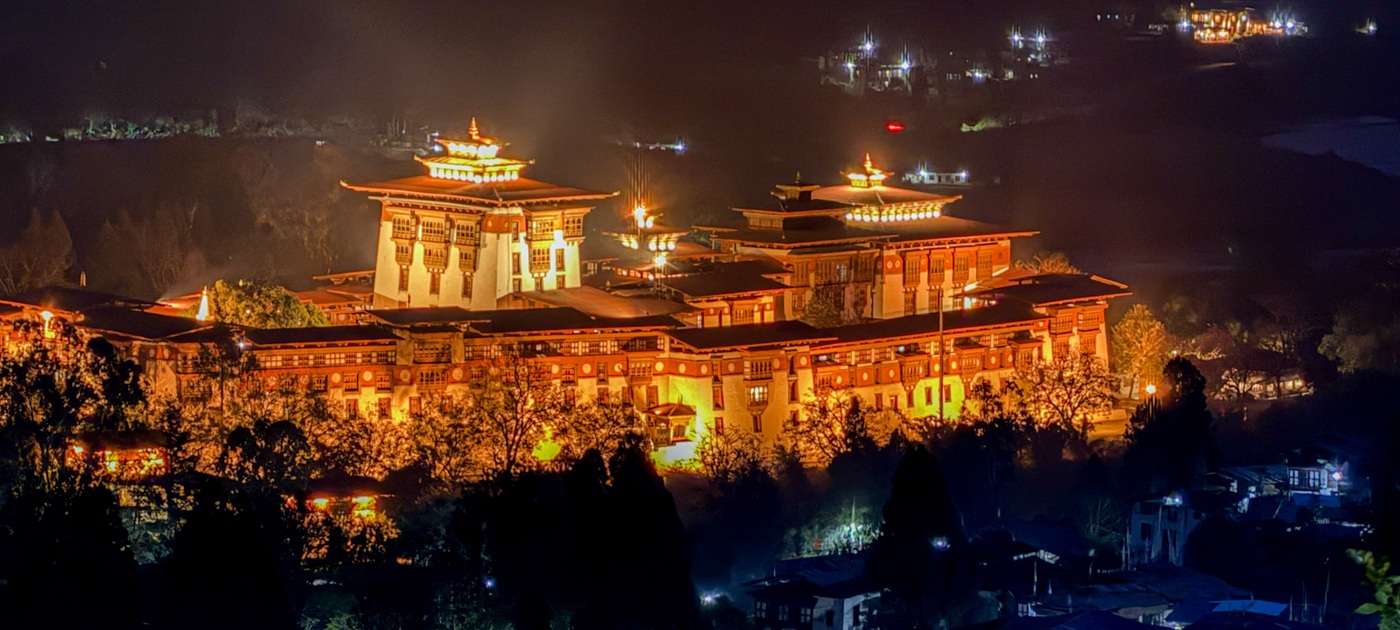
Paro Tshechu — spring, usually falling in late March or early April. The kingdom's most celebrated spring festival is held at Rinpung Dzong.
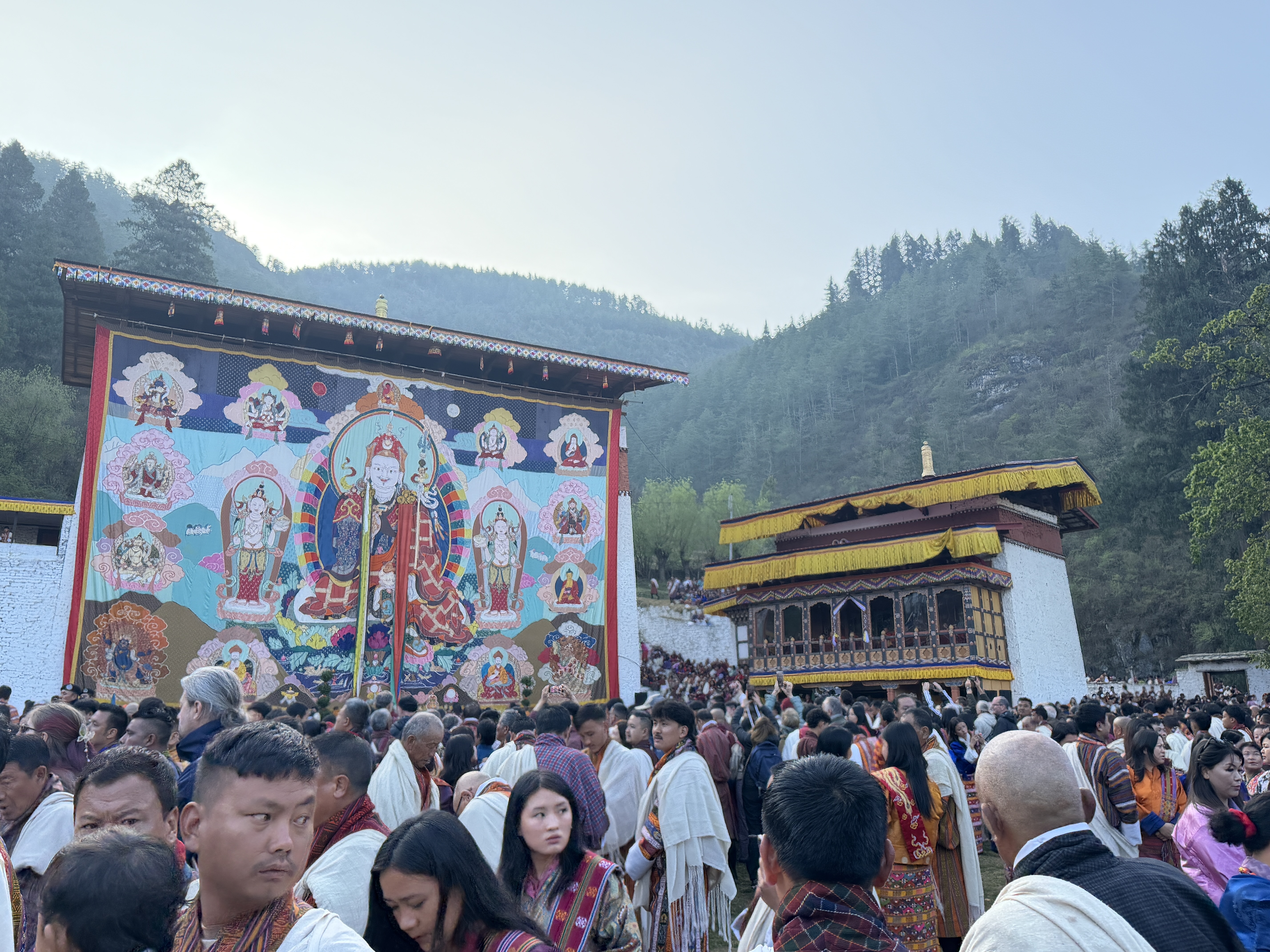
On the final morning, before first light, monks unfurl the thongdrel — a giant sacred appliqué several stories tall— only to roll it away again the moment direct sun could damage its silk.
Merely seeing it is held to cleanse negative karma. We brief our guests the evening before: be in the courtyard by half past four, because by sunrise the thongdrel is already being rolled away — and the moment asks for folded hands rather than raised cameras.
Thimphu Tshechu — autumn, usually September or October. The largest gathering in the country, held at Tashichho Dzong with frequent royal presence and preceded by days of protective drubchen liturgies dedicated to Palden Lhamo.
The festival was instituted in the seventeenth century by the fourth Desi, Gyalse Tenzin Rabgye, and the third King, Jigme Dorji Wangchuck, expanded its dance repertoire in the 1950s to strengthen a shared national identity.
It is also the kingdom's greatest textile display — citizens from all twenty districts arrive in their finest hand-woven dress.
Punakha Drubchen and Tshechu — late winter, in the warm low valley where the rivers meet at about 1,200 meters.
The drubchen is unique in Bhutan: local men in seventeenth-century wool battle armor — the pazaps — reenact the defense against Tibetan invasion led by Zhabdrung Ngawang Namgyal, when invading forces sought the self-arisen relic Ranjung Kharsapani and were turned back.
They sweep down from the dzong to the riverbank in mock battle. The tshechu, added in 2005 by the seventieth Je Khenpo, follows immediately after and closes with one of the largest thongdrels in the kingdom — an applique of Guru Rinpoche roughly 25 by 28 meters, worked from more than six kilometers of silk brocade by 51 master artists over two years.
Wangdue Tshechu — autumn, known for its lozey narrative folk songs and the Dance of the Ox.
These are the festivals we recommend for a first journey: the pageantry is at full scale, the valleys are accessible, and the surrounding lodges give you a quiet room within reach of the loudest, brightest days of the Bhutanese year.
The Sacred Dances You Will Witness
Every Cham dance in a festival program carries its own theology; here are the six worth knowing before you sit down on the flagstones.
Zhana Cham, the Black Hat Dance. The most spiritually charged dance in the repertoire, tracing its origin to 842 CE, when the monk Lhalung Pelkyi Dorji assassinated the anti-Buddhist king Langdarma while wearing a reversible black-and-white robe. The dancers move slowly and heavily, tracing geometric patterns on the stone to subdue obstructive forces and purify the ground for the festival.
Dramitse Ngacham, the Drum Dance of Drametse. The only Bhutanese practice inscribed on UNESCO's Intangible Cultural Heritage list. Sixteen dancers in animal masks beat double-sided hand drums in athletic unison — the "lion's roar" of the Dharma, composed in the sixteenth century after a vision received by the nun Choeten Zangmo in eastern Bhutan.
Guru Tshengye, the Eight Manifestations of Guru Rinpoche. The theological centerpiece of most tshechus: eight forms of Padmasambhava enter the courtyard in sequence, from the serene yellow-masked Shakya Sengye with his alms bowl to the three-eyed, wrathful red Dorje Drolo with his ritual dagger.
Shawa Shachi, the Dance of the Stag and Hounds. A morality play in two acts: the saint Milarepa converts a cruel hunter, his hounds, and the stag they pursue to the Dharma. It is the most narrative of the great dances, and the one Bhutanese parents use to teach children about karma and compassion.
Durdag, the Lords of the Cremation Grounds. Dancers in white skeleton costumes represent the protectors of the eight charnel grounds — a leaping, rattling reminder of mortality that sets up the judgment dance to come.
Raksha Mangcham, the Judgment of the Dead. The courtyard becomes the bardo. Shinje, the bull-headed Lord of Death, weighs a soul's virtues against its failings while peaceful and wrathful deities argue the case. It is public moral teaching of enormous dramatic force, and the crowd goes silent for it.
Sit low, stay for the whole dance rather than sampling, and let your guide narrate. The choreography carries meaning in every gesture — each mudra, each turn — and a good guide transforms an impressive spectacle into a comprehensible one.
The Atsaras: Holy Clowns with a Serious Job
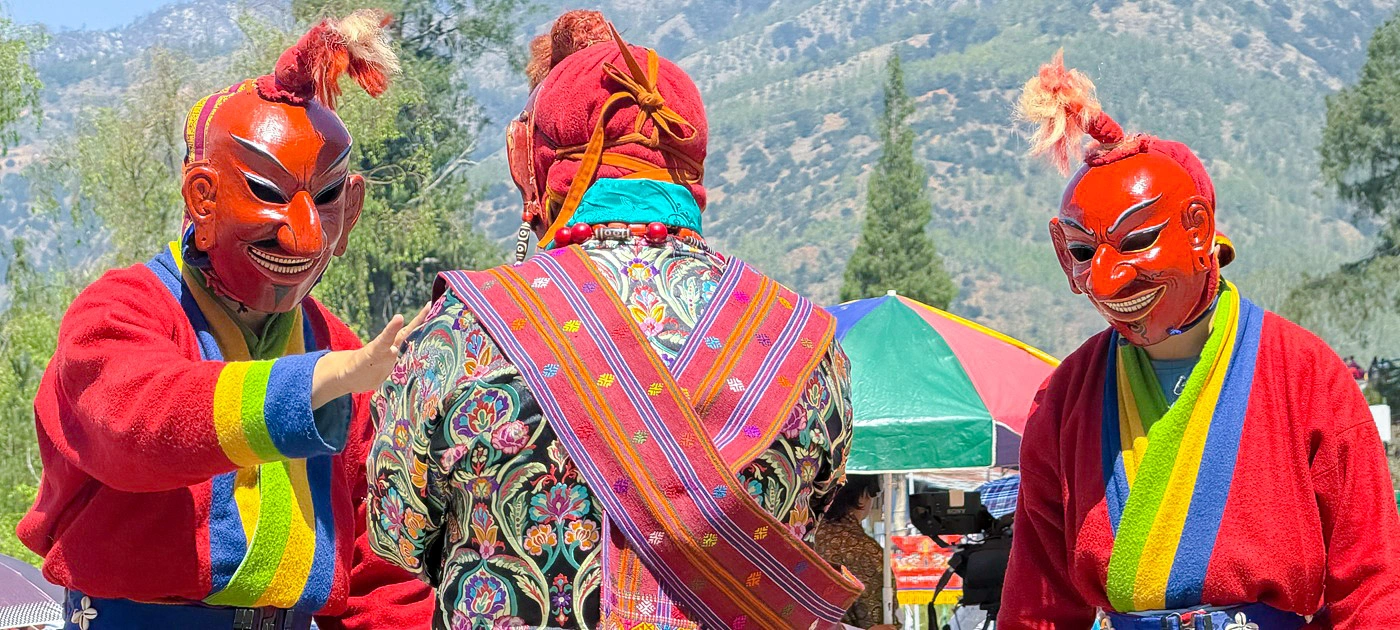
The red-masked clowns darting between dancers are Atsaras, and they are the most misunderstood figures at any Bhutanese festival. The name derives from the Sanskrit word acharya, meaning "teacher."
They represent the eighty-four Mahasiddhas of ancient India, saints who used outrageous behavior and "crazy wisdom" to puncture ego and pretension.
Their comedy has structure. The Atsara manages the crowd, and he is the only person permitted to touch a dancer mid-Cham — straightening a slipped mask, untangling a robe — which means he must know the entire repertoire better than the performers themselves.
He translates dense liturgy into folk humor for the crowd. And his wooden phallus, waved at dignitaries and tapped on the heads of women hoping to conceive, is a fertility blessing and a ward against evil, not a vulgarity.
Expect to be teased. It is an honor, loosely speaking. Small offerings to the Atsaras are traditionally given only on the final festival day, and your guide will show you how to do it gracefully.
Beyond the Dzongs: The Intimate Festivals of Bumthang, Haa, and the Highlands
Cross the Dochu La and Pele La passes eastward, or the 3,988-meter Chele La westward into Haa, and the festivals change register — smaller courtyards, older temples, liturgies specific to a single valley's lineage. For travelers returning to Bhutan or for those who want depth over scale, these are the journeys we build most carefully.
Jambay Lhakhang Drup — late autumn, Bumthang. The temple is one of 108 that tradition credits the Tibetan king Songtsen Gampo with raising in a single day to pin down a demoness obstructing Buddhism across the Himalaya; Jambay Lhakhang holds her left knee. Two nocturnal rituals define its festival.
The Mewang fire blessing sends pilgrims running through a burning pine gate to cleanse the year's karma — and, by long-held local belief, to bless those hoping to conceive.
The Tercham, the midnight sacred naked dance, is performed by sixteen masked local men under torchlight. Photography of the Tercham is strictly forbidden — equipment is confiscated on the spot — and we brief every guest on this before the evening begins.
Chorten Kora — early spring, Trashi Yangtse in the far east. Two circumambulation festivals around a stupa built in 1740 as a replica of Boudhanath: the first draws Dakpa pilgrims from across the border in Arunachal Pradesh; the second, the local Bhutanese communities.
Talo Tshechu — spring, above Punakha at 2,800 meters. Famous for Zhungdra, the slow, unaccompanied classical song tradition performed by the village's own troupe.
Haa Summer Festival — the Haa Valley sits across the Chele La from Paro and stayed closed to foreign visitors until the early 2000s because of its sensitive border position, which is exactly why its traditions run so deep.
The festival is a highland fair rather than a tshechu: archery and khuru stone-throwing, yak-dairy foods and hoentay buckwheat dumplings, and a dance dedicated to Ap Chundu, the valley's pre-Buddhist guardian deity — one of the rare public rituals in Bhutan that predates Buddhism itself.
Black-Necked Crane Festival — early winter, Phobjikha Valley, at about 3,000 meters. Held in the courtyard of Gangtey Gompa since 1998, when the Royal Society for the Protection of Nature founded it after conservationists persuaded the government to spare the valley's wetlands from drainage for potato farming.
Each winter, roughly 300 to 400 black-necked cranes — Thrung Thrung Karmo — fly down from the Tibetan Plateau, and locals hold that they circle the monastery three times before landing. Schoolchildren in crane costumes dance in their honor.
Royal Highland Festival — autumn, Laya, at roughly 4,000 meters. Founded in 2016 by His Majesty King Jigme Khesar Namgyel Wangchuck to sustain the highland communities and draw attention to the fragile glacial ecosystems above them.
Yak races and yak beauty contests, exhibitions of the Bhutanese mastiff, Auley oral epics, the beadworked conical bamboo hats of the Layap women — and the Tokha, a communal meal sponsored by the King at which herders, officials, and travelers eat together on the ground beneath the ice peaks. Reaching Laya requires a multi-day trek or rough driving followed by a steep hike, which is precisely what keeps it uncrowded.
The Full Festival Field, Season by Season
Every tshechu centers on the tenth day of its lunar month — so once you know a festival's month, you know its window, even before the astrologers publish the year's dates. That single rule is the evergreen key to Bhutanese festival planning. Here is the complete field, grouped by season.
Late winter and spring:
- Lhamoi Dromchhen — Trongsa Dzong; protective liturgies to Mahakali in an intimate monastic setting
- Punakha Drubchen and Punakha Tshechu — Punakha Dzong; the armored pazap reenactment, then the tshechu, in the warm low valley
- Tharpaling Thongdrol — Bumthang; a rare one-day pre-dawn thongdrol display on a mountain ridge
- Tangsibi Mani — Bumthang; village-level masked dances and community feasts
- Chorten Kora — Trashi Yangtse; two koras in the third lunar month, the Dakpa Kora on the fifteenth day and the Drukpa Kora on the thirtieth
- Talo Tshechu — above Punakha; Zhungdra classical song and the Talo Zungki pageant
- Gomphu Kora — Trashigang; pilgrims circle the cave where Guru Rinpoche subdued a demon
- Gasa Tshechu — Gasa Dzong; remote, high-altitude, and deeply traditional
- Paro Tshechu — Rinpung Dzong; the spring climax, in the second lunar month
- Domkhar Tshechu — Chumey, Bumthang; private clan relics and old monastic dances
- Rhododendron festivals — Lamperi Botanical Park near Thimphu and the Brokpa highlands of Merak; forty-six native species in bloom
Summer:
- Ura Yakchoe — Bumthang; the sacred Vajrapani statue and rituals with pre-Buddhist roots
- Nimalung Tshechu — Bumthang; a nine-meter thongdrel in a quiet monastery courtyard
- Kurjey Tshechu — Kurjey Lhakhang, Bumthang; honors Guru Rinpoche at the temple, holding his body imprint
- Haa Summer Festival — Haa Valley; herder culture, the Ap Chundu guardian dance, local food, and highland sport
- Matsutake festivals — Genekha and Ura; the prized wild mushroom harvest
Autumn:
- Thimphu Drubchen and Thimphu Tshechu — Tashichho Dzong; the national gathering
- Wangdue Tshechu — Wangdue Phodrang Dzong; lozey narrative songs and the Dance of the Ox
- Tamshing Phala Chhoepa — Bumthang; dance liturgies composed by the fifteenth-century saint Pema Lingpa
- Gangtey Tshechu — Phobjikha Valley; an autumn thongdrel above the crane marshes
- Thangbi Mani — Bumthang; purification through sacred fire ceremonies
- Jakar Tshechu and Chhukha Tshechu — the "Castle of the White Bird" in Bumthang, and the most accessible of the western festivals
- Jambay Lhakhang Drup — Bumthang; the Mewang fire blessing and the midnight Tercham
- Royal Highland Festival — Laya; yak races at four thousand meters
Early winter:
- Black-Necked Crane Festival — Gangtey Gompa, Phobjikha Valley
- Nalakhar Tshechu — Bumthang; remote liturgies of the local terton lineages
- Druk Wangyel Tshechu — the Dochu La pass; Cham danced by the Royal Bhutan Army
- Trongsa Tshechu and Lhuentse Tshechu — the ancestral seats of the royal line, the latter famed for its textiles
- Lomba — the traditional New Year of Paro and Haa, marked with Hoentay buckwheat dumplings and archery
When to Go: Reading the Festival Seasons
Because the dates float, plan Bhutan festivals by season rather than by month and day.
Late winter to spring brings the Punakha festivals in the warm, low valley, and the spring cycle culminates in Paro. Rhododendrons flame through the middle elevations, and mountain views are frequently sharp.
Summer is monsoon-green and quiet, with intimate events in Bumthang and highland gatherings like the Haa Summer Festival. It is the season for travelers who value near-empty temples over guaranteed blue sky.
Autumn is the grand season: Thimphu, Wangdue, Gangtey, and the Bumthang cycle running into the Jambay Lhakhang Drup. Skies clear after the monsoon, and demand for flights and rooms peaks accordingly.
Early winter offers the Black-Necked Crane Festival, the army-performed Druk Wangyel Tshechu at the Dochu La pass, and the Trongsa and Lhuentse festivals in the ancestral seats of the royal line — cold, clear, and far less traveled.
In some years, the lunar calendar lands two festivals within a single travel window — a Haa gathering beside the Thimphu Tshechu, or the Royal Highland Festival a few days before the Jambay Lhakhang Drup. When it does, we build two-festival itineraries of fourteen days or more; the pairings change year to year with the astrologers' calendar, and upon inquiry we tell you straight away if your season offers one.
One planning rule sits above all others: commit to a season and a valley four to six months out, hold flexible days around the expected window, and let the confirmed lunar dates fine-tune the itinerary. Rigid date-first planning is how travelers fly home having missed the thongdrel by a day.
Planning Realities: Fees, Guides, and the Flight In
Bhutan manages tourism under a deliberate high-value, low-volume policy, and three of its rules shape every festival journey.
First, the Sustainable Development Fee. International visitors pay a nightly government levy — USD 100 per adult at the time of writing, with reduced or waived rates for children — which funds healthcare, education, and conservation across the kingdom.
Current rates and any changes are confirmed on the official Department of Tourism channels, and we state the exact applicable fees in every proposal.
Second, guiding. All international visitors must travel with a licensed Bhutanese guide, and entry to any dzong, temple, or monastery is permitted only with one. Self-driving is not permitted for foreign visitors.
On a private journey, this rule is a gift rather than a restriction: your guide is your translator of everything the courtyard does not explain.
Third, the flight. Paro's airport sits in a narrow valley and is certified for visual-approach flying only, served by just two carriers, Drukair and Bhutan Airlines, from a short list of regional gateways.
The roughly one-hour Kathmandu–Paro sector passes Everest and Chomolhari on clear mornings and pairs naturally with our Nepal journeys. Seats around the major festivals are the scarcest resource in Bhutanese travel; they are the first thing we book — four to six months ahead as a floor, and nine to twelve months for Paro and Thimphu, where festival-week rooms in the valley sell out earliest of all.
Altitude deserves a line of its own. Paro and Thimphu sit above 2,200 meters, Phobjikha at about 3,000, and Laya near 4,000 — so we sequence festival itineraries to climb gradually, and we recommend travel insurance that covers helicopter evacuation for any journey touching the highlands.
A last set of local rules worth knowing: Bhutan has long designated Tuesday a national dry day, with no alcohol sold; tobacco brought into the country must be declared at customs, with the receipt carried throughout your stay; and drones are prohibited everywhere in the kingdom without written approval from the civil aviation authority — leave yours at home.
Festival Etiquette in Practice
The courtyards are consecrated ground, and a handful of habits mark the respectful visitor. Walk clockwise around stupas, mani walls, and temple structures — always.
Dress modestly with shoulders and knees covered; long trousers and collared shirts sit well beside the national dress around you. Many of our guests go further and wear a rented gho or kira for the festival days — we arrange it, and the warmth it draws from monks and elders is immediate.
Photograph the dances only from the courtyard edges, never from the dance circle itself, and never inside temple sanctuaries or during the Tercham. A zoom in the 24–200mm range covers the courtyard without crowding anyone. Ask before photographing people — people are not monuments — and put the camera down for the thongdrel moment itself.
Point with an open palm rather than a single finger at statues, monks, or sacred objects. Keep feet pointed away from dancers and altars when seated, and step around, never over, anyone seated on the flagstones.
None of this is onerous. Bhutanese crowds are among the most forgiving hosts in the Himalaya, and a visitor who follows their lead is drawn into the day within an hour — offered a seat, a share of the picnic, an explanation of the mask now entering the courtyard.
Frequently Asked Questions
Why do Bhutan festival dates change every year?
Bhutanese festivals follow a lunisolar calendar with leap months inserted every two to three years, so the same festival can fall weeks apart in successive Gregorian years. Monastic astrologers typically confirm final dates only two to three months ahead. We plan by season and lunar month first, then lock the itinerary once dates are gazetted.
Is photography allowed at the Tercham midnight dance during Jambay Lhakhang Drup?
No. The Tercham, the sacred naked dance performed at midnight during Jambay Lhakhang Drup in Bumthang, is subject to an absolute ban on photography. Officials confiscate equipment and remove violators from the grounds. All other daytime dances at the festival may generally be photographed from the spectator areas, and your guide confirms boundaries each day.
Which Bhutan Tshechu is best for a first-time visitor —Paro or Thimphu?
Paro Tshechu offers the pre-dawn thongdrel unfurling and a compact, spectacular valley setting in spring; Thimphu Tshechu is the country's largest gathering, in autumn, with frequent royal presence. First-time travelers wanting the single most iconic moment usually choose Paro. Those pairing a festival with wider autumn touring usually choose Thimphu.
When does Paro Tshechu take place each year?
Paro Tshechu centers on the tenth day of the second lunar month, which usually falls in late March or early April on the Gregorian calendar. Because Bhutan's lunisolar calendar shifts, exact dates are confirmed by monastic astrologers only two to three months ahead. We hold flights and rooms against the expected window, then finalize your daily plan once dates are gazetted.
How far in advance should a trip to a Bhutan festival be booked?
Four to six months minimum — and nine to twelve months for Paro Tshechu and Thimphu Tshechu, whose festival-week rooms sell out earliest. Paro's airport is served by only two carriers, and festival-period seats and the best rooms go long before monastic astrologers confirm exact dates. We reserve flights and lodges against the expected lunar window, then fine-tune daily plans once the official schedule is published.
What is the Sustainable Development Fee for festival travel in Bhutan?
Bhutan charges international visitors a nightly Sustainable Development Fee — USD 100 per adult at the time of writing, with reduced rates for children aged 6 to 12 and a waiver for those under 6. The fee funds healthcare, education, and conservation. We confirm the exact current rates in your proposal, as the government periodically revises them.
Can visitors attend the Black-Necked Crane Festival in Phobjikha Valley?
Yes. The festival is held each early winter in the courtyard of Gangtey Gompa, overlooking the marshes where the endangered cranes roost after migrating from the Tibetan Plateau. It is a single-day, community-led celebration — schoolchildren perform the crane dance in full costume — and pairs beautifully with two or three quiet nights in the valley.
What should travelers wear inside a dzong during a tshechu?
Modest dress is required: shoulders and knees covered; no hats in courtyards; shoes removed before entering temple interiors. Long trousers and a collared shirt or equivalent are ideal. Bhutanese attendees wear formal national dress — we can arrange a gho or kira rental for guests who wish to join them — and visitors who dress considerately are received noticeably more warmly by monks and officials alike.
Do the Atsaras at Bhutanese festivals expect money from visitors?
Only on the final day of a tshechu, when tradition permits the Atsaras to collect small offerings from the crowd for their days of demanding physical work. Your guide will indicate the appropriate moment and amount. Handing money at other times is unnecessary and slightly awkward — a laugh at their teasing is payment enough.
Can two Bhutan festivals be combined in one private journey?
Sometimes. Because every festival floats with the lunar calendar, certain years place two within one window — a Haa gathering alongside the Thimphu Tshechu, or the Royal Highland Festival days before the Jambay Lhakhang Drup. When your season offers a pairing, we build a two-festival itinerary of 14 days or more; when it doesn't, we say so at the time of inquiry rather than force the geography.
The right festival, in the right valley, changes what a journey to Bhutan means. If the dances described here have caught you, our private Bhutan Festival Journeys pair the great tshechus with the quiet days around them — and we handle the lunar-calendar timing, the flights, and every permit from the first conversation.