Luxury Bhutan: The Complete Planning Guide to the Kingdom's High-End Circuit
Luxury Bhutan is not a marketing label. It is national policy. The kingdom caps its own tourism through a daily Sustainable Development Fee, requires every visitor to travel with a licensed private guide, and licenses only a handful of top-tier lodges.
The result is a country where "luxury Bhutan tour" describes the default way in, not an upgrade.
That structure rewards travelers who plan properly and punishes those who wing it. Payments move by bank wire, not card. The best suites in Punakha sell out months before the spring rice turns green.
This guide covers what we brief our clients on before any Bhutan departure: the real costs, the two great lodge circuits, the independent routes worth a detour, the route we actually run, helicopter logistics, and the seasons that matter.
Why Bhutan Works Differently for Every Luxury Traveler
Bhutan admits visitors on its own terms, and those terms shape every high-end itinerary. The kingdom's High Value, Low Volume policy dates to the 1970s and still governs entry today: fewer guests, higher spend per guest, and revenue directed into free healthcare, education, and conservation.
The rules are concrete. Independent travel is prohibited, so every itinerary runs with a pre-arranged private guide and vehicle. Over seventy percent of the country remains forested, and Bhutan absorbs more carbon than it emits.
For our clients, this is good news dressed as bureaucracy. A private guide is mandatory anyway, so the gap between a standard tour and a fully private journey is smaller here than anywhere else in the Himalaya. You are paying for judgment, pacing, and access rather than for privacy you would otherwise lack.
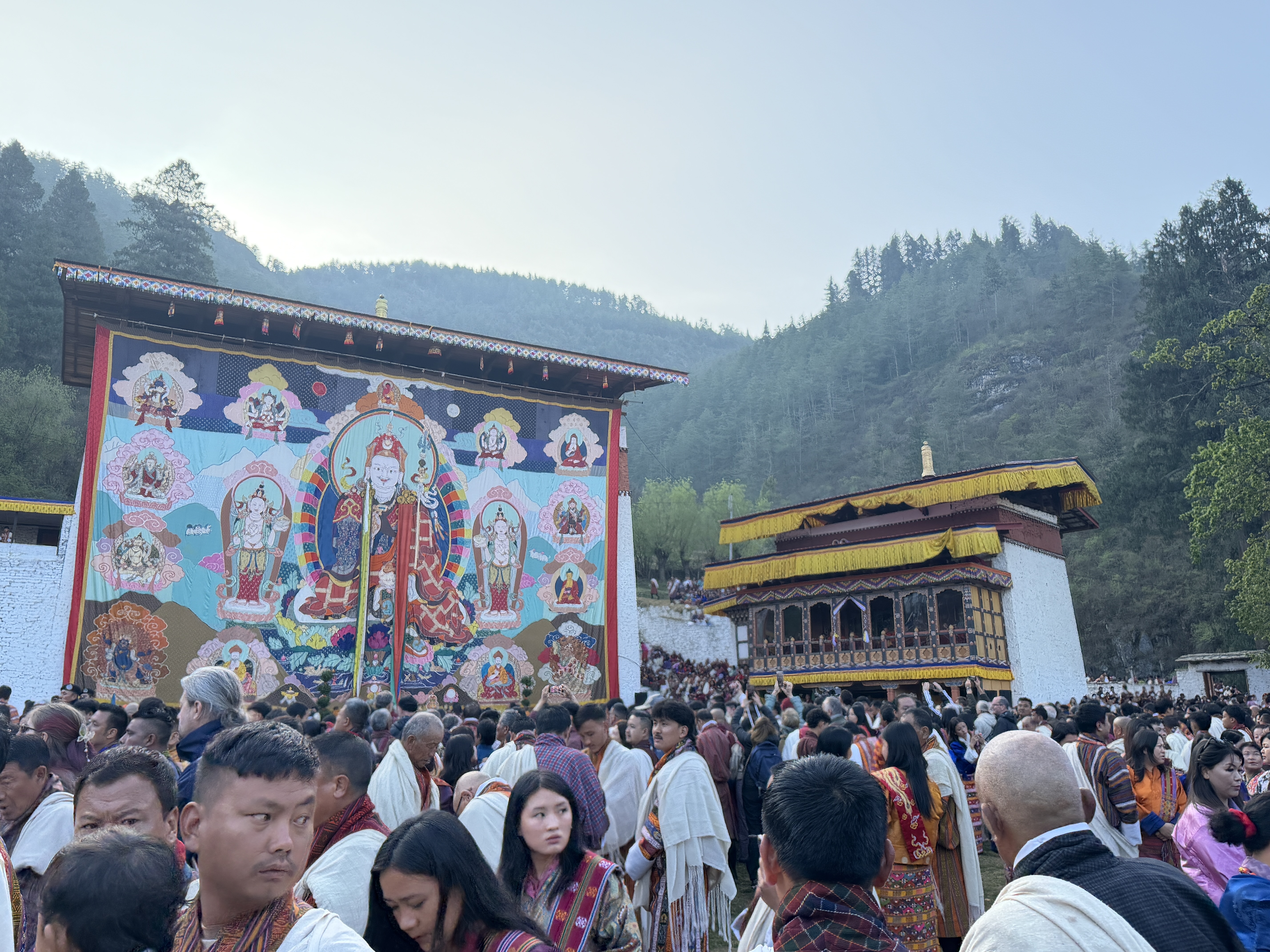
One recent change matters for temple lovers. The National Monument Fund and Supervision Committee has lifted the old closures of sacred sites on auspicious days, so key dzongs and temples now admit visitors daily regardless of the lunar calendar.
The Sustainable Development Fee, Explained
Bhutan's Sustainable Development Fee is USD 100 per adult per night, a reduced rate that will remain in effect through August 31, 2027. Children aged 6 to 11 pay USD 50 per night, and children under 5 stay free. The fee is added to your tour cost and funds the systems that keep the country uncrowded.
A separate electronic visa fee of USD 40 per person applies, paid in advance and non-refundable. Both charges are handled before arrival, which is where Bhutan's most unusual quirk emerges: immigration clearance generally requires payment of the SDF via international bank wire, and the process can take up to a week.
We handle the wires, clearances, and flight bookings for our guests, which is exactly what this system was designed for. Your only job is to have a passport valid for at least 6 months beyond your departure.
The current half-price SDF window makes longer itineraries unusually attractive. A ten-night circuit that once carried USD 2,000 in fees per person now carries USD 1,000, and that math holds until the legislated end date. If a slow, five-valley journey has been on your list, the next two seasons are the time.
What a Luxury Trip to Bhutan Costs
Private luxury travel in Bhutan typically runs USD 500 to 1,000 per person per day, with week-long five-star journeys ranging from approximately USD 4,500 to over USD 7,000 before international flights. That band covers a private guide and driver throughout, top-tier lodges, all meals in most cases, and the SDF.
The spread inside that band comes down to three choices. Lodge tier moves the number most: a Pemako pool villa or an Amankora suite costs a multiple of an excellent four-star. Helicopter segments add four figures per hop. And pace matters, because a two-valley week costs less per day than a five-valley sprint with long transfer days.
At the top of the market, an eleven-day spiritual journey at the andBeyond Punakha River Lodge starts at approximately USD 13,440 per person. Nobody needs to spend that. Plenty of our guests choose to, and the difference shows in the depth of the guiding and the rooms.
Cards work at the big lodges, but rural Bhutan runs on cash in Ngultrum or Indian Rupees. Guests traveling on Indian-issued cards should note that USD-denominated cards do not work in Bhutan under current RBI rules.
Getting In: Visas, Wires, and the Flight into Paro
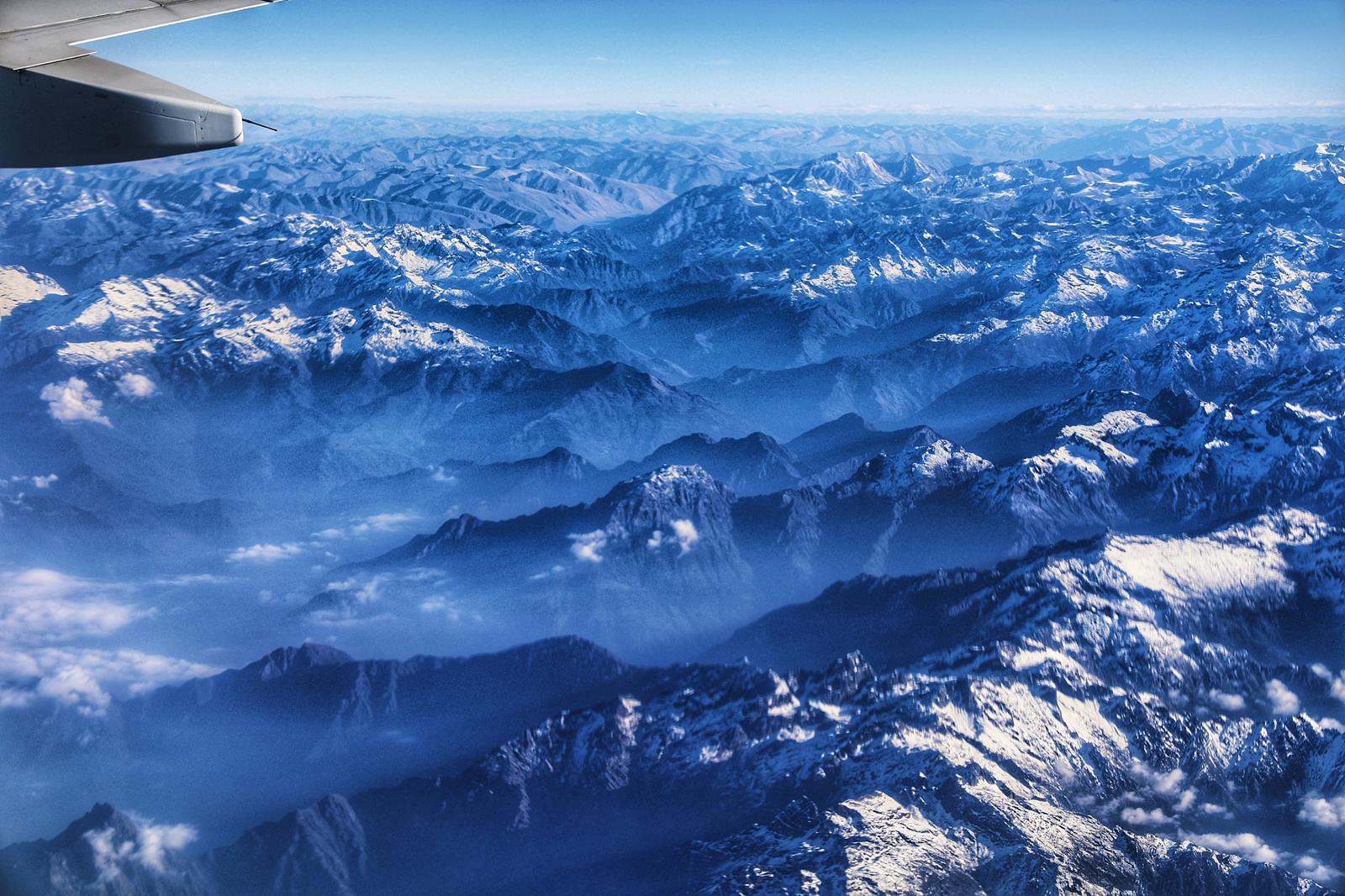
Entry to Bhutan comes down to three things: an e-visa secured in advance, an SDF payment cleared by wire, and a seat on one of two airlines. Drukair and Bhutan Airlines are the only commercial carriers permitted into Paro International Airport, one of the most demanding visual-approach airports in the world.
The approach is part of the experience. Pilots thread the aircraft between forested ridgelines by sight, banking low over farmhouses before the runway appears. Sit on the left, flying in from Kathmandu and the high Himalaya, with Everest, visible on a clear day, lining the horizon.
Americans, Britons, Europeans, and Australians all follow the same process: no embassy visit, everything electronic, visa granted once the SDF wire clears.
Biometric e-gates now speed arrivals at Paro and at the Phuentsholing land crossing. Regional routings keep improving too, with Guwahati in Assam adding direct Paro connections, letting us pair an Indian wildlife safari at Manas with a Bhutanese valley circuit in a single arc.
Start the paperwork thirty to ninety days out. The wires are slow, spring and autumn lodge inventory is tight, and the auspicious-season flights fill with festival traffic.
Amankora vs Six Senses: The Two Great Lodge Circuits
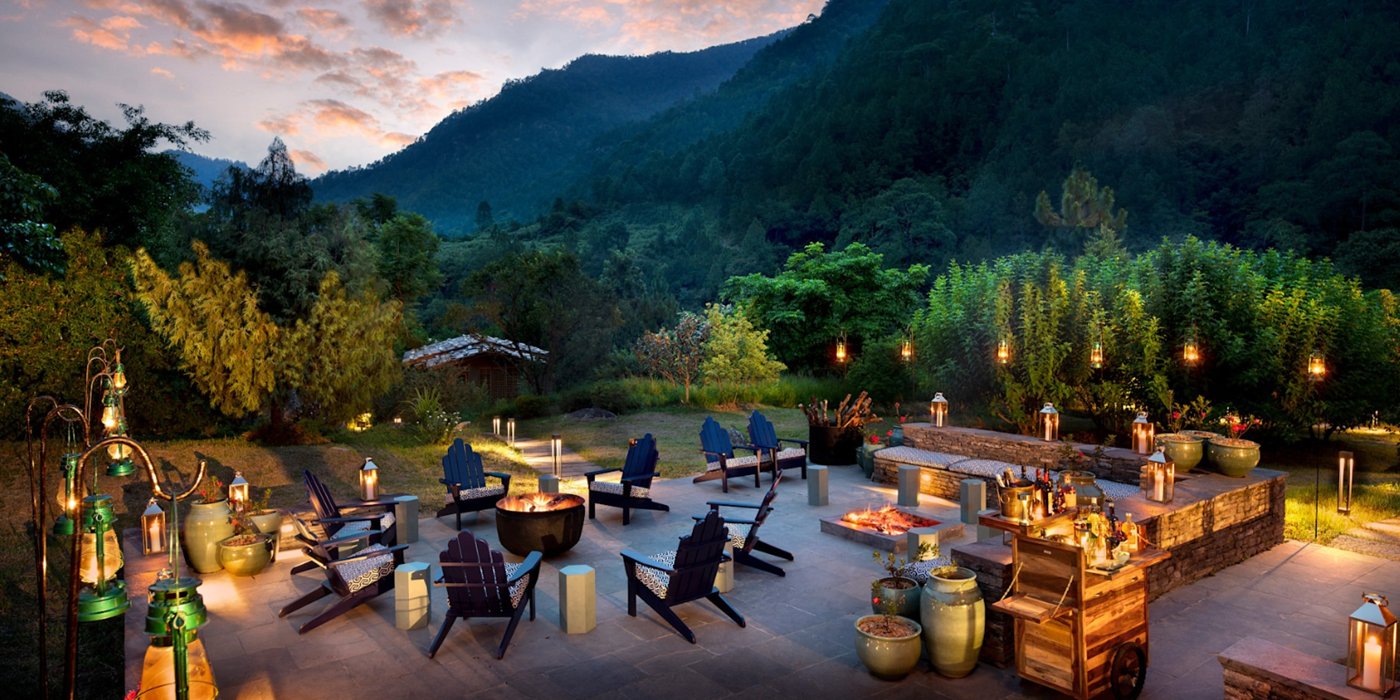
Both Amankora and Six Senses operate five lodges each across the same five valleys: Paro, Thimphu, Punakha, Gangtey, and Bumthang. The circuits look identical on a map and feel entirely different on the ground.
Amankora is the quiet one. Its lodges sit low in the valleys, screened by blue pine, with minimalist wood interiors warmed by bukhari stoves. One rate covers everything: dining, private excursions, transfers, laundry, house wines, and spirits. You never sign a chit. One dedicated guide and driver stay with you across the whole circuit, which is the single feature our returning guests praise most.
Six Senses is the dramatic one. Each lodge takes its own architectural theme: the stone "Palace in the Sky" above Thimphu, facing the Buddha Dordenma; the "Stone Ruins" design beside a 15th-century fortress at 9,500 feet in Paro; the cantilevered "Flying Farmhouse" lounge floating over a heated pool in Punakha. Wellness is the spine here, with serious spas, gyms, and heated pools throughout, and a Guest Experience Maker acts as your personal fixer.
The trade-offs are honest ones. Six Senses buys its views with long, winding access roads that add drive time every single day. Amankora buys its calm with a more uniform look and, historically, fewer pools. We match guests to circuits by temperament: contemplatives to Amankora, active travelers and pool devotees to Six Senses.
Independent Lodges That Earn a Detour
Beyond the two big circuits, a handful of independents give Bhutan itineraries their texture. These are the properties we splice into mixed routes.
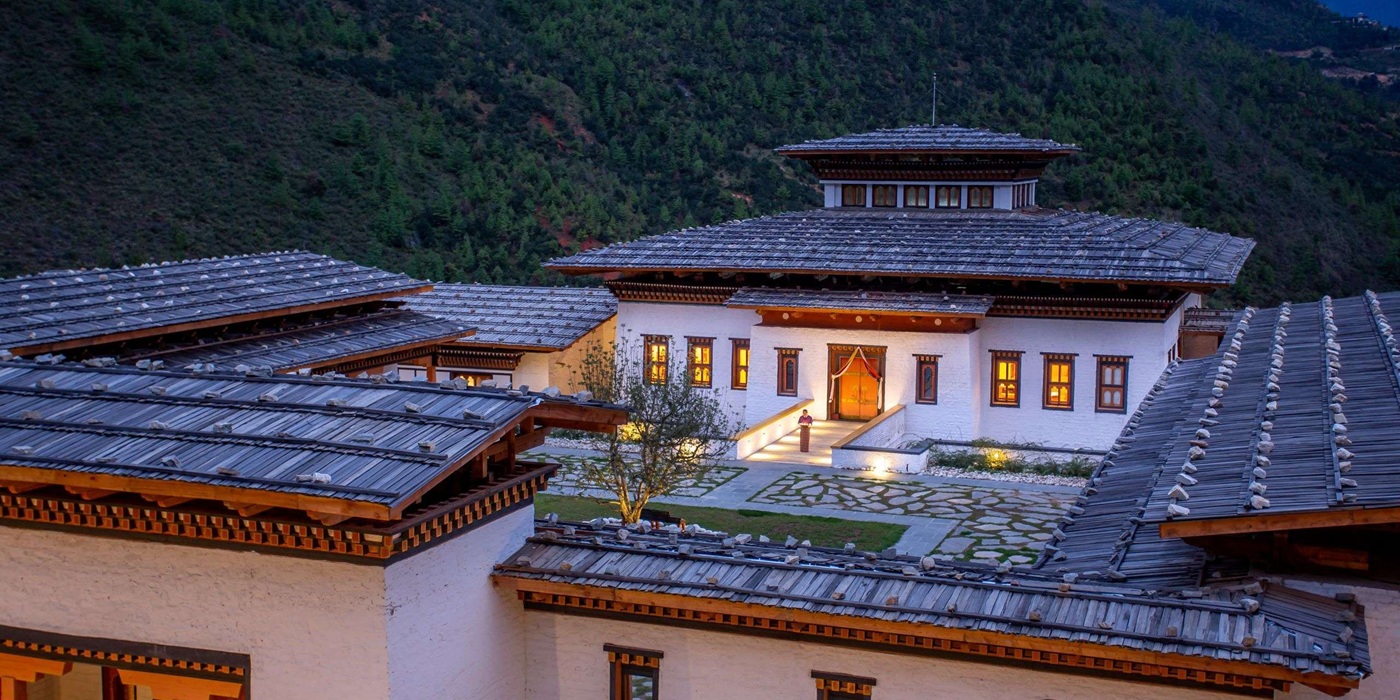
Pemako Punakha is reached on foot across a suspension bridge over the Mo Chhu river, which sets the tone before you check in. Nineteen Bill Bensley-designed tented villas each feature a temperature-controlled plunge pool and butler service, and the Lotus Realm Spa offers Sowa-Rigpa programs with an on-site herbalist mixing remedies for hot-stone baths.
andBeyond Punakha River Lodge, the brand's first wholly owned Asian property, puts six canvas-and-wood suites among rice terraces on the Mo Chhu, ten minutes from Punakha Dzong. Copper soaking tubs, outdoor showers, and rafting straight off the property.
Gangtey Lodge holds twelve suites above the Phobjikha valley, each with a brick fireplace and a deep tub set against floor-to-ceiling glass facing the 17th-century Gangtey Monastery.
The whole team sings to welcome arriving guests. In winter, black-necked cranes wheel over the marshes below — the same landscape our guests walk on the Gangtey valley trek.
Bhutan Spirit Sanctuary, fifteen minutes from Paro airport in the Neyphu valley, includes daily consultations with traditional Bhutanese medicine doctors and fully herbal treatments in its rate; we profile it alongside its neighbors in our guide to the best luxury hotels in Paro.
Dhensa in Punakha and the architect-led Zhiwa Ling Ascent round out the shortlist for guests who prefer small, understated accommodations. Pemako Thimphu, the former Taj Tashi, remains the most polished base among Thimphu's luxury hotels.
A Seven-Night Luxury Bhutan Route We Run
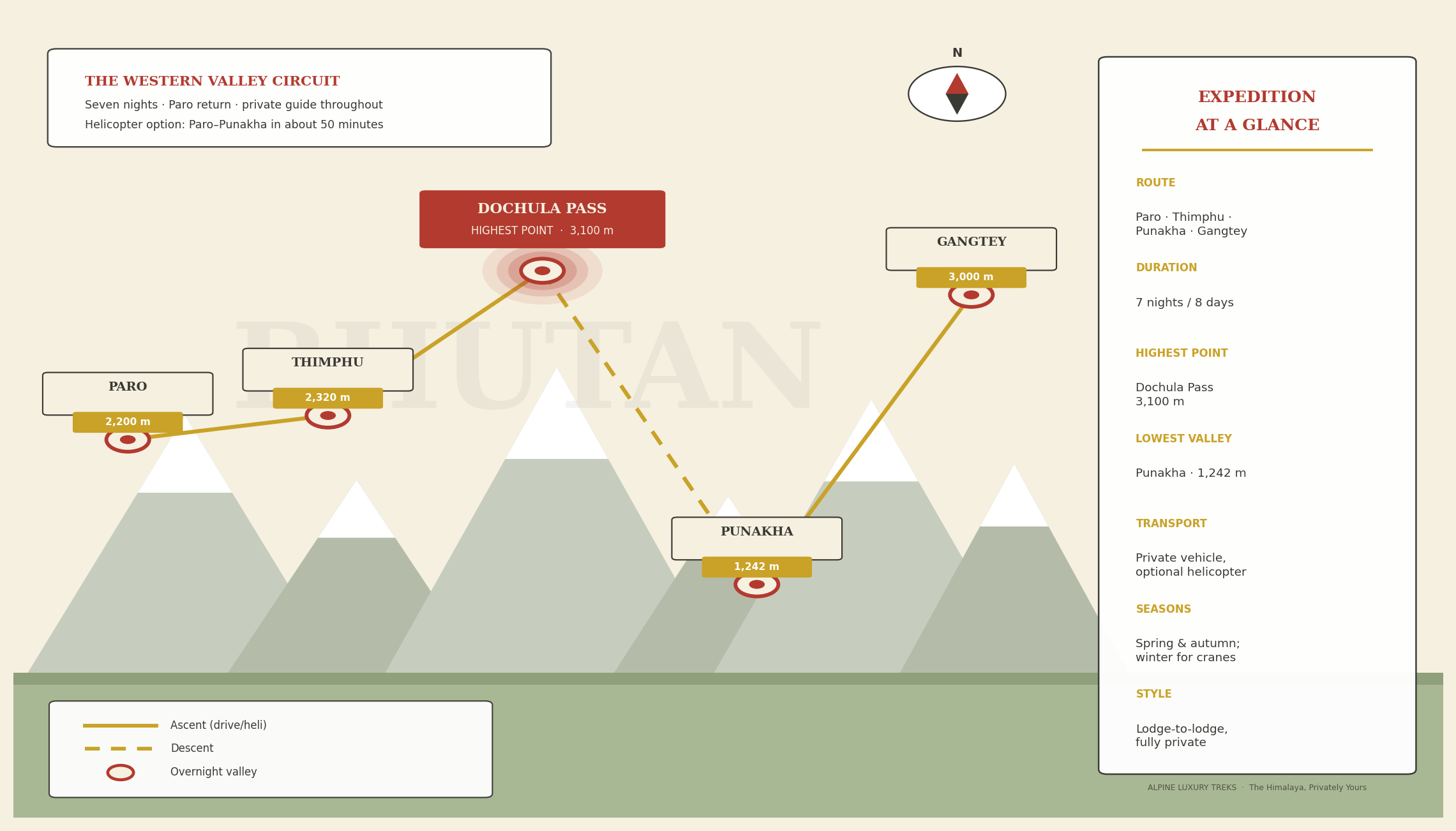
Seven nights is the shortest span that lets Bhutan breathe: four valleys, one high pass, and the Tiger's Nest saved for the finale. This is the western circuit we run most often, and the route map below shows how the elevations actually change.
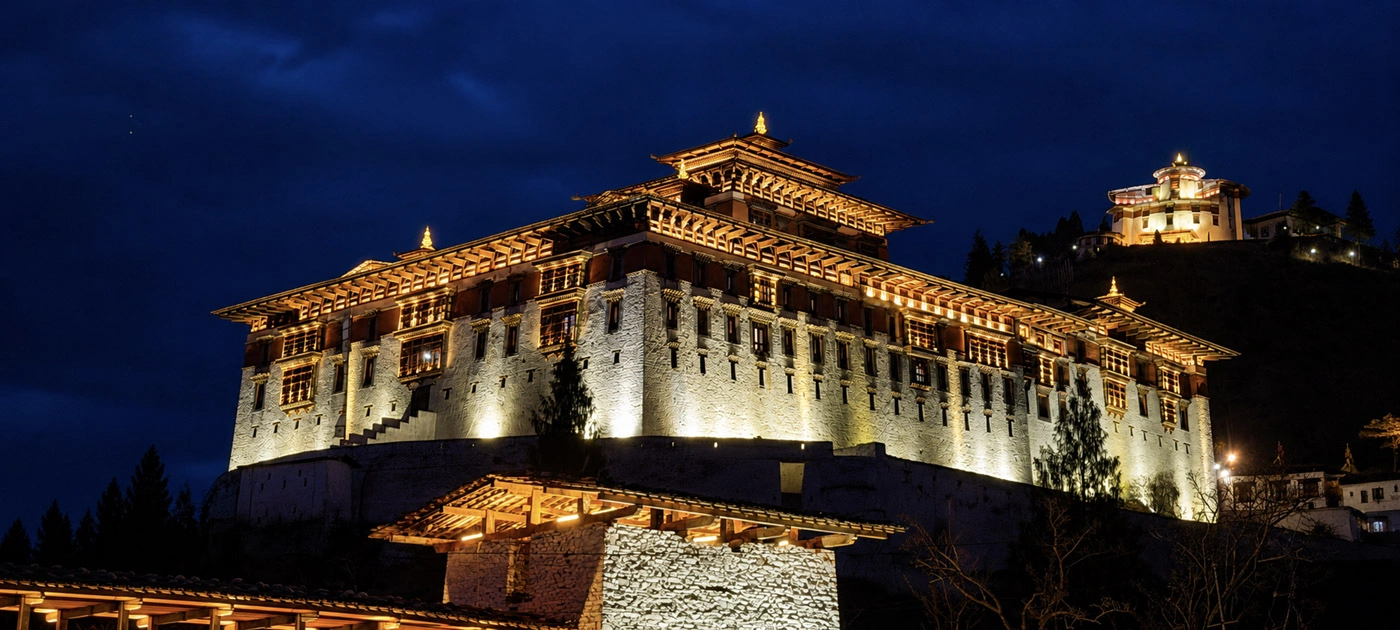
Paro, first night. Land on the morning Drukair flight, clear the e-gates, and settle within fifteen minutes at a Paro valley lodge. The afternoon stays gentle on purpose: Rinpung Dzong, the wooden cantilever bridge below it, and early dinner. Arrival day is for arriving.
Thimphu, two nights. A ninety-minute drive takes you to the world's only capital without traffic lights. The giant Buddha Dordenma, the weekend market, the national takin preserve, and time with a painting master at the traditional arts school. Your guide handles every permit and timing so the days feel unscheduled even though nothing is.
Punakha, two nights. The road crests the Dochula pass at 3,100 meters, where 108 memorial chortens face the eastern Himalaya, then drops nearly two vertical kilometers into subtropical warmth.
Punakha Dzong, the kingdom's most beautiful fortress, stands at the meeting of the Mo Chhu and Pho Chhu rivers. Raft the gentle stretch past it, or cross the suspension bridge to dinner. Guests short on time replace this drive with the fifty-minute helicopter hop.
Gangtey, one night. Climb back to 3,000 meters into the glacial bowl of the Phobjikha valley. An afternoon on the Gangtey nature trail through dwarf bamboo, evensong at the monastery, and a fireplace suite. In winter, cranes.
Paro, the final two nights. Return west for the climb every Bhutan journey builds toward: Paro Taktsang, the Tiger's Nest, perched on a cliff 900 meters above the valley floor.
We schedule it on your last full day, once your body has adjusted to the altitude, starting before the crowds with a horse option for the lower half and the Taktsang cafeteria terrace for the pause. A farewell hot-stone bath at a farmhouse closes the circuit properly.
Ten- and twelve-night versions push east to Bumthang's temple country by road or charter. The bones stay the same: slow mornings, one anchor experience per day, and a guide who reads your pace.
Eating Well in Bhutan
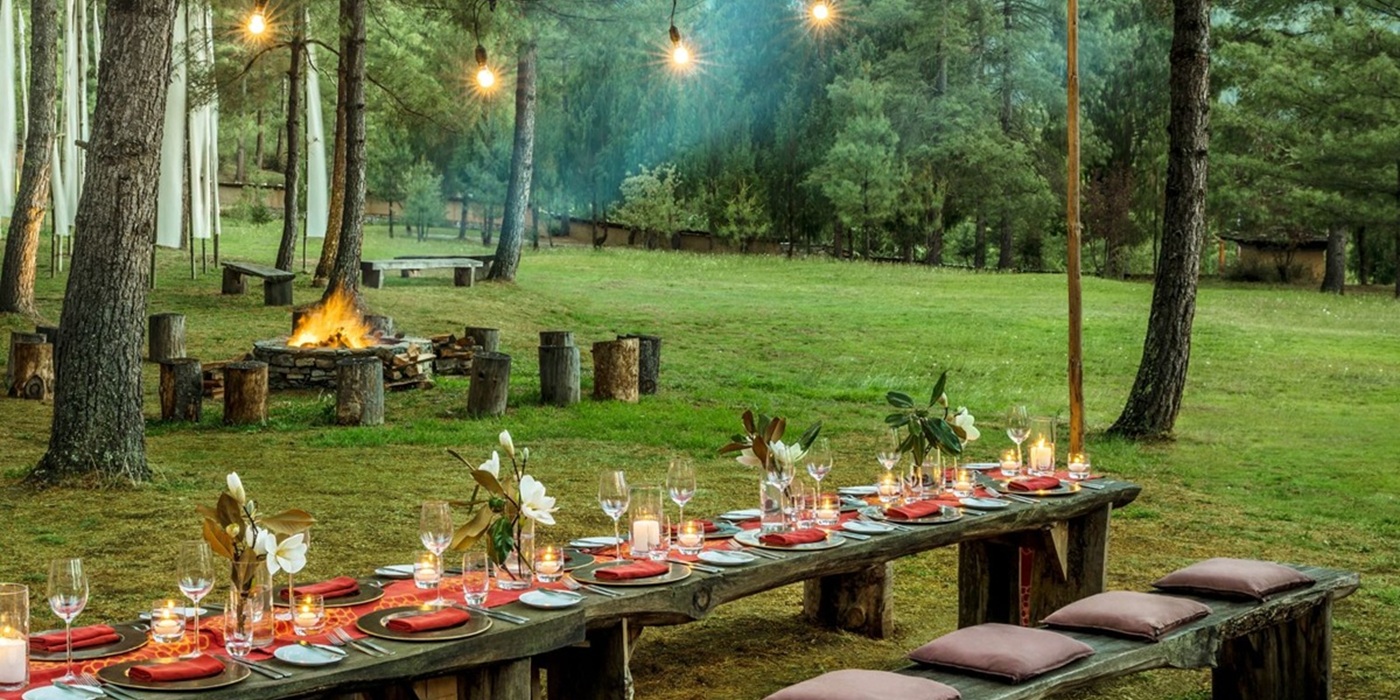
Bhutanese food is the Himalaya's most underrated, and the top lodges have learned to serve it straight rather than tame it. The national dish, ema datshi, is chilies and cheese treated as vegetables rather than garnish. Order it at least once at full strength.
Red rice from the Paro valley anchors most meals, nutty and faintly pink, grown at 2,200 meters in paddies you drive past daily. Punakha's warmth adds river fish and subtropical produce; Gangtey brings buckwheat pancakes and mountain potatoes. Lodge kitchens fold all of it into tasting menus alongside the international standards.
The experiences worth asking for sit outside the dining rooms. A farmhouse lunch with a Paro family, momos folded in a kitchen warmed by a bukhari, and a measured glass of ara, the local rice spirit, offered by your host. Suja, the salted butter tea, is divided evenly among guests. Try it hot at the Dochula pass, where it makes the most sense.
Private Helicopters Inside Bhutan
Helicopter charter is the honest answer to Bhutan's geography. Roads here climb and switchback for hours; a chartered Airbus H130 covers the Paro to Punakha route in about 50 minutes, replacing a long mountain drive over the Dochula pass, at approximately USD 3,646 per transfer.
Royal Bhutan Helicopter Services, a state-owned operator since 2015, operates a fleet of mountain-certified aircraft seating up to 6 guests. Short hops are modest by charter standards: Paro to Thimphu runs about 20 minutes and roughly USD 1,458. The long east-country legs are the splurge, with Paro to Bumthang at around 110 minutes and USD 8,021, and Paro to Trashigang from approximately USD 12,250.
The scenic programs deserve a line of their own. A thirty-minute flight over Paro Taktsang, Rinpung Dzong, and the Jomolhari massif costs around USD 2,200, and a one-hour routing toward the snow peaks on the Tibetan border costs around USD 4,400. From Bumthang, charters reach the weaving village of Khoma, the lakes above Gomthang, and the alpine yak-herding country of Merak-Sakteng.
Two practical notes from our operations side. Weather holds an absolute veto over mountain flying, so we build road fallbacks into every heli day. And any traveler heading to altitude should carry insurance that explicitly covers helicopter evacuation, because rescue charters cost roughly USD 10,500 per hour.
The Best Time to Visit Bhutan
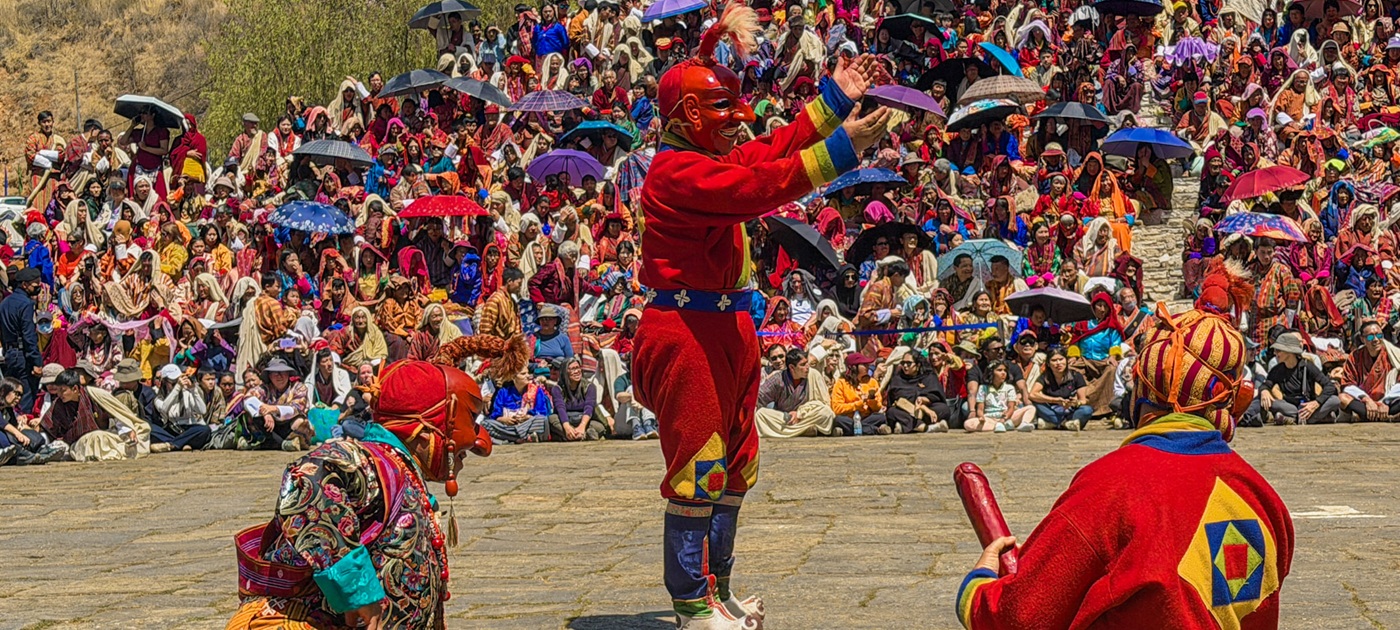
Spring and autumn are Bhutan's headline seasons, and they earn it. March through May brings rhododendron bloom to the passes and stable flying weather; October and November deliver the sharpest mountain views of the year and the great valley festivals.
Each shoulder has a case, too. Winter empties the trails and brings the black-necked cranes to Phobjikha, where Gangtey Lodge fireplaces do their best work, though the high passes get cold. Summer monsoon greens the rice terraces of Punakha spectacularly, at the price of afternoon rain and occasional flight delays into Paro.
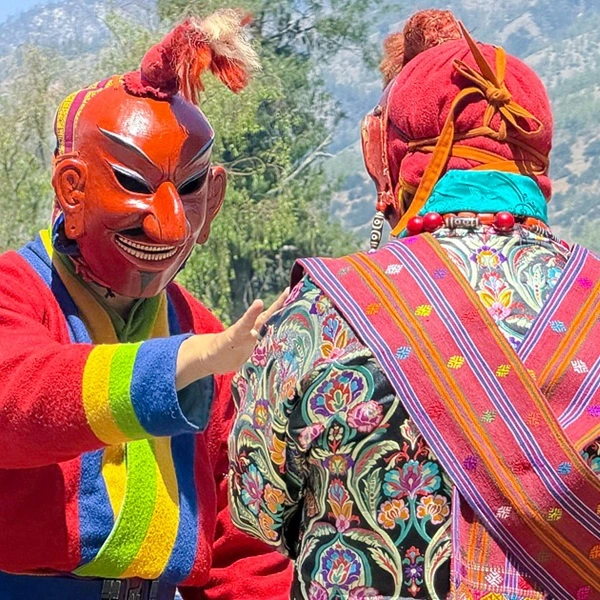
Festival timing follows the lunar calendar, so the great tshechus of Paro and Thimphu shift within their general spring and autumn windows each year. We confirm exact festival dates at booking against the lunar calendar and hold lodge space accordingly, because festival-week inventory in Paro is the tightest in the kingdom.
On our most recent spring departure, our guests reached the Dochula pass just after eight in the morning, before the day traffic from Thimphu, and had the 108 chortens and the full eastern Himalayan skyline to themselves for close to an hour. That hour is why we schedule Punakha transfers early.
Pairing Bhutan with Nepal
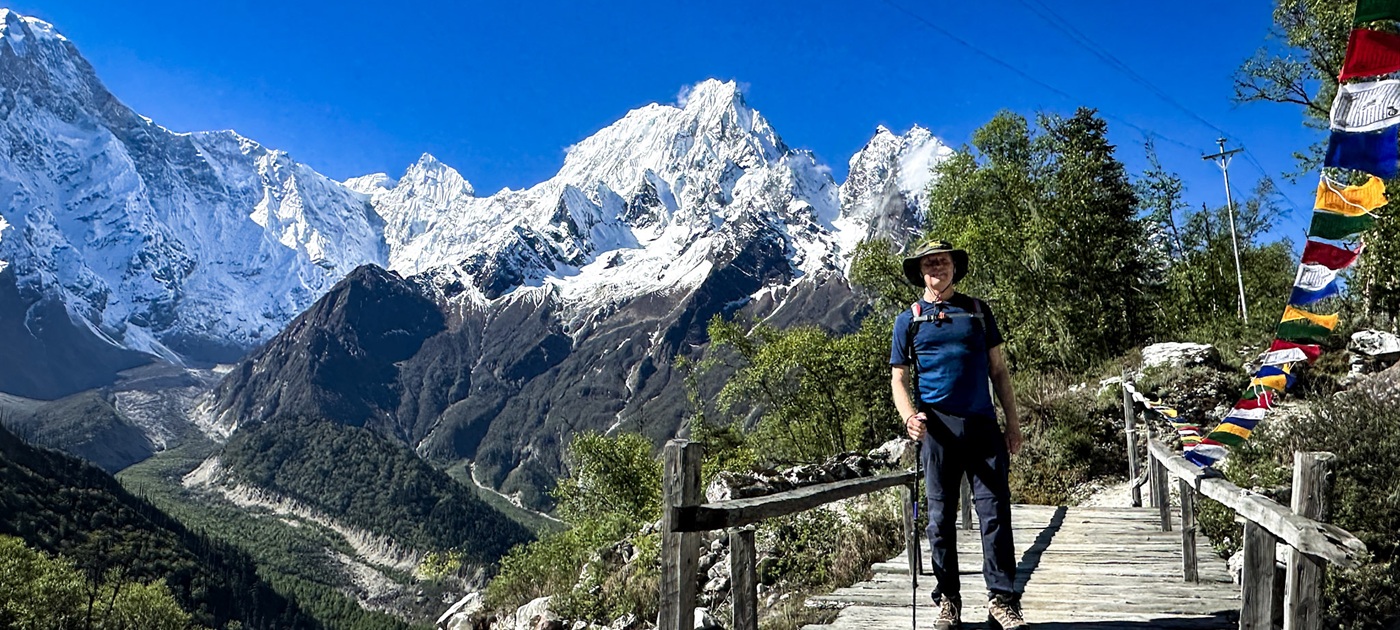
Bhutan and Nepal sit ninety minutes apart by air and complement each other almost perfectly. Nepal delivers scale: the Everest amphitheater, helicopter mornings at Kala Patthar, the living chaos of Kathmandu's temple squares. Bhutan delivers stillness, order, and lodges that Nepal's trekking valleys cannot match.
Our favorite structure runs in Kathmandu first. Two or three days among the UNESCO monuments and a private Everest helicopter morning — the same flight logic behind our Everest Base Camp Luxury Trek — then the short Drukair hop to Paro with the high peaks off the left wing. Bhutan then unfolds at half the pace.
Bangkok and Delhi work as third anchors for guests flying long-haul, and the new Guwahati link opens an Assam safari extension at Royal Manas. This is the multi-country layering we build across all our luxury travel in the Himalayas, with one team holding every wire transfer, permit, and flight.
How We Plan a Luxury Bhutan Journey
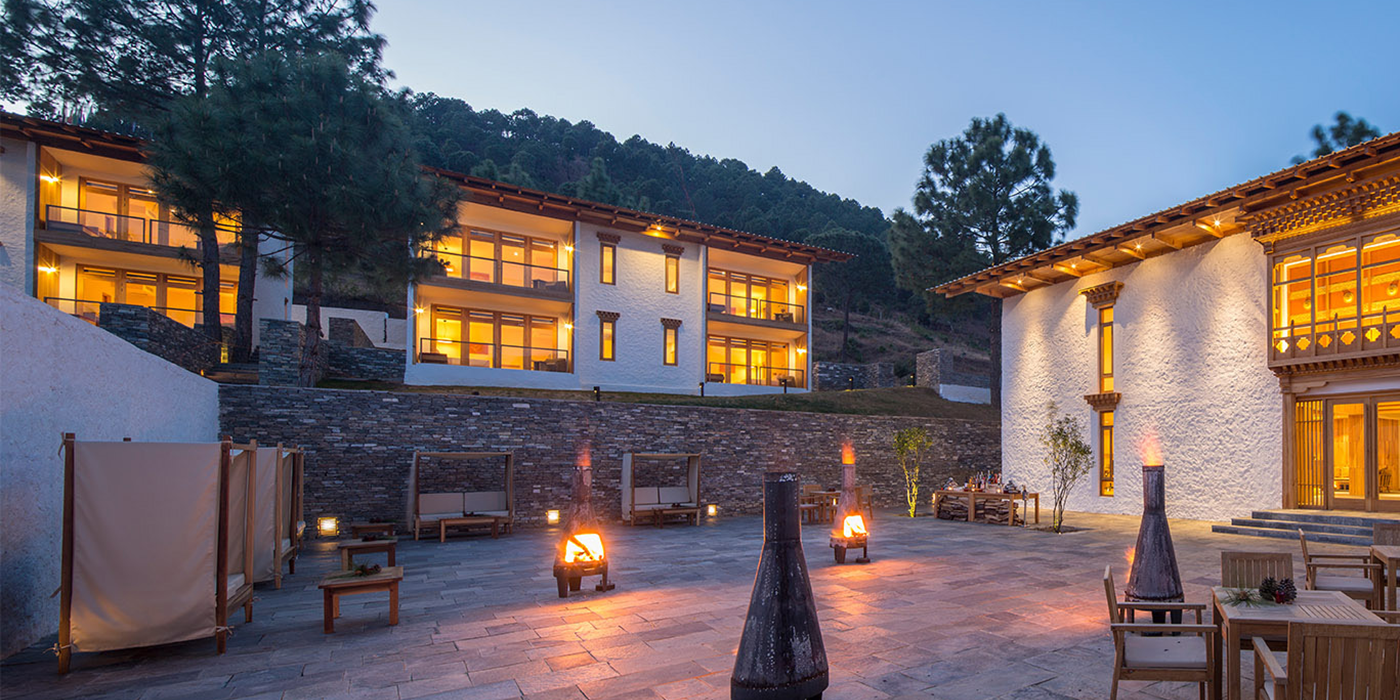
Every Bhutan itinerary we build starts with three questions. Which temperament, Amankora calm or Six Senses drama, or an independent mix? Which pace, two valleys deep or five valleys wide? And which season, festival energy or empty-trail quiet?
From there, the machinery is ours to run: SDF wires lodged early, e-visas cleared, Drukair seats held on the mountainside, helicopters chartered with road fallbacks, and a private guide matched to your interests rather than assigned by rota. Guests tell us afterward that Bhutan felt effortless. It is not. It is simply handled out of sight, which is rather the point.
If Bhutan is forming on your horizon, our Luxury Bhutan Private Tour is the natural starting point, and we shape every departure from there around you.
FAQs — Luxury Bhutan
Why is Bhutan so expensive to visit compared with Nepal?
Because Bhutan charges every visitor a USD 100 nightly Sustainable Development Fee and requires a licensed private guide and vehicle throughout, costs in Nepal do not include these fees. The fee funds free healthcare, education, and the conservation that keeps the country forested and uncrowded. On a luxury Bhutan tour, the structure works in your favor: you were paying for private guiding anyway.
Is a luxury Bhutan tour worth the money?
For travelers who value uncrowded sites, genuinely private guiding, and lodges of world standard, yes. The same policy that raises the price removes the crowds: you will often have a 17th-century dzong nearly to yourself. Travelers who measure value in sights-per-dollar will do better in Nepal or India; travelers who measure it in depth and quiet rarely regret Bhutan.
Can Americans travel to Bhutan on a luxury tour?
Yes. US citizens follow the same electronic process as all Western visitors: an e-visa at USD 40 per person, the Sustainable Development Fee paid in advance by bank wire, and entry on Drukair or Bhutan Airlines through Paro. No embassy visit is needed. Allow 30 to 90 days for wiring and clearances, which we handle end to end for our guests.
How much does a luxury Bhutan trip cost per person?
Plan on USD 500–1,000 per person per day, fully private, or roughly USD 4,500–7,000+ for a week at five-star lodges, before international flights. That includes your guide, driver, most meals, and the SDF. Top-tier itineraries built around pool-villa properties can exceed USD 13,000 per person for longer journeys.
Is the Sustainable Development Fee included in luxury Bhutan tour prices?
Usually, yes, and it is in all of ours. The SDF is USD 100 per adult per night, USD 50 for children ages 6 to 11, and free for children under 5, and is legislated at this reduced rate through August 31, 2027. Reputable operators include the fee in the quoted price and handle the required bank wire payment on your behalf before your arrival.
Amankora or Six Senses — which suits a first luxury Bhutan journey?
Choose by temperament. Amankora offers quiet valley-floor lodges, one all-inclusive rate, and a single dedicated guide across the whole circuit, ideal for travelers who want calm and zero friction. Six Senses offers dramatic ridge-top settings, heated pools, and deep wellness programming, at the cost of longer daily access drives. First-timers wanting both often split the circuit mid-route.
Can you travel to Bhutan without a guide?
No. Bhutanese law requires every foreign visitor to travel with a licensed guide and pre-arranged transport, and prohibits independent exploration. In practice, this works in a luxury traveler's favor: every journey is private by default, and the guide becomes the single biggest quality variable, which is why we match guides to guests individually rather than by rota.
Can you charter a private helicopter between Paro and Punakha in Bhutan?
Yes. Royal Bhutan Helicopter Services flies the leg in about 50 minutes aboard an Airbus H130, from approximately USD 3,646 per charter for up to six passengers, replacing the mountain road over the Dochula pass. Weather can ground mountain flights at short notice, so we always hold a road fallback on helicopter days.
How many days do you need for a luxury Bhutan itinerary?
Seven nights is the working minimum for a luxury Bhutan itinerary that covers Paro, Thimphu, Punakha, and Gangtey without rushing, with the Tiger's Nest climb on the final full day. Ten to twelve nights adds Bumthang's temple country in the center of the kingdom. Anything under five nights forces choices we would rather you not make.
When is the best season for a luxury Bhutan tour?
Spring (March–May) and autumn (October–November) are the strongest windows, bringing stable Paro flying weather, clear mountain views, and the major tshechu festivals. Winter suits travelers chasing empty trails and the black-necked cranes of Phobjikha. Festival dates follow the lunar calendar, so we confirm exact timing at booking and secure lodge space early.