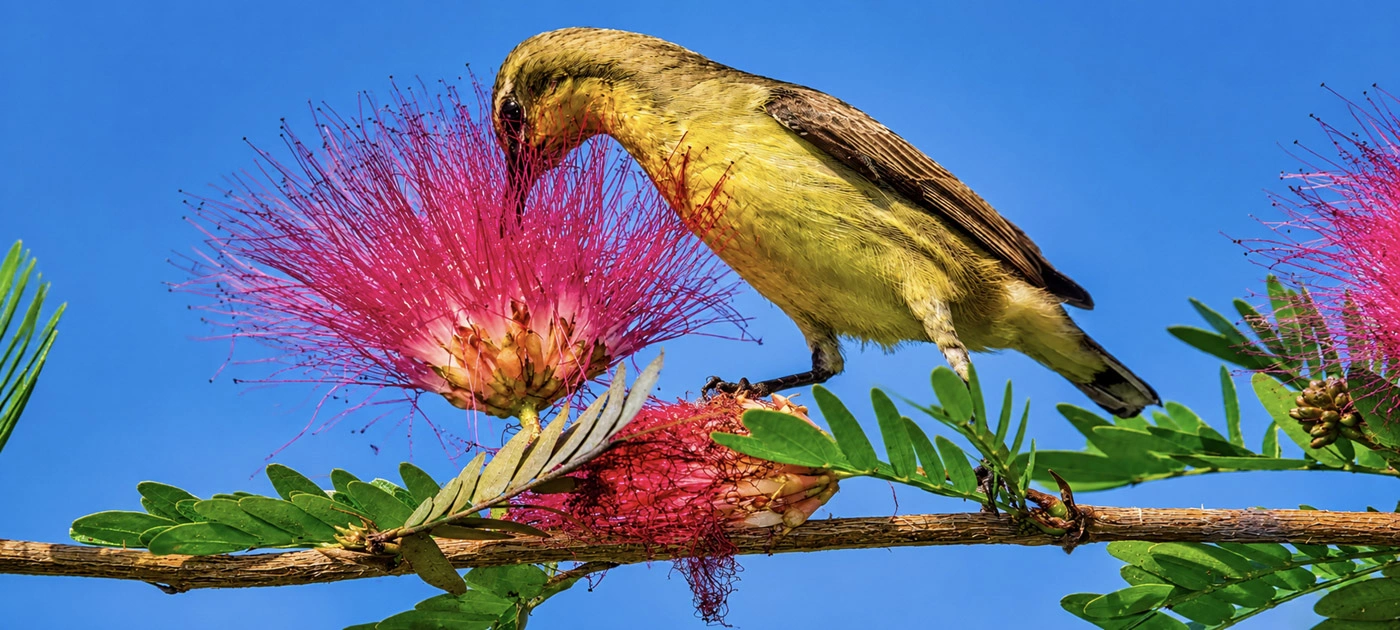
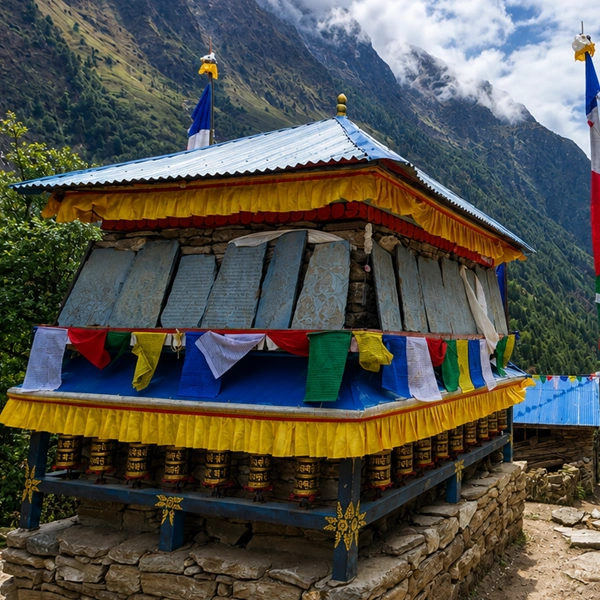
Why Nepal Is a World-Class Birding Destination
Nepal holds more than 900 recorded bird species in a country smaller than many single US states—roughly nine percent of all the birds on earth—which makes it, acre for acre, one of the finest birdwatching destinations anywhere.
The reason is elevation. Nepal drops from the 8,848-meter summit of Everest to just 60 meters in the subtropical Terai lowlands, and it does so over a remarkably short horizontal distance. That extreme compression stacks tropical, subtropical, temperate, and alpine habitats almost on top of one another, so a birder can move from a steamy jungle full of hornbills to a high rhododendron forest full of pheasants in a single day's travel. Few places on earth turn over species so fast.
Nepal sits at the meeting point of two great biological worlds—the Palearctic realm to the north and the Indomalayan to the south—and beneath one of the planet's major migratory corridors.
The result is an extraordinary concentration of resident specialists and migrant multitudes. We build dedicated birding journeys and fold birdwatching into treks and jungle safaris, and this guide covers the species, the hotspots, and the conservation stories that make Nepal so special.
The Spiny Babbler: Nepal's Only Endemic Bird
The Spiny Babbler is the only bird found nowhere else on earth but Nepal, making it the single most sought-after species for any serious birder visiting the country.
Known locally as Kande Bhyakur, the "thorny bird," it's a medium-sized, greyish-brown bird with distinctive spiky, streaked plumage and an extremely shy nature. Its story is the stuff of birding legend.
First described in 1836, it then vanished from the scientific record for over a century, and many feared it extinct—until the American ornithologist S. Dillon Ripley famously rediscovered it in 1948, a defining moment in Himalayan bird study.
The bird lives in the dense scrub of the Middle Hills, roughly between 500 and 2,135 meters, foraging for insects on the ground among leaf litter, which makes it notoriously hard to see.
Your best chance comes in the early breeding season, when males climb to the top of a small tree and sing—a bright run of squeaks, chuckles, and melodious chirps.
Ticking the Spiny Babbler off is a rite of passage, and the accessible scrub on the Kathmandu Valley rim is one of the most reliable places to try.
The Bar-headed Goose: The Bird That Flies Over the Himalaya
The Bar-headed Goose performs one of the highest migrations on earth, crossing the Himalaya at altitudes where most animals would black out—and understanding how it does so is one of the great wonders of bird physiology.
These geese routinely fly a broad Himalayan front between 5,000 and 6,000 meters, with documented individuals reaching around 7,290 meters—higher than every peak but a handful.
Up there, the air holds roughly half the oxygen of sea level, and the thin air gives their wings so little to push against that horizontal flight demands far more power than at sea level.
They manage it through a stack of extreme adaptations: they can hyperventilate many times their resting rate without ill effect, their hemoglobin binds oxygen with unusual efficiency, and their flight muscles are packed with extra capillaries and oxygen-processing machinery positioned to grab every molecule available.
Just as striking is the choice they make. Models suggest they could save energy by riding the afternoon's rising winds, yet the geese usually avoid that turbulent air, migrating instead at night or early morning on their own staggering aerobic power—climbing as fast as two kilometers of vertical elevation in an hour. They trade energy savings for control and safety. It's a humbling thing to think about while standing beneath the same peaks.
The Demoiselle Crane: A Migration in Two Different Routes
The Demoiselle Crane makes one of the most extraordinary "loop" migrations known to science, crossing the Himalaya by one route in autumn and taking a completely different path back in spring.
Known locally by the onomatopoeic name Karyangkurung, these elegant grey cranes breed in Northeast Asia and winter in India.
On the southward autumn journey, rather than flying over the highest peaks, they funnel through the deep river gorges—most famously the Kali Gandaki through Upper Mustang and the Karnali through Dolpo—hugging lower ground to dodge the worst cold and thin air.
Watchers in the Mustang villages of Kagbeni, Jomsom, and Marpha regularly see thousands of them streaming through in classic V-formations, resting at stopover sites along the way.
The spring return is a different story. Battling headwinds and poor conditions over the high plateau would be brutal, so instead the cranes detour all the way around the western edge of the Himalaya, over the Hindu Kush and the Pamirs. It's a far longer road, but a safer one. Timing a Mustang journey to the autumn crane passage is one of the great spectacles in Himalayan birding.
The autumn crane migration typically peaks in early to mid-September; exact timing varies year to year with the weather. We align Mustang departures to it where we can.
The Best Birding Hotspots in Nepal
Nepal's birding hotspots run from urban valley forests to vast lowland wetlands, and their variety in close quarters is exactly what lets birders rack up huge species counts in a short trip. Here are the ones we build journeys around.
Phulchowki and the Kathmandu Valley Rim
Phulchowki, the highest hill on the rim of the Kathmandu Valley at 2,791 meters, is widely considered the finest birding site in central Nepal, with over 300 recorded species just a short drive from the city.
Its name means "Hill of Flowers," and its steep, continuous slope of oak and rhododendron forest packs a whole cross-section of Himalayan bird life into one mountain.
Birders come here for the endemic Spiny Babbler alongside jewels like the Nepal Cutia, the elusive Fire-tailed Myzornis, the Red-headed Trogon, and a dazzling range of laughingthrushes, minivets, warblers, and flycatchers.
It's at its best during the spring and autumn migration windows, when the forest acts as an altitudinal refuge.
Nearby, tiny Taudaha Lake southwest of the city is a jewel of a different kind—a small, culturally sacred freshwater lake that becomes a critical winter stopover for migratory waterbirds.
In the peak winter months, it fills with Gadwall, Common Teal, Eurasian Wigeon, Northern Shoveler, and the globally vulnerable Common Pochard, all within minutes of Kathmandu. It's the perfect gentle half-day for a birder easing into a trip.
Koshi Tappu: Asia's Finest Wetland for Birds
Koshi Tappu Wildlife Reserve, on the floodplains of the Sapta Koshi River in eastern Nepal, is often called Asia's finest wetland for birdwatching, with over 450 recorded species.
This is duck country above all—more than two dozen varieties gather here—but it's the rarities that draw serious birders.
Koshi Tappu offers some of the best chances anywhere for the threatened Swamp Francolin, the critically endangered Bengal Florican, the towering Black-necked Stork, and the striking Baer's Pochard.
For anyone whose list leans toward waterbirds and grassland specialists, it's the single richest destination in the country and a rewarding contrast to the forested hills.
Chitwan and Bardia: Birds Among the Big Game
Chitwan and Bardia National Parks are famous for tigers and rhinos, but both are ornithological heavyweights—Chitwan alone supports over 500 bird species, making a jungle safari here a birding trip in disguise.
In Chitwan's Sal forests and grasslands, you'll find the Great Hornbill, the Lesser Florican, an enormous variety of woodpeckers, and a wealth of raptors, all while watching for the megafauna.
Bardia, in the quieter, drier mid-western lowlands, lists over 500 reliable species and shelters a long roll of threatened birds along its rivers.
For travelers who want wildlife and birds together—and a warm lowland counterpoint to a mountain trek—these parks are ideal. We describe the lodges by their setting and confirm the exact property in your booking proposal.
The Eastern and Western Forest Refuges
Beyond the famous names, quieter forest reserves reward birders chasing localized specialists, and they see a fraction of the visitors.
In the far east, the lush, high-rainfall Mai Valley is a corridor for localized Sino-Himalayan species, with over 250 recorded in the lower valley alone, and is a habitat for the near-endemic Nepal Cupwing and the vulnerable Satyr Tragopan.
In the west, the Madane forest in Gulmi has recorded over 300 species and is a stronghold for the vulnerable Cheer Pheasant, one of Nepal's nine legally protected birds.
These are the places for birders who've done the headline sites and want something wilder and more remote—the kind of off-list journey we love to build.
The Vulture Story: One of Conservation's Great Success Stories
No account of birds in Nepal is complete without its vultures, whose near-total collapse and remarkable recovery are one of the most important conservation stories of our time.
From the 1990s into the 2000s, vulture populations across the region crashed by more than 99 percent.
The cause was traced to a livestock painkiller called diclofenac: when vultures fed on the carcasses of recently treated cattle, the drug caused fatal kidney failure, and because vultures feed in flocks, a single contaminated carcass could kill dozens at once.
The loss cascaded through the ecosystem—rotting carcasses fuelled feral dog populations and disease, a stark reminder of how much invisible work these scavengers do.
Nepal's response became a global blueprint. In 2006, a community leader and ornithologist established the world's first community-run vulture feeding station in the Chitwan buffer zone—nicknamed a "Jatayu Restaurant" after the heroic vulture of the Ramayana.
The model is elegant: it buys old cattle from local farmers, keeps them free of toxic drugs, and safely provisions the carcasses for the vultures after natural death, generating income for the community while feeding the birds.
The recovery has been dramatic, with sites spreading across the country and populations climbing steadily back.
A Living Policy: Nepal's Fight for Its Vultures
Nepal has continued to legislate to protect its vultures as new threats emerge, cementing its place as a regional leader in raptor conservation.
After banning veterinary diclofenac in 2006 and promoting a vulture-safe alternative, Nepal faced newer drugs shown to be equally lethal.
In 2026, the government moved to ban several of these remaining veterinary painkillers outright—a significant step directly tied to the national Vulture Conservation Action Plan.
For birders, the practical upshot is thrilling: the "Jatayu Restaurants" are places where you can reliably witness large flocks of Himalayan Griffons and other vultures gathering to feed, their natural hierarchy playing out in real time. It's conservation you can actually stand and watch.
The Birder as Conservation Ally
Choosing to watch birds in Nepal is itself a form of conservation, because birdwatching tourism gives rural communities a direct economic reason to protect habitats and the species within them.
Birdwatchers tend to stay longer and spend more than general sightseers, and their money flows directly into the rural areas that overlap with biodiversity hotspots—local guides, transport to remote reserves, and community-run lodges.
That economic logic has driven a genuine cultural shift: a whole generation of skilled local bird guides has emerged, some of whom moved from childhood hunting to passionate conservation once they saw the lasting value of living birds.
Local birders now feed sightings into citizen-science apps that continually sharpen the country's conservation data.
When we run a birding journey, we work with these local guides and community lodges deliberately, because it puts your trip on the right side of that equation.
You get the expertise of someone who knows exactly where the Spiny Babbler is singing this week, and your visit helps keep the forest it sings in standing.
When to Go and How to Plan
The best birdwatching in Nepal falls in the spring and autumn windows, when resident species are active and the great migrations are moving.
Spring, roughly March to May, brings breeding season—the Spiny Babbler singing, pheasants displaying, and the forests alive with resident specialists in fresh plumage.
Autumn, roughly October to November, delivers the migration spectacle, including the Demoiselle Crane passage through the Mustang gorges in September, and clear post-monsoon skies.
Winter is prime for the waterbirds at Koshi Tappu and Taudaha, when northern ducks pack the wetlands. The heavy monsoon summer is the one window we generally steer birders away from.
A great Nepal birding trip usually strings together contrasting habitats: the Kathmandu rim for hill species, a lowland park or wetland for jungle and waterbirds, and a mountain leg for high-altitude specialists.
We handle the guides, permits, lodges, and logistics, and shape the route around the species you most want to see.
FAQs: Birdwatching in Nepal
How many bird species are there in Nepal?
Nepal has more than 900 recorded bird species—around nine percent of all the birds on earth—according to the most recent national checklist. That's an extraordinary number for such a small country, driven by its enormous range of elevations and habitats, from subtropical lowland jungle at 60 meters to alpine zones above 5,000 meters. It's one of the highest species densities of any country on the planet.
What is Nepal's only endemic bird?
The Spiny Babbler, known locally as Kande Bhyakur, is the only bird found exclusively in Nepal. It's a shy, greyish-brown bird of the Middle Hills scrub, famous for vanishing from science for over a century before being rediscovered in 1948. It's the top target for visiting birders, and the scrub forest on the Kathmandu Valley rim, especially around Phulchowki, is one of the most reliable places to find it.
When is the best time for birdwatching in Nepal?
Spring (March to May) and autumn (October to November) are the two prime windows. Spring is breeding season, with resident specialists singing and displaying; autumn brings the great migrations, including the Demoiselle Crane passage through the Mustang gorges around September. Winter is excellent for migratory waterbirds at lowland wetlands. We generally avoid the monsoon summer for dedicated birding trips.
Where are the best birdwatching spots in Nepal?
The headline sites are Phulchowki on the Kathmandu Valley rim (over 300 species close to the city), Koshi Tappu in the east (often called Asia's finest birding wetland), and Chitwan and Bardia National Parks (over 500 species each, alongside tigers and rhinos). Quieter forest reserves like the Mai Valley and Madane reward birders chasing localized specialists. We combine several habitats into a single trip to achieve the highest species count.
Can I combine birdwatching with a trek or safari?
Absolutely, and it's how we design most birding journeys. A jungle safari in Chitwan or Bardia is a birding trip in disguise, with hundreds of species alongside the big game. Treks through the hills and Mustang pass through prime habitat for high-altitude specialists and, in autumn, the crane migration. We weave birdwatching into treks and safaris so you experience Nepal's landscapes and its birds together.
What is a "Jatayu Restaurant"?
It's a community-run vulture feeding station, part of a Nepalese conservation success story. After vulture populations crashed by over 99 percent from a toxic livestock drug, these stations—the first established in 2006 near Chitwan—began providing safe, drug-free carcasses to the birds. They've helped populations recover and are now places where birders can reliably watch large flocks of vultures gather and feed. The name honors the vulture Jatayu from the Ramayana.
Which birds can I see crossing the Himalaya?
The most famous is the Bar-headed Goose, which flies over the range at up to around 7,290 meters—higher than nearly every peak—thanks to remarkable physiological adaptations. The Demoiselle Crane crosses through the deep river gorges in huge autumn flocks, funneling through Mustang. Watching these migrations against a backdrop of snow peaks is one of the great experiences in world birding.
Do I need a specialist guide for birdwatching in Nepal?
We strongly recommend one, and we always include expert local bird guides. Many of Nepal's most prized species—like the ground-skulking Spiny Babbler and Nepal Cupwing—are far easier to detect by call than by sight, and a skilled guide knows exactly where and when to find them. Working with local guides also directs your trip's value to the communities that protect these habitats.
The Journey We Build Around You
Birdwatching in Nepal is a chance to stand beneath the highest mountains on earth and watch a bird fly over them—to find a species that exists nowhere else, or a flock of vultures brought back from the brink. Few destinations offer so much life in so little space.
We build birding journeys around the species and habitats that matter most to you, working with expert local guides and community lodges so your trip supports the very birds you've come to see.
From the Kathmandu rim to the lowland wetlands to the crane gorges of Mustang, we handle the logistics so you can keep your eyes on the canopy.
If you'd like a birdwatching journey through Nepal shaped around your target species, our team will design it with you from the first conversation. Explore our luxury journeys in Nepal, or write to us directly.