The festivals of Upper Mustang are among the last living Tibetan Buddhist traditions on earth—the masked demon-subjugation dances of Tiji in late spring, the thundering horse races of Yartung at summer's end, and the dual winter New Year of Losar. In a high desert kingdom closed to outsiders until 1992, these are not performances but the heartbeat of a surviving civilization. Here's how to witness them.
The Festivals of Upper Mustang
A Kingdom That Kept Its Festivals
The festivals of Upper Mustang survive in a way they don't anywhere else, because this remote high-desert kingdom was closed to the outside world until 1992 and its traditions never had the chance to fade.
Tucked into Nepal's far north, in the rain shadow behind Annapurna and Dhaulagiri, Upper Mustang is a trans-Himalayan desert of eroded canyons, cliff caves, and whitewashed villages—the old Kingdom of Lo, a Tibetan Buddhist culture that evolved in near-total isolation. Its people, the Loba, kept alive rituals that have largely vanished elsewhere on the Tibetan plateau.
In Mustang, festivals aren't entertainment. They regulate the farming year, summon protective forces against drought and harsh winters, and hold a small society together in one of the most unforgiving landscapes on earth.
For a traveler, witnessing them is one of the most extraordinary cultural experiences in the Himalaya—and because they're woven into our Mustang journeys, you can time a trek to coincide with them. This guide walks through the great festivals and how to see them respectfully.
Tiji: The Sacred Drama of Demon Subjugation
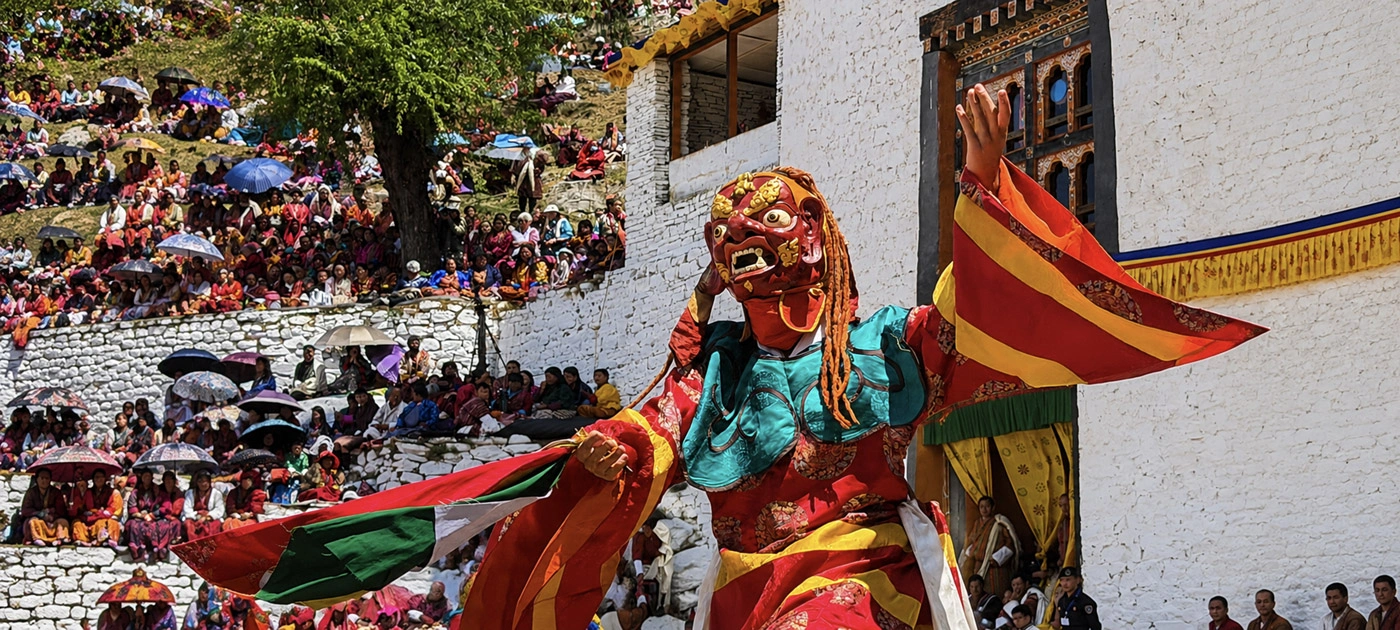
The Tiji Festival is Upper Mustang's most famous and spectacular event—a three-day masked ritual dance in the courtyard of the Lo Manthang royal palace, enacting a myth of good defeating the forces of chaos.
Its full name means, roughly, "Prayer for World Peace," and it's rooted in an old tantric practice brought to the Himalaya in the 8th century by Guru Rinpoche.
The festival took its Mustang form in the mid-17th century, when a king facing drought and instability invited a great Sakya master to cleanse the kingdom of destructive forces. What began as a private royal ritual grew, over three centuries, into the public spectacle seen today—a continuous spiritual shield for the realm.
At its heart is a three-act story: the deity Dorje Jono does battle with a demon who withholds water, brings drought, and unleashes storms and disease. That demon is really the land's greatest fears made visible—drought, famine, climatic chaos.
By ritually defeating him each year, the community asserts a kind of metaphysical control over a hostile environment, praying the rains will come and the harvest will hold. It's ancient theatre with a deadly serious purpose.
Inside the Three Days of Tiji
Tiji unfolds over three days that build from slow invocation to explosive climax, each with its own dances, masks, and meaning.
The lead dancer, who embodies the deity, prepares with a three-month meditation retreat before he may perform. On the first day, a colossal centuries-old sacred scroll of Guru Rinpoche is unfurled down the palace wall to consecrate the ground, and slow, meditative masked dances begin as horns, oboes, and drums echo off the city walls.
The cultural king of Mustang watches from the palace, and the monks in silk brocade take their places—the old bond between king and monastery on full display.
The second day escalates dramatically. Dancers appear in fierce, oversized masks of protector deities, animals, and skeletons, enacting the core struggle between the deity and the demon through dozens of distinct movements.
These wrathful forms aren't evil; in this tradition, they represent the fierce compassion needed to shock souls toward enlightenment and drive off destructive forces.
On the third day, an effigy of the demon, molded from barley flour donated by every household, is ritually destroyed. The whole community processes out of the walled city to an open field, where the effigy is torn apart and cast to the wind—drought and disease exiled for another year.
Volleys of gunpowder are fired to scare off lingering spirits, and as the procession re-enters the gates, people leap over a purifying fire. The king offers a silk scarf to the lead dancer in thanks, and the kingdom is secured for another year.
Tiji is held over three days in the third Tibetan lunar month, usually falling in May or early June. Exact dates shift each year with the lunar calendar and are confirmed at the time of booking.
Yartung: The Horse Races of Summer's End
If Tiji is solemn monastic theatre, Yartung is its joyous opposite—a raucous, dust-choked equestrian festival that marks the end of summer with horse racing, feasting, and revelry.
Held around the full moon of late August, Yartung means "summer's farewell." Its roots stretch back over a thousand years to the martial, horse-riding societies of the plateau, when victorious warriors held riding celebrations.
As Mustang unified and demilitarised, those displays became an annual post-harvest release: the barley is in, the herds are down from the high pastures, and before the long winter freeze, the community needs a burst of life. Yartung provides it.
Celebrated over three days in and around Lo Manthang—and spilling down toward Muktinath and the lower villages—the festival centers on spectacular horsemanship.
The sturdy Tibetan ponies, which run free in the pastures for months beforehand, are groomed and adorned with ribbons and woven blankets.
Riders of all ages compete not just on speed but on daring stunts: the prized feat is galloping at full tilt and snatching a silk scarf or a banknote off the ground while hanging from the saddle.
Archery, stone-throwing from horseback, tug-of-war, folk songs, and barley beer fill the days. It's the warmest, most human window into Mustang life a traveler could hope for.
Losar: The Winter New Year, Twice Over
Losar, the Tibetan New Year, is celebrated across the Buddhist Himalaya, but Upper Mustang observes it uniquely—as two separate three-day festivals in the depths of winter.
The Loba divide their new year into two observances, both usually falling in February or March, each tied to the twelve-year animal cycle of the lunar calendar.
The reason is the brutal isolation of the Mustang winter: temperatures far below freezing, snow blocking the passes north and south, farming suspended, and the community confined for weeks. Splitting Losar into two festivals breaks the monotony and keeps people socially connected and resilient through the hardest season.
Preparations begin with a deep clean of the home and altar, sweeping away the old year's misfortune. Food is central—intricately braided deep-fried pastries offered to deities and guests, buckwheat dumplings shaped like the year's animal, and hearty yak dishes and hot noodle soup eaten in quantity for warmth.
Over the three days, families visit relatives, neighbors, and elders to exchange greetings and gifts, while monasteries glow with thousands of butter lamps and the sound of chanting rolls through the frozen valleys. It's an intimate, hospitable festival, and to be welcomed into it is a rare privilege.
The Quieter Rituals of the Ritual Year
Beyond the three great festivals, Mustang's calendar is punctuated by smaller, deeply local rituals that keep the bond between community, monastery, and land intact.
Among them is a protector-deity dance at a ridge-top monastery near Lo Manthang, whose masks are said to be centuries old and whose thundering drums are meant to clear obstacles and threats from the kingdom's borders—commemorating an old legend of a snowstorm summoned to turn back an invading army.
There are pilgrimage festivals honoring Guru Rinpoche at ancient cliff monasteries, one of which is said to have been founded by the master himself in the 8th century.
In deep winter, monks chant and drum for days in a "spiritual reset" that purifies the village through stillness, the quiet counterpart to Tiji's spectacle. And in spring, rites are performed right in the fields to call for timely rain and fertile soil before planting.
There's also a late-summer feast of gratitude before the harvest, when the community gathers by peer group—mothers, elders, young men, young women—to cook, share, and sing, strengthening the bonds needed for the hard, coordinated work of bringing in the barley.
The Sand Mandala and the Lesson of Impermanence
One of Mustang's most moving rituals isn't a festival at all but the making and unmaking of a sand mandala, a practice that captures the heart of Buddhist teaching.
Over several days, trained monks use a ridged metal funnel to lay millions of grains of coloured sand into a geometrically perfect image of a deity's universe—white for purity, red for compassion, blue for boundless vastness. The precision is extraordinary, the concentration total.
Then, when it's finished, the beautiful work is deliberately swept away. The blessed sand is carried in procession to a river and released into the current, so the blessings flow downstream to all beings. Nothing is kept.
It's a direct, unforgettable lesson in impermanence—that even the most beautiful things are made to be let go. Witnessing it stays with travelers long after they leave.
The Kingdom Behind the Festivals
The festivals only make sense against the backdrop of Mustang's history as a semi-independent Tibetan Buddhist kingdom, whose royal and monastic institutions still sustain them.
The Kingdom of Lo was founded around 1380, when a warrior-statesman built the walled capital of Lo Manthang, still standing today.
For centuries, the kingdom grew wealthy as a hub of the trans-Himalayan salt trade, balancing relations with powerful neighbors before being absorbed into Nepal in 1769 while retaining remarkable autonomy.
The monarchy formally ended in 2008, but the royal family's cultural and religious authority endures—the presence and patronage of the cultural king remain essential to holding festivals like Tiji and Yartung.
The rituals are run by monks of the Sakya tradition from Lo Manthang's ancient monasteries, whose walls hold Maitreya Buddha statues, mandala murals painted in turquoise and gold, and towering assembly halls.
That living partnership of king and monastery, unbroken for centuries, is what keeps these festivals authentic rather than staged—they are, still, the community praying for its own survival.
Planning a Festival Journey to Upper Mustang
Reaching Upper Mustang for its festivals requires planning because the region is protected by strict permit requirements and is reached via a remarkable trekking route that is itself a pilgrimage.
The journey typically begins with a flight from Pokhara to Jomsom, then follows the windswept Kali Gandaki gorge north through old villages—Kagbeni, Chele, Ghami, Tsarang—to the walled city of Lo Manthang at 3,840 meters.
Along the way, you pass the astonishing Sky Caves, thousands of chambers carved into cliffs two to three thousand years ago. The trail itself feels like an initiation into the kingdom.
Upper Mustang is a restricted area, which means a special permit, a licensed guide, and regional conservation and trekking permits—all of which we arrange in advance.
The restricted-area permit is USD 50 per person per day, and solo travelers are now welcome as long as they trek with a licensed guide.
Because access is deliberately controlled to protect this fragile culture, planning ahead matters, especially to align with a festival whose exact dates follow the lunar calendar.
We time Mustang journeys to Tiji, Yartung, or Losar for travelers who want to witness the living heart of the Kingdom of Lo.
FAQs: The Festivals of Upper Mustang
What is the Tiji Festival in Upper Mustang?
Tiji is Upper Mustang's most famous festival—a three-day masked ritual dance held in the courtyard of the Lo Manthang royal palace. It enacts a myth in which a deity defeats a demon who brings drought and chaos, symbolically driving those threats from the kingdom for another year. Rooted in an 8th-century tantric practice and localized in the 1600s, it's one of the most spectacular living Buddhist rituals in the Himalaya.
When are the festivals of Upper Mustang held?
Tiji takes place over three days in the third Tibetan lunar month, usually in May or early June. Yartung, the horse-racing festival, is held around the full moon of late August. Losar, the winter New Year, is observed as two separate festivals, usually in February or March. All follow the Tibetan lunar calendar, so exact dates shift each year and are confirmed closer to the travel date—we time journeys to align with them.
What happens during the Tiji Festival?
Over three days, masked monks perform sacred dances that build from slow invocation to a dramatic climax. A giant sacred scroll is unfurled to consecrate the palace square, dancers in fierce deity and animal masks enact a cosmic battle, and finally a barley-flour effigy of the demon is destroyed and cast to the wind. The community processes out of the city, fires gunpowder to scare off spirits, and leaps a purifying fire—securing the kingdom for another year.
What is the Yartung Festival?
Yartung is Upper Mustang's exuberant end-of-summer festival, held around the late-August full moon, centered on horse racing and feasting. It descends from the martial, horse-riding heritage of the plateau and marks the completion of the harvest before winter. Riders perform daring stunts—snatching scarves off the ground at full gallop—alongside archery, folk songs, and barley beer. It's the warmest, most joyful window into Loba life.
Why is Losar celebrated twice in Upper Mustang?
The Loba split the Tibetan New Year into two three-day festivals, usually in February or March, because of the extreme isolation of the Mustang winter. With passes snowbound, farming halted, and the community confined for weeks, the dual celebration breaks the monotony and keeps people socially connected and resilient through the hardest season. Both involve deep cleaning, festive foods, family visits, and monastery prayers.
Do I need a permit to visit Upper Mustang for its festivals?
Yes. Upper Mustang is a restricted area requiring a special restricted-area permit—USD 50 per person per day—plus regional conservation and trekking permits, and you must travel with a licensed guide. Solo travelers are now welcome as long as they trek with a guide. The rules are set by the Nepalese government to protect this fragile culture. We arrange all permits and guiding in advance and confirm current requirements when planning your journey.
How do you reach Lo Manthang for the festivals?
The classic route flies from Pokhara to Jomsom, then treks north up the Kali Gandaki gorge through ancient villages—Kagbeni, Chele, Ghami, Tsarang—to the walled city of Lo Manthang at 3,840 meters, passing the remarkable cliff-carved Sky Caves along the way. The trek itself feels like a pilgrimage into the kingdom. We can also ease sections of the journey for comfort, and we time our arrival at the festival.
Is it respectful for tourists to attend these festivals?
Yes, when approached with care. Since Mustang opened to tourism in 1992, festivals like Tiji and Yartung have welcomed respectful visitors, and tourism income genuinely sustains the monasteries and encourages young Lobas to stay and preserve their heritage. The key is to attend as an honored guest—following your guide's lead on etiquette, photography, and where to stand—remembering these are living rituals, not performances staged for outsiders.
The Journey We Build Around You
The festivals of Upper Mustang are a rare sight in the modern world—living rituals in a kingdom that has kept its culture intact. To witness the masked dances of Tiji, the horse races of Yartung, or the butter-lamp warmth of Losar is to step into a civilization still praying for its own survival.
We time our Mustang journeys to these festivals for travelers who want the real thing, arranging permits, guiding, and comfort so that all you need to do is be present. Approached with respect, this is one of the most profound cultural experiences the Himalaya can offer.
If you'd like a journey to Upper Mustang shaped around its festivals, our team will design it with you from the first conversation. Explore our Upper Mustang journeys, or write to us directly.
Need Help? Call Us+977 9851013196orChat with us on WhatsApp
Need Help? Call Us+977 9851013196