1. The Potala Palace and Norbulingka
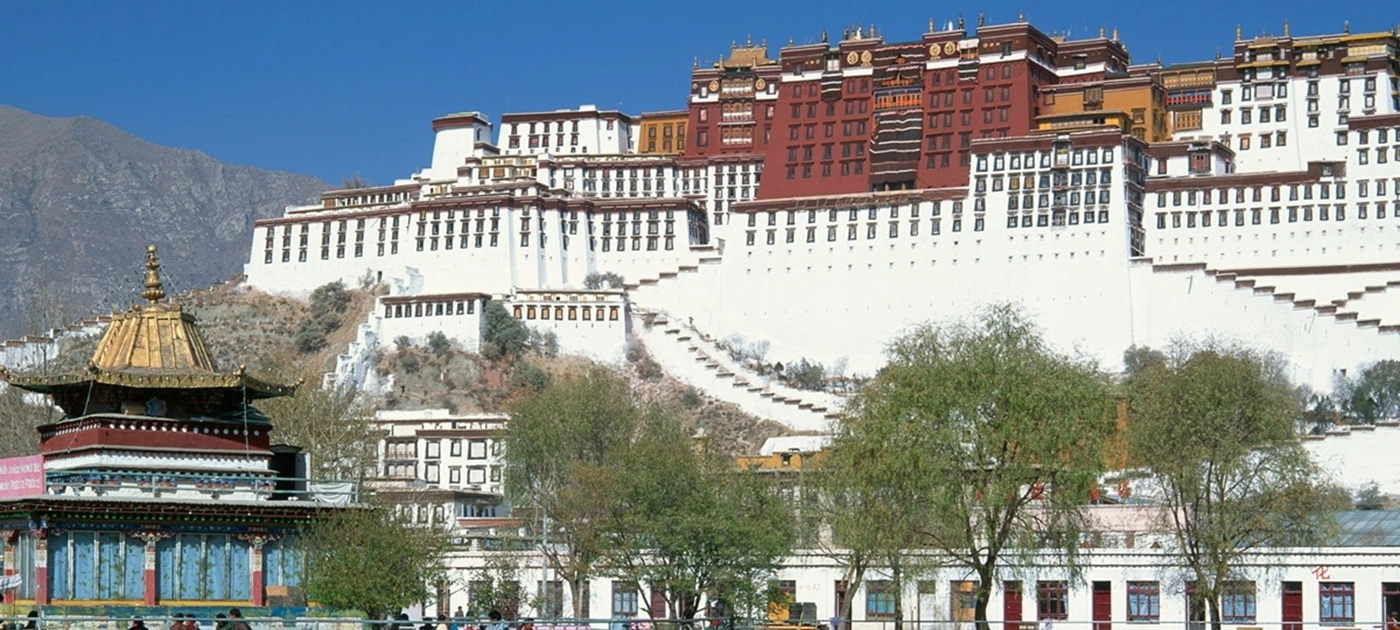
Lhasa opens with the two seats of the Dalai Lamas. The Potala rises from Red Hill in thirteen stories of stone and timber, a seventh-century fortress expanded to its present form from 1645 under the Great Fifth: the White Palace for governance, the Red Palace for ritual, and within it the gilded funerary chortens of the Dalai Lamas themselves.
Three kilometers west, Norbulingka answers the fortress with a garden. Founded in 1755 as the summer palace, its pavilions and shaded walks show the contemplative, domestic side of the same institution.
Our practical counsel: visit the Potala on your second morning in Lhasa, not your first. The palace's staircases are a workout at 3,650 meters, and daily visitor numbers are capped, so entry slots are secured well ahead — ours are booked with the permits.
2. The Jokhang and the Barkhor Circuit
The Jokhang is Tibet's holy of holies, built in the seventh century by King Songtsen Gampo and shaped by his two marriages — to Princess Bhrikuti of Nepal and Princess Wencheng of Tang China — whose legacies are reflected in the temple's fusion of Tibetan, Newari, Indian, and Han design.
Legend says the site was a lake, filled with earth carried by white goats to pin down the ogress of the wild land: Rasa, goat-earth, became Lhasa, place of the gods.
Within sits the Jowo Rinpoche, the gilded image of the Buddha at twelve years old, the most revered object in Tibet. Pilgrims prostrate at the doors from before dawn; the devout fund fresh gold for the statue's face.
Around the temple runs the Barkhor, the kora-cum-bazaar where prostrating pilgrims and turquoise sellers share the same flagstones. Walk it clockwise, twice: once to see it, once to stop seeing and just walk.
3. Sera and Drepung: The Monastic Universities
Lhasa's hills hold the great Gelug universities. Drepung, founded in 1416, once functioned as a monastic city of thousands; its whitewashed lanes still feel like a town that happens to be a monastery. Sera, founded three years later, keeps the tradition's most theatrical classroom.
Every afternoon in Sera's shaded courtyard, monks debate doctrine in formalized combat — a standing challenger winding up a full-arm handclap to drive each point at the seated defender, feet stamping, beads swinging. It is philosophy as a contact sport, and it has run for six centuries.
We schedule Sera for the debate hour and keep the rest of that day light. Two full days in Lhasa is the minimum we will run; three is better, and the altitude agrees.
4. Yamdrok Lake and Samding Monastery
The road west begins with a coil of switchbacks to the Gampa La pass at about 4,990 meters, and then the floor drops away into turquoise: Yamdrok, one of Tibet's great sacred lakes, sprawling over 600 square kilometers in the shape locals read as a scorpion.
The lake is considered the life-spirit of Tibet and the body of a protector deity, which is why tradition forbids swimming and fishing in it — a taboo we ask every guest to honor.
On a ridge above the far shore stands Samding Monastery, seat of Dorje Pakmo, the highest female incarnation line in Tibetan Buddhism — a reminder that the plateau's institutions held powerful women's lineages centuries before the phrase existed.
The Gampa La viewpoint is the trip's first great photograph. Wind and altitude make it a fifteen-minute stop, and that is enough.
5. The Karo La Glacier
An hour beyond Yamdrok, the road does something almost indecent: it passes within a few hundred meters of a hanging glacier. Karo La spills from the ice cap of 7,206-meter Noijin Kangsang in two frozen tongues, their edges folded into tower formations sculpted by sun and wind.
Chinese cinema used the glacier as a backdrop in the 1990s; climate science uses it now, as one of the plateau's most closely watched thermometers, its meltwater feeding — and increasingly worrying — the farms of Shigatse downstream.
It is the most accessible serious glacier that most travelers will ever stand near. Dress for the wind; the weather is cold year-round.
6. Gyantse and the Kumbum
Gyantse rewards the detour into its old town. The Pelkor Chode compound, founded in 1418, once housed colleges of three rival schools — Gelug, Sakya, and Shalu — within a single red wall, a rare experiment in institutional tolerance.
Its treasure is the Kumbum, the Myriad Buddha Stupa of 1427: nine tiers, 108 gates, 77 chapels, a three-dimensional mandala you ascend chapel by chapel past some of the finest fifteenth-century murals in the Himalayan world. History cut deep here too — Younghusband's British expedition took Gyantse in 1904, and the scars of that campaign and the Cultural Revolution frame the restoration you see today.
Climb to the Kumbum's upper terraces for the view over the fort and barley fields. The light is best late in the day, when the tour flow has moved on.
7. Tashilhunpo Monastery, Shigatse
Shigatse, Tibet's second city, is built around Tashilhunpo, seat of the Panchen Lamas, founded in 1447 by Gendun Drup and sprawling across the hillside in a small city of gilded roofs and cobbled lanes.
Its centerpiece is the Jamkhang Chenmo, the Maitreya chapel of 1914, housing a seated Future Buddha 26 meters tall — among the largest gilded bronze statues on Earth, worked by hundreds of artisans and coated in hundreds of kilograms of gold, jeweled with coral, amber, and pearl.
The tomb chortens of the Panchen Lamas answer it in gold of their own, and the great thangka wall above the complex still displays giant scroll paintings at the summer festival.
Shigatse, at 3,850 meters, is the route's natural second base. We overnight here in the city's best house and let guests walk the monastery's lingkhor at dusk with the local pilgrims.
8. Sakya: The Grey-Earth Fortress and Its Library
South of the highway, Sakya Monastery is worth every kilometer of the detour. The southern complex of 1268 is a fortress in monastic dress — grey walls, watchtowers, a moat — built when the Sakya lamas governed Tibet under the Yuan emperors.
Inside the great hall, forty timber pillars hold the roof, four of them wrapped in legend: one a gift of the emperor, one carried from India by a tiger, one hauled by a wild yak, one home to a naga spirit.
Monks still sound a white conch presented, tradition says, by Kublai Khan. And behind it all runs the library wall — tens of thousands of volumes shelved to the ceiling, a hoard that has earned Sakya the name "the Second Dunhuang."
Local lore adds that certain scriptures slide forward on their shelves before great world events. We pass that on as the monks tell it, and let the wall itself do the convincing.
9. Rongbuk and Everest's North Face
The route's southern spur climbs to the place photographs cannot inflate: Rongbuk, the highest monastery on Earth at about 5,000 meters, with the north face of Everest filling the end of the valley — 8,849 meters of rock and ice presented head-on, no foreground, no mercy.
To Tibetans, the mountain is Qomolangma, home of the goddess Miyolangsangma, and the monastery has watched expeditions come and go for a century.
En route, the switchbacks of the Gawu La viewpoint lay out four eight-thousanders in a single line — Everest, Lhotse, Makalu, Cho Oyu — the densest panorama of giant peaks reachable by road anywhere.
Guests who have stood at Base Camp on the Nepal side consistently tell us the Tibetan view is the more overwhelming of the two. Nights here are high and cold; we treat Rongbuk as a visit, not a sleep, whenever the schedule allows.
10. Pelkhu Tso and Shishapangma
Rejoining the westward highway, the road crosses dune country and drops to Pelkhu Tso, the cobalt lake at 4,590 meters that mirrors 8,027-meter Shishapangma — the youngest of the world's fourteen highest peaks and the only one entirely inside Tibet. Red-brown shores, blue water, white summit: the plateau's palette at full strength.
Travelers arriving on the Kerung road meet this same lake from the south; it is where the two great Kailash routes braid together. Our Kerung-route guide covers that approach in full.
From here west, the crowds thin to nothing. The plateau begins to feel the way the old accounts describe it.
11. Saga and the Drongpa Grasslands
Saga — the name means happy land — is the last real town before the far west, set in grasslands where the young Yarlung Tsangpo, the future Brahmaputra, braids between the Gangdise range and the Himalaya. Beyond it, Drongpa county holds the river's source country: nomad tents, yak herds, sand dunes running improbably parallel to snow peaks.
Saga's job in the itinerary is physiological. At about 4,600 meters, it is the final acclimatization step before the Kailash region, and we keep the evening deliberately idle — soup, thick blankets, and an early night.
From Saga to Darchen, the driving is long and the landscape hypnotic. This is the day guests stop checking phones that stopped working anyway, and the journey does its quietest work.
12. Mansarovar, Chiu Gompa, and the Dark Twin
Arrival at Lake Mansarovar is the journey's emotional gate: the lake of Brahma's mind at 4,590 meters, ringed by its historic monasteries — Chiu on its red crag above the hot springs, Trugo with the lake's largest active community on the south shore, Gosul where tradition holds Atisha meditated for a week.
Chiu's cave preserves the footprint of Guru Rinpoche, who is said to have spent his final seven days on Earth here.
Pilgrims bathe, offer pujas at the waterline, and collect water and mineral sand from the shore's purification gates. West across the isthmus, saline Rakshastal — Ravana's lake, shunned for bathing — supplies the shadow that completes the picture, with the Sutlej rising at its far tip.
We give the lake a full day and night before Darchen, always. The story of these twin lakes, and the stranger claims that swirl around the mountain above them, get their own treatment in our guide to the Mount Kailash mysteries.
13. Darchen, Yamadwar, and the Kora's Three Days
Darchen, the gravel-plain town at 4,575 meters, is where wheels stop, and feet take over. The 52-kilometer kora opens at Yamadwar, the Gateway of the God of Death, at an elevation of 4,724 meters — in Hindu tradition, the portal where Yama's accountant strikes past sins from the ledger; in Buddhist tradition, the threshold where ordinary ground becomes mandala. The Tarboche flagpole beside it is raised each Saga Dawa anew, on dates the lunar calendar sets.
The circuit's rhythm is fixed by its three halts. The first night at Dirapuk, about 5,080 meters, faces Kailash's sheer north wall across the Lha Chu — the closest most humans ever stand to the mountain.
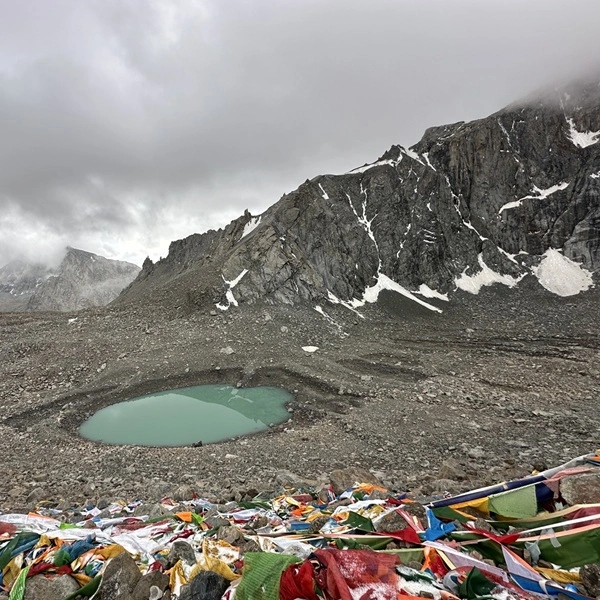
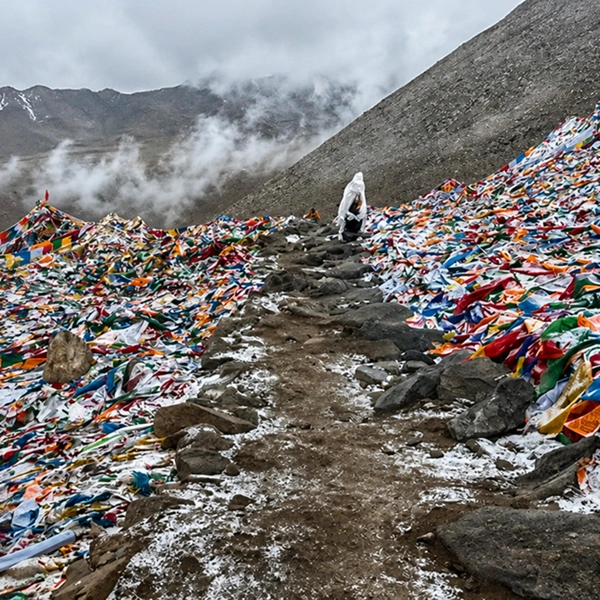
The second day crosses the Dolma La at about 5,630 meters, passes the emerald pool of Gauri Kund below the far side, and descends to Zutulpuk, the "cave of miraculous deeds," built around Milarepa's cell — its low ceiling still bearing, tradition says, the prints where the saint pushed the rock upward during his contest with the Bon master Naro Bonchung.
The third day walks out gently to Darchen, and the route's 1,300 kilometers resolve into their point.
Sleeping in the simple guesthouses at Dirapuk and Zutulpuk, upgraded with our own bedding and crew, is part of the completion. Comfort at 5,000 meters is real, but it is earned, not installed.
Permits, Pacing, and Choosing Your Route In
The Lhasa route runs on paperwork as much as it does on fuel, and the sequence matters. Every foreign traveler needs the Tibet Travel Permit from the Tibet Tourism Bureau to board a flight or train to Lhasa; beyond Lhasa, the Alien Travel Permit is issued en route; and the far west adds the military-area clearance for Ngari, the slowest document of the set, needing several weeks' processing. Guests entering via Kathmandu use the group visa issued there, which we coordinate with the permit stack as one package. The practical rule is simple: commit ninety days out, and every document arrives calm.
On pacing, the route is its own altitude plan — Lhasa at 3,650 meters, Shigatse at 3,850, Saga at 4,600, then the lakes — but only if you spend the nights it asks for. We run Lhasa-to-Darchen in no fewer than seven days of driving and resting, with the same daily oximeter checks, hydration discipline, and carried oxygen we hold to on every high route.
Choosing between the two great approaches comes down to appetite. The Kerung road from Kathmandu is shorter, cheaper, and superbly staged for acclimatization; the Lhasa route costs more days and more budget and repays them with the Potala, Gyantse, Tashilhunpo, Sakya, and Everest before the mountain.
Many of our guests solve it the obvious way: fly into Lhasa, travel west gathering Tibet as they go, complete the kora, and exit down the Kerung corridor to Kathmandu — the full arc in one journey. Our private Kailash Mansarovar journey is built to run either way, in line with the standards we maintain across all our luxury travel in the Himalayas.
FAQs — Lhasa to Kailash
How long does the Lhasa to Kailash overland tour take?
Plan a minimum of seven days for the roughly 1,300-kilometer drive from Lhasa to Darchen with proper overnights in Shigatse and Saga, then three days for the kora and the return or exit via Kerung — thirteen to fifteen days for the full journey. Shorter schedules exist, but compress acclimatization, which is the one economy this route punishes.
What permits do you need for the Lhasa-Kailash route?
Three layers beyond your Chinese visa: the Tibet Travel Permit to enter Lhasa, the Alien Travel Permit for areas beyond it, and a military-area clearance for Ngari prefecture, the slowest to process. Travelers entering from Kathmandu use the group visa issued there instead of an individual visa. All are available only through licensed operators — we file the full stack, and 90 days' lead time keeps it comfortable.
Should you choose the Lhasa route or the Kerung route to Kailash?
Choose Lhasa if Tibet itself is half the point: the Potala, Gyantse's Kumbum, Tashilhunpo, Sakya, and Everest's north face all sit on this road, at the price of more days and budget. Choose Kerung for the shortest well-staged overland approach from Kathmandu. The strongest itinerary uses both — in via Lhasa, out via Kerung — and never repeats a kilometer.
Can you see Mount Everest on the Lhasa to Kailash drive?
Yes, and better than most expect. The southern spur to Rongbuk Monastery puts Everest's full north face at the end of the valley, and the Gawu La viewpoint en route lines up Everest, Lhotse, Makalu, and Cho Oyu in a single panorama. The detour adds a long day at a serious altitude, and it is the one addition our guests never regret.
Why is swimming forbidden in Yamdrok Lake?
Because Yamdrok is sacred, Tibetan tradition holds that the lake is the life-spirit of Tibet and the body of a protector deity, so swimming and fishing in it are taboo. Travelers experience the lake from the Gampa La pass viewpoint at about 4,990 meters and along the shoreline road. We ask every guest to honor the prohibition as local pilgrims do.
What is inside the Gyantse Kumbum?
A walkable mandala: nine tiers rising 35 meters, entered through 108 gates into 77 chapels lined with fifteenth-century murals and thousands of clay and copper images. Commissioned in 1427 within the Pelkor Chode compound, it is the finest surviving stupa of its kind in Tibet. Ascending it chapel by chapel, spiraling clockwise, is the intended devotional experience — allow a full unhurried hour.
Where do you sleep on the Kailash kora from Darchen?
Two nights on the mountain: at Dirapuk, about 5,080 meters, facing Kailash's north wall, and at Zutulpuk, about 4,790 meters, beside Milarepa's cave. Accommodation at both is simple guesthouse stock, which we upgrade with our own bedding, dining, and support crew. There are no luxury lodges on the kora itself — the comfort is in the preparation, pacing, and people around you.
What makes Sakya Monastery's library famous?
Scale and survival: a wall of shelves holding tens of thousands of volumes of scripture and manuscript, accumulated since the era when Sakya's lamas governed Tibet under the Yuan emperors, earning it the nickname "the Second Dunhuang." The 1268 fortress-monastery around it, with its legendary forty pillars and Kublai Khan's white conch, makes the southern detour from the highway one of the route's richest half-days.