The Jain Sacred Mountain at Kailash
Most Kailash content focuses on the Hindu and Buddhist perspectives. The Jain perspective is older, more specific, and architecturally more extraordinary than either. Ashtapad is not just a place where a deity resides. It is the place where a human being — the first Tirthankara — completed the journey of liberation.
The eight steps of the mountain represent the eight categories of karma that a soul must destroy to achieve absolute omniscience. The Crystal Palace on the summit housed 24 statues foretelling every enlightened teacher who would ever appear. The mountain is a map of the entire Jain spiritual path, from bondage to liberation, frozen in rock and ice at 5,000 meters.
In This Guide
- The four-religion framework: what Kailash means to each faith
- The Jain narrative: Rishabhdev’s nirvana and King Bharat’s palace
- The eight steps: a map of karma and liberation
- The Ravana story: Jain version vs Hindu version
- The lost palace: archaeological expeditions 2006-2009
- Modern replicas: New York and Hastinapur
- Seeing Ashtapad on the Kailash Yatra
- Frequently asked questions
Four Religions, One Mountain
|
Religion
|
Name
|
What It Is
|
Direction of Kora
|
|
Hinduism
|
Kailash / Meru
|
The eternal abode of Shiva and Parvati. Physical Shiva lingam. Source of the Ganges.
|
Clockwise
|
|
Jainism
|
Ashtapad
|
Adi Tirtha. The site where Rishabhdev (the 1st Tirthankara) attained nirvana. Crystal palace with 24 gemstone Tirthankara idols.
|
Varies/debated
|
|
Buddhism
|
Gang Rinpoche
|
Navel of the universe. Dwelling of Demchok (Chakrasamvara). Living tantric mandala.
|
Clockwise
|
|
Bon
|
Yungdrung Gutseg
|
Nine-story swastika mountain. Seat of Sipaimen. Where Tonpa Shenrab descended from heaven.
|
Counter-clockwise
|
All four religions agree on one thing: this is the center of the universe. How they interpret that center is where the stories diverge. The Jain story is the most specific, the most architectural, and the most human. It is not about a god who lives on the mountain. It is about a man who left the mountain by achieving liberation.
Rishabhdev’s Nirvana and King Bharat’s Crystal Palace
Bhagwan Rishabhdev — also known as Adinath, the First Lord — is not just a spiritual figure. In the Jain tradition, he is the founder of human civilization: the teacher of agriculture, trade, writing, mathematics, and defense. After ruling for an immense epoch, he divided his empire, renounced the world, and withdrew to the Himalayas for extreme asceticism.
On the peak called Ashtapad, Rishabhdev and 10,000 monks meditated until the final vestiges of karmic bondage were destroyed. His soul ascended to the apex of the universe. The event is called the Nirvana Kalyanak — the fifth and final auspicious event in a Tirthankara’s life.
His eldest son, Chakravarti King Bharat (the first universal monarch, after whom India is named Bharatavarsha), built a memorial palace on the summit: the Sinha Nishadhya Prasad, the Lion’s Abode. It was not built from stone. It was built from solid crystal and studded with gemstones. It was designed to be Sarvatomukhi — four-sided with no rear wall, so devotees could approach from all directions equally.
The 24 Gemstone Idols
Inside the palace, Bharat installed 24 life-sized idols of every Tirthankara who would ever appear in the current cosmic cycle — past, present, and future. Each idol was carved from a specific gemstone matching that Tirthankara’s skin color. They were arranged in four directions following the sacred formula “Chattari Aattha Das Doy”: two in the East, four in the South, eight in the West, ten in the North.
Bharat also installed idols of his 99 brothers (all of whom renounced their kingdoms to become ascetics), his sisters Brahmi and Sundari, and his grandmother Marudevi Mata. Iron guards (Loh Purush) were stationed to protect the site from desecration. The palace was, in effect, a complete spiritual library of the entire Jain cosmos, frozen in crystal at the top of the world.
The Eight Steps: A Map of Karma and Liberation
The name Ashtapad — eight steps — is not merely topographical. Each step represents one of the eight categories of karma that a soul must destroy to achieve liberation.
|
Step
|
Karma
|
What It Does to the Soul
|
|
1
|
Jnanavarana (knowledge-obscuring)
|
Blindfolds the intellect. Prevents infinite knowledge.
|
|
2
|
Darshanavarana (perception-obscuring)
|
Blocks perfect intuition. Prevents seeing reality as it is.
|
|
3
|
Antaraya (obstacle-creating)
|
Restricts the soul’s infinite energy, charity, and spiritual power.
|
|
4
|
Mohaniya (deluding)
|
THE HARDEST. Generates false beliefs, anger, pride, deceit, and greed. Intoxicates the soul.
|
|
5
|
Nama (body-determining)
|
Determines physical form, species, and characteristics of incarnation.
|
|
6
|
Ayu (lifespan-determining)
|
Dictates the exact duration of the current life.
|
|
7
|
Gotra (status-determining)
|
Establishes social status, lineage, and family environment.
|
|
8
|
Vedaniya (feeling-producing)
|
Creates the experience of pleasure and pain.
|
The first four (Ghatiya karmas) are the destructive ones: they directly obscure the soul’s infinite qualities. The last four (Aghatiya karmas) determine the conditions of physical existence. Ascending all eight steps — destroying all eight karmic categories — is the Jain path to liberation. The mountain is a physical map of that path.
Ravana at Kailash: Two Versions of the Same Story
The Jain Version: Devotion Through Self-Sacrifice
Ravana traveled to Ashtapad with his queen, Mandodari, to worship at the crystal palace. Mandodari began an ecstatic devotional dance. Ravana accompanied her on his veena. When a string snapped mid-performance, he feared the silence would break her trance.
Using his mystical powers, he sliced his own arm open, pulled out a vein, and strung it onto the instrument to keep the music alive without missing a beat. This selfless devotion earned him the Tirthankar Nam-karma: the cosmic guarantee that, in a future cosmic cycle, he will be born as one of the 24 Tirthankaras.
The Hindu Version: Arrogance and Submission
Ravana, intoxicated by power after defeating Kubera, refused to circumambulate Kailash. He thrust his twenty arms under the mountain and tried to uproot it. Shiva pressed it back down with his right big toe. Ravana was trapped for a thousand years.
In agony, he tore out his thigh nerves to make a stringed instrument and composed the Shiva Tandava Stotram in desperate praise. Shiva released him, named him Ravana (“the one who roars/cries”), and granted him divine weapons. The scene is carved in the Ellora Caves, the Hoysala temples, and as far away as Banteay Srei in Cambodia.
TWO TRADITIONS, ONE GEOGRAPHY
The Jain Ravana is a complex devotee whose selfless act guarantees future spiritual supremacy. The Hindu Ravana is an arrogant king whose forced submission becomes devotion. Both traditions place the story at the same mountain. Both use the story to teach the same lesson: the ego must be destroyed. The method of destruction differs. The location does not.
The Lost Palace: Archaeological Expeditions 2006-2009
The Jain Center of America in New York established the Ashtapad Research Foundation and funded three scientific expeditions to the Kailash-Mansarovar region in 2006, 2007, and 2009. The teams included geologists, archaeologists, satellite imagery experts from the Indian Space Research Organization, linguists, and Jain scholars. They surveyed Nandi Parvat, the Dharma King Norsang area, and Gyangdrak Monastery using advanced satellite imaging.
No physical remnants of the Sinha Nishadhya Prasad, the iron guards, or the gemstone idols were found. The archaeologist John Vincent Bellezza, after twelve years surveying the Zhang Zhung region, reached a conclusion that has become the accepted paradigm: Mount Kailash itself is the temple.
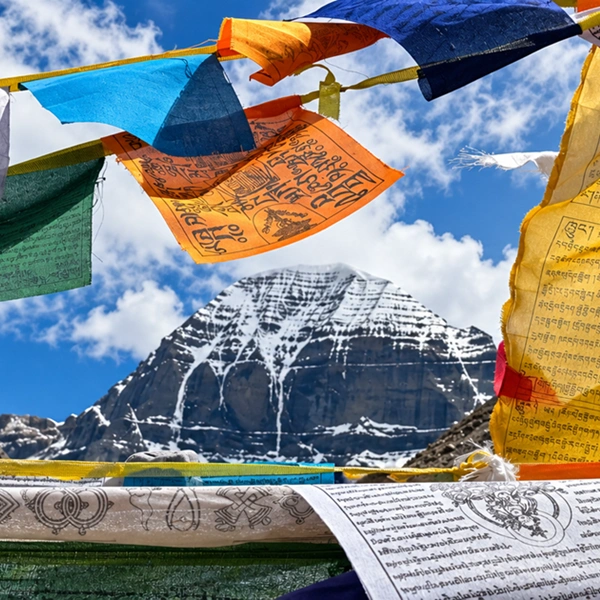
No structure was built upon it because the mountain — an ageless, perfect mass of rock and ice — is the supreme natural symbol of spiritual ascension. The eight steps are geological. The Crystal Palace is the mountain’s ice. The Adi Tirtha is the peak itself.
Modern Replicas: New York and Hastinapur
The Crystal Mountain in Queens, New York
When the Jain Center of America built its facility in Elmhurst, Queens, they constructed a miniaturized Ashtapad replica from 30 tons of raw crystal quartz, refined to 7.5 tons, supported by a 1.5-ton steel frame. It stands 13 feet tall with exactly eight foundational steps, five upper peaks, and 24 niches.
Each of the 24 Tirthankara idols is carved from a specific gemstone sourced from around the world: deep pink thulite from Norway, smoky quartz from Brazil, pink opal from Peru, and white onyx from Argentina. The building won the “Best Religious Building” award from the Queens Chamber of Commerce.
The irony is beautiful. King Bharat dreamed that Dharma would migrate to distant lands. Twenty-six centuries later, a crystal replica of his father’s palace stands in a New York borough, fulfilling the prophecy.
The 151-Foot Ashtapad in Hastinapur
In Hastinapur, Uttar Pradesh, a 151-foot Ashtapad Teerth took twenty years and Rs 25 crore to construct. Its outer surface features 1,503 individual ascetic idols — 501 on each of three levels — honoring the hermits Gautam Swami encountered on his descent from the original mountain. Four Rishabhdev idols face the four cardinal directions in a ground-floor Samavasaran.
Seeing Ashtapad on the Kailash Yatra
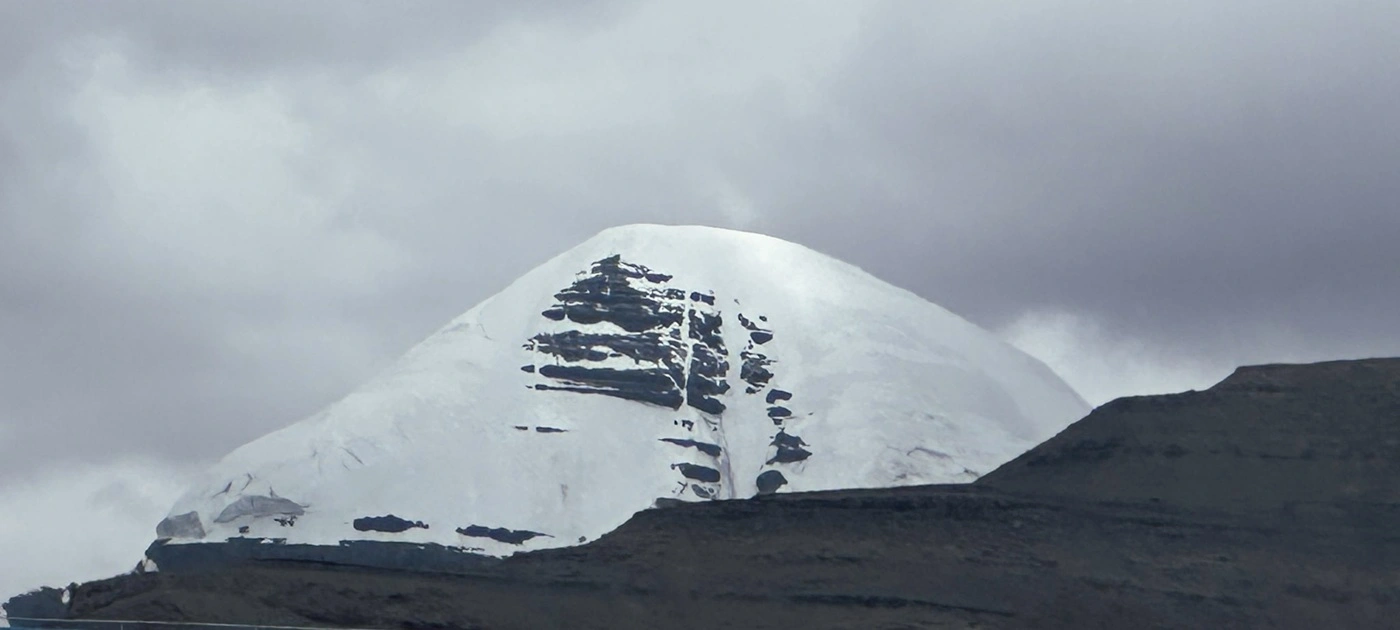
On the standard Outer Kora, the south face of Kailash — where the vertical Meru Danda cleft runs through the center — is visible from Yam Dwar at the start of the trek. This is the face associated with Ashtapad and the Jain tradition. Nandi Parvat, the rock formation resembling Shiva’s bull with its head raised toward the summit, is visible from the approach.
The Inner Kora route provides closer access to the Ashtapad-associated sites: Nandi Parvat, the Saptarishi Cave, and the 13 Golden Chortens. The Jain pilgrimage site of Ashtapad (identified with the area near the southern face) is directly visible from the Inner circuit. For Jain pilgrims specifically, the Inner Kora offers an experience that the Outer does not: proximity to the exact geography where Rishabhdev’s nirvana is believed to have occurred.
We build Jain-specific Kailash itineraries that include a dedicated south-face viewing stop at Yam Dwar, a lakeside puja at Mansarovar, and — for guests assessed as fit — the Inner Kora as an optional excursion that provides direct access to the Nandi Parvat and Ashtapad area. We arrange vegetarian meals throughout and can coordinate with Jain scholars for on-site spiritual guidance.
Frequently Asked Questions
What is Ashtapad?
Ashtapad (“eight steps”) is the Jain name for the mountain where Bhagwan Rishabhdev, the first Tirthankara, achieved nirvana — total liberation from the cycle of rebirth. It is located in the Kailash massif in western Tibet. The eight steps represent the eight categories of karma a soul must destroy to achieve liberation. It is the Adi Tirtha — the original, foundational pilgrimage site of Jainism.
Is Ashtapad the same as Mount Kailash?
In practical terms, yes. Ancient texts place Ashtapad adjacent to Kailash, roughly seven miles from Lake Mansarovar. Modern archaeological expeditions (2006-2009) found no separate structure. The accepted conclusion: the mountain itself is Ashtapad. Kailash, Ashtapad, Gang Rinpoche, and Yungdrung Gutseg are different names from different traditions for the same geographic formation.
What is the Sinha Nishadhya Prasad?
The crystal palace built on the summit of Ashtapad by King Bharat to commemorate his father Rishabhdev’s nirvana. Built from solid crystal and studded with gemstones. Four-sided with no rear wall. Contained 24 life-sized Tirthankara idols carved from specific precious stones. Guarded by iron sentinels (Loh Purush). No physical remnants have been found.
What are the eight steps?
The eight categories of karma in Jain metaphysics are Jnanavarana (knowledge-obscuring), Darshanavarana (perception-obscuring), Antaraya (obstacle-creating), Mohaniya (deluding), Nama (body-determining), Ayu (lifespan-determining), Gotra (status-determining), and Vedaniya (feeling-producing). Ascending all eight — destroying all eight karmic categories — achieves liberation.
What did the archaeological expeditions find?
Three expeditions (2006, 2007, 2009) funded by the Jain Center of America surveyed the Kailash region using satellite imagery, geological analysis, and on-ground archaeology. No remnants of the crystal palace, iron guards, or gemstone idols were found. The conclusion: Mount Kailash itself is the temple — a natural, enduring symbol of spiritual ascension.
Where is the modern Ashtapad replica?
Two major replicas exist. The Jain Center of America in Elmhurst, Queens, New York, houses a 7.5-ton crystal-quartz replica featuring 24 gemstone Tirthankara idols. In Hastinapur, Uttar Pradesh, a 151-foot Ashtapad Teerth with 1,503 ascetic idols took twenty years to construct. Both serve as modern pilgrimage sites.
Can I see Ashtapad on the standard Kailash Kora?
The south face of Kailash (associated with Ashtapad) is visible from Yam Dwar at the start of the Outer Kora. For closer access to the Nandi Parvat and Ashtapad-area sites, the Inner Kora route is required. We build Jain-specific itineraries that include dedicated south-face viewing and, for fit guests, the Inner Kora excursion.
How does the Jain Ravana story differ from the Hindu version?
In the Jain version, Ravana at Ashtapad is a devoted worshipper who slices his own arm to replace a broken veena string during his wife’s devotional dance. His selflessness earns him Tirthankar Nam-karma (future Tirthankara status). In the Hindu version, Ravana arrogantly tries to uproot Kailash. Shiva pins him with his toe. After a thousand years of suffering, Ravana composes the Shiva Tandava Stotram in submission.
Why is Ashtapad important for Jain pilgrims at Kailash?
Ashtapad is the Adi Tirtha — the first and supreme pilgrimage site. It ranks above Sammed Shikharji (20 Tirthankaras’ nirvana), Girnar (Neminath), and Pavapuri (Mahavira). For a Jain pilgrim, being at Kailash is not just about the Kora. It stands at the exact geographic location where the founder of the tradition achieved liberation.
Do you offer Jain-specific Kailash itineraries?
Yes. We build itineraries for Jain pilgrims that include south-facing viewing from Yam Dwar, Mansarovar lakeside puja, vegetarian meals throughout, and the Inner Kora for guests deemed fit. We can coordinate with Jain scholars for on-site guidance. The standard Outer Kora visits the Hindu and Buddhist sacred sites; the Jain-specific additions focus on the Ashtapad geography.
The Final Word
Most people who walk around Mount Kailash see a Hindu abode or a Buddhist mandala. They miss the oldest layer: the Jain one. The mountain is not just a place where a god lives. It is a place where a human has left. Rishabhdev climbed the eight steps, destroyed the eight karmas, and achieved what every soul in the universe is trying to achieve. His son built a crystal palace on the summit to mark the spot. Nobody has found it. The mountain has.
If you are a Jain pilgrim planning a Kailash Yatra, we will build the itinerary around Ashtapad — not around the Hindu or Buddhist framework. The south face. The Inner Kora. Nandi Parvat. The geography of liberation. Tell us your dates.
Planning a Jain pilgrimage to Kailash?
We build Jain-specific Kailash itineraries: south-face viewing, Mansarovar puja, vegetarian meals, and the Inner Kora for the Ashtapad geography.