The Luxury Day Tour That Deserves an Overnight
Why Bhaktapur Instead of Kathmandu
Three Durbar Squares exist in the Kathmandu Valley: Kathmandu, Patan, and Bhaktapur. Each was the royal seat of a competing Malla king. Kathmandu’s square is surrounded by traffic, shops, and modern chaos. Patan is hemmed in by urban development. Bhaktapur is hemmed by Bhaktapur — a pedestrianized medieval city where the architecture, the craft traditions, and the daily rhythms have survived in a way the other two have not.
The city charges a heritage entry fee of NPR 1,800 for foreign visitors (~$14). This fee funds preservation and limits casual day-trippers. The result: fewer crowds, cleaner streets, and an atmosphere that feels closer to the 15th century than to the 21st.
Durbar Square: The Architectural Core
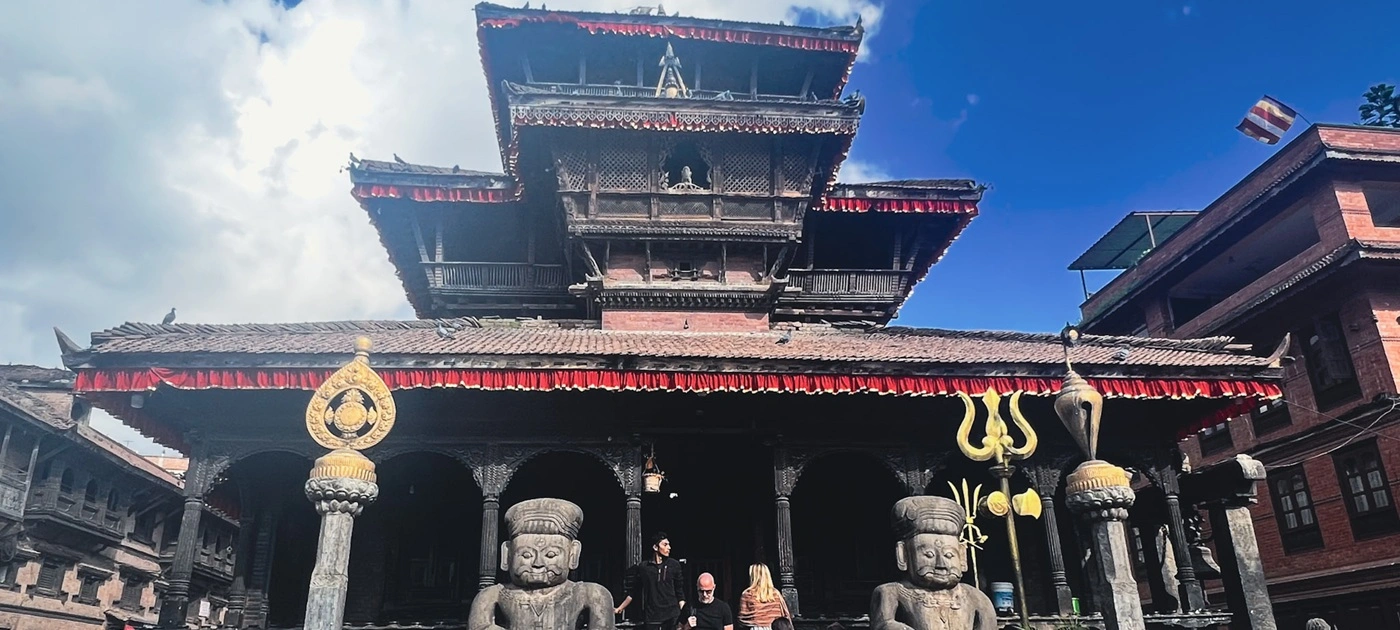
The Golden Gate (Sun Dhoka): considered the single finest piece of gilded metalwork in Nepal. A copper-and-gold-plated doorway depicting multi-armed Taleju Bhawani, surrounded by mythical creatures. It leads into the 55-Window Palace — the former Malla royal residence, its balconied facade a masterclass in Newari woodcarving with exactly 55 intricately carved windows.
The Vatsala Temple: a stone shikhara (Indian-style spire temple) in the square. Besides it, the Taleju Bell — rung historically by citizens seeking justice from the king. The square also contains the Big Bell, the Siddhi Lakshmi Temple with its stone guardians ascending the stairway (men, horses, elephants, lions, griffins, and goddesses in ascending pairs), and the stone replica of the original Chyasin Dega (Krishna Temple), destroyed in the 2015 earthquake and rebuilt using salvaged materials.
Taumadhi Square and the Five-Story Temple
A five-minute walk southeast from Durbar Square. Taumadhi is dominated by the Nyatapola Temple, Nepal's tallest pagoda temple. Five stories. 30 meters high. Built in 1702 by King Bhupatindra Malla. It has survived every earthquake in 300 years, including the devastating 7.8-magnitude Gorkha earthquake of 2015. The base stairway features five pairs of stone guardians, each ten times stronger than the pair below: wrestlers, elephants, lions, griffins, and goddesses Baghini and Singhini.
Across the square: the Bhairavnath Temple, dedicated to the fierce manifestation of Shiva. During Biska Jatra (Bhaktapur’s New Year festival in April), the chariot of Bhairav is pulled through these streets by hundreds of men — the most visceral display of collective physical devotion in the Kathmandu Valley.
The Living Craft: Pottery Square and Woodcarving
Pottery Square (Talako)
An open courtyard near the Dattatreya Temple where potters spin clay on wooden wheels by hand, exactly as their ancestors did. Rows of freshly formed pots, planters, and ritual vessels dry in the sun. You can sit and watch. You can try the wheel (children love this). The clay comes from local sources, and the firing is done in traditional ground kilns. No factory. No machine. No shortcut.
The Peacock Window
In the Dattatreya Square area, set into the wall of the Pujari Math (a 15th-century priest’s house): the Peacock Window. Widely considered the finest single piece of woodcarving in Nepal. An intricately carved peacock with a fully fanned tail, surrounded by floral and geometric patterns, all cut from a single piece of wood. It appears on Nepali postage stamps and tourism posters. Most tourists walk past it. A guide who knows the city will take you directly to it.
The Shilpakar Family — 14 Generations
In Bhaktapur, the Shilpakar family has been executing architectural woodcarving for 14 generations. Ancient chisels. Traditional techniques. The same methods were used to create the carvings on the valley’s UNESCO temples. We arrange private workshop visits where you watch them work and hear the lineage story. You can commission a piece — the historical resonance is not in the object alone but in the unbroken continuity of the hands that made it.
The Nanee: The Overnight That Changes the Experience
Eighteen rooms adjacent to Durbar Square. Vaastu Shastra-inspired architecture harmonizes the five elements. Contemporary design with local stone, terracotta, brass, and handwoven textiles. The rooms are good. The experiences are why you stay.
A Housewife’s Morning
A local Newari woman takes you through Bhaktapur’s hidden alleys for two hours. You visit the oil press, the beaten rice mill, and the makers of Juju Dhau — the King of Curd, Bhaktapur’s famous thick, sweet, creamy yoghurt traditionally set in clay pots. The tour ends at a Bara Shop, where you can enjoy hearty lentil breads (Bara), marinated, spiced meats (Chuya Lah), and the full Samay Baji platter. This is not a cooking class. It is the sourcing journey that precedes the cooking.
A Morning Life Walk
One hour of silent guided observation at dawn. Monks pouring holy water. Women drawing from ancient wells. Temple bells. The early farmers’ market where locals in traditional Haku Patashi trade goods. You walk. You watch. You do not speak. This is the experience that makes the overnight worthwhile — the city at the hour when it belongs to its people.
Baakha Kuthu and the Chef’s Table
The Storytelling Room. Local artisans and scholars share oral histories of Bhaktapur in the ancient tradition of Shruti Parampara. The Contemporary Newari Tasting Menu and Exotic Chef’s Table (6-10 courses) weave historical narratives into each dish. You consume the culture intellectually and gastronomically at the same table.
Juju Dhau: The King of Curd
Bhaktapur’s signature product. A thick, sweet, creamy yogurt set in unglazed clay pots that absorb excess moisture during fermentation. The clay is as important as the milk — the pot is part of the recipe. Juju Dhau has been produced in Bhaktapur for centuries using buffalo milk, sugar, and specific fermentation cultures passed between families. It is served at every Newari feast, every festival, and every celebration. It is not available in Kathmandu at this quality. You eat it here, or you do not eat it at all.
How to Visit
|
Format |
Time |
What You Get |
|
Half-day tour |
3-4 hours |
Durbar Square, Taumadhi Square, Pottery Square, Peacock Window. Private guide and vehicle from Kathmandu. Surface-level but covers the highlights. |
|
Full-day tour |
6-8 hours |
All of the above plus: Dattatreya Square, Shilpakar woodcarving workshop, Siddha Pokhari royal pond, Juju Dhau tasting, Bara Shop lunch. Unhurried pacing. |
|
Overnight at The Nanee |
24+ hours |
Everything above plus: A Morning Life Walk at dawn, A Housewife’s Morning sourcing tour, Baakha Kuthu storytelling, Chef’s Table dinner. The city before the tourists arrive and after they leave. |
Getting there: 40 minutes by private vehicle from central Kathmandu. 30 minutes from Tribhuvan Airport (Bhaktapur is east of the airport, making it an ideal first or last stop). Heritage entry fee: NPR 1,800 (~$14) for foreign visitors. The fee is valid for the duration of your stay if you register at the entry checkpoint.
OUR RECOMMENDATION
Stay overnight. The half-day tour is what every other operator offers. The overnight is what transforms Bhaktapur from a checklist item into a memory. The Morning Life Walk at dawn and the Housewife’s Morning sourcing tour are not available to day visitors. They require sleeping in the city. The Nanee has 18 rooms. Book early.
Frequently Asked Questions
How far is Bhaktapur from Kathmandu?
- 40 minutes by private vehicle. 30 minutes from Tribhuvan Airport. Bhaktapur is east of the airport, making it an ideal first or last stop on a Nepal itinerary.
Is a half-day enough?
- A half-day covers Durbar Square, Taumadhi, Pottery Square, and the Peacock Window. It is surface-level. A full day adds the woodcarving workshops, Juju Dhau tasting, and Bara Shop lunch. An overnight at The Nanee adds the dawn experiences that day visitors cannot access.
What is The Nanee?
- An 18-room boutique hotel adjacent to Bhaktapur Durbar Square. Vaastu Shastra-inspired design. The signature experiences are A Housewife’s Morning (sourcing tour through hidden alleys), A Morning Life Walk (silent dawn observation), Baakha Kuthu (storytelling room), and the Chef’s Table (6-10 course Contemporary Newari menu).
What is Juju Dhau?
- Bhaktapur’s King of Curd. Thick, sweet, creamy yogurt set in unglazed clay pots. Buffalo milk, sugar, and centuries-old fermentation cultures. The clay pot is part of the recipe — it absorbs excess moisture during fermentation. Not available at this quality outside Bhaktapur.
What is the Peacock Window?
- The finest single piece of woodcarving in Nepal. Set into the wall of the 15th-century Pujari Math in the Dattatreya Square area. An intricately carved peacock with a fully fanned tail, cut from a single piece of wood. Appears on Nepali postage stamps. Most tourists walk past it. A good guide takes you directly to it.
Can I watch woodcarving being done?
- Yes. The Shilpakar family in Bhaktapur has been carving for 14 generations. We arrange private workshop visits. You watch the process, hear the lineage story, and can commission a piece.
Is Bhaktapur accessible for seniors and families?
- Yes. The city is pedestrianized and mostly flat within the old town. Some cobblestone streets are uneven. The Durbar Square area is fully walkable. Pottery Square is interactive for children. No altitude risk (1,400m, same as Kathmandu).
What festivals happen in Bhaktapur?
- Biska Jatra (New Year, April): the chariot of Bhairav pulled through the streets. Gai Jatra (August): eight-day Ghintang Ghisi stick dance and Taha-Macha processions. Dashain (October): the city’s temples are at their most decorated. We time Bhaktapur visits to coincide with festivals whenever the calendar allows.
Is there an entry fee?
- NPR 1,800 (~$14) for foreign visitors. Valid for the duration of your stay if you register at the entry checkpoint. The fee funds heritage preservation and limits casual traffic, keeping the city quieter and cleaner than Kathmandu’s Durbar Square.
How does Bhaktapur compare to Patan?
- Bhaktapur is larger, more pedestrianized, and more immersive — a full medieval city, not just a square. Patan is the metalwork and bronze capital. Both are essential. Bhaktapur for the living Newari experience (pottery, woodcarving, food culture). Patan for the artisan workshops (bronze, singing bowls, Thangka). We include both in our Kathmandu Valley cultural program.
The Final Word
Bhaktapur is what Kathmandu would look like if nobody had built over it. Brick alleys. Pagoda temples. Potters on wooden wheels. A five-story temple that has outlasted every earthquake for 300 years.
A yogurt that can only be made in the clay of this city. And at dawn, before the tourists arrive, a woman in traditional dress takes you through the alleys to show you where the oil is pressed, where the rice is beaten, and where the King of Curd is set in its clay pot.
Three hours is a tour. Twenty-four hours is an immersion. Stay overnight. The city deserves it.
Including Bhaktapur in your Kathmandu program?
Half-day, full-day, or overnight at The Nanee. We build around how deep you want to go.