Fagu Purnima: Nepal’s Festival of Colors, the Chir, and the Two-Day Split
Visitors who arrive during Fagu Purnima and assume they are seeing “Nepalese Holi” are seeing only part of the picture. The color-play is shared with India. Everything else is different. The Chir pole tradition is uniquely Nepali. The two-day geographical split exists nowhere else. The Newari tantric interpretation of the pole as a fertility symbol is indigenous. The Newari feast (Bhoj) that follows the colors is a culinary architecture with no Indian equivalent. The endangered Jogira folk songs of the Terai plains are a musical tradition on the edge of extinction.
At Alpine Luxury Treks, our team celebrates Fagu Purnima with our own families across the Kathmandu Valley. This guide draws on that lived experience and on the cultural depth our Newari team members bring to the traditions that happen behind the public color-play.
In This Guide
- The mythology: Prahlad, Krishna, and the sanctioned subversion
- The Chir tradition: a 32-foot pole with three meanings
- The two-day geographical split
- Nepal vs India: what makes Fagu Purnima different
- The Newari Bhoj feast
- The music: Jogira, Thumri, and Resham Firiri
- Conversation
- How to experience Fagu Purnima as a visitor
- Frequently asked questions
Mythology: Three Stories, Three Layers
Prahlad and Holika: Faith Survives Fire
The demon king Hiranyakashipu conquered the three worlds and demanded universal worship. His son Prahlad refused, remaining devoted to Lord Vishnu. When direct execution failed, the king enlisted his sister Holika, who possessed divine immunity to fire. She lured Prahlad onto her lap and ordered a pyre lit around them. But the immunity carried a condition: it would be revoked if used for malice. Holika burned. Prahlad survived. The bonfire lit on the eve of Fagu Purnima (Holika Dahan) commemorates this: faith survives fire; arrogance does not.
Krishna and Radha: Why We Throw Color
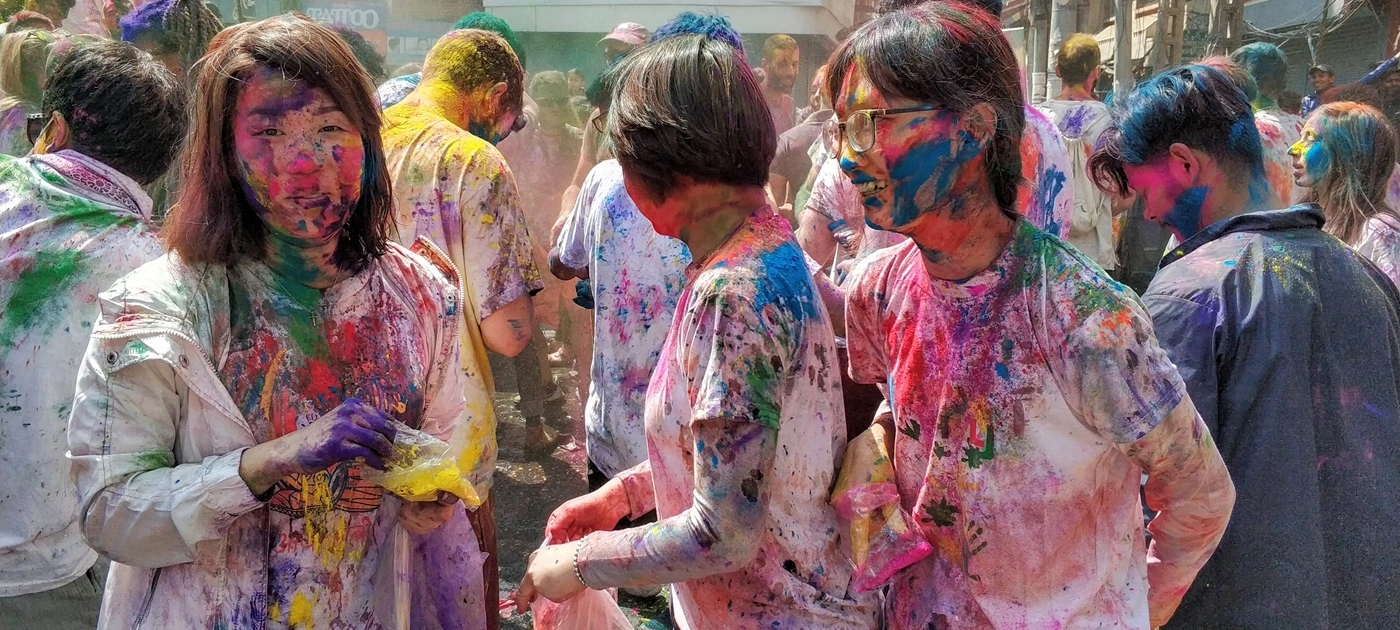
The dark-skinned Krishna, playfully jealous of Radha’s fair complexion, applied color to her face. The tradition of smearing coloured powder (abir) and splashing water traces directly to this divine romance. The color-play parallels the biological blossoming of spring: the human world mirrors what the flowers are already doing.
The Ogress Dhundhi: Why Bad Behavior Is Permitted
A third, lesser-known myth explains why Fagu Purnima tolerates behavior that would be unacceptable on any other day. The ogress Dhundhi, who devoured children, could only be repelled by the collective violation of social norms — shouting, rudeness, obscenity, chaos. The myth provides theological permission for the temporary suspension of decorum. It is the festival’s built-in pressure valve: one day a year, the social hierarchy is deliberately inverted.
The Chir Tradition: A 32-Foot Pole with Three Meanings
Eight days before the color-play, the festival begins. At Basantapur Durbar Square, a 32-foot bamboo pole — the Chir — is erected at a time calculated by the Nepal Calendar Determination Committee. The Manandhar sub-caste of the Newari community leads the installation. A gun salute from the Gurju Paltan announces the festival’s arrival.
Meaning 1: Krishna’s Theft
The strips of coloured cloth draped on the pole represent the garments Krishna stole from the Gopis (cowherd maidens) while they bathed in the Yamuna River and hung in a Kadamba tree. The theological purpose: by forcing the Gopis to emerge unclothed, Krishna destroyed their bodily shame — the last barrier preventing their souls from achieving divine realization. The Chir recreates that tree.
Meaning 2: The Three Worlds
The pole has three distinct umbrella-like tiers. They represent the three worlds of Hindu cosmology: Swarga (heaven), Prithivi (earth), and Paatal (the underworld). The Chir is a vertical cosmological map standing in the center of a medieval palace square.
Meaning 3: Tantric Fertility (Bhaktapur)
In Bhaktapur’s Newari tradition, the pole carries explicit tantric significance. The wooden lingam is Bhimsen's phallus (the Mahabharata hero worshipped as a symbol of male power). A red cloth symbol of Draupadi is attached. The installation — Chir Swayegu — simulates divine sexual intercourse to provoke a flood of creative energy for the spring harvest. The Chir stands at the intersection of classical Hindu mythology, Malla-era statecraft, and indigenous tantric fertility cults.
THE CHIR HARAN: HOW IT ENDS
On the full-moon evening, the Chir is brought down (Chir Haran). In some communities, it is burned, directly symbolizing Holika’s death. In Kathmandu, it is carried in procession to the Bagmati River for immersion — within sight of the cremation fires at Pashupatinath. The vibrant colors of the festival and the solemn flames of the funeral pyres burn simultaneously on the same riverbank. Ashes from the burnt Chir are considered highly auspicious: senior citizens apply them as a tika for protection against evil spirits.
The Two-Day Geographical Split
Nepal is the only country that officially splits its festival of colors across two consecutive days based on geography.
|
|
Day 1: Hills
|
Day 2: Terai
|
|
Region
|
Kathmandu Valley, Pokhara, hill districts
|
Biratnagar, Birgunj, Janakpur, southern plains
|
|
Public holiday
|
Government offices in the hills closed
|
Government offices in Terai closed
|
|
Character
|
Urban street parties, water balloons, DJ concerts, and Durbar Square gatherings
|
Community-based, Holika Dahan on eve, family visits, Jogira folk songs, mud-play in the far west
|
|
Why this day
|
Full moon day (Purnima) of Phagun
|
Day after the full moon: Holika Dahan must occur on the night of Purnima; colors follow the next morning. Also, the 15-day Mithila Parikrama concludes on the full moon.
|
The Terai delay is not logistical. It is theological and historical. In the Terai, celebrating victory before the battle (Holika Dahan) would be spiritually inappropriate. And in the eastern Terai, thousands of devotees are completing the 15-day Mithila Parikrama — a religious circumambulation tracing the paths of Rama and Sita across the Mithila belt — which concludes precisely on the full moon. The color celebration happens the morning after their journey ends.
Nepal vs India: What Makes Fagu Purnima Different
|
Feature
|
Nepal (Fagu Purnima)
|
India (Holi)
|
|
Initiation
|
The pole was erected 8 days early. Unique to Nepal.
|
No Chir tradition. Begins with Holika Dahan.
|
|
Schedule
|
Two-day split: hills Day 1, Terai Day 2. Hills celebrate one day before India.
|
Unified national celebration.
|
|
Water balloons
|
Heavy ‘Lola’ culture: water balloons thrown for an entire week before the main day.
|
Focus on dry powder (gulal) and water guns (pichkaris).
|
|
Tantric layer
|
Bhaktapur Chir carries explicit Tantric fertility symbolism.
|
No equivalent Tantric tradition.
|
|
Feast
|
Newari Bhoj: multi-course ritual feast with Samay Baji, Chhwela, Juju Dhau.
|
Gujiya, Thandai, and family meals. No equivalent communal feast architecture.
|
|
Mountain setting
|
Pokhara: colors against white Himalayan peaks.
|
Celebrated on plains (Mathura, Jaipur).
|
The Newari Bhoj: The Feast That Follows the Colors
After the colors, the Newari community sits down. Cross-legged on woven straw mats. Shoulder to shoulder. Strangers become friends through food. The Newari Bhoj is not a meal. It is a multi-course ritual with a strict serving sequence.
First wave: Chiura (beaten rice) as the carbohydrate base. Haku Musya (roasted black soybeans in mustard oil). Pickled beans. Spiced potato salad. Raw ginger and garlic as palate cleansers. Second wave: Bara (savory lentil pancakes) and Chatamari (crispy rice-flour crepe, sometimes called “Newari pizza”). Third wave — the climax: Chhwela (boiled, spiced, barbecued buffalo meat in mustard oil). Fried fish.
Deep-fried boiled egg. Fourth wave — sweet and drink: Juju Dhau (the King of Yogurts, a rich custard-like curd from Bhaktapur). Yomari (steamed rice-flour dumplings with molasses). And Ayla — traditional Newari rice wine, poured from elevated brass jugs in an unbroken stream into small clay bowls.
The Samay Baji is engineered for festival conditions: beaten rice doesn’t spoil, dried beans travel, smoked meats keep. It is the food of a merchant and farming society that learned how to feast during harvest without refrigeration. We arrange Newari Bhoj experiences for guests during the Fagu Purnima period.
The Music: What You Will Hear
In the Terai: The Endangered Jogira
The Jogira is the soul of Terai Holi: fast-paced folk songs in Maithili and Bhojpuri driven by the Dholak drum. The Jogiraa — often intoxicated on Bhang — dances from village to village, spreading love and biting social satire. Historically, accompanying Natuva dancers cross-dressed to play both genders. Cultural anthropologists warn that the tradition is nearing extinction: Youth migration to the Gulf, electronic DJ setups replacing acoustic instruments, and the breakdown of intergenerational knowledge transfer.
In the Hills: Classical to Cinematic
Classical Hori Thumris (semi-classical compositions in ragas like Khamaaj and Kaafi detailing Radha-Krishna’s romantic color-play) coexist with Resham Firiri — Nepal’s most universally recognized folk song, first recorded in 1970 with Sarangi, Madal, and Basuri. Modern street celebrations are soundtracked by Nepali cinema anthems. The generational friction is real: the Dholak vs the DJ, the Thumri vs the electronic bass drop.
The Consent Conversation
This section exists because honesty requires it. Fagu Purnima’s “Lola” culture — water balloons thrown from rooftops and moving vehicles for an entire week before the main day — has a documented dark side. For many women in Nepal, the approach of the festival produces anxiety rather than joy.
The cultural guise of celebration is manipulated to bypass consent: unwanted physical contact, forceful application of colors on unconsenting individuals, and, in severe cases, harassment and assault. The U.S. Embassy in Nepal routinely issues explicit security alerts for the festival.
A growing movement among Nepali Youth advocates for consent-driven celebration. Many women withdraw from public festivities entirely. The theological core of Fagu Purnima — the triumph of good over malice, the protection of the innocent — is fundamentally contradicted when the festival itself becomes the vehicle for violating personal autonomy.
We brief every guest on Fagu Purnima etiquette in advance. We arrange private rooftop celebrations at partner properties where guests can participate in the color-play in a controlled, consensual environment. For guests who want the street experience, our guides position you in safer zones (Durbar Square, curated hotel courtyards) and accompany you throughout. Wear clothes you do not mind destroying. Protect camera gear with waterproof covers. Apply coconut oil to skin and hair before the colors — it makes the pigment easier to wash out. And if anyone applies color without your consent, your guide will intervene.
How to Experience Fagu Purnima as a Visitor
2026 Dates
Hills (Kathmandu, Pokhara): March 14, 2026. Terai (Janakpur, Birgunj, Biratnagar): March 15, 2026. The Chir is erected at Basantapur eight days before, approximately March 6.
Where to Be
Basantapur Durbar Square for the Chir erection (March 6) and the street celebration (March 14). Thamel for the chaotic, backpacker-heavy street party. Pokhara Lakeside for the most photogenic setting — colors against the Annapurna range. For a Newari Bhoj, we arrange feasts in traditional courtyards in Patan or Bhaktapur.
What to Wear
White. The colors show best on white clothing. Wear items you will never wear again — the synthetic dyes stain permanently. Protect your phone in a waterproof pouch. Apply coconut oil to all exposed skin and hair before going outside. Wear sunglasses — colored powder in the eyes stings badly.
Frequently Asked Questions
What is Fagu Purnima?
Fagu Purnima is Nepal’s festival of colors, celebrating the triumph of faith over arrogance (the Prahlad-Holika myth) and the romantic color-play of Krishna and Radha. It marks the transition from winter to spring. It is distinct from Indian Holi through the Chir pole tradition, the two-day geographical split, the Newari tantric interpretations, and the Bhoj feast culture.
When is Fagu Purnima in 2026?
March 14 (hills: Kathmandu, Pokhara) and March 15 (Terai: Janakpur, Birgunj). The Chir pole is erected on or around March 6 at Basantapur. The festival follows the full moon of the Nepali month of Phagun.
What is the Chir?
A 32-foot bamboo pole was erected at Basantapur Durbar Square eight days before the main celebration. It is draped in coloured cloths representing the garments Krishna stole from the Gopis. Its three tiers represent heaven, earth, and the underworld. In Bhaktapur, the pole carries tantric fertility symbolism. It is brought down (Chir Haran) on the full-moon evening and either burned or immersed in the Bagmati River.
Why does Nepal celebrate on two different days?
The hills celebrate on the full moon (Purnima). The Terai celebrates the following day because: (1) Holika Dahan must occur on the night of the full moon, and celebrating victory before the battle is theologically inappropriate; (2) the 15-day Mithila Parikrama concludes exactly on the full moon, and the color celebration follows the next morning.
Is Fagu Purnima the same as Holi in India?
The mythology and the color-play are shared. Everything else differs. Nepal has the Chir pole tradition, the two-day geographical split, the Newari tantric fertility interpretation, the Bhoj feast, and the Lola (water balloon) culture that begins a week before the main day. Nepal’s hill celebration occurs one day before India’s primary date.
What is the Newari Bhoj?
A multi-course Newari feast is served after the colors. Guests sit cross-legged on straw mats. The centerpiece is Samay Baji: beaten rice, roasted soybeans, spiced potato, Bara (lentil pancakes), Chhwela (barbecued buffalo meat), Juju Dhau (the King of Yogurts from Bhaktapur), and Ayla (rice wine poured from brass jugs). We arrange Bhoj experiences in the courtyards of Patan and Bhaktapur.
What is the Jogira tradition?
Jogira are fast-paced folk songs in Maithili and Bhojpuri sung during Holi in the Terai, driven by the Dholak drum. The Jogiraa dances village to village, spreading social satire and love. The tradition is endangered: Youth migration, electronic music, and the breakdown of intergenerational transfer are replacing it.
Is it safe for women?
The Lola (water balloon) culture and the crowd dynamics during Fagu Purnima have a documented dark side involving unwanted physical contact and harassment. The U.S. Embassy issues annual security alerts. We brief every guest, arrange private or controlled celebration environments, and provide guide accompaniment throughout. The consent conversation is active and growing in Nepal.
What should I wear?
White clothing you will never wear again — synthetic dyes stain permanently. Waterproof phone pouch. Sunglasses (color powder stings). Apply coconut oil to skin and hair before going out — it prevents the pigment from bonding. Carry minimal valuables.
Can I combine Fagu Purnima with other experiences in Nepal?
Yes. Fagu Purnima (March 14) falls at the start of the spring trekking season. A common framework: attend the festival in Kathmandu or Pokhara, then begin a spring trek (Annapurna, Langtang, or the Khumbu for Mani Rimdu at Thame in May). The festival also naturally pairs well with Kathmandu Valley cultural touring, a Chitwan safari, or a Bhutan extension via Paro.
The Final Word
Fagu Purnima is not a copy of Indian Holi with mountains in the background. It is a Nepali festival with its own architecture (the Chir), its own feast (the Bhoj), its own music (the Jogira), its own tantric undercurrent (the fertility pole in Bhaktapur), and its own structural logic (the two-day split). The colors are on the surface. Underneath is a week-long sequence of mythology, cosmology, and community engineering that begins with a gun salute at a medieval palace and ends with a bamboo pole burning on the same riverbank where the cremation fires never stop.
If you are in Nepal in mid-March, this is the festival that puts color on your skin and a Newari feast in your stomach. We will tell you when the Chir goes up, where the safest and most beautiful color-play happens, and which courtyard serves the best Juju Dhau.
Planning a trip during Fagu Purnima?
Tell us your March dates. We will time your arrival to the Chir erection, arrange safe color-play, and book a Newari Bhoj in a traditional courtyard.