Guide to Kathmandu’s Self-Arising Stupa
In This Guide
- The creation myth: the lake, the sword, and the lotus
- The architecture: every element decoded
- The 13 tiers: the stages from consciousness to Buddhahood
- The Panchapur: five elemental shrines protecting the flame
- Shantipur: the tantric master in suspended animation
- The syncretism: Hariti, the reformed demoness
- The festivals: Gunla and the 12-year Samyak Mahadan
- The 2015 earthquake and restoration
- Visiting Swayambhunath
The Creation Myth: The Lake, the Sword, and the Lotus
The Swayambhu Purana records it. During the Satya Yuga, the Kathmandu Valley was a massive, silent lake called Kalihrada, guarded by serpent deities (Nagas). At the center of the water, a self-created eternal flame manifested on a thousand-petalled lotus. This flame — the jyotirupa — was the physical manifestation of the primordial Buddha principle. Seven Buddhas of the Past traveled across cosmic ages to pay homage to it.
The Bodhisattva Manjushri, residing at Mount Wutai in China, received a vision of the flame. He crossed the Himalayas riding a blue lion, accompanied by his tantric consorts. At the southern rim of the mountains, he struck a single blow with his flaming Chandrahasa sword, cleaving the rock at Chobhar Gorge. The lake drained. The lotus settled on a rocky hill. That hill is Swayambhunath.
The displaced Nagas needed a home. Manjushri carved a basin southwest of Chobhar: the lake of Taudaha, where the Naga King Karkotaka still resides. He founded the first human settlement, Manjupattana, at the confluence of the Bagmati and Vishnumati rivers. And the monkeys? Manjushri neglected his tonsure during meditation.
His hair grew long. It was infested with lice. The lice transformed into the rhesus macaques that inhabit the northwestern slopes today. Because they originated from the body of the Bodhisattva of Wisdom, they are holy.
The Architecture: Every Element Decoded
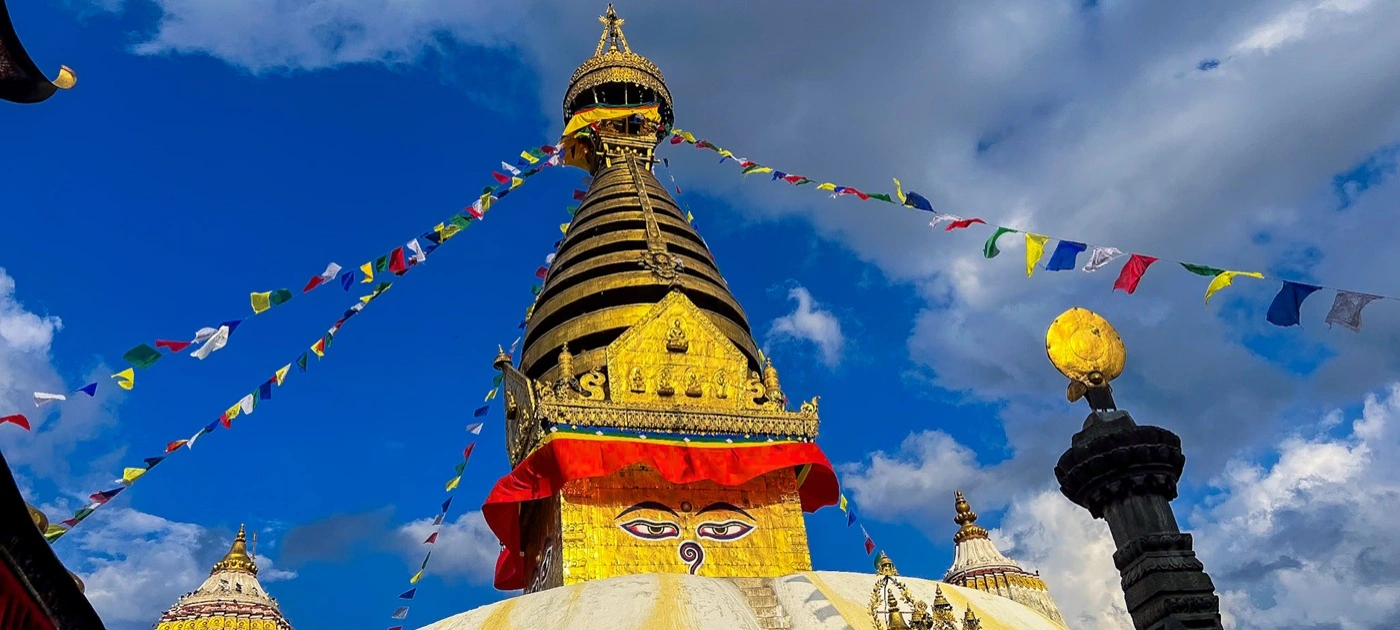
The stupa is 82 feet tall. It is the body of the Buddha rendered in architectural form. Every structural element maps to a metaphysical concept.
The Dome (Kumbha)
The massive white hemisphere at the base. 28 feet high. Represents the earth element and the infinite womb of creation. Hidden inside: the original rocky hilltop, protruding 11 feet above ground — the autochthonous site of the eternal flame. The dome is not built on the hill. It is built around it.
The Yashti (Life Tree)
A solid hardwood pole pierces the center of the dome, extending 72 feet vertically. Nearly 40 feet rise above the harmika. In the Tibetan tradition, the sok shing, the life tree, channels cosmic energy from heaven into earth. The structural and spiritual spine of the entire monument.
The Harmika and the All-Seeing Eyes
The cuboid tower above the dome. 16.5 feet high. Faces the four cardinal directions. Painted on all four faces: the Buddha Eyes — the omniscient, compassionate gaze watching over the valley. The right eye is the sun. The left eye is the moon. Between them: not a nose, but the Nepali numeral “ek” (१) — the number one. It represents the singular ultimate truth that all spiritual paths converge upon. Above it: a third eye, the urna, emanating the light that cuts through ignorance.
The 365 Steps
The eastern stairway, commissioned by King Pratap Malla in the 17th century. Exactly 365 steps. One for each day of the solar year. The physical exertion of climbing is the somatic metaphor: daily, continuous effort is the price of spiritual ascent. At the top: a massive gold-plated brass Vajra (thunderbolt) on a gilt copper base representing the Dharmadhatu mandala of Manjushri. The threshold between the arduous climb and the sacred space.
The 13 Tiers: The Stages from Consciousness to Buddhahood
The golden spire above the harmika consists of thirteen diminishing gilded copper rings. They are not decorative. They are the thirteen bhumis — the stages of spiritual ascent a bodhisattva must master to achieve Buddhahood. The first ten come from the classical sutra tradition. The final three come from the esoteric Vajrayana tantra.
|
#
|
Bhumi
|
What It Means
|
|
1
|
Pramudita (Joyous)
|
Realization of emptiness. Joy at entering the path of the Noble Ones.
|
|
2
|
Vimala (Stainless)
|
Complete purification of moral discipline. Freedom from all ethical defilements.
|
|
3
|
Prabhakari (Luminous)
|
Radiating the light of Dharma. Conquering anger through infinite patience.
|
|
4
|
Archishmati (Radiant)
|
Burning away afflictions through intense, joyful effort.
|
|
5
|
Sudurjaya (Hard to Conquer)
|
Mastery of meditative concentration. Defeating inner mental demons.
|
|
6
|
Abhimukhi (Manifest)
|
Direct realization of dependent origination. Perfection of transcendent wisdom.
|
|
7
|
Durangama (Far-Reaching)
|
Perfecting skillful means. Acting effortlessly to aid beings across time and space.
|
|
8
|
Achala (Immovable)
|
Irreversible. Action without conceptual effort. Firmly rooted in truth.
|
|
9
|
Sadhumati (Good Intelligence)
|
Four analytical knowledges. Faultless communication of Dharma to all beings.
|
|
10
|
Dharmamegha (Cloud of Dharma)
|
Showering teachings on all beings impartially, as a cloud nourishes the earth.
|
|
11
|
Universal Radiance
|
Complete illumination across all dimensions. Transcending the sutra stages.
|
|
12
|
Lotus of Non-Attachment
|
Existing within suffering to aid beings while remaining unpolluted. Like a lotus in mud.
|
|
13
|
Vajradhara (Vajra Holder)
|
Supreme Buddhahood. The ultimate state of Enlightenment.
|
Crowning the spire: the gajur (finial) with a parasol displaying a treasure-filled bowl. The apex. The absolute sovereignty of the Dharma over the terrestrial realm. The architectural map is complete: earth (dome), human aspiration (harmika with eyes), spiritual ascent (13 tiers), and ultimate liberation (finial).
The Panchapur: Five Elemental Shrines
The tantric master Shantikar Acharya (formerly King Prachandadev) concealed the original eternal flame beneath the stupa and established five shrines to bind and balance the five elements. They form an energetic ward protecting the site against natural disasters.
|
Shrine
|
Element
|
Function
|
|
Vasupur
|
Earth
|
Temple of Bashundhara. Grounding, fertile forces.
|
|
Agnipur
|
Fire
|
Northwest of the stupa. Red face of Agni Bhairava. Wisdom and transformative energy.
|
|
Vayupur
|
Air
|
Southwest entry. Green. The breath of life. Transforms jealousy into accomplishment.
|
|
Nagpur
|
Water
|
North, before Amoghasiddhi Buddha. Rectangular pit housing the serpent king. Love and life-giving waters.
|
|
Shantipur
|
Ether/Sky
|
Northwest. Subterranean. The most sacred and restricted shrine in Newar Buddhism. 27 secret chambers.
|
Shantipur: The Tantric Master in Suspended Animation
Of the five shrines, Shantipur commands the most reverence and fear. An inconspicuous brick structure on the northern slope, it is the entrance to 27 underground chambers believed to connect to the stupa's hidden core. Shantikar Acharya is believed to still reside in the deepest chamber, in suspended animation, serving as an eternal guardian who can manipulate weather and avert catastrophe.
In 1658, during a devastating drought, King Pratap Malla descended into Shantipur. He navigated spectral obstacles through 27 chambers until he found the emaciated figure of Shantikar Acharya in eternal meditation. The master gave him a mandala inscribed with serpent blood. Upon bringing it to the surface and presenting it to the sky, torrential rains ended the drought immediately.
The vestibule murals depicting the Swayambhu Purana were severely damaged in the 2015 earthquake. UNESCO and the Department of Archaeology detached, stabilized, and relocated the remaining 1904-era paintings to the National Museum using synthetic resins while the shrine undergoes structural retrofitting.
Hariti: The Reformed Demoness
Northwest of the dome: the two-tiered pagoda of Hariti Devi, known locally as Ajima. She was originally a demoness who devoured children and spread smallpox. The Buddha hid her favourite son beneath his alms bowl. Frantic with grief, she sought the Buddha’s help. He asked her to compare her pain over one missing child to the grief of every mother whose children she had lost. She accepted the Dharma, renounced her predatory nature, and became the protector of all children.
She vowed to sustain herself on pomegranates (which, in Tantric symbolism, resemble human flesh) rather than on human children. Today, mothers of all faiths worship her for the protection and healing of their children. Devotees offer prayers, incense, and small clay figurines. This is institutional Buddhism at its most elegant: a local terror pacified, elevated, and made useful.
The Festivals: Gunla and the 12-Year Samyak Mahadan
Gunla: The Month of Merits
The ninth month of the lunar Nepal Sambat calendar (July-August). Thousands walk to Swayambhunath before dawn daily for a month. Gunla Bajan music fills the air: Dha drums and Meku buffalo-horn instruments, originally devised to awaken a sleeping Buddha. Devotees mould miniature stupas from black clay (Dyah Thayegu), offer almsgiving (Panchadan), and display rare ancient paubha scroll paintings (Bahidyah Bwayegu).
Samyak Mahadan: Every 12 Years
The largest almsgiving ceremony in Newar Buddhism. Hundreds of life-sized Dipankara Buddha statues are assembled from local courtyards. Massive wealth redistribution: grain, sweets, and currency were offered to priests, deities, and the poor. The Kathmandu iteration occurs only once every twelve years at Bhuikhel grounds beneath Swayambhunath. The tradition traces to Nepal Sambat 135 (1015 AD).
The 2015 Earthquake and Restoration
The April 2015 Gorkha Earthquake (7.8 magnitude) severely damaged the peripheral structures, historical monasteries, and smaller chaityas. The main dome — re-gilded in 2010 with 20 kilograms of gold, funded by the Tibetan Nyingma Meditation Center of California — largely survived.
The Pratappur and Anantapur twin temples (commissioned by Pratap Malla and damaged by earlier lightning strikes) were fully restored by the Department of Archaeology. Shantipur’s murals were rescued in an emergency by UNESCO conservators. Long-term reconstruction continues into 2026.
Visiting Swayambhunath
Open daily from dawn to dusk. Entrance fee for foreign visitors: NPR 200. The eastern stairway (365 steps) is the traditional approach. A vehicle road from the west provides access for those who cannot climb. Circumambulate clockwise. Spin the prayer wheels clockwise. Remove shoes and hats inside temples. Do not touch the monkeys — they bite.
Best times: early morning (before 7 AM for fewer crowds and golden light on the stupa) or sunset (the valley lights up below). During Saga Dawa (May-June) and Gunla (July-August), the site is at its most spiritually active. We include Swayambhunath in every Kathmandu Valley cultural itinerary and use the 5-day Tibet visa processing buffer to schedule guided visits with architectural context.
THE CIRCUMAMBULATION PRACTICE
Walk clockwise. Keep the stupa on your right. Spin every prayer wheel as you pass. Recite a mantra (Om Mani Padme Hum or the Vajrasattva purification mantra). Completing 13 full circuits is considered highly auspicious — directly correlating to mastery of the 13 bhumis on the spire. Our guides walk the first circuit with guests, explaining each architectural element.
Frequently Asked Questions
Why is it called the Monkey Temple?
According to the Swayambhu Purana, when the Bodhisattva Manjushri raised the hill to secure the sacred lotus, he neglected his tonsure during meditation. Lice infested his hair. The lice transformed into rhesus macaques. Because they originated from the body of the Bodhisattva of Wisdom, the monkeys are considered holy. They inhabit the northwestern slopes today.
What does Swayambhunath mean?
Swayambhu means “self-arising” or “self-sprung” in Sanskrit. It refers to the eternal flame (jyotirupa) that spontaneously manifested on a lotus in the primordial lake that once filled the Kathmandu Valley. The stupa was built to enshrine this self-created phenomenon.
What do the eyes on the stupa represent?
The All-Seeing Eyes painted on all four faces of the harmika represent the Buddha’s omniscient, compassionate gaze. The right eye is the sun. The left eye is the moon. Between them: the Nepali numeral “ek” (one) — the singular truth. Above: a third eye (urna) representing penetrating insight.
What are the 13 tiers on the golden spire?
The thirteen bhumis — the stages of spiritual ascent from initial joy at entering the path (Pramudita) to supreme Buddhahood (Vajradhara). The first ten come from the classical sutra tradition. The final three come from the esoteric Vajrayana tantra. The spire is a vertical map of the entire Buddhist path to Enlightenment.
What is Shantipur?
The most sacred and restricted shrine in Newar Buddhism. An inconspicuous brick structure on the northern slope with 27 underground chambers. The tantric master Shantikar Acharya is believed to still reside in the deepest chamber in suspended animation, guarding the stupa’s eternal flame. In 1658, King Pratap Malla descended to the 27th chamber during a drought and received a rain-summoning mandala.
What is the Panchapur?
Five elemental shrines (Earth, Fire, Air, Water, Ether) were established by Shantikar Acharya to bind and balance the five elements of the universe. They form a protective energetic ward around the stupa: Vasupur (Earth), Agnipur (Fire), Vayupur (Air), Nagpur (Water), and Shantipur (Ether/Sky).
Who is Hariti?
A former demoness who devoured children. The Buddha hid her son to teach her empathy. She accepted the Dharma and became the supreme protector of children. Her pagoda temple at Swayambhunath is worshipped by mothers of all faiths. She sustains herself on pomegranates instead of human flesh.
Was Swayambhunath damaged in the 2015 earthquake?
The main dome survived largely intact (it had been re-gilded with 20 kg of gold in 2010). The surrounding structures, monasteries, and smaller chaityas were severely damaged. The Pratappur and Anantapur temples have been fully restored. Shantipur’s murals were emergency-rescued. Restoration continues into 2026.
How many steps are there?
365 steps on the eastern stairway, commissioned by King Pratap Malla in the 17th century. One for each day of the solar year. A vehicle road from the west provides access for those who cannot climb.
When is the best time to visit?
Early morning (before 7 AM) for golden light and fewer crowds. Sunset for valley views. During Saga Dawa (May-June) and Gunla (July-August) for peak spiritual activity. We include Swayambhunath in every Kathmandu Valley cultural itinerary.
The Final Word
The Kathmandu Valley was a lake. A bodhisattva drained it. A flame settled on a hill. Someone built a stupa with eyes that see in four directions, a spire with thirteen steps to Enlightenment, and a secret underground chamber where a tantric master has been sitting in suspended animation for a thousand years, guarding the flame that started everything. Below the stupa, mothers pray to a reformed demoness for the protection of their children.
On the steps, monkeys descended from the lice of a bodhisattva steal tourists’ sunglasses. And every morning before dawn, for an entire month each year, thousands climb 365 steps in the dark to accumulate merit at a structure that is, in its own reckoning, the physical body of the Buddha.
Nothing about Swayambhunath is decorative. Everything means something. Climb the steps. We will explain what you are looking at.
Including Swayambhunath in your Kathmandu itinerary?
We schedule guided visits with full architectural context. Early morning for the light. Sunset for the valley views. Always with the story.