How to train for the Kailash Yatra comes down to twelve focused weeks: an aerobic base, then weighted hill work, then long back-to-back trek days, tapering before departure. Fitness won't stop altitude sickness, but it builds the reserve that carries you over the Dolma La — and the descent, not the climb, is what most pilgrims undertrain. Here is the full plan.
How to Train for the Kailash Yatra: A 12-Week Preparation Guide

How to train for the Kailash Yatra is the question that should come right after "which route" and right before "when do I book." The pilgrimage asks the body for three consecutive days of high-altitude walking, capped by the Dolma La at about 5,630 meters — and while no training makes thin air thick, the right twelve weeks decide whether you cross the pass with reserve or arrive at its base already spent.
We give every guest the same honest framing our guides use: this is not an athletic event, and you do not need to be a mountaineer. You need sustained aerobic endurance, legs that can brake a long descent, and lungs you have taught to work calmly under load.
Here is the preparation we walk clients through — the baseline test, the twelve-week build, the descent training almost everyone neglects, the breath work that genuinely helps, and the health prep that has nothing to do with fitness and everything to do with finishing.
First, the Reality Fitness Can and Can't Change
Let's be precise about what training does, because the misunderstanding here gets fit people into trouble. Cardiovascular fitness expands your functional reserve — it lets your heart and muscles do more work on less oxygen, recover faster overnight, and hold a steady pace where an unfit body would flag. That reserve is real, and it matters on every step of the kora.
What fitness does not do is prevent altitude sickness. The fit and the unfit develop AMS at the same rates when they ascend too fast, and strong athletes often sicken first precisely because they push hardest and ignore early signals. Our altitude guide covers that mechanism in full.
So train hard, and hold two truths together: the training earns you a body that copes, and the acclimatization schedule of your chosen route — not your fitness — is what keeps you safe. One without the other fails.
The Baseline Test: Are You Ready to Start?
Before week one, measure where you stand with a single honest test: can you walk three to five kilometers at a brisk pace, without stopping and without gasping for breath? If yes, you have the aerobic foundation to begin the standard twelve-week program below.
If you can't yet — if that distance leaves you winded or aching — the answer isn't to skip preparation; it's to add a gentle on-ramp. Spend three to four weeks building basic walking endurance and mobility first, then enter the program. Starting the full plan on an untested base is how injuries arrive in week five.
Either way, the readiness that matters most isn't on a treadmill. It's the medical clearance we treat as non-negotiable — the cardiac and pulmonary screening our senior citizens' guide details, which decides candidacy before any training question does.
Timeline: Start Twelve Weeks Out (Sixteen Is Better)
Begin structured conditioning at least three months before departure — four to six is better if you're starting from a lower base or are over sixty. The body adapts to progressive load on its own schedule, and rushed training produces overuse injuries, not readiness.
That twelve-week runway also aligns neatly with your booking timeline. The ninety-day permit window we repeat across the cluster is roughly the moment to lace up in earnest, so paperwork and preparation move together.
The program divides into three phases: four weeks building an aerobic base, four weeks of hiking-specific and weighted work, and four weeks of peak volume followed by a deliberate taper. Each phase has a job, and skipping straight to the hard part is the commonest self-sabotage we see.
Phase 1 — Base Building (Weeks 1–4)
The first month builds the engine. Four sessions a week of low-intensity steady-state cardio — brisk walking, cycling, swimming, 40 to 50 minutes at a pace you could hold a conversation through — plus one longer weekend walk of 60 to 90 minutes. The goal is aerobic base, not speed; you are teaching your body to burn fuel efficiently for hours.
Twice a week, add simple lower-body strength: bodyweight squats, walking lunges, and step-ups, around three sets of fifteen to twenty. These are the muscles the kora taxes, and early conditioning prevents the knee and hip strain that the Dolma La descent finds mercilessly.
Two habits start now and never stop. Fifteen minutes of daily breathing practice, which we'll come to. And if you smoke, this is the week to quit — nothing you do in twelve weeks lifts your oxygen-carrying capacity more.
Phase 2 — Hiking Specificity (Weeks 5–8)
The middle month makes the training look like the mountain. Weekday cardio rises to 50 to 60 minutes and gains a stair-climbing session — the closest home rehearsal for sustained ascent there is. The centerpiece becomes the weekend hike: three to six hours on varied, uneven terrain, in the boots you'll wear on the kora, now thoroughly broken in.
Load the pack progressively, from around six kilograms toward ten, so your shoulders, back, and legs learn to carry. And add the exercise most pilgrims skip and most regret skipping: eccentric single-leg step-downs, which train the muscles that control descent and stabilize the knees.
Late in this phase, introduce back-to-back hiking days — a long walk Saturday and another Sunday. This teaches overnight recovery under fatigue, which is precisely what the kora's three consecutive days demand.
Phase 3 — Peak and Taper (Weeks 9–12)
The final month peaks, then deliberately backs off. Weeks nine and ten hold your longest efforts: a seven-to-eight-hour hike carrying a ten-kilogram pack, ideally on consecutive days, simulating the kora's hardest stage while you still have time to recover.
Then you taper, and this is where disciplined pilgrims fail by trying too hard. Week eleven cuts training volume by about thirty percent. Week twelve is genuinely light — two or three thirty-minute walks, real rest, and no heroics. The fitness is already banked; the taper lets your body arrive fresh rather than depleted, which is worth more at 5,000 meters than one last punishing session.
Through the taper, keep the breath work and prioritize sleep. You are not building anymore. You are arriving.
The Descent Nobody Trains For
Here is the single most useful thing in this guide, because it contradicts instinct. Pilgrims train to climb the Dolma La. The climb is not what hurts them.
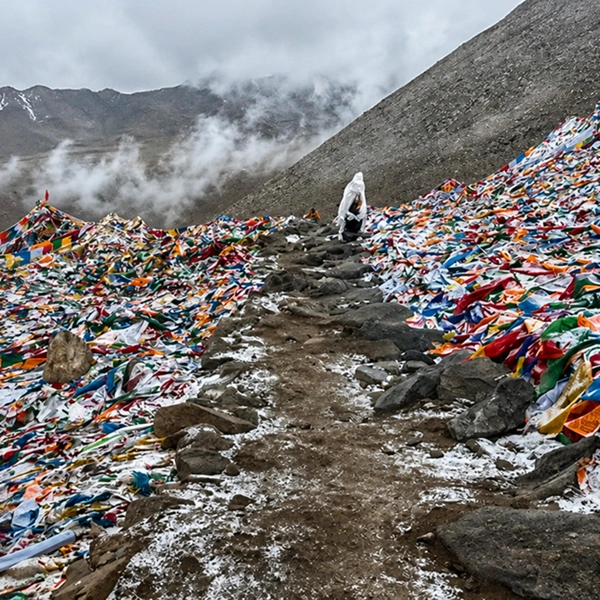
The 840-meter descent off the far side — steep, loose scree, taken on legs already emptied by the ascent — is the kora's true injury zone, and the rule that makes it non-negotiable surprises everyone: ponies are barred from carrying riders down. Everyone dismounts at the pass and walks that section on foot, however old, however tired, as our Dolma La guide explains in full.
Descent is eccentric work — muscles lengthening under load to brake each step — and it is trained differently from climbing. Step-downs, downhill hiking practice, and quadriceps strength are the specific preparation, and trekking poles used properly are the equipment that saves your knees on the day.
Train the descent, and you protect the part of your body the mountain targets. Neglect it, and no amount of cardio spares your knees on that scree.
Training Your Lungs Before You Need Them
Breath work earns its daily fifteen minutes because it trains the respiratory muscles and the calm you'll draw on when air runs thin. Traditional yogic pranayama is well suited to it: alternate-nostril breathing and diaphragmatic practice strengthen control and tidal volume, while the gentle throat constriction of ujjayi breath creates a mild natural back-pressure that improves oxygen exchange under exertion.
In the peak phase, add box breathing — inhale, hold, exhale, hold, each for an even count — and a simple rhythmic mantra matched to your stride. Both regulate breathing under physical stress and steady the mind, which matters more than pilgrims expect on the hell slopes, where panic and hyperventilation feed each other.
None of this replaces the acclimatization or medication decisions you'll make with a doctor. It is respiratory conditioning, practiced early enough to be automatic when the pass demands it — and one of the few genuinely useful things you can do for altitude before you ever reach it.
Health Prep That Isn't Fitness
Two categories of preparation have nothing to do with training and everything to do with finishing, and both belong in a conversation with your physician well before departure.
The first is vaccination. Because the yatra means shared, basic accommodation and remote conditions with minimal medical care, travel-medicine guidance commonly covers protection against hepatitis A and B, typhoid, tetanus, and meningitis — but the right list, timing, and boosters are a decision for a travel clinic reviewing your history, not a blog. Book that consultation early; some vaccines need weeks and multiple doses.
The second is your medical screening and any altitude medication. The cardiac and pulmonary panel that clears you to travel is the same file that lets a doctor advise on preventive medication such as acetazolamide, matched to your route's ascent profile. We won't put dosing on a web page; we will say plainly that this conversation is as important as any training session, and more so if you're over sixty or manage a chronic condition.
Round it out with the unglamorous kit — broken-in boots tested over real distance, a hygiene routine to dodge the gut infections that fell more pilgrims than altitude does, and the sun and cold protection our what-to-expect briefing details. Preparation is the whole picture, not just the cardio.
If You Can't Meet the Full Standard
Not every devotee can complete a twelve-week athletic build, and the honest, hopeful truth is that the mountain still has a form for them. Pilgrims who can't train for the full kora, or whose medical screening rules out the pass, keep a complete yatra at Lake Mansarovar — darshan, shoreline ritual, and the lake's parikrama by vehicle — with a fraction of the physical demand.
Beyond that sit the no-trek paths our senior citizens' guide covers in depth: the Aerial Darshan that views Kailash and Mansarovar from a pressurized flight with no altitude exposure, and the Limi Valley route through Nepal's Humla district, where the mountain's face shows from Yak Kharka near 4,900 meters without crossing into Tibet at all.
Train for the version of the yatra your body can hold. Every one of them meets the same mountain — and the pilgrims who prepare honestly, at whatever level, are the ones who come home glad rather than broken. When you know which version is yours, our private Kailash Mansarovar journey builds the whole of it around you, on the standards we keep across all our luxury travel in the Himalayas.
FAQs — Training for the Kailash Yatra
How fit do you need to be for the Kailash Yatra?
Fit enough to walk three to five kilometers briskly without stopping is the baseline to begin training; the yatra itself demands sustained endurance for three consecutive days of high-altitude walking. You don't need to be an athlete or a mountaineer. You need aerobic reserve, descent-ready legs, and trained breathing — built over about twelve weeks — plus medical clearance, which decides candidacy before fitness does.
When should you start training for the Kailash Yatra?
At least twelve weeks before departure, and four to six months if you're starting from a low fitness base or are over sixty. The body adapts to progressive load on its own timeline, and rushing produces overuse injuries rather than readiness. This runway aligns with the ninety-day booking and permit window, so your preparation and paperwork advance together toward the same departure date.
What is the best training plan for the Kailash Yatra?
A three-phase, twelve-week build: weeks one to four establish an aerobic base with steady walking and basic leg strength; weeks five to eight add weighted hikes, stair climbing, and eccentric step-downs on varied terrain; weeks nine to twelve peak with long back-to-back hikes carrying a ten-kilogram pack, then taper. Daily breathing practice runs throughout. Descent training and boot break-in are the pieces most pilgrims skip.
Why is descent training important for the Dolma La Pass?
Because the descent, not the climb, is where pilgrims get hurt: an 840-meter drop over steep loose scree, taken on tired legs, with ponies barred from carrying riders down — so everyone walks it. Descent is eccentric muscle work, trained specifically with step-downs, downhill practice, and quadriceps strength, and protected on the day by trekking poles. Neglecting it is the commonest preventable injury on the kora.
What breathing exercises help for the Kailash Yatra?
Yogic pranayama practiced daily for twelve weeks builds respiratory control and calm: alternate-nostril and diaphragmatic breathing strengthen the muscles, and ujjayi breath's gentle throat constriction creates a mild back-pressure that aids oxygen exchange under exertion. Box breathing and a stride-matched mantra, added in the peak phase, steady breathing during hard effort. None replaces acclimatization or medical advice — it's conditioning that becomes automatic when the pass demands it.
What vaccinations are needed for the Kailash Yatra?
Because the route means shared basic accommodation and remote conditions, travel-medicine guidance commonly covers hepatitis A and B, typhoid, tetanus, and meningitis — but the correct list, timing, and boosters must be set by a travel clinic reviewing your own history, not a checklist. Book that consultation early, since some vaccines need several weeks and multiple doses to take full effect before you travel.
Can being fit prevent altitude sickness on the Kailash Yatra?
No. Fitness expands your functional reserve — helping you walk longer, recover faster, and hold a steady pace — but the fit and unfit develop altitude sickness at identical rates when ascent is too fast, and strong trekkers often sicken first by pushing hardest. Prevention comes from your route's acclimatization schedule, hydration, and heeding early symptoms — never from cardio alone. Train hard; still respect the mountain's pace.
Can older or less-fit pilgrims still complete the Kailash Yatra?
Often yes, with medical clearance, a longer training runway, and pony support to the pass — though everyone walks the descent on foot. For those who can't complete the kora, a Mansarovar-focused yatra offers the full spiritual experience at far lower exertion, and no-trek options like the Aerial Darshan and the Limi Valley viewpoint require no high-altitude trekking at all. The right preparation is the one matched to your body.
Need Help? Call Us+977 9851013196orChat with us on WhatsApp

Need Help? Call Us+977 9851013196