Mount Kailash is sacred to four faiths at once — Hinduism, Buddhism, Jainism, and Bön — a distinction no other mountain on earth holds. Each sees it as the axis of the universe: Shiva's throne, a living mandala, the site of the first Tirthankara's liberation, the nine-story swastika mountain. Here is what each tradition believes, and why they share one peak.
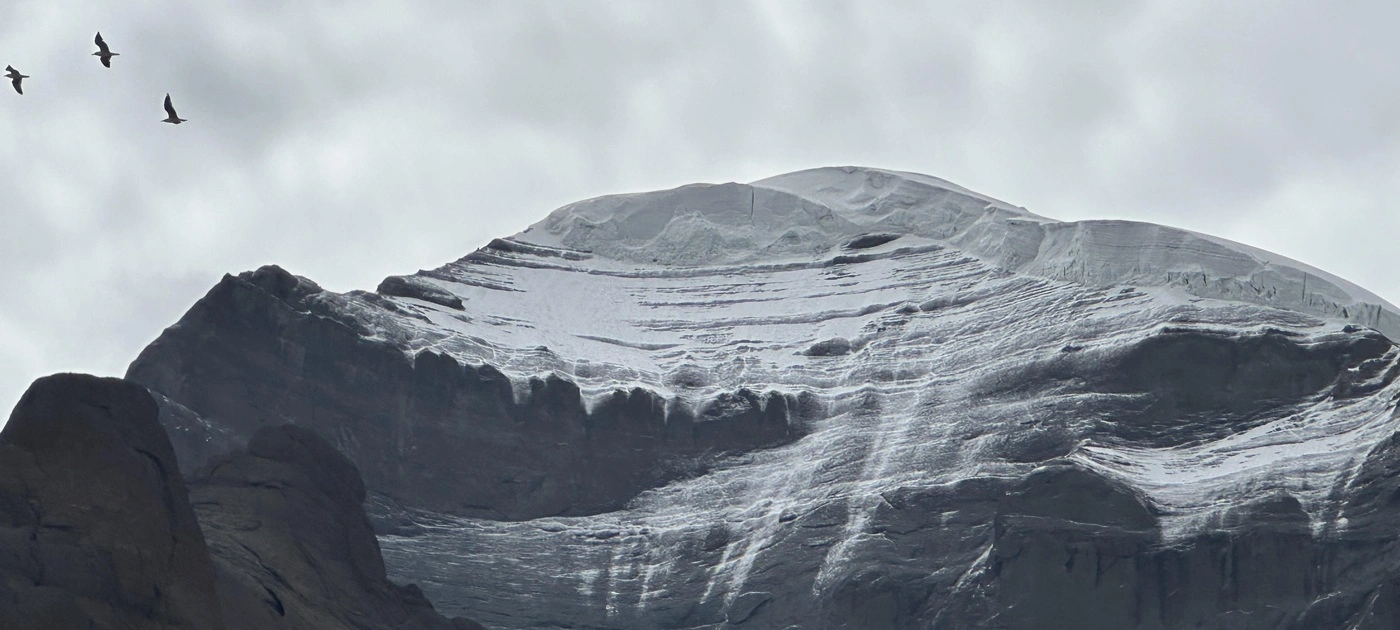
Why Mount Kailash Is Sacred: One Mountain, Four Faiths

Ask why Mount Kailash is sacred, and you get four answers, all of them ancient, all of them centered on the same 6,638-meter pyramid of black rock in western Tibet. No other mountain on earth is revered by four distinct religious traditions at once — Hinduism, Buddhism, Jainism, and the pre-Buddhist Bön of Tibet — and for close to a fifth of humanity, this single peak is the axis around which the universe turns.
We guide pilgrims from all four traditions to Kailash, and one of the quiet privileges of the work is watching a Hindu sadhu, a Tibetan Buddhist family, a Jain devotee, and a Bönpo practitioner share the same trail toward the same summit, each walking inside a different cosmos. This is our briefing on those four cosmologies — the one we give before every departure, because understanding why the mountain is holy transforms how it feels to walk around it.
Here is what each faith sees when it looks at Kailash, and the remarkable geography that let one mountain become the center of the world four separate times.
The Axis of the World: Why This Mountain, and No Other
Before the theology, the geography — because Kailash earned its sanctity partly by looking and behaving exactly like the cosmic mountain the scriptures describe. Its four near-symmetrical faces align close to the cardinal directions, giving it the appearance of a deliberate, four-sided monument rather than an accident of erosion. Stand beneath the south face and the word that surfaces, in every language, is "built."
Then there is the water. Within a tight radius of the peak rise the headwaters of four of Asia's great rivers, and they flow outward toward the four directions to sustain more than a billion people downstream. The Indus runs north, the Sutlej west, the Brahmaputra east, and the Karnali — feeding the Ganges — south. Tradition names them for animals: the Lion, Elephant, Horse, and Peacock rivers, each pouring from the base of the world.
This is precisely the structure the old texts assign to Mount Meru, the mythic cosmic mountain from whose summit sacred waters irrigate the four quarters of creation. A symmetrical peak at the source of four life-giving rivers was, to the ancient world, not a metaphor for the center of the universe. It was the evidence.
Two lakes complete the picture at the mountain's foot: freshwater Manasarovar, round and clear, the solar and creative pole, and saline Rakshastal, crescent and dark, its shadow-twin. The mountain between four rivers and two opposed lakes is a cosmology you can walk into — which is exactly what pilgrims have done for over a thousand years.
Hinduism: The Throne of Shiva
To Hindus, Kailash is not a symbol of Shiva's home. It is his home — the literal, eternal abode of the great ascetic, where Lord Shiva sits in unbroken meditation with the goddess Parvati, their sons Ganesha and Kartikeya, and his retinue of attendants. Where other deities dwell in distant heavens, Shiva lives here, on a summit you can stand beneath, which is why the pilgrimage carries the charge it does.
The scriptures thicken the mountain with story. The Ramayana and the Shiva Purana tell of the demon king Ravana, who tried to uproot Kailash and carry it to his kingdom; Shiva pressed down with a single toe and pinned him beneath the peak until Ravana, humbled, composed a hymn of praise to win his release. The tradition reads it as a lesson about ego before the sacred — the mountain will not be moved by force.
Hindu cosmology also makes Kailash the landing place of the celestial Ganges. To spare the earth the force of the river's descent, Shiva caught the falling waters in his matted hair and let them flow gently into the Himalaya. And to the Shaivite eye, the whole snow-capped, symmetrical peak reads as a natural Shiva lingam — the formless made visible in stone and ice.
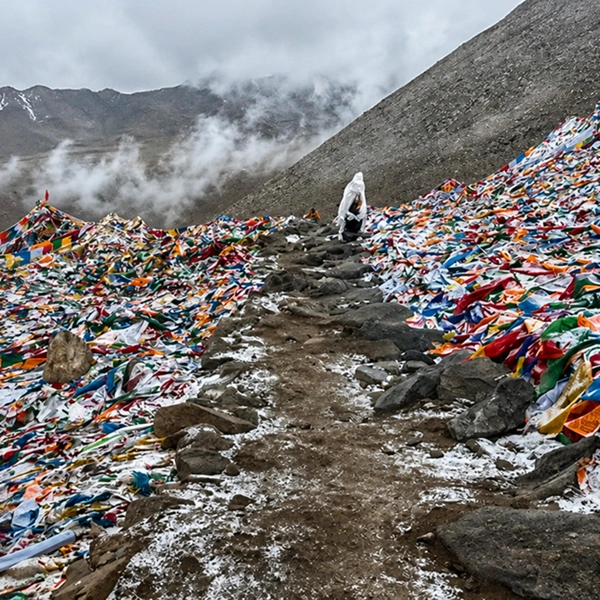
For a Hindu pilgrim, the 52-kilometer parikrama around the mountain is a walk through birth, death, and rebirth itself, each hard step in the thin air an inner fire burning away the karma of lifetimes. The circuit is not a hike with a view. It is liberation practiced with the feet.
Buddhism: The Mandala of Demchok
Tibetan Buddhists call the mountain Kangri Rinpoche, the Precious Jewel of Snow, and they do not see a landmark. They see a living, three-dimensional mandala — a sacred diagram of the path to enlightenment, rendered in rock and sky at full scale. The peak is the central palace of the deity Demchok, or Chakrasamvara, the embodiment of supreme bliss and the union of compassion and wisdom, while the surrounding valleys and streams teem with dakinis, protectors, and enlightened beings.
In this vision, mountain and lake form a divine polarity: Kailash, the masculine principle of method and compassion; Manasarovar, the feminine principle of primordial wisdom. To circle one and behold the other is to walk the whole of the path in miniature.
The region's Buddhist authority was sealed by one of Tibet's most beloved legends, which our guides tell at the guesthouses below the north face. When the yogi-saint Milarepa and the Bön master Naro Bönchung both claimed the mountain, they settled it with a race to the summit at dawn. Naro Bönchung flew up on his shamanic drum; Milarepa sat in meditation until the first sunlight struck the peak, then rode the sunbeam to the top and arrived first. The Bön master's drum tumbled down the south face, the story holds, carving the vertical scar visible there to this day.
Milarepa's win established Buddhism as the mountain's presiding tradition, though he left the nearby Bönri mountain to the Bönpos in a gesture of respect. Walk the kora in a Tibetan Horse Year, tradition promises, and a single circuit carries the merit of twelve or thirteen — which is why those years fill the trail with pilgrims from across the plateau.
Jainism: Ashtapada, Where the First Teacher Was Freed
To Jains, the mountain is Ashtapada — "eight steps" — and it holds a different kind of sanctity: not the residence of a living god, but the ground zero of their spiritual history. Here, tradition holds, Rishabhadeva, also called Adinath, the first of the twenty-four Tirthankaras and the founder of the faith, attained Kevala Jnana, omniscience, and then Moksha, the soul's complete liberation from the cycle of rebirth.
Rishabhadeva's story is a civilizational one. Born into a mythic age of effortless plenty, he is credited with teaching humanity the arts of survival when that age faded — agriculture, writing, crafts, commerce, law — before renouncing his kingdom for severe asceticism and, finally, liberation on the cold slopes of Ashtapada. His son, the emperor Bharata, is said to have raised a jeweled crystal temple on the mountain to honor him, housing images of all twenty-four Tirthankaras.
The name carries a double meaning Jains hold dear. Ashtapada is a mountain of eight terraces, yes — but the eight steps are also the stages of spiritual ascent a soul climbs toward liberation, shedding karma through right faith, right knowledge, and right action, and above all through ahimsa, non-violence.
That last principle shapes how Jains approach the mountain: not as a summit to conquer but as a silent teacher. Because access to the historical site is heavily restricted today, many Jain devotees express their reverence at grand replica temples of Ashtapada in India, at Palitana and Hastinapur — the mountain honored from afar, its meaning undimmed by distance.
Bön: The Nine-Storey Swastika Mountain
The oldest claim on Kailash belongs to Bön, the indigenous tradition of Tibet that shaped the land long before Buddhism crossed the Himalaya. For the Bönpo, this is no borrowed Indian holy site — it is the primordial center of their entire universe, the origin point of their world.
Bön calls the mountain Yungdrung Gutseg, the Nine-Storey Swastika Mountain, and the name is a cosmology in itself. Yungdrung is the Bön swastika, turning counter-clockwise, the emblem of eternal, indestructible truth — which is why Bönpo pilgrims walk the kora anticlockwise, against the flow of every other tradition, a difference you will see with your own eyes on the trail. Gutseg means the nine tiers, the nine stacked realms that link underworld, earth, and heaven, with the mountain as the pillar running through them all.
The Bönpo revere Kailash as the seat of Sipai Gyalmo, the Queen of Existence and their chief protective deity, and as the heart of the ancient Zhang Zhung kingdom that flourished across western Tibet before recorded Tibetan history. In their sacred geography, the physical mountain mirrors a mythic paradise, Olmo Lung Ring, at whose center rises a pyramid mountain feeding four great rivers to the four directions — the same fourfold pattern the land itself displays.
To walk beside a Bönpo pilgrim circling the mountain the "wrong" way is to be reminded that Kailash was holy here first, in a tradition whose roots run back beyond the reach of written record. Their counter-clockwise circuit is not contrariness. It is the older map.
One Mountain, Four Cosmologies, One Trail
What moves our guests most, again and again, is not any single tradition's grandeur but the fact of the four together. Hindu sadhus with ash-marked foreheads, Tibetan families spinning prayer wheels, quiet Jain pilgrims, Bönpo practitioners moving against the current — all on one path, around one peak, each certain it is the center of the world, and none of them wrong within their own cosmos.
That shared reverence is also why the mountain remains unclimbed. When mountaineer Reinhold Messner was offered a permit in the 1980s, he declined, reasoning that to summit Kailash would be to conquer something in the human soul. After protests met a proposed expedition in 2001, climbing was banned outright. Four faiths that agree on little else agree that this summit is not for standing on — only for circling, always with the peak above you and to your right, or for the Bönpo, to your left.
You do not need to share any of these beliefs to feel the weight of them here. The pilgrims around you carry a thousand years of certainty up the same trail you walk, and the mountain holds it all without strain. When you are ready to stand in that company, our private Kailash Mansarovar journey is built to bring you there with the care the place asks for — and our guide to the mountain's other enduring mysteries is where the wonder deepens, on the standards we keep across all our luxury travel in the Himalayas.
FAQs — The Faiths of Mount Kailash
Why is Mount Kailash considered sacred?
Because four religions independently identify it as the center of the universe — the axis mundi. Its four near-symmetrical faces align to the cardinal directions, and four of Asia's great rivers rise around its base and flow to the four quarters, matching ancient scriptural descriptions of the cosmic Mount Meru. For Hindus, Buddhists, Jains, and the Bönpo alike, this made Kailash not a symbol of the world's center but the evidence of it.
Which religions consider Mount Kailash holy?
Four: Hinduism, where it is the eternal abode of Lord Shiva; Tibetan Buddhism, where it is the mandala-palace of the deity Demchok; Jainism, where it is Ashtapada, the site of the first Tirthankara's liberation; and Bön, Tibet's indigenous faith, where it is Yungdrung Gutseg, the nine-storey swastika mountain. No other single mountain on earth holds central sacred status in four distinct traditions at once.
What does Mount Kailash mean in Hinduism?
It is the literal, eternal home of Lord Shiva, who is said to sit there in perpetual meditation with the goddess Parvati and their family. Hindu tradition ties the mountain to the legend of Ravana pinned beneath it, to Shiva catching the descending Ganges in his hair, and to the peak itself read as a natural Shiva lingam. The 52-kilometer parikrama is walked as a symbolic passage through death and rebirth toward liberation.
Why do Buddhists revere Mount Kailash?
Tibetan Buddhists see the mountain, which they call Kangri Rinpoche, as a living three-dimensional mandala and the palace of the deity Demchok (Chakrasamvara), embodiment of supreme bliss. The famous legend of the yogi Milarepa defeating the Bön master Naro Bönchung in a race to the summit sealed the mountain's Buddhist authority. Walking the kora is a structured ritual of purification, especially meritorious in a Tibetan Horse Year.
What is Ashtapada in Jainism?
Ashtapada, meaning "eight steps," is the Jain name for Mount Kailash and the site where Rishabhadeva (Adinath), the first of the twenty-four Tirthankaras and founder of the faith, is believed to have attained omniscience and final liberation. The name also signifies the eight stages of spiritual ascent toward moksha. Because access is restricted today, many Jains venerate replica Ashtapada temples in India at Palitana and Hastinapur.
What is the Bön connection to Mount Kailash?
Bön, Tibet's pre-Buddhist tradition, holds Kailash as the primordial center of the universe — Yungdrung Gutseg, the Nine-Storey Swastika Mountain — and the heart of the ancient Zhang Zhung kingdom. The Bönpo revere it as the seat of their protective deity Sipai Gyalmo and, uniquely, walk the kora anticlockwise, reflecting the counter-clockwise orientation of the Bön swastika. Theirs is the oldest sacred claim on the mountain.
Why are the four rivers around Mount Kailash significant?
Four of Asia's major rivers — the Indus, Sutlej, Brahmaputra, and Karnali — rise within a short radius of Kailash and flow outward toward the four cardinal directions, sustaining over a billion people downstream. Tradition names them the Lion, Elephant, Horse, and Peacock rivers. This fourfold divergence matches ancient descriptions of the cosmic Mount Meru, providing the geographic basis for the mountain's identification as the center of the world.
Why do Bön pilgrims walk around Mount Kailash the opposite way?
Because the Bön swastika, their central symbol of eternal truth, turns counter-clockwise, and their circumambulation follows it. While Hindu, Buddhist, and Jain pilgrims walk the kora clockwise, keeping the peak on their right, Bönpo practitioners walk anticlockwise, keeping it on their left. On a busy day, both directions of pilgrims pass each other on the same path — one of the most striking sights of the whole circuit.
Need Help? Call Us+977 9851013196orChat with us on WhatsApp
Need Help? Call Us+977 9851013196