The Kailash kora route runs 52 kilometers around the sacred mountain, walked over three days from Darchen through the north-face valley, over the Dolma La pass at 5,630 meters, and down the eastern valley back to the start. Its landmarks — gateways, monasteries, mani stones, a sacred lake — are woven into four faiths. Here is the circuit, stop by stop.
THE KAILASH KORA, LANDMARK BY LANDMARK

The Kailash kora route is a 52-kilometer circuit around the mountain, walked clockwise by most pilgrims over three days from the base village of Darchen. But to call it a 52-kilometer walk is to miss the point entirely. Every rock, gateway, monastery, and pass along the way carries meaning in Hindu, Buddhist, Bön, and Jain tradition, so the circuit is less a trek than a sequence of sacred thresholds crossed on foot.
We guide this route every season, and the question we hear most from pilgrims planning it is simply: what will I actually pass, and what does each place mean? This is that map — the landmarks in the order you meet them, what happens at each, and the practical notes that keep the walking safe.
The circuit's shape is fixed and worth holding in mind before the detail: from Darchen into the north-face valley, up and over the Dolma La, then down the long eastern valley back to where you began. Here is what fills it.
The Sacred Rhythm of the Circuit
The kora follows one unvarying sequence: Darchen to the Dirapuk area on the first day, over the Dolma La to Zutulpuk on the second, and back to Darchen on the third. The first day walks you into the great valley beneath the north face; the second crosses the high pass that is the circuit's physical and spiritual climax; the third completes the ring through a gentler valley of reflection.
Direction matters, and it divides the traditions. Hindu, Buddhist, and Jain pilgrims walk clockwise, keeping the mountain always on their right. Bönpo pilgrims walk anticlockwise, following their tradition, so on a busy day you will pass them coming the other way — one of the most quietly moving sights on the whole circuit.
Devout Tibetans sometimes complete the entire loop in a single punishing day, and the most dedicated cover it in body-length prostrations over weeks. Our pilgrims take three days, walking well, with the acclimatization and support that let the landmarks land rather than blur past in exhaustion.
Darchen: Where the Circuit Begins and Ends
Everything starts at Darchen, the gravel-plain town at about 4,575 meters that serves as the kora's base camp. This is where pilgrims rest before the walk, where intentions are set and prayers made, and where ponies and porters are arranged for the days ahead. It is unlovely and essential — a staging post rather than a sight.
The town's role is psychological as much as logistical. Pilgrims arrive here having already traveled for days across Tibet or up from Nepal, and Darchen is where the journey narrows to its true purpose: the mountain, and the circle you are about to walk around it. We hold a full rest here before setting out, because the body that starts the kora acclimatized is the body that finishes it well.
When you return three days later, Darchen is also where the circuit closes — the same dusty street, met by a different person than the one who left it.
Yama Dwar: The Gateway of the God of Death
A short drive from Darchen brings pilgrims to Yama Dwar, the formal starting gate of the kora and one of its most charged thresholds. The name means the Gateway of Yama, the god of death, and walking through its square arch is understood as leaving your old self behind — passing symbolically through death so that the circuit ahead becomes a rebirth.
Many Hindu pilgrims pause here to offer prayers before stepping through, and the moment carries real weight even for those who arrive skeptical. You enter the kora a different way than you enter an ordinary trail: through a door, on purpose, having marked what you hope to leave on the far side.
From Yama Dwar, the walking proper begins, dropping into the valley of the Lha Chu river with the mountain drawing closer ahead.
Into the North-Face Valley: Prayer Flags and Mani Stones
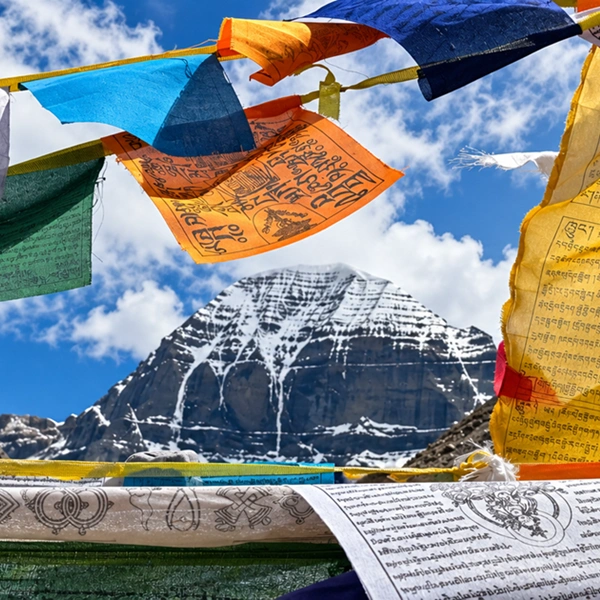
The first day's path threads the Lha Chu valley, and the landmarks here are the quiet, cumulative kind. Prayer-flag sites appear where generations of pilgrims have paused, the flags carrying prayers on the wind as they fray — and the etiquette matters: we ask guests to respect the existing flags and never add or remove items without a guide's direction, because this is living devotion, not decoration.
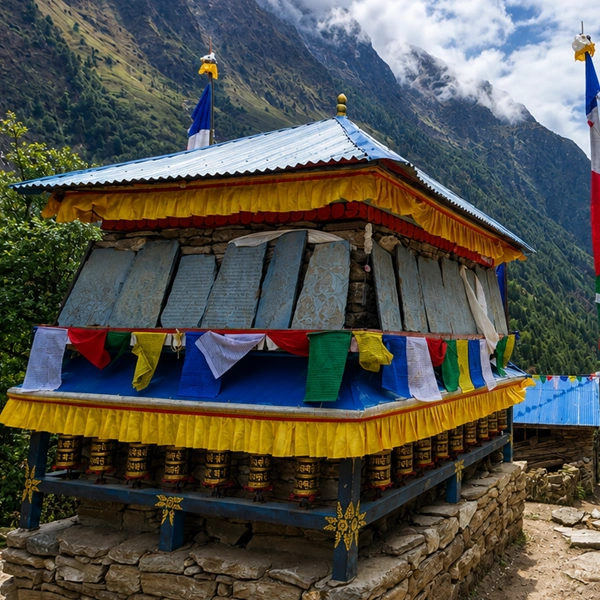
Near the valley's entrance, the route passes the Qugu (Chuku) monastery area and its bridge, a traditional marker of the pilgrimage moving into the inner valley. Further on lie fields of mani stones — slabs and cairns inscribed with Buddhist prayers, built up over centuries. Custom is to pass them, keeping the sacred objects to your right on the clockwise circuit, a small discipline that keeps you inside the tradition's grain.
None of these is dramatic on its own. Together they do something a single monument couldn't: they turn an ordinary river valley into consecrated ground, one flag and one carved stone at a time.
Dirapuk: The First Night Beneath the North Face
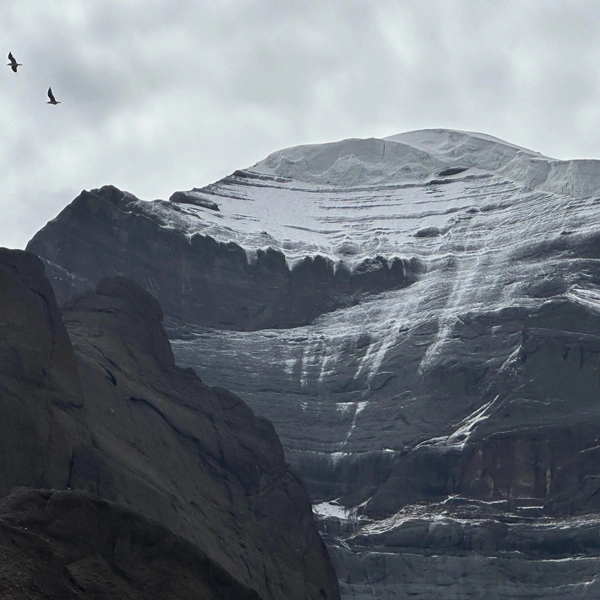
The first day ends at Dirapuk, the monastery and guesthouse cluster that sits directly opposite the sheer north face of Kailash — the closest and most overwhelming view of the mountain on the entire circuit. The striated black wall rises straight from the valley under its cap of permanent snow, and at dawn the first light fires the summit gold. This is the view pilgrims cross the world for.
Dirapuk is the usual first-night stop, and honesty about the accommodation matters: these are basic guesthouses at over 5,000 meters, unheated, simple, which we improve with our own bedding, dining, and support crew. The luxury here is not in the room. It is in standing at the guesthouse door at first light with the north face filling the sky.
The monastery itself is one of the outer kora's most important, historically a place of intense meditation facing the mountain's most powerful aspect. Pilgrims settle here for the night, knowing the hardest day waits at dawn.
Charan Sparsh: The Side Route We Usually Counsel Against
From the Dirapuk area, an optional side route climbs toward the very base of the north face — Charan Sparsh, "touching the feet," which for Hindu devotees means approaching the sacred foot of the mountain itself. On paper it is the most intimate contact with Kailash the pilgrimage offers.
In practice we counsel most pilgrims against it, and we say so plainly. The route climbs steep, unstable ground to serious altitude; access depends entirely on conditions, permissions, and safety on the day, and it adds hard exertion at the worst possible point — the morning before the Dolma La crossing, when your reserves are needed for the pass. For the great majority of our guests, the north-face darshan from Dirapuk is the complete and profound encounter, and Charan Sparsh is an ambition better admired than attempted.
Where a genuinely strong, well-acclimatized pilgrim wishes to consider it, we assess honestly against that day's conditions and their oximeter readings, and we are equally willing to say no. The mountain is not diminished by being approached with caution.
The Dolma La: The Circuit's Summit
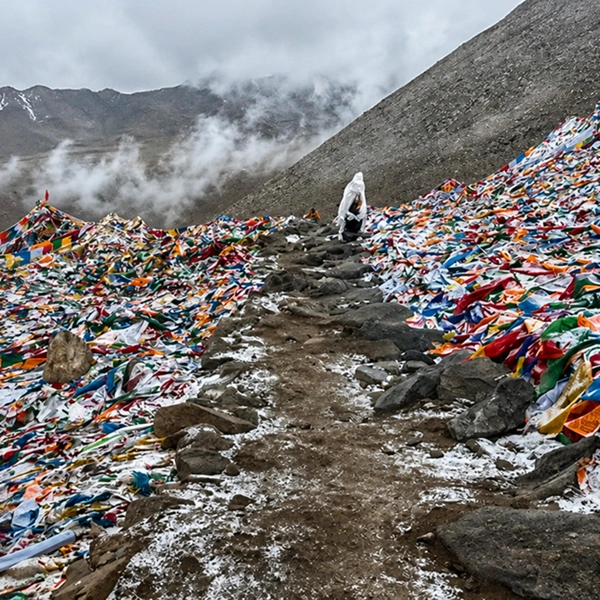
The second day is the crossing, and it builds to the Dolma La pass at about 5,630 meters — the highest point of the kora and its spiritual climax. Named for Tara, the goddess of compassion, the pass is buried under decades of prayer flags and understood as the crossing of the bardo, the intermediate state between death and rebirth. Pilgrims reach it changed and leave it changed.
On the climb, the route passes Shiva Tsal, the ground where pilgrims leave behind a piece of clothing, a lock of hair, or a small belonging — the death of the ego enacted before the rebirth of the pass. We brief this the night before so the offering is chosen with intention, not improvised breathlessly at 5,300 meters.
The crossing is demanding enough that it has its own full guide — our deep account of the Dolma La covers the pre-dawn start, the thin air, and the descent every pilgrim walks. Here it is enough to say: this is the landmark the whole circuit turns around.
Gauri Kund: The Sacred Lake You View From Above
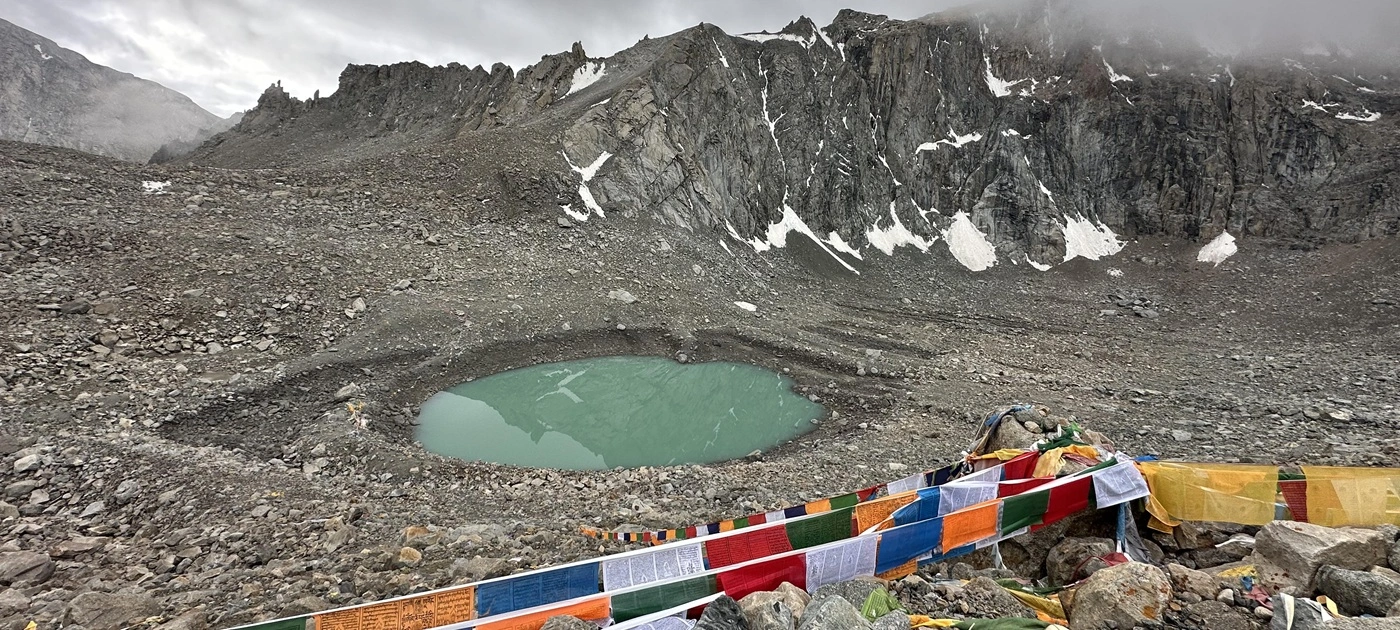
On the steep descent from the pass lies Gauri Kund, a small, perfectly formed lake of deep emerald cupped in the rock — sacred in Hindu tradition as the bathing pool of the goddess Parvati and the place of Ganesha's creation. It is one of the circuit's most beautiful sights, and one of its most important safety lessons.
You view Gauri Kund from above, from the trail. There is no safe path down to its shore; the water sits near freezing under partial ice even in summer; and any attempt to descend to it invites a fall or worse at an altitude where rescue is days away. Pilgrims take darshan from the trail, and a guide's collected water, touched to the head, serves the blessing. The lake gives what it gives from a distance.
Below Gauri Kund, the route passes Budong Didin, a recognized landmark on the long descent, as the trail loses altitude toward the valley floor and the walking finally eases.
Zutulpuk: The Cave of Miracles
The second day ends at Zutulpuk, "the cave of miraculous deeds," the monastery and guesthouse cluster built around the cell where the yogi Milarepa is said to have meditated during his legendary contest with the Bön master Naro Bönchung. The rock still bears what tradition holds are his handprints and footprints, pressed into the stone as he raised the cave's roof.
This is the usual second-night stop, on the gentler eastern side of the circuit, and pilgrims arrive here spent from the pass but lighter for having crossed it. Butter tea, soup, a guesthouse bed improved with our own bedding, and the particular sleep of people who have been over the top.
The monastery's association with Milarepa ties this stop directly to the mountain's Buddhist history — the same story of the sunbeam race that established Buddhism's authority over Kailash, told now at the very cave where the contest reached its climax.
The Return Valley: Completing the Circle
The final day is the gentlest — a walk of a few hours through the Zongdui area and the return valley, dropping steadily back toward Darchen along the Dzong Chu gorge. The dramatic landmarks are behind you now, and this stretch is for something quieter: reflection on the circuit completed, the mountain circled, the intention carried the whole way round.
Pilgrims often walk these final hours in near silence, and not only from tiredness. The kora is a closed loop by design — you end where you began, having passed through the gateway of death, stood beneath the north face, crossed the pass of compassion, and come down the far side. The return valley is where that arc resolves.
Darchen appears ahead, and the circle closes. Fifty-two kilometers, three days, one circuit that pilgrims of four faiths have walked for over a thousand years.
The Wider Landscape: Lakes and Tarboche
Two of the Kailash region's greatest sites are not, strictly, on the walking circuit. Lake Mansarovar and Rakshastal, the sacred and shadow lakes, lie to the south and are visited before or after the kora rather than during it — Mansarovar especially, where ritual prayer and purification form their own chapter of the pilgrimage, covered in our route guides. Tarboche, the great flagpole raised each Saga Dawa, sits near Yama Dwar and features in festival-season journeys.
We build the full pilgrimage to include these — the lakes before the kora, so the circuit is walked with Mansarovar's calm already in the body. The kora is the heart, but it beats inside a larger sacred geography, and a complete yatra honors both.
When you are ready to walk this circuit yourself, our private Kailash Mansarovar journey is built around getting you over every landmark well — the gateway, the north face, the pass, and the cave — to the standards we keep across all our luxury travel in the Himalayas.
FAQs — The Kailash Kora Route
What is the route of the Kailash kora?
The kora is a 52-kilometer circuit around Mount Kailash, walked over three days from Darchen: into the Lha Chu valley beneath the north face to Dirapuk on the first day, over the Dolma La pass at about 5,630 meters to Zutulpuk on the second, and back to Darchen through the return valley on the third. Most pilgrims walk clockwise; Bönpo pilgrims walk the opposite way.
How many days does the Kailash kora take?
Three days for most pilgrims, which is how we run it — an unhurried pace that allows acclimatization and lets the landmarks register. The most devout Tibetans complete the full 52-kilometer circuit in a single day, and some pilgrims perform it in body-length prostrations over two to three weeks. A three-day circuit balances the physical demand of the Dolma La with a realistic, safe rhythm.
What are the main landmarks on the Kailash kora?
In order: Darchen (base village), Yama Dwar (the death-gateway starting gate), prayer-flag sites and mani-stone fields in the Lha Chu valley, Dirapuk monastery beneath the north face, the Dolma La pass with Shiva Tsal on its climb, Gauri Kund lake on the descent, Zutulpuk monastery around Milarepa's cave, and the return valley back to Darchen. Each carries meaning across the four pilgrim traditions.
What is Yama Dwar on the Kailash kora?
Yama Dwar, the Gateway of Yama (the god of death), is the ceremonial arch a short drive from Darchen where the kora formally begins. Walking through it symbolizes leaving one's old self and past behind, so that the circuit ahead becomes a spiritual rebirth. Many Hindu pilgrims pause to offer prayers here before stepping through and beginning the parikrama proper.
Where do you sleep on the Kailash kora?
At two points: the Dirapuk area at the end of the first day, directly opposite Kailash's north face, and Zutulpuk at the end of the second, on the gentler eastern side around Milarepa's cave. Both are basic, unheated guesthouses at over 4,700 metres, which we improve with our own bedding, dining, and support crew. There are no luxury lodges on the circuit itself.
What is Charan Sparsh, and can pilgrims do it?
Charan Sparsh, "touching the feet," is an optional side route from the Dirapuk area toward the very base of Kailash's north face, meaningful to Hindu devotees as approaching the mountain's sacred foot. We counsel most pilgrims against it: it climbs steep, unstable ground to serious altitude, depends on conditions and permissions, and adds hard exertion right before the Dolma La. For most, the north-face darshan from Dirapuk is the complete encounter.
Which direction do you walk around Mount Kailash?
Clockwise for Hindu, Buddhist, and Jain pilgrims, keeping the mountain on the right — the direction our journeys follow. Bönpo pilgrims, following the counter-clockwise orientation of the Bön swastika, walk anticlockwise, keeping the mountain on their left. On a busy day, the two streams of pilgrims pass each other on the same trail, a striking expression of the mountain's shared sanctity across traditions.
Are Lake Mansarovar and Rakshastal part of the kora? No — the two lakes lie south of the mountain and are visited before or after the walking circuit rather than as stops on it. Lake Mansarovar in particular holds its own major ritual significance for prayer and purification, and we build a full day there into the wider pilgrimage. The kora circles the mountain itself; the lakes belong to the surrounding sacred landscape.
Need Help? Call Us+977 9851013196orChat with us on WhatsApp

Need Help? Call Us+977 9851013196