The Banned Trek, the Four Sacred Faces, and the Aerial Alternative
The word “Charan” means feet. “Sparsh” means touch. In Hindu and Buddhist tradition, touching the feet of a teacher, an elder, or a deity is the ultimate act of humility. At Mount Kailash, the teacher is the mountain itself. Because climbing the peak is prohibited by four religions and enforced by Chinese law, the base of the North Face is the highest point of physical contact any human can achieve. Charan Sparsh is the pilgrimage to that point.
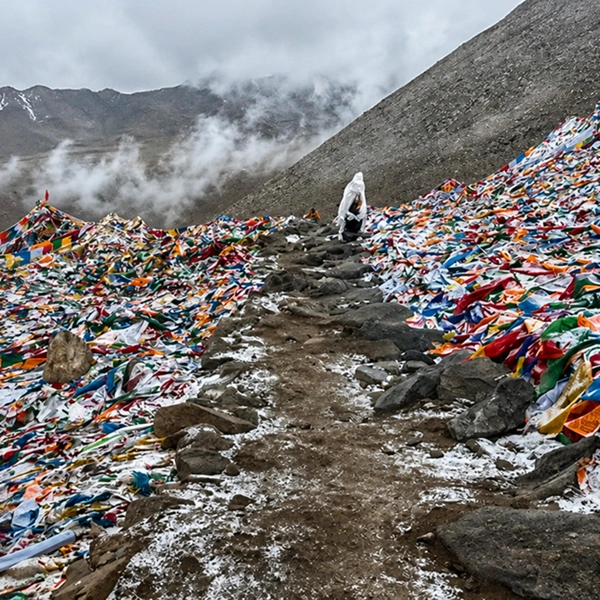
The trek was never easy. A 7-kilometer round trip from Dirapuk over loose gravel and glacial moraine, climbing to 5,200-5,300 meters with no trail, no rescue infrastructure, and 4-6 hours of continuous exertion at altitude. In 2026, the environmental crisis has completely closed it. The glaciers are receding. The permafrost is thawing. The rocks are falling. The authorities have drawn a boundary line 15-20 minutes from Dirapuk. That is as close as you can get.
In This Guide
- What Charan Sparsh means across four religions
- The four sacred faces of Mount Kailash
- The trek that was: the 7km route from Dirapuk
- Why has it been banned in 2026
- What you CAN do: the boundary prayer and the aerial darshan
- Frequently asked questions
What Charan Sparsh Means Across Four Religions
|
Religion
|
What Kailash Is and What Charan Sparsh Means
|
|
Hinduism
|
Kailash is the eternal abode of Lord Shiva and Goddess Parvati. The mountain is a physical manifestation of Shiva’s lingam. Charan Sparsh is ultimate surrender — burning lifetimes of negative karma to receive wisdom, protection, and liberation (moksha). Rituals include Sashtang Pranaam (lying flat), puja, incense, tika, and offering milk.
|
|
Buddhism
|
Kailash is Kang Rinpoche (“Precious Snow Mountain”), equated with Mount Meru, the center of the Buddhist cosmos. Dwelling place of Demchok (Chakrasamvara). The pilgrimage is a living tantric mandala. Charan Sparsh involves full-body prostrations, mantra chanting (Om Mani Padme Hum), and the acknowledgment of impermanence.
|
|
Jainism
|
Kailash is Ashtapada — the Eight-Stepped Mountain, where the first Tirthankara Rishabhanatha attained nirvana. The eight steps represent progressive stages of spiritual liberation. Jain pilgrims approach in silence and non-violence (ahimsa), seeking the Southern face rather than the North.
|
|
Bon
|
Kailash is Yungdrung Gutseg — the Nine-Story Swastika Mountain. Seat of Sipaimen, the Sky Goddess. Bon practitioners circumambulate counter-clockwise, against the flow of time, honoring the primordial path of the ancient Zhang Zhung Empire.
|
The Four Sacred Faces of Mount Kailash
|
Face
|
Gemstone
|
Character
|
When You See It
|
|
South
|
Lapis Lazuli
|
Shiva’s calm power. Vertical cleft reads as his spine or third eye. Protection from untimely death.
|
From Yam Dwar at the Kora start and from Lake Rakshastal. Meditating here earns karma equivalent to a partial Kora.
|
|
West
|
Ruby
|
Compassion and healing. The “gentlest” face. A massive human-like visage in the rock. Glows ruby-red at sunset.
|
During Day 1 of the Outer Kora. Sunset is the most powerful viewing moment. Chant Om Namo Bhagavate Rudraya.
|
|
North
|
Gold / Crystal
|
The most imposing. “Golden Kailash” — the early morning sun casts brilliant gold across the sheer rock and ice. Absolute power, transformation, wisdom.
|
From Dirapuk Monastery. This is the Charan Sparsh destination. Sashtang Pranaam (lying flat) and deep silence.
|
|
East
|
Crystal / Ruby
|
The most elusive. Silence, inner exploration, esoteric awakening, sacred fire. Rarely seen fully.
|
Briefly visible after Gauri Kund. Primarily accessible via the Inner Kora route.
|
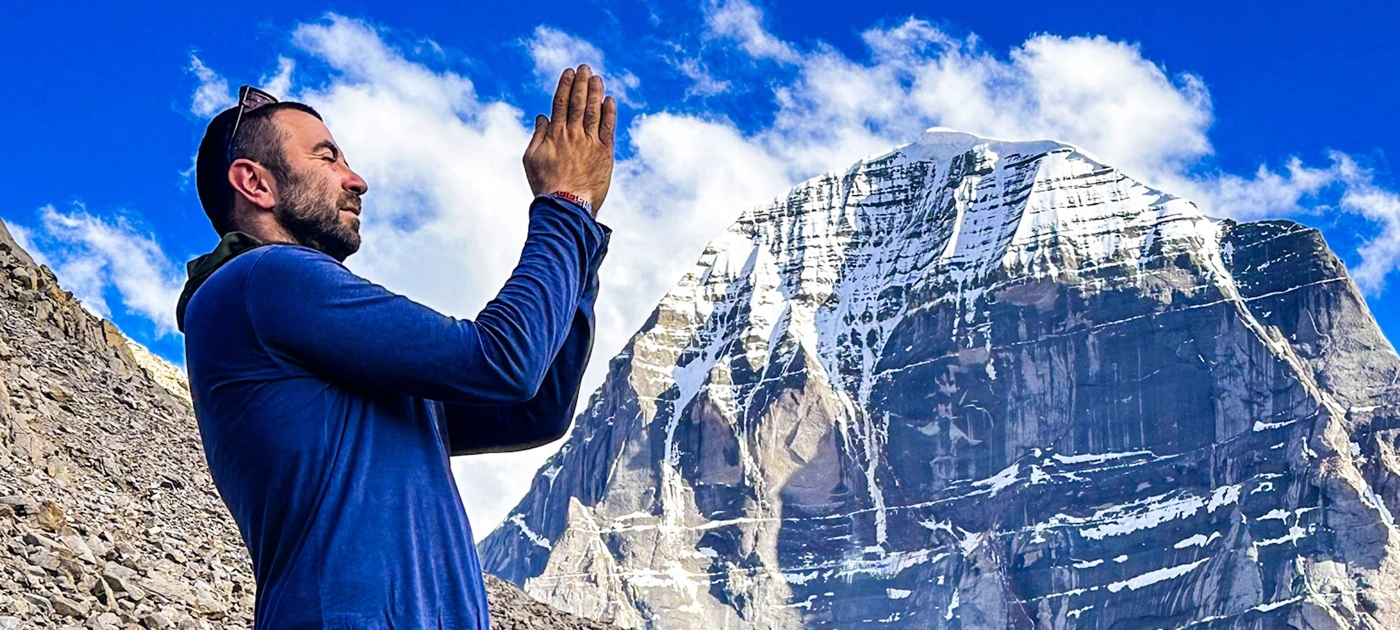
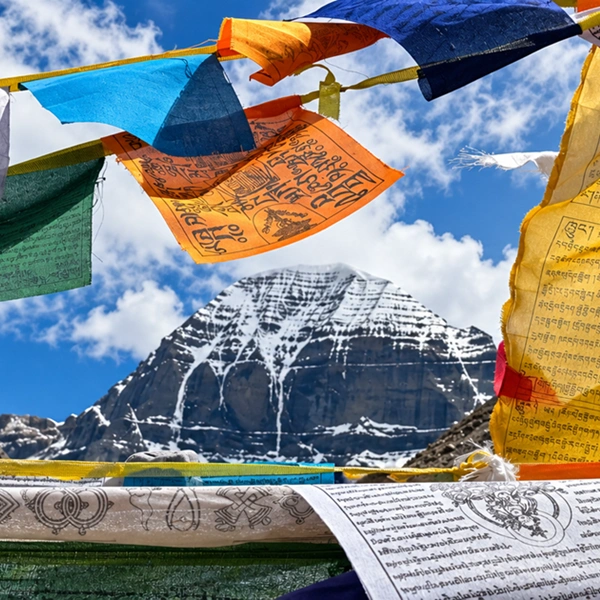
The North Face is the Charan Sparsh destination because it is the most powerful and the most accessible — Dirapuk Monastery sits directly below it. In early morning, the sun turns it gold. At midday, it is sheer grey-white ice and rock. By evening, it darkens into shadow. Pilgrims who see the golden sunrise from Dirapuk describe it as one of the most overwhelming visual experiences of the entire Yatra.
The Trek That Was: 7 Kilometers Toward the North Face
Before the ban, the Charan Sparsh trek was appended to Day 1 of the Outer Kora. After arriving at Dirapuk Monastery (4,900m), pilgrims who wished to perform Charan Sparsh continued 3.5 kilometers south toward the North Face base, climbing to 5,200-5,300 meters over loose gravel, unstable moraine, and icy slopes adjacent to the glacier.
There was no trail. No markings. No rescue infrastructure. The round trip took 4-6 hours at a painfully slow pace dictated by the lack of oxygen. The weather was volatile: high winds, sub-zero temperatures, sudden snowstorms. Upon reaching the designated area near the base, pilgrims performed prostrations, pujas, lit incense, applied tika, and offered milk. The ritual concluded with profound silence.
The spiritual prerequisite was historically rigorous: completing at least one full Outer Kora before attempting Charan Sparsh, to purify the mind before seeking direct physical contact with the mountain’s base.
Why Charan Sparsh Has Been Banned in 2026
The ban is driven by four compounding environmental and safety factors.
Accelerated glacial collapse. The Himalayan cryosphere is in crisis. North Face glaciers have receded significantly, increasing water volume in local glacial rivers and destabilizing the terrain that pilgrims formerly walked across.
Permafrost thaw. The structural integrity of the rock faces above the Charan Sparsh access point is compromised. Unpredictable, lethal rockfalls have become frequent. The slopes that were stable enough for foot traffic a decade ago are no longer safe.
Ecological preservation. The fragile high-altitude ecosystem cannot absorb unregulated foot traffic across off-trail moraines. Authorities have determined that human proximity to the immediate foothills must be curtailed.
Evacuation impossibility. The terrain is inaccessible to ground rescue vehicles and dangerous for helicopter evacuations due to unpredictable thermals and cliff faces. Permitting thousands of pilgrims onto unstructured terrain presents an unacceptable safety liability.
Pilgrims at Dirapuk Monastery can walk 15-20 minutes toward the mountain. They must halt at a clearly marked boundary, perform prayers and prostrations from a distance, and return. Any attempt to bypass the boundary violates travel regulations. Tour operators encourage pilgrims to view the completed Outer Kora as fully meritorious.
What You CAN Do: The Boundary Prayer and the Aerial Darshan
The Boundary Prayer at Dirapuk
The 15-20-minute walk from Dirapuk toward the boundary remains deeply powerful. You are closer to the North Face than you will be at any other point on the Kora. The golden morning light on the rock, the silence, and the scale of the mountain above you are overwhelming. Pilgrims perform full prostrations, light incense, and sit in silence. The physical touch is gone. The proximity remains.
Aerial Darshan from Nepal Airspace
For pilgrims who cannot undertake the Kora at all — due to the age-70 cap, medical disqualification, or physical inability — aerial darshan flights offer panoramic views of Kailash and Mansarovar from a chartered aircraft.
|
Feature
|
Detail
|
|
Route
|
Departs Nepalgunj (occasionally Lucknow). Flies close to the Tibetan border within Nepali airspace. Panoramic 360-degree view of Kailash and Mansarovar.
|
|
Visa/Permit
|
NONE required. The aircraft does not cross the border or land in Tibet. No Chinese visa. No Tibet Travel Permit. No passport needed.
|
|
Medical
|
No age limit. No BMI restriction. No medical certificate. No fitness test. Accessible to elderly devotees, children, and those with cardiac conditions.
|
|
Cost
|
Approximately $550 USD / ₹55,000-65,000 INR per person. Every passenger gets a window seat.
|
|
Duration
|
Flight time is approximately 1-2 hours, depending on weather and route.
|
For the 2026 season, a helicopter parikrama is also available for pilgrims already on the Tibetan plateau: a 20-minute chartered helicopter circumambulation of the mountain at altitude.
We operate both the ground Kora and the aerial darshan. For guests who complete the Outer Kora, we schedule the Dirapuk boundary prayer into the Day 1 itinerary — a 15-20-minute walk toward the North Face, with time for prostrations and silence. For guests who cannot make the ground journey, we arrange the aerial darshan from Nepalgunj. We are transparent about the Charan Sparsh ban: physical touch is no longer permitted, but proximity at the boundary and aerial views are genuine spiritual experiences, not consolation prizes.
Frequently Asked Questions
What is Charan Sparsh?
Charan Sparsh (“touching the feet”) is the practice of walking from Dirapuk Monastery toward the North Face base of Mount Kailash to physically touch the ground at the closest accessible point to the peak. It is the ultimate act of devotional humility. The trek was 7 km round trip, climbing to 5,200-5,300m over unmarked terrain. It has been banned for the 2026 season.
Why is Charan Sparsh banned in 2026?
Accelerated glacial collapse, permafrost thaw causing lethal rockfalls, ecological fragility, and the impossibility of evacuating casualties from the terrain. Pilgrims at Dirapuk can walk 15-20 minutes toward the mountain and pray from the marked boundary, but cannot proceed further.
Can I still get close to the North Face?
Yes. From Dirapuk Monastery, a 15-20 minute walk toward the boundary is permitted. This is the closest point to the North Face on the Outer Kora and still offers an overwhelming view, especially at golden sunrise. Full prostrations and prayers are performed here.
What are the four sacred faces of Mount Kailash?
South (Lapis Lazuli): Shiva’s calm power, viewed from Yam Dwar. West (Ruby): compassion and healing, glows red at sunset. North (Gold/Crystal): the most imposing face, “Golden Kailash” at sunrise, the Charan Sparsh destination. East (Crystal): the most elusive, accessed mainly via the Inner Kora.
What is the aerial darshan?
A chartered flight from Nepalgunj that flies close to the Tibetan border within Nepali airspace, providing a panoramic view of Mount Kailash and Lake Mansarovar. No visa, no permit, no passport, no medical certificate, no age limit. Approximately $550 USD. Every passenger gets a window seat.
Who should consider the aerial darshan?
Devotees over 70 (excluded by the Chinese age cap), those with cardiac conditions or high BMI (excluded by medical requirements), pilgrims who cannot physically complete the 52km Kora, and family members who want to see the mountain without the trekking commitment. It is the only way to view Kailash without entering the Chinese jurisdiction.
Is the helicopter parikrama available?
Yes. For pilgrims already on the Tibetan plateau who cannot walk the Kora, a 20-minute chartered helicopter circumambulation of the mountain is available for the 2026 season. It requires the standard Tibet permit matrix. Pricing is case-by-case.
Does completing the Outer Kora without Charan Sparsh still earn full merit?
Yes. Tour operators and religious authorities encourage pilgrims to view the completed Outer Kora as fully meritorious. The 13x Fire Horse Year multiplier applies to the Kora itself. Charan Sparsh was always an additional devotional act, not a requirement for the Kora’s spiritual efficacy.
Which face of Kailash is most visible?
The South Face from Yam Dwar (the Kora starting point) and the North Face from Dirapuk Monastery (Day 1 overnight). The West Face is visible during the first hours of the Outer Kora. The East Face is the most elusive, briefly visible after Gauri Kund and primarily via the Inner Kora.
Will the Charan Sparsh ban be lifted?
There is no indication of a timeline for lifting the ban. The environmental factors driving it — glacial recession, permafrost thaw, rockfall — are worsening, not improving. We monitor the situation and will update guests if the policy changes.
The Final Word
The mountain that cannot be climbed can no longer be touched. The glaciers are receding. The rocks are falling. The boundary line at Dirapuk is the new closest point. But the North Face is still there: golden at sunrise, sheer and silent at noon, dark and massive at dusk.
The 15-20 minute walk to the boundary, the prostration on the gravel, the silence — these remain genuinely powerful. And for those who cannot walk at all, the aerial darshan from Nepali airspace offers a view of the axis of the universe from the only angle most humans will ever see it: from above.
The physical touch is gone. The mountain remains. Tell us what kind of encounter with Kailash is right for you, and we will build it.
Planning your Kailash experience?
Ground Kora with boundary prayer. Aerial darshan from Nepal. Helicopter parikrama. We offer all three and help you choose.