The Holy Lake and the Ghost Lake
They lie less than a kilometer apart at the foot of Mount Kailash. Mansarovar is freshwater. Rakshastal is salt. Mansarovar is round. Rakshastal is a crescent. Mansarovar is turquoise. Rakshastal is dark grey. Mansarovar sustains sparse life.
Rakshastal supports none. Pilgrims bathe in one and avoid touching the other. The contrast is so stark that four religions have built their entire theological framework around it: the sacred and the profane, divine purity and demonic ambition, existing side by side in the same high-altitude basin.
In This Guide
- The comparison: Mansarovar vs Rakshastal at a glance
- The mythology: why one lake is holy and the other cursed
- Four rivers from one source
- What do you do at each lake
- The Chiu Gompa viewpoint
- Visiting both lakes on the Kailash Yatra
- Frequently asked questions
Mansarovar vs Rakshastal: The Comparison
|
Attribute
|
Lake Mansarovar
|
Lake Rakshastal
|
|
Tibetan name
|
Mapam Yumtso (“Invincible Lake”)
|
Lhanag Tso (“Dark Lake”)
|
|
Altitude
|
4,590–4,600m
|
4,575m
|
|
Area
|
~320 km²
|
~250 km²
|
|
Shape
|
Nearly round
|
Crescent/irregular
|
|
Water
|
Freshwater, slightly alkaline (pH ~7.5–8)
|
Saltwater, endorheic (no outflow)
|
|
Depth
|
Max ~100m
|
Avg ~38m, max ~84m
|
|
Colour
|
Turquoise/vivid blue
|
Dark blue-grey/sombre
|
|
Life
|
Sparse algae, migratory birds, no fish
|
No plants, no fish, no aquatic life
|
|
Connection
|
Overflows via Ganga Chhu channel into Rakshastal
|
Receives water from Mansarovar. No outflow.
|
|
Mythology
|
Created by Brahma. Bathing cleanses all sins. Associated with Shiva and Parvati.
|
Created by Ravana to meditate on Shiva. Called “The Ghost Lake.” Locals avoid touching its water.
|
|
Pilgrim activity
|
Bathing, parikrama (88km circumference), puja at Eight Bathing Gates.
|
Viewing only. Brief offerings from shore. No bathing.
|
|
Protected status
|
Ramsar site (Mapangyong Cuo wetland, 2004)
|
Ramsar site (same designation, with Mansarovar)
|
The Mythology: Why One Lake Is Holy and the Other Cursed
Mansarovar: The Mind of God
The Sanskrit name Manasarovar combines “manas” (mind) and “sarovar” (lake): the lake born from the mind of Brahma, the creator god. Hindu tradition holds that bathing in Mansarovar cleanses the sins of a hundred lifetimes. Shiva is believed to have tamed the Ganges here.
The Puranas describe it as the purest water on earth. Tibetan Buddhists call it Mapam Yumtso — the Invincible Lake — and regard it as the “mother” lake to Kailash’s “father.” The Bon religion holds that its founder, Tonpa Shenrab, bathed in its waters.
Rakshastal: The Demon’s Penance
Rakshastal’s mythology is the inverse. In the Ramayana, the demon king Ravana created this lake as a platform for performing extreme penance to Lord Shiva. He stood in the water and methodically cut off his own ten heads, one by one, as offerings. Shiva, moved by this terrifying devotion, granted Ravana immense powers — the same powers he later used to kidnap Sita and wage war against Rama.
The lake carries the residue of that demonic ambition. Its water is salty. Its shores are barren. No life survives in it. Locals call it the Ghost Lake. Pilgrims do not bathe in it. Some Buddhists symbolically toss black yarn into it to purify demons. Otherwise, it is observed from a respectful distance. The two lakes together represent the complete moral spectrum: Mansarovar is what devotion creates when it is pure. Rakshastal is what devotion creates when it serves the ego.
Four Rivers from One Source
The Kailash-Mansarovar region is the hydrological source of four of Asia’s greatest river systems. The Indus, the Sutlej (Langqen Zangbo), the Brahmaputra (Yarlung Tsangpo), and the Karnali (a major Ganges tributary) all originate in this high basin. Four rivers. Four directions. Billions of people downstream. The theological claim that Kailash is the axis of the universe — the point where heaven meets earth — has a hydrological basis that is difficult to argue with.
A short natural channel called the Ganga Chhu connects Mansarovar to Rakshastal. When Mansarovar’s water level is high enough, freshwater overflows through the channel into the saltwater lake. The theological interpretation: even the demon’s lake receives grace from the holy lake. The hydrological reality: Rakshastal is endorheic — water enters but never leaves. It accumulates salt through evaporation. The channel is the reason the two lakes exist as a pair rather than as separate bodies.
What You Do at Each Lake
At Mansarovar
Bathe. Even a splash of Mansarovar water on the face is believed to purify past-life karma. Full immersion is the ideal. The water is approximately 10°C in summer and freezing in other seasons. Most pilgrims enter briefly, chant, and emerge. Some pour milk into the lake as an offering to Shiva.
Walk. The 88-kilometre parikrama around the lake’s circumference is a full-day walk on mostly flat terrain. Most Yatra itineraries do not include time for the complete circuit, but a 2-3 hour partial lakeside walk is standard.
Pray. Chiu Gompa, a small 7th-century monastery perched on a hill on the eastern bank, is the primary ritual site. Pilgrims light butter lamps, spin prayer wheels, and perform puja. The Eight Bathing Gates around the shoreline mark locations where deities are said to have bathed.
At Rakshastal
View. Pilgrims stop at viewpoints along the road between Mansarovar and the Kailash Kora starting point. The dark water, barren shoreline, and red rock islands are visible from the elevated road. Some pilgrims make brief offerings from the shore — tossing black stones or incense. No one bathes. No formal ritual takes place on the water.
The Chiu Gompa Viewpoint
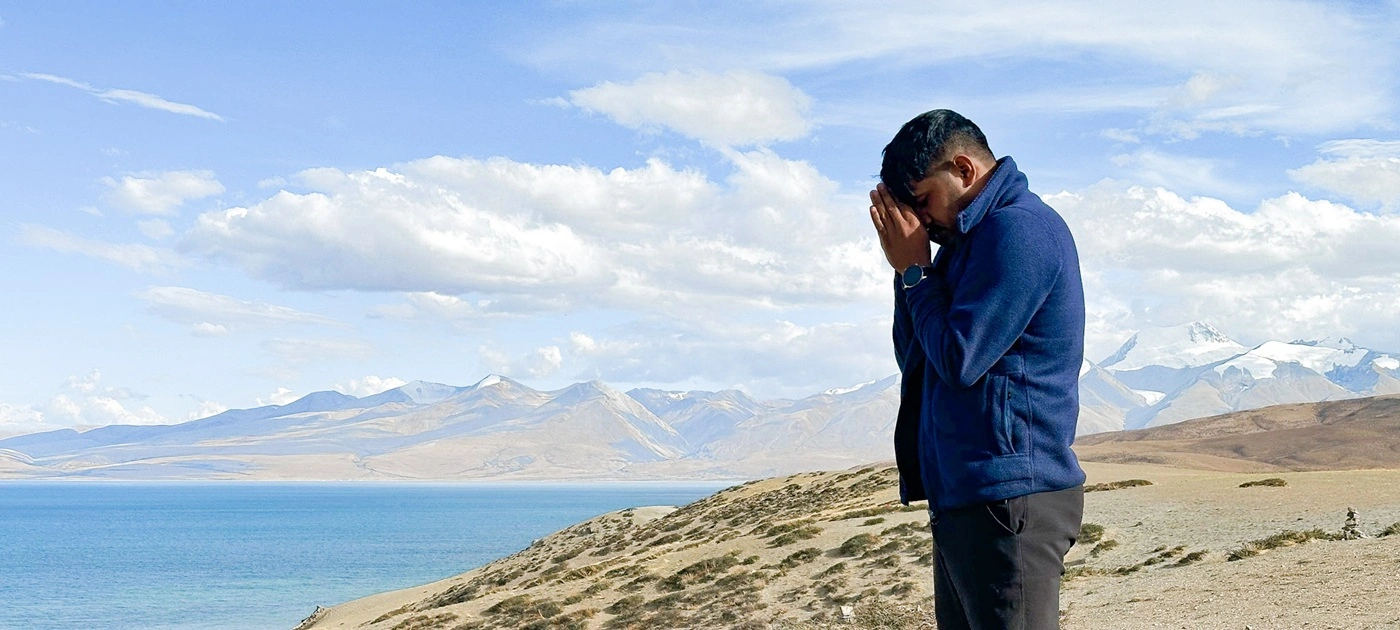
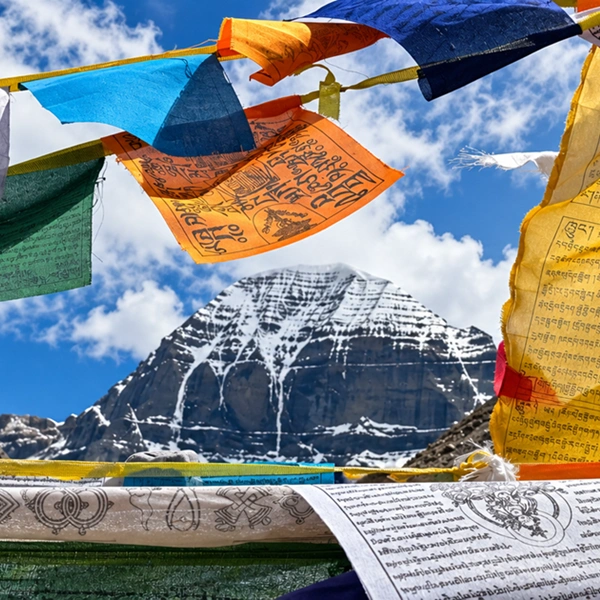
Chiu Gompa sits on a rocky hill on Mansarovar’s eastern shore. It is small — a handful of rooms, a few monks. But its position gives you what may be the single most beautiful view on the entire Kailash Yatra: Mansarovar’s turquoise surface in the foreground, the snow peaks of the Gangdise Range behind, and Mount Kailash’s pyramid rising above everything. At dawn, when the water is still, and Kailash is reflected in the lake, the view is the reason people endure the altitude, the permits, and the overland drive.
We schedule a sunrise visit to Chiu Gompa on every Kailash itinerary. It is the moment when the theological claim and the physical reality align: the mountain is reflected in the lake born from the mind of God.
Visiting Both Lakes on the Kailash Yatra
Both lakes are included in every standard Kailash Mansarovar Yatra itinerary. Mansarovar is the overnight stop before or after the Kora. Rakshastal is visible from the road between Mansarovar and Darchen. A typical schedule allocates one full day to Mansarovar (bathing, lakeside walk, and a visit to Chiu Gompa) and passes by Rakshastal by vehicle with a photo stop.
Accommodation at Mansarovar is basic: simple guesthouses near the shore with minimal insulation and no permanent plumbing. Our operator teams deploy portable toilet tents. The night at Mansarovar is cold, clear, and — on a full moon — genuinely transcendent: the moonlight reflecting off the glassy surface, the silence, and Kailash visible in the distance.
ENVIRONMENTAL RESPONSIBILITY
Both lakes are part of the Mapangyong Cuo Ramsar wetland site. Leave no trace. Do not wash clothing or apply soap in Mansarovar. Use only designated bathing spots. Carry all waste out. Our teams use portable stoves and pack-in food. The lakes are pristine because very few people reach them. Every pilgrim who visits has a responsibility to leave them that way.
Frequently Asked Questions
What is the difference between Mansarovar and Rakshastal?
Mansarovar is a round, turquoise freshwater lake (~320 km², 4,590m) considered one of the holiest bodies of water on earth. Pilgrims bathe in it to cleanse karma. Rakshastal is a crescent-shaped saltwater lake (~250 km², 4,575m) called the Ghost Lake. Created by the demon Ravana in Hindu mythology. No life survives in it. Pilgrims do not bathe. They are connected by the Ganga Chhu channel.
Can you swim in Lake Mansarovar?
Pilgrims bathe briefly in designated spots. The water is approximately 10°C in summer. Full immersion is the ideal, but most pilgrims enter briefly, chant, and emerge. There is no swimming in the recreational sense. Soap, detergent, and washing are prohibited to protect the lake’s purity. Rakshastal bathing is culturally forbidden.
Why is Rakshastal called the Ghost Lake?
Hindu mythology says the demon king Ravana created Rakshastal as a platform for penance to Lord Shiva, offering his ten heads as sacrifices. The lake carries the residue of that demonic ambition: its water is salt, its shores are barren, and no life survives. Locals call it the Ghost Lake and avoid touching its water.
Are the two lakes connected?
Yes. A short natural channel, the Ganga Chhu, connects Mansarovar to Rakshastal. When Mansarovar’s water level is high enough, freshwater overflows into Rakshastal. The theological interpretation: even the demon’s lake receives grace from the holy lake.
What rivers originate near the lakes?
Four of Asia’s greatest rivers originate in this region: the Indus, the Sutlej (Langqen Zangbo), the Brahmaputra (Yarlung Tsangpo), and the Karnali (a Ganges tributary). The Kailash-Mansarovar basin is one of the most important hydrological source areas on the planet.
What is Chiu Gompa?
A small 7th-century Buddhist monastery perched on a rocky hill on Mansarovar’s eastern shore. It offers the finest view on the Kailash Yatra: Mansarovar’s turquoise water in the foreground, Kailash’s pyramid behind, the Gangdise Range beyond. At dawn, Kailash is reflected in the lake. We schedule a sunrise visit on every itinerary.
How much time is spent at the lakes?
A standard Kailash Yatra allocates one full day to Mansarovar: bathing, lakeside walk, and a visit to Chiu Gompa. Rakshastal is viewed from the road between Mansarovar and Darchen with a photo stop. Accommodation is an overnight stay at basic guesthouses near Mansarovar’s shore.
What is the accommodation like at Mansarovar?
Basic mud-house guesthouses near the shoreline with minimal insulation, no permanent plumbing, and unreliable solar power. Our teams deploy portable toilet tents. Bring a sub-zero sleeping bag. The night is cold but, on a clear or full-moon night, genuinely transcendent.
Is Rakshastal worth visiting?
You pass it by vehicle on every standard itinerary. The dark water, barren shores, and red rock islands are visually striking — especially in contrast to Mansarovar’s turquoise. Understanding the mythology (Ravana’s penance, the theological duality with Mansarovar) transforms what could be a quick photo stop into a genuinely meaningful moment.
Are the lakes environmentally protected?
Yes. Both are part of the Mapangyong Cuo Ramsar wetland site (designated 2004) and included on UNESCO’s Tentative World Heritage list. Leave no trace. No soap in the water. No washing. No litter. The lakes are pristine because of their remoteness. Every visitor has a responsibility to keep it that way.
The Final Word
Two lakes. One holy, one haunted. One turquoise, one grey. One sustains life, one sustains nothing. They sit side by side at the foot of the mountain that four religions call the center of the universe, connected by a channel that lets the holy water flow into the cursed one. The duality is not an accident of geology. It is the theology made visible: devotion can create purity or destruction, depending on who is doing the devoting and why.
Stand between them at dawn. Look at Mansarovar’s surface reflecting Kailash. Look at Rakshastal’s dark water reflecting nothing. Then walk to the Kora starting point. You will understand why people come here.
Including both lakes in your Kailash Yatra?
We schedule Mansarovar bathing, a sunrise visit to Chiu Gompa, and a stop at the Rakshastal viewpoint on every Kailash itinerary.