One-Horned Rhino Safari in Nepal: A Luxury Guide to the Five Best Habitats
A one-horned rhino safari in Nepal is, in some ways, the most accessible serious wildlife trip in the country, and, in other ways, the most underestimated. Accessible because Chitwan National Park sits at the center of nearly the entire Nepal rhino population, runs on a mature safari infrastructure, and produces near-guaranteed rhino encounters in any half-decent season.
Underestimated because most international travelers arriving in Nepal think of the country as a Himalayan trekking destination and barely register that the lowlands hold one of the densest concentrations of greater one-horned rhinoceros anywhere in the world — a population now in the high hundreds, recovered from a near-extinction crisis fifty years ago. The combination of high density, mature infrastructure, multiple safari modalities, and meaningful conservation backstory makes the rhino safari an excellent companion to either a Kathmandu cultural circuit or a Himalayan mountain experience.
After years of running wildlife departures into the Terai, our team has watched the rhythm of rhino-focused safaris settle into a clear pattern. The single most important variable is the park selected — Chitwan delivers the highest sighting probability simply because it holds the overwhelming majority of the national population, while Bardia, Shuklaphanta, Parsa, and Koshi Tappu each offer specific reasons to choose them over Chitwan for the right traveler.
The second variable is the safari modality — jeep, walking, or canoe, each of which produces a meaningfully different experience of the same animal in the same forest. The third is the season — March and April are statistically the strongest sighting window because rhinos are forced to predictable water sources by the heat. Understanding these three variables honestly is the foundation of planning a successful rhino safari.
This guide covers the five protected areas where we run rhino safaris — Chitwan, Bardia, Shuklaphanta, Parsa, and Koshi Tappu. We explain the spring timing that determines sighting probability, the four safari modalities (jeep, walking, canoe, and the elephant-back option that we do not run and recommend against), the conservation backstory that has made Nepal a global rhino conservation success, the human-wildlife conflict reality that ethical travelers should understand, and how our team operates these departures.
Important: Rhino sightings in Chitwan are nearly guaranteed in any decent season — the density of animals is high enough that even casual safari travelers typically encounter multiple rhinos across a 2–3 day stay. The other parks have lower densities and lower sighting probabilities. We are honest about this at the time of booking. Travelers prioritizing the strongest possible rhino encounter should choose Chitwan; travelers prioritizing solitude, walking safaris, or wider biodiversity should choose Bardia or Shuklaphanta; travelers wanting the most distinctive wetland experience and the rare combination of rhinos with Ganges river dolphins should consider Koshi Tappu.
Why Nepal Is the Strongest Country for Rhino Sightings
The greater one-horned rhinoceros — sometimes called the Indian rhinoceros — survives today in only two countries with meaningful wild populations: India and Nepal. India holds the largest total share, concentrated overwhelmingly in Kaziranga National Park in Assam. Nepal holds the second-largest national population, concentrated overwhelmingly in Chitwan.
Of the two, Nepal offers the more accessible safari experience for international travelers — easier visa logistics, smaller distances between major destinations, lower visitor density at the parks themselves, and the option to combine the rhino safari with the Himalayan experience that brought most travelers to the region in the first place.
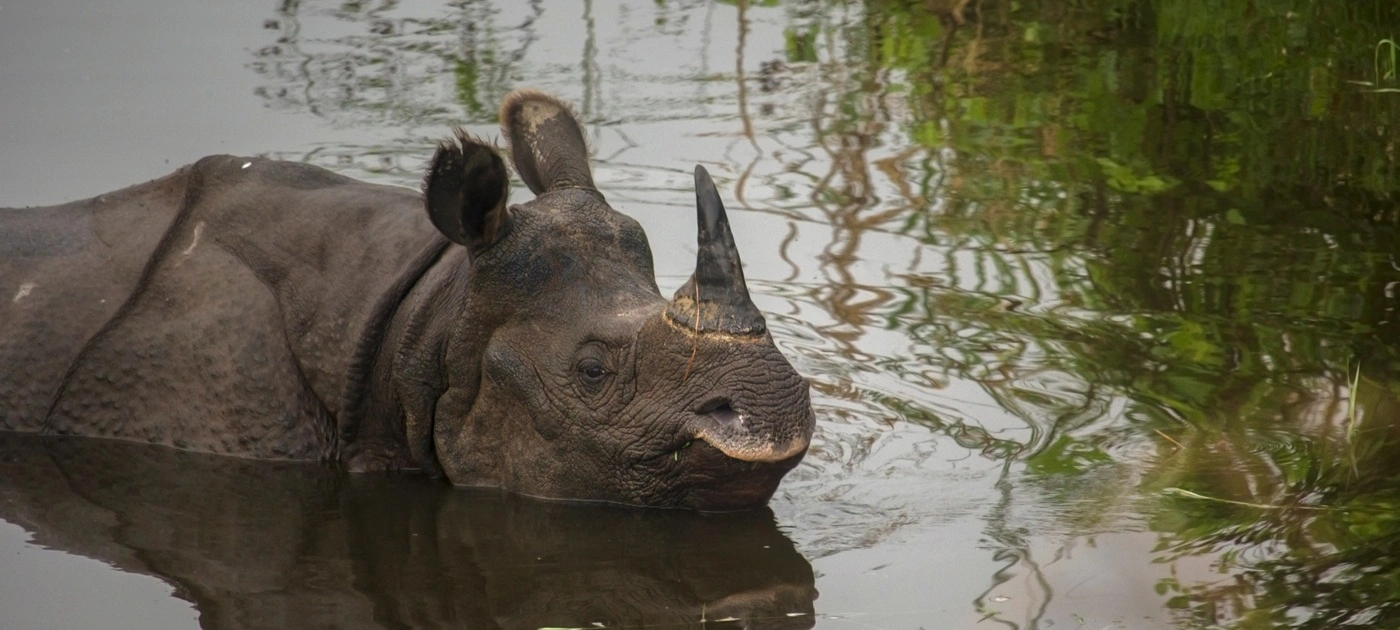
Within Nepal, Chitwan is the dominant rhino destination because it has the largest population. Over 9 out of every 10 rhinos in Nepal live in Chitwan and its adjoining forests, which means the probability of a rhino sighting per safari day in Chitwan is the highest of any park in the country.
The other four parks covered in this guide each represent specific conservation strategies — Bardia and Shuklaphanta as translocation-built secondary populations to reduce the species' vulnerability to localized catastrophe, Parsa as the contiguous eastern extension that absorbs spillover from Chitwan as the central population grows, and Koshi Tappu as the new eastern sanctuary launched in 2023 to establish a third geographically distinct breeding population.
The Conservation Story Behind Today's Numbers
Understanding the recovery is worth a short detour because it explains why sightings are even possible today. By the early 1970s, the Nepal rhino population had collapsed to around one hundred individuals — the cumulative result of colonial-era trophy hunting and the mid-twentieth-century agricultural conversion of the Terai floodplains following malaria eradication.
The establishment of Chitwan National Park in 1973 was the first turning point. The second was a series of translocation programs through the late 1980s, 1990s, and early 2000s that moved breeding rhinos from Chitwan to Bardia and Shuklaphanta to establish geographically distinct secondary populations. The third was the development of Community-Based Anti-Poaching Units in the buffer zones — local citizens trained and equipped to monitor their own forests.
Nepal has periodically achieved milestones of zero poaching across stretches of consecutive months and years, the result of multi-tiered security operations that combine national army presence in the core zones with community patrols in the buffer zones.
The 2023 launch of a dedicated wildlife-crime canine unit — trained specifically to detect rhino horn, tiger pelts, and other illicit wildlife products at checkpoints and borders — added a further enforcement layer. The conservation infrastructure that makes a luxury rhino safari viable today is, fundamentally, the income that the safaris themselves generate. Travelers who book with us participate directly in the funding model that keeps the species alive.
Seasonal Timing: Why March and April Are the Strongest Months
Rhino safari timing in Nepal is similar to tiger safari timing — and similarly counterintuitive. The most comfortable months are not the best months for sightings. The strongest-sighting months are demanding because of the heat, but the probability of sightings climbs sharply enough to justify the discomfort for serious wildlife travelers.
Pre-Monsoon Spring (March to May) — The Strongest Window
March and April are the absolute peak window for rhino sightings, and there are two specific reasons. First, in early March, the buffer-zone communities are permitted to enter the parks to harvest the towering elephant grass for traditional building material and thatch.
The harvesting transforms the dense, impenetrable vegetation into wide-open golden plains for several months, dramatically increasing the line of sight and making rhinos visible at distances that the post-monsoon vegetation never allows. Second, as temperatures climb through April, rhinos are biologically forced to congregate around the few remaining water sources — riverbanks, oxbow lakes, mud wallows — to thermoregulate.
Wallowing is mandatory for the species at high temperatures because their immense body mass produces metabolic heat that they cannot dissipate any other way. The combination of open visibility and concentrated movement at predictable water sources produces sighting probabilities that no other window matches.
The cost is the heat. Late April and May produce daytime temperatures in the low-to-mid 40s Celsius. Safaris are scheduled for early morning and late afternoon to avoid the lethal midday, which is spent at the lodge. Pre-monsoon humidity also rises sharply through May, which makes the heat genuinely punishing. We typically recommend mid-March to mid-April as the sweet spot — strong visibility, concentrated movement, and heat that is high but not yet brutal.
Winter (December to February) — The Second-Strongest Window
Winter offers a genuinely good chance of sightings with much more comfortable conditions. Cool mornings often start with thick fog that burns off by 9:00 AM, pleasant 20-25 Celsius afternoons, and cold nights. Wildlife remains active throughout the daylight hours rather than retreating to deep shade. The post-grass-cutting visibility advantage from spring carries into winter — the grasslands remain relatively open through January and February before regrowth begins. Travelers who prioritize comfort and good sighting probability typically choose January or February.
Post-Monsoon Autumn (Late September to November) — Moderate
The post-monsoon window is the most aesthetically beautiful but produces a moderate sighting probability. The forest is lush, the rivers run high, and the mountain backdrops are at their crispest. The trade-off is that thick post-monsoon vegetation reduces visibility significantly — rhinos can be meters from the safari track and remain invisible in the regrown elephant grass.
Abundant surface water also disperses the rhinos across the entire park rather than concentrating them along predictable corridors. Add leech infestation in the damp underbrush — making walking safaris uncomfortable without long trousers tucked into thick socks — and the autumn window is a moderate rather than strong choice.
Monsoon (Late June to Mid-September) — Not Recommended
We do not run rhino safaris during the monsoon. Core park zones are largely closed for the season, jeep tracks turn into impassable mud, river levels rise dangerously, and the explosive regrowth of vegetation makes wildlife observation effectively impossible. Travelers planning a rhino safari should coordinate their trip with the dry-season schedule.
The Five Habitats Where We Run Rhino Safaris
1. Chitwan National Park — The Heart of the Population
Chitwan is the default answer for any traveler serious about seeing a one-horned rhinoceros. The 952-square-kilometer park in the inner Terai sits at the center of nearly the entire Nepal rhino population — over nine in ten of the country's rhinos live within Chitwan and its adjoining forests. Sighting probability is genuinely high in any decent season — most travelers encounter multiple rhinos across a 2-3 day stay, and the rhino encounters are essentially guaranteed at the right time of year.
The park's topography is built around the Rapti and Narayani rivers, which produce a productive mosaic of climax sal forest, dense riverine forest, and vast alluvial grasslands. The towering elephant grass — reaching 6-8 meters at the end of the monsoon — provides the primary dietary staple for the rhinos and the dense cover needed for females to rear calves. The oxbow lakes and mud wallows scattered throughout the park serve as the operational anchor of any pre-monsoon safari, because rhinos at high temperatures must wallow regularly to thermoregulate.
Chitwan also offers the most developed luxury accommodation of any wildlife destination in Nepal. Our team uses specific properties for our safari guests, as confirmed in the private booking proposal. The general standard available is mature — heated rooms, hot showers, restaurant-tier dining, professional naturalist support, and lodge gardens that often produce wildlife sightings without leaving the property.
Beyond rhinos, Chitwan supports a dense Bengal tiger population, gharial crocodiles in the Rapti River, sloth bears in the dry forest, leopards on the periphery, and over 500 documented bird species. Standard luxury Chitwan rhino safaris run 3-5 days plus access logistics.
2. Bardia National Park — The Translocation Stronghold
Bardia is the secondary rhino population built by deliberate translocation from Chitwan. The 968 square kilometer park in the far western Terai received over eighty rhinos transferred from Chitwan across two decades of programmed releases, establishing a geographically distinct breeding population centered in the Babai Valley.
The history of this population is more complicated than the simple translocation success story — heavily armed, organized poaching syndicates decimated the Bardia rhino population during the period of national instability in the early 2000s, eliminating most of the gains made through the original translocations. The recovery began with the restoration of national security and the reinstatement of intensive anti-poaching operations, supplemented by additional translocations in 2016-2017.
The current Bardia rhino population is in the dozens rather than the hundreds — meaningful but small compared to Chitwan. The probability of a sighting per safari day is therefore lower. The case for Bardia despite the lower density, is the broader experience — Bardia is widely considered the strongest park in Nepal for tiger sightings, the open grassland and savannah terrain produces better visual penetration than Chitwan's dense vegetation, walking safaris on foot are the primary modality (a genuinely distinctive experience), and visitor density is a fraction of Chitwan's. Travelers booking Bardia typically include the rhino as part of a broader wildlife trip rather than as the sole target.
The Khata transboundary corridor connecting Bardia to Katarniaghat in India runs along the southern boundary of the park and is one of the great success stories of community-led habitat restoration. GPS-collared rhinos have been documented moving fluidly across the international border using this corridor. Standard luxury Bardia rhino-focused safaris run 4-5 days plus access logistics.
3. Shuklaphanta National Park — The Grassland Refuge
Shuklaphanta is the smallest of Nepal's rhino-bearing parks at 305 square kilometers, but it holds a small, slowly growing rhino population that is genuinely thriving. The park is dominated by the famous Shukla Phanta itself — the largest continuous open grassland in the region, which gives the park its name (Shukla Phanta translates as 'white grassland'). The visual character is unusual for the subcontinent — sweeping savannah-like vistas more reminiscent of East Africa than of typical Nepal jungle, with rhinos visible at distances no dense-forest park can match.
The probability of rhino sightings at Shuklaphanta is moderate rather than high — the population is small. The case for Shuklaphanta is the combination of the grassland visibility, the genuinely low visitor density (the park sees a tiny fraction of Chitwan's foot traffic), and the world's largest continuous swamp deer herd, which provides the broader wildlife framing.
The remoteness is the operational cost — Shuklaphanta requires a domestic flight from Kathmandu to Dhangadhi plus an overland transfer of around 90 minutes. Most luxury Shuklaphanta safaris are organized as inclusive 4-5-day packages that combine access logistics, accommodation, and safari days into a single coordinated program.
4. Parsa National Park — The Contiguous Extension
Parsa shares its entire western boundary with Chitwan and extends the Terai megafauna ecosystem to the east. The 627-square-kilometer park has historically hosted only a small, transient rhino population — typically a handful of individuals — because the dry Chure hilltopography is significantly different from Chitwan's river-fed floodplain habitat. The Parsa rhinos are essentially a spillover from Chitwan, sub-dominant individuals pushed eastward by territorial competition as Chitwan approaches its ecological carrying capacity.
Travelers typically do not choose Parsa for the rhinos themselves. Travelers choose Parsa as a quiet companion to a Chitwan stay — adding genuinely uncommercialized safari days at low visitor density to the broader trip, with the chance of an opportunistic rhino encounter alongside birdlife, wild Asian elephants, and the rugged Chure-hill character that Chitwan does not offer. Parsa extensions typically add 2-3 days to a primary Chitwan booking.
5. Koshi Tappu Wildlife Reserve — The New Eastern Sanctuary
Koshi Tappu is the newest chapter in Nepal's rhino conservation strategy. The 175 square kilometer reserve in the far-eastern Terai — historically known as Nepal's most important wetland (designated under the Ramsar convention) and the last refuge for the country's wild water buffalo population — was outside the modern range of the greater one-horned rhinoceros until 2023.
In September 2023, the Ministry of Forests and Environment launched a deliberate translocation program that moved breeding rhinos from Chitwan to Koshi Tappu to establish a third geographically distinct breeding population. The strategic logic is clear — relying on a single dominant population (Chitwan) leaves the species vulnerable to localized catastrophe, and a third population in the eastern floodplains spreads that risk.
The Koshi Tappu safari experience is genuinely different from the other parks. The terrain is heavily inundated wetland — extensive mudflats, dense reed beds, sprawling freshwater marshes — rather than the grassland-and-forest mosaic of the western Terai. Jeep safaris are limited to the higher ground and levees.
The signature modality is the gentle non-motorized boat ride down the Sapta Koshi River. The species mix is unusual — the newly introduced rhinos alongside the rare Ganges river dolphin, the wild water buffalo population (now in the hundreds), and several hundred bird species, including a significant share of the migratory waterfowl that pass through the reserve in winter.
Koshi Tappu is the right answer for travelers who want the most distinctive Nepal wildlife experience and the rare combination of rhinos with Ganges river dolphins. The visitor density is genuinely low because the reserve is off the standard tourist circuit. Access requires a domestic flight from Kathmandu to Biratnagar, followed by a ground transfer. Standard luxury Koshi Tappu safaris run 4-5 days plus access logistics.
Five Habitats Compared
|
Habitat
|
Best For
|
Duration
|
Sighting Probability
|
|
Chitwan
|
Highest sighting probability; mature luxury infrastructure; heritage core
|
3–5 days
|
Highest
|
|
Bardia
|
Walking safaris; combined tiger and rhino focus; lower visitor density
|
4–5 days
|
Moderate
|
|
Shuklaphanta
|
Grassland savannah character; very low visitor density; swamp deer herds
|
4–5 days
|
Moderate
|
|
Parsa
|
Quiet Chitwan companion; opportunistic rhino plus broader wildlife
|
2–3 days extension
|
Low
|
|
Koshi Tappu
|
New sanctuary; rhinos plus Ganges dolphins; wetland boat safaris
|
4–5 days
|
Low-Moderate
|
Safari Modalities: Jeep, Walking, Canoe, and Why We Do Not Run Elephant Safaris
Jeep Safari
The default modality for most rhino safaris. Open-topped 4WD jeeps cover large areas of the park, allowing safari teams to respond quickly to sighting cues several kilometers apart. The jeep's structural barrier also provides safety during encounters with rhinos, sloth bears, and other megafauna that can be unpredictable on the ground.
We run private jeep safaris for our luxury guests rather than the heavily commercialized, half-day shared jeeps that follow fixed circular routes through the most trafficked sectors. Private vehicles allow the morning to be calibrated to your group's pace, the safari team's specific knowledge of where rhinos are wallowing that day, and the guests' photographic preferences.
Walking Safari
The visceral modality. Walking safaris are particularly strong at Bardia, where the open terrain allows safe observation distances, and at Chitwan in the open river-edge zones during pre-monsoon, when grass-cutting season has reduced cover. Walking safaris run with at least two licensed guides per group — a senior tracker leading the way and a second guide securing the rear.
The experience involves analyzing fresh footprints in river silt, identifying dung middens, interpreting broken vegetation along game trails, and reading rhinos' body language at close range. The encounter dynamics on foot differ from those in vehicles — rhinos respond to humans on foot more cautiously, and the protocols around silence, scent management (no perfume or strong deodorant), and group cohesion in the event of a contact are rigorously enforced.
The risk is real, the reward is substantially deeper than any jeep encounter, and the modality is largely unavailable in the equivalent Indian rhino reserves.
Canoe Safari
The silent observation modality. Traditional hand-carved wooden canoes drift down the Rapti or Narayani rivers in Chitwan or the Karnali in Bardia. The silence is the operational asset — birds tolerate close approach, gharials bask undisturbed on the banks, and rhinos coming to drink at the water's edge in the late afternoon hours often allow remarkable proximity to a silently passing canoe.
Canoe safaris are particularly strong for the broader bird and reptile work — the Rapti River canoe trips in Chitwan are excellent for gharial crocodile observation, and the avian biodiversity is genuinely exceptional. We typically include at least one canoe morning in any multi-day Chitwan or Bardia rhino itinerary.
Why We Do Not Run Elephant Safaris
Elephant-back safaris are still offered by some operators in Nepal as a way to track rhinos through the tall grass at elevated vantage. We do not run them, and we recommend against them. The training methods used to make elephants tolerate human riders involve practices that are not appropriate to fund through luxury bookings.
We are also direct about adjacent operations — the elephant breeding centers that present themselves as ethical conservation projects but breed elephants for lifelong manual labor, and tourist riding camps that are not appropriate to visit. The international wildlife travel industry has been moving away from elephant-back tourism for the past decade for ethical reasons, and the global luxury tier has largely completed that transition.
Travelers wanting elephant interaction can observe wild elephants on jeep safaris — the wild herds in Chitwan, Parsa, and Bardia are regularly visible — or participate in genuinely cruelty-free observation activities at sanctuaries that meet international welfare standards. We are direct with any guest who asks why.
How the Rhino Safari Combines With Other Nepal Experiences
Rhino safaris run in the southern Terai lowlands at 150-300 meters altitude and require modest fitness — they are tropical jungle trips rather than mountain expeditions. This makes them genuinely complementary to a wide range of other Nepal experiences. The most common combinations we run:
- Rhino safari plus Kathmandu cultural circuit — the 8-10 day classic introduction to Nepal that combines wildlife with the heritage sites of the Kathmandu Valley
- Rhino safari plus Pokhara lake retreat — the 9-12 day relaxed itinerary that combines Chitwan with the lakeside ease of Pokhara and optional Annapurna foothills hiking
- Rhino safari plus Bengal tiger safari — the 7-10 day wildlife-focused itinerary combining Chitwan or Bardia with a multi-park tiger focus
- Rhino safari plus Everest helicopter day tour — the jungle-and-mountain itinerary that combines the rhinos in the Terai with the world's highest mountain in a single trip
- Rhino safari plus Bhutan extension — the 14-21 day combined Himalayan kingdoms itinerary that adds Bhutan's distinct cultural and wildlife character
The right combination depends on the time available and the relative priority weights for wildlife, culture, and mountain experience. We build combined itineraries on request and typically anchor them around Chitwan because of the high sighting probability that produces the wildlife photographs travelers come home wanting.
The Human-Wildlife Conflict Reality Travelers Should Understand
The honest counterpart to Nepal's rhino conservation success is the reality of human-wildlife conflict in the buffer zones. As the rhino population has grown and territorial competition within the parks has intensified, subdominant rhinos increasingly cross park boundaries into surrounding agricultural lands, particularly at night during harvest seasons when high-calorie crops like rice and corn are most attractive. The frequency of human-rhino contact has grown alongside population recovery, and encounters between a 3,000-kilogram megaherbivore and human village life sometimes end badly.
Each year, encounters with megafauna in Nepal produce a small but persistent toll of human fatalities — most concentrated in the buffer-zone communities surrounding Chitwan and Bardia, predominantly indigenous Tharu families and hill-migrant farmers. The conservation literature sometimes frames this as a problem to be solved through better mitigation.
The honest framing is more complex — these communities are paying the day-to-day cost of a conservation success that the international community celebrates from a distance. The way travelers can contribute meaningfully is through direct economic flow into the buffer zone communities.
That means: lodges that employ local Tharu staff at proper wages, purchases of local handicrafts directly from the makers, contributions to the wildlife victim compensation programs that buffer the financial impact of livestock loss and crop damage, and acceptance that the modest extra cost of community-supporting operations is the actual price of an ethical safari. Operators who undercut on price are usually cutting community payments, which is the wrong place to save money.
Permits, Costs, and Practical Logistics
Park Entry and Daily Fees
Park entry fees for foreign nationals are modest in absolute terms — typically USD 10-20 per day, depending on the park, with small additional charges for vehicle and guide services. Costs change periodically, and the fee structure is administered through the registered agency rather than by the traveler directly.
Our team confirms current fees at the time of booking. Beyond entry fees, the substantive costs are vehicle hire (a private jeep is the right tier for luxury safaris), guide fees (both park-mandated guides and our own naturalist), accommodation, and any specialist canoe or boat arrangements.
Access Logistics by Park
- Chitwan — easiest. 25-minute domestic flight from Kathmandu to Bharatpur or 5-6 hour scenic road transfer
- Parsa — same access as Chitwan, with a short overland transfer to the eastern boundary
- Bardia — flight from Kathmandu to Nepalgunj (approximately 1 hour) plus overland transfer of 2-3 hours
- Shuklaphanta — flight from Kathmandu to Dhangadhi (approximately 1 hour 10 minutes) plus 90-minute overland transfer
- Koshi Tappu — flight from Kathmandu to Biratnagar (approximately 50 minutes) plus a ground transfer of around 90 minutes
Lead Time for Booking
- Chitwan luxury accommodation: 4-6 months ahead for spring (March-April) and the December-February peak winter window. Strongest properties tighten earliest
- Bardia luxury accommodation: 5-7 months ahead because the inventory is smaller, and the strongest tiger-and-rhino combined window concentrates demand
- Shuklaphanta and Koshi Tappu: 4-6 months ahead for the inclusive package format. Domestic flight inventory to Dhangadhi and Biratnagar has limited daily capacity
- Parsa (as Chitwan extension): added at the same time as the primary Chitwan booking
How Tracking Actually Works on the Ground
The Daily Rhythm in Pre-Monsoon Season
- 4:30 AM — Wake at lodge. Light breakfast in the cool morning before the heat builds
- 5:30 AM — Jeep departs into the park for the morning safari. The first hour after sunrise is statistically the strongest single window of the day for rhino sightings at water sources
- 6:00–9:30 AM — Active tracking. The team focuses on known wallowing sites, riverside corridors, and grassland clearings. Rhinos visible at water edges, often with calves nearby. Photographic light is best in the first 90 minutes
- 9:30–10:00 AM — Return to lodge as temperatures begin to climb. Brunch and rest
- 10:00 AM–3:30 PM — Lodge time. Midday recovery. The deep middle of the day is unproductive for most wildlife — rhinos retreat to deep shade or remain in wallows. The Tharu cultural visit is available for guests who want it
- 3:30 PM — Light tea, jeep departs for the afternoon safari
- 4:00–6:30 PM — Afternoon tracking through the cooler late-afternoon window. Rhinos active around water sources before nightfall. The evening hours produce a strong sighting probability, and the warm late light is excellent for photography
- 6:30 PM onward — Return to lodge, hot dinner, briefing for the following day
What Trackers Actually Look For
Local trackers read the forest at a level that travelers cannot replicate. The specific signals that indicate a rhino nearby — fresh dung middens at the territorial boundaries (rhinos use specific marking sites repeatedly, which makes them predictable), broken vegetation along the regular forage paths, the hollow sound of an underwater wallow with the animal still submerged, the alarm-call patterns of langur monkeys when something disturbs the forest below — these are the variables that convert long safari hours into actual sightings.
The accumulated knowledge of which water holes are currently active, which mother rhinos have calves and where they are protecting them, which corridors a particular dominant male is patrolling — this is what an experienced operator's tracker team brings.
Ethical Rhino Safari Standards
- Maintain at least 50 meters distance from rhinos. Closer approaches induce stress and can trigger lethal defensive charges, particularly from females with calves
- Maintain silence during sightings. Loud conversation, ringing phones, and excited reactions ruin the experience for the rest of the safari party and disturb the animals
- Wear neutral earth-toned clothing. Bright colors startle wildlife and reduce sighting opportunities for the entire group
- No flash photography during low-light sightings. Flash temporarily blinds and disorients animals at dawn, dusk, and in shaded forest
- Decline elephant rides regardless of operator persuasion. The training methods are not appropriate to fund through your bookings
- Decline visits to elephant breeding centers that present themselves as ethical conservation but breed elephants for lifelong manual labor. Wild observation only
- Use community-employing lodges and locally-guided operations. The buffer zone communities pay the daily cost of conservation success and deserve direct economic flow from the tourism that depends on it
- Pack-in, pack-out for any walking safari. Plastic and other waste in the park have serious downstream consequences for wildlife and water quality
How Our Team Operates Rhino Safaris
After years of running wildlife departures into the Terai, our operating standards for rhino safaris have settled into the practices below. We publish them so prospective travelers can compare across operators.
- Local trackers are the central asset. Every rhino safari we run is led by experienced local guides — typically Tharu naturalists whose families have lived alongside these forests for generations. Their tracking knowledge has accumulated over decades and is the difference between safaris that produce sightings and those that produce stories about how close everyone got.
- Private jeep safaris for luxury guests. We do not put our guests on shared-seat half-day jeeps that follow fixed circular routes through the most-trafficked sectors. Private vehicles allow the morning to be calibrated to your group's pace, the safari team's specific knowledge of where rhinos are wallowing that day, and your photography preferences.
- Honest sighting probability disclosure. Chitwan rhino sightings are nearly guaranteed, and we say so directly. Bardia, Shuklaphanta, and Koshi Tappu have lower densities, and we are honest about the realistic probability of encountering wildlife in those parks. Operators who promise the same sighting guarantee for all five parks are misrepresenting the densities.
- We do not run elephant-back safaris. The training methods used to domesticate elephants for human riding are not appropriate for the fund. We use jeeps, walking safaris, canoes, and (at Koshi Tappu) river boats as our modes of transport. We are direct with guests who ask why.
- We do not visit elephant breeding centers that breed elephants for ride camps. The institutional framing of these facilities as ethical conservation projects does not align with their operational realities. We do not include them in our itineraries even when guests request them, and we explain why on request.
- Strict ethical observation protocols. Distance maintained, silence during sightings, no flash photography, no off-track pursuit. Our guides enforce these standards on every safari regardless of guest pressure.
- Community-employing accommodation choices. We use lodges that employ local Tharu staff at proper wages, source food locally, and contribute to buffer-zone communities. The specific properties are confirmed in the private booking proposal in line with our standard practice.
- Conservation contribution is built into the trip cost. A portion of every rhino safari cost is contributed directly to the Community-Based Anti-Poaching Units, buffer-zone community projects, and wildlife-victim compensation programs that mitigate the financial impact of human-wildlife conflict. Travelers who book with us are part of the funding model that keeps the species alive.
Frequently Asked Questions
Are rhino sightings guaranteed in Chitwan?
They are not formally guaranteed, but they are nearly guaranteed in any decent season. Chitwan holds over 90% of Nepal's rhinos, and the density is high enough that most travelers encounter multiple rhinos during a 2-3 day stay. We are honest about this at booking and say directly that Chitwan is the right choice for travelers prioritizing the strongest possible rhino encounter. The other parks have lower densities and lower sighting probabilities — we explain those probabilities honestly when travelers consider Bardia, Shuklaphanta, Parsa, or Koshi Tappu.
When is the best time of year for a rhino safari?
Pre-monsoon spring (March and April) is the strongest single window because grass-cutting in early March improves visibility, and the rising heat forces rhinos to predictable water sources. Winter (December to February) is the second-strongest window and is more comfortable. Post-monsoon autumn (late September to November) offers a moderate—to—beautiful landscape, but reduced visibility due to regrown vegetation. The monsoon season (late June to mid-September) is not recommended.
Which park gives the best rhino safari experience?
Different parks deliver different experiences. Chitwan delivers the highest sighting probability and the most developed luxury infrastructure — it is the right answer for most rhino-focused travelers. Bardia offers walking safaris and a combined tiger-and-rhino focus, which suit travelers seeking a more visceral experience. Shuklaphanta delivers the open grassland savannah character and very low visitor density. Koshi Tappu offers a rare combination of rhinos and Ganges river dolphins. Travelers should choose based on the experience they want, not just the number of species.
Can I see rhinos from a canoe?
Yes, regularly. Canoe safaris on the Rapti or Narayani in Chitwan and the Karnali in Bardia produce excellent rhino encounters at the water's edge — particularly in the late afternoon hours when rhinos come down to drink and bathe before nightfall. The silent approach of a canoe often allows closer observation than a jeep would. We typically include at least one canoe morning in any multi-day rhino itinerary because the experience adds a dimension that no jeep safari can replicate.
Should I book a half-day shared jeep or a full-day private jeep?
For luxury wildlife travelers, the full-day private jeep is the right answer. The half-day shared jeep is the budget option that takes you on a fixed circular route with five strangers through a heavily trafficked section of the park. The full-day private jeep penetrates deep into the park interior, adapts to your group's pace and photography preferences, and delivers a more meaningful safari experience. The cost difference is real, but the experience difference is greater. We do not put our luxury guests on shared half-day jeeps.
Is a walking safari safe?
With qualified guides and proper protocols, yes. Walking safaris run with at least two licensed guides per group — a senior tracker leading and a second guide securing the rear. The genuine risks are encounters with rhinos with calves, sloth bears, or tigers — all of which are managed through strict protocols around silence, scent (no perfume or strong deodorant), distance, group cohesion, and how to respond if a contact occurs. Travelers must follow guide instructions exactly during sightings — staying still rather than moving is almost always the right response. Travelers with cardiac conditions or other health concerns should consult their physician before booking walking safaris specifically.
What about elephant safaris?
We do not run elephant-back safaris and do not recommend them. The training methods used to domesticate elephants for human riding involve practices that are not appropriate to fund through luxury bookings. We also do not include visits to elephant breeding centers that present themselves as ethical conservation projects but breed elephants for lifelong manual labor and tourist riding camps. Travelers wanting elephant interaction can observe wild elephants from jeep safaris in Chitwan, Parsa, and Bardia, or participate in genuinely cruelty-free observation activities at sanctuaries that meet international welfare standards. We are direct with any guest who asks why.
Can I combine the rhino safari with other Nepal experiences?
Yes, in many productive ways. The most common combinations are: rhino safari plus Kathmandu cultural circuit (the standard 8-10 day introduction), rhino safari plus Pokhara lake retreat, rhino safari plus Bengal tiger safari for serious wildlife travelers, rhino safari plus the Everest helicopter day tour for the jungle-and-mountain framing, and rhino safari plus Bhutan extension for the combined Himalayan kingdoms itinerary. We build combined trips on request — the right combination depends on the time available and priority weighting between wildlife, culture, and mountain experience.
How much should I budget?
Standalone luxury rhino safaris (3-5 days in Chitwan, with appropriate accommodation, private vehicles, and experienced trackers) typically cost USD 2,500-4,500 per person. Bardia rhino-and-tiger combined safaris run USD 4,000-6,500 per person. Shuklaphanta and Koshi Tappu inclusive packages typically run USD 1,500-2,500 for 4-5 day formats. Combined wildlife trips that pair the rhino safari with another major Nepal experience run higher depending on the scope. International flights, travel insurance, gratuities, and discretionary purchases are additional. The lead time for booking is 4-7 months for the strongest seasons.
How fit do I need to be for a rhino safari?
Moderate fitness for jeep-only itineraries — the demand is sitting in a vehicle for several hours and short walks at the lodge. Higher fitness for itineraries that include walking safaris — the walks run 4-6 hours through varied terrain in genuinely hot conditions during the strongest sighting season. Travelers planning walking safaris should arrive in reasonable cardio condition and accept that the heat in the pre-monsoon season is a serious physical variable. We send fitness guidance to every confirmed walking safari guest in the pre-departure brief.
How early should I book?
Four to seven months ahead for the strongest seasons (pre-monsoon spring and winter) at the better luxury accommodation tiers. Chitwan luxury inventory is the largest of the five parks, but it fills up the earliest because demand is highest. Bardia's luxury inventory is smaller. Shuklaphanta and Koshi Tappu have small inventory and limited daily flight capacity to Dhangadhi and Biratnagar, respectively. Travelers contacting us in January for a March-April departure are usually too late to secure the best dates.
What about the human-wildlife conflict reality?
This is worth understanding before booking. The buffer zone communities surrounding Chitwan and the other rhino parks pay the day-to-day cost of living alongside megafauna — real fatalities, crop damage, livestock loss, and psychological burden carried disproportionately by some of the poorest communities in the country. Travelers can contribute meaningfully through community-employing lodges, locally-sourced food, support for buffer-zone economic projects, and acceptance that the modest extra cost of community-supporting operations is the actual price of an ethical safari. Operators who undercut on price often do so on community payments, which is the wrong place to save money.
Plan Your Rhino Safari With Us
Tell us your preferred park, your dates, your safari modality preferences, and any combination of interest with other Nepal wildlife or cultural experiences. Our team returns a written proposal within 48 hours covering the route, the tracker team, the accommodation tier, the conservation contribution included, and the realistic sighting probability for your dates. The Nepal rhino safari is one of the great conservation comeback stories of our era — and one of the most accessible serious wildlife trips in the country.