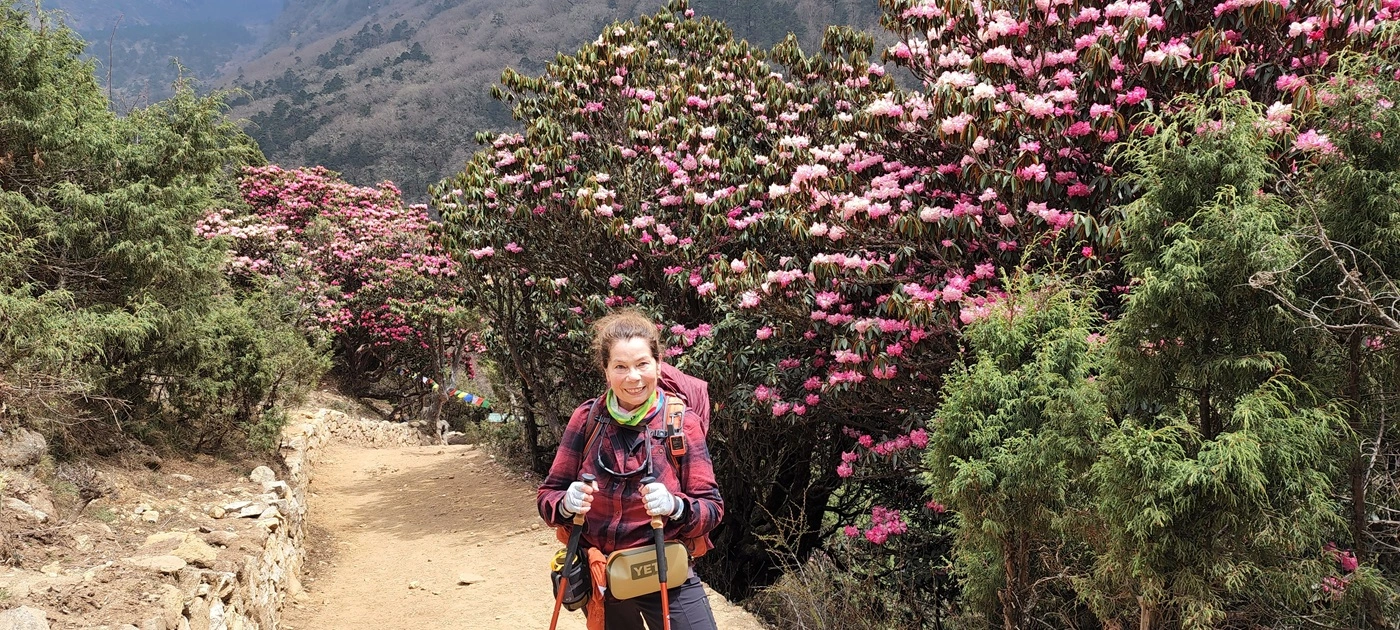
Rhododendron trekking in Nepal runs on altitude rather than dates. Crimson tree rhododendrons flower between 1,600 and 2,500 metres from late February through March, mid-elevation forests peak in early April, and pale subalpine shrubs above 3,500 metres bloom into early May. This guide maps every band and route.
Rhododendron Trekking in Nepal: How the Bloom Climbs the Mountain

Rhododendron trekking in Nepal works on altitude, not on the calendar. The bloom starts low and climbs. Crimson canopy fills the mid-hills while the high valleys are still locked in frost, and six weeks later the same spring is opening pale mauve flowers beside melting snowpack at 3,900 meters.
Miss the band by 800 meters of elevation, and you walk under bare branches or past buds that will not open for another month. Hit it, and you spend most of two days inside a closed flowering canopy with Dhaulagiri showing through the gaps.
This guide maps the bloom band by band and route by route. We plan our spring departures this way, so it is written the way we actually brief guests before they choose their dates.
When Do Rhododendrons Bloom in Nepal?
Nepal's rhododendrons bloom from late February to early May, and the flowering line moves uphill as spring warms the slopes. There is no single national bloom date. There is a thermal escalator, and the flowers ride it.
Lower forests between 1,600 and 2,500 meters go first. Mid-elevation stands between 2,500 and 3,500 meters follow through late March and the first half of April. The subalpine belt above 3,500 meters comes last, often flowering within sight of unmelted snow.
| Elevation band | Peak bloom | Dominant colours | Growth habit |
|---|---|---|---|
| 1,600–2,500 m | Late February to late March | Deep crimson and red | Canopy trees, 15–20 m |
| 2,500–3,500 m | Late March to mid-April | Rose, blush, white-pink | Mid-canopy trees and large shrubs |
| 3,500–4,000 m+ | Early April to early May | Pale mauve, purple, white | Subalpine shrubs and dwarf mats |
Nepal's main trekking windows are mid-March to mid-June (spring) and mid-October to mid-December (autumn). Worth knowing before you book: the lowest bloom band opens ahead of that spring window, so a trek built purely around crimson forest at 2,000 meters sometimes wants a departure slightly earlier than a standard spring itinerary.
Why the Flowers Change Color as You Climb
Color shifts with altitude because pigment does different work at different elevations. Low-forest Rhododendron arboreum carries heavy anthocyanin loading, which reads to the eye as deep crimson and helps the flower absorb warmth and shrug off ultraviolet exposure through unstable late-winter weather.
Climb, and the reds thin into rose, then blush, then white-pink. By the time the trail reaches the tree line, the palette has gone again — pale mauve, purple, cream, and clean white on plants barely taller than your boot.
The plants themselves shrink on the same gradient. Below 2,500 meters, R. arboreum grows into a 15 to 20 meter tree with a trunk you cannot get your arms around. Near 3,800 meters, cold, wind shear, thin soil and a short growing season produce compact shrubs and prostrate mats instead.
Nepal holds more than 30 rhododendron species. R. arboreum — Lali Gurans, the national flower — is the one nearly every trekker photographs, but the high-country species are the ones most visitors have never heard of.
Ghorepani and Poon Hill: The Densest Forest Walking in the Annapurnas
The Ghorepani ridge gives the most concentrated rhododendron walking in Nepal, and it does it on a route almost any reasonably fit walker can manage. The trail starts at Nayapul at 1,070 meters and climbs through Ulleri at roughly 2,050 meters to the ridge village of Ghorepani at 2,850 meters.
That climb crosses two bloom bands in a day and a half of walking. The stone staircase above Ulleri is the section people remember, partly for the thighs and partly because the canopy closes overhead about halfway up.
Ghorepani itself sits in the sweet spot. The forest around the village reaches full density between late March and early April, when red, pink and white all flower on the same slope.
The viewpoint at Poon Hill, 3,210 meters, then puts Dhaulagiri and Annapurna South above the flowering canopy in a single frame.
The onward leg is quieter and, for flowers, better. From Deurali at 2,960 meters, the trail drops to Tadapani at 2,630 meters and on to the Gurung village of Ghandruk at 1,940 meters, staying inside old-growth forest for hours at a stretch.
We prefer this direction for photographers. Morning light comes through the canopy on the descent rather than behind it.
The Modi Khola Gorge and the Climb to Annapurna Sanctuary
The Modi Khola gorge grows the tallest rhododendrons on any trail we operate. Its humid, sheltered microclimate produces R. arboreum specimens at the very top of the species' size range, and the walk from Chhomrong upward moves through them for a solid morning.
Then the structure changes completely. Tree rhododendrons give way to R. campanulatum thickets as the trail climbs past Deurali at 3,200 meters, and by the time the gorge opens into the Sanctuary at Annapurna Base Camp, 4,130 meters, the forest has stopped entirely.
That transition is the reason we rate this route highly for anyone who wants to understand the plant rather than just photograph it. You watch a 20-meter tree become a chest-high shrub over about 1,500 vertical meters of walking.
Timing here favors the first half of April. The gorge forest is at peak while the upper thickets are opening, which means one trek covers two bands.
Langtang: Bamboo Below, Pale Blossom Above
Langtang delivers the pale end of the spectrum better than any accessible valley in Nepal. Cold air drains off the glaciers into a narrow valley, holding the upper corridor several weeks behind the Annapurnas.
The lower section from Syabrubesi at 1,460 meters through Bamboo to Lama Hotel at 2,470 meters runs through mixed forest where rhododendron grows tangled with Himalayan bamboo, Yushania maling. This stretch peaks from late March into mid-April.
Above Lama Hotel, the valley widens under Langtang Lirung. Langtang Village sits at 3,430 meters and Kyanjin Gompa at 3,870 meters, and it is here that white, mauve and purple R. campanulatum flowers from mid-April into early May, often with moraine and old snow in the same view.
The standard approach to Langtang is a six- to seven-hour mountain road day. We fly it. Private helicopter is our default wherever the road access runs past four hours, which on this route means guests are inside the forest on their first morning instead of their second afternoon.
Tserko Ri, at 4,984 meters, adds the acclimatization-permitting high day. The flowers stop well below the summit, but the walk up passes the last dwarf shrubs clinging to the ridge.
Where Else the Bloom Shows Up: Khumbu, Pikey Peak and the East
Rhododendron forest exists on the Everest trail, but in pockets rather than corridors. The best of it sits between Lukla and Namche Bazaar, where R. arboreum and R. campanulatum stand in flower in early April with Ama Dablam behind them.
Lower Solukhumbu does it better. The Pikey Peak ridgeline carries long continuous stands of pink and white flowering varieties at trekking-friendly altitudes, and sees a fraction of the foot traffic of the main Khumbu trail.
Further east, Makalu Barun National Park takes the heaviest monsoon moisture in the country and repays it with botanical range. Large-leaved species including R. falconeri and R. grande grow here at the western edge of their range, and flowering above 3,800 meters can hold into late May.
That late window matters for planning. If your travel dates are fixed to May, the east is where the bloom still is.
How We Plan Rhododendron Trekking in Nepal
We build rhododendron trekking in Nepal around a target elevation band first and a route second. Tell us which colors you want, and we work backward to a departure date, because the reverse order is how people end up in bare forest.
A guest who wants crimson canopy and old trees leaves Kathmandu in the last week of March for the Annapurna mid-hills. A guest who wants pale subalpine flowers against glacier ice leaves around three weeks later for upper Langtang. Same spring. Different trek.
Everything else follows the same house pattern we use across Nepal. A rest and orientation day in Kathmandu after the international flight, unhurried altitude gain, a private guide holding the pace and running oximeter checks each evening, and a buffer night back in Kathmandu before you fly home.
Accommodation on these routes is a mix of the best lodges on the ridge and, lower down, a heritage-style property in the valley. We confirm the exact property in your booking proposal.
Permits are ours to handle. The Annapurna routes need Annapurna Conservation Area entry and a TIMS card; Langtang needs Langtang National Park entry and TIMS. Guests carry nothing but a passport copy.
The Bloom Is Arriving Earlier, and What That Means for Planning
Spring is starting earlier in Nepal's mid-hills, and the flowering calendar is moving with it. Mid-hill stands between 2,000 and 2,500 meters that once flowered reliably from mid-March now show first blooms as early as February in warm years.
Two consequences follow for anyone booking a trek. The first is simple: at the low end, book earlier than the guidance you read five years ago. The second is that variability itself has increased, so a fixed date is a weaker plan than a flexible band.
The ecological cost is more serious than a missed photograph. Early budburst exposes flowers to late frost, which can wipe out a season's seed production, and it risks pulling flowering out of step with the insect and bird pollinators whose cycles track daylight rather than temperature.
There is also nowhere left to go. As lower boundaries warm, forest belts shift uphill, but the subalpine species at the top run into thin soil, bare rock and wind. Community forestry groups and buffer-zone programs under Nepal's national park framework are doing the practical work of keeping these corridors intact.
What This Means When You Choose Dates
Pick the flower, then the mountain. Below is the short version of what we tell guests on a planning call.
For deep red canopy and the largest trees, aim at 2,000 to 3,000 meters from late March to early April, on the Ghorepani ridge or the lower Modi Khola.
For the full color range in one trek, walk the Ghorepani to Ghandruk arc in the first ten days of April, when three bands flower at once across a single hillside.
For pale, high, snow-adjacent flowers, aim at 3,200 to 4,000 meters from mid-April to early May, in upper Langtang, the upper Sanctuary approach, or Makalu Barun.
Walking Softly Through Flowering Forest
Flowering forest is working habitat, and spring is the season it can least afford damage. Our guides ask three things of guests on these routes, and they are small enough that nobody minds.
Stay on the trail through the canopy sections. The understory holds seedlings and moss that take years to recover from a shortcut, and the shortcut rarely saves more than a minute.
Leave the flowers on the tree. Fallen blossom carpets the trail in peak week and photographs better than anything picked, and in Nepal the Lali Gurans carry cultural weight beyond the botanical.
Ask before photographing people, particularly around the Gurung and Tamang villages these trails pass through. Most people say yes. The asking is the point.
Local forest user groups manage much of this woodland directly, and the lodges you stay in sit inside that system. Trekking here in spring funds the protection of the thing you came to see.
Frequently Asked Questions About Nepal's Rhododendron Season
When do rhododendrons bloom on the Ghorepani Poon Hill trail?
The forest around Ghorepani at 2,850 meters peaks between late March and early April. Lower sections near Ulleri, around 2,050 meters, start earlier, from the first week of March. Walking up through both bands in the same trek is the reason this route photographs so well: you cross roughly 1,800 meters of elevation and several weeks of flowering in three days.
Which Nepal trek has the best rhododendron forest for a first-time trekker?
The Ghorepani ridge, walked through to Ghandruk. It keeps you inside old forest for hours at a time, tops out at 3,210 meters on Poon Hill, and needs no altitude experience. The descent through Tadapani is the flower-heavy half and the part most itineraries rush. We give it a full day.
Are there rhododendrons on the Everest Base Camp trek?
Yes, in the lower Khumbu between Lukla and Namche Bazaar, flowering in early April. The stands are patchy rather than continuous, because the trail climbs above the tree line quickly. If flowers are your main reason to travel, the Annapurna or Pikey Peak routes give far more forest for the same walking days.
Why are Langtang's rhododendrons white and purple rather than red?
Because the upper valley sits above 3,400 meters, where Rhododendron campanulatum replaces the crimson tree species of the mid-hills. High-altitude species carry different pigment loads and produce pale mauve, purple and white flowers. The red R. arboreum is still there, but lower down, between Syabrubesi and Lama Hotel.
How high do rhododendrons grow in the Nepal Himalaya?
Rhododendrons grow to roughly 4,000 meters and a little beyond, at which point dwarf species such as R. anthopogon and R. setosum take over as scented, ankle-height mats on open ridges. Above that, thin soil, wind and a very short growing season end the genus. Everything higher is rock, lichen and snow.
Can we see rhododendrons and high mountain views on the same Nepal trek?
Yes, and the combination is easier than most people expect. Poon Hill at 3,210 meters puts Dhaulagiri and Annapurna South above a flowering canopy, and Kyanjin Gompa at 3,870 meters sets pale blooms against Langtang Lirung and its glaciers. Both sit within a week's walking of Kathmandu with helicopter access.
Is late February too early for a rhododendron trek in Nepal?
Not for the lowest band. Forests between 1,600 and 2,200 meters often show good color by the last week of February, particularly in warm years. Higher up, nothing has opened. A late-February trek needs to stay low deliberately, and we would build a valley-and-mid-hills route rather than a ridge route for those dates.
How does Alpine Luxury Treks time a private rhododendron trek?
We start from the elevation band you want, not from a fixed departure date. Once you tell us which colors and which forest structure matter to you, we set the dates, route, and altitude profile around that, then hold flexibility in the first two days so we can adjust if the season runs early or late.
Walking It
Spring in the Nepalese mid-hills is loud, warm and full of color, and it lasts about ten weeks if you follow it uphill. Most trekkers catch a slice of it by accident. Planning around the bands is how you catch the part you actually came for.
If you would like us to build a spring departure around a specific bloom band, our private Ghorepani Poon Hill trek is where most rhododendron journeys start, and we adjust the route and dates from there.
Need Help? Call Us+977 9851013196orChat with us on WhatsApp
Need Help? Call Us+977 9851013196