The Everest Base Camp trek in winter trades company for clarity. From December to February, the Khumbu empties, the air dries out, and the mountains sharpen. Nights at Gorak Shep fall to -25°C, high lodges shut, and the Pheriche aid post closes for the season. Cold, quiet, and demanding.
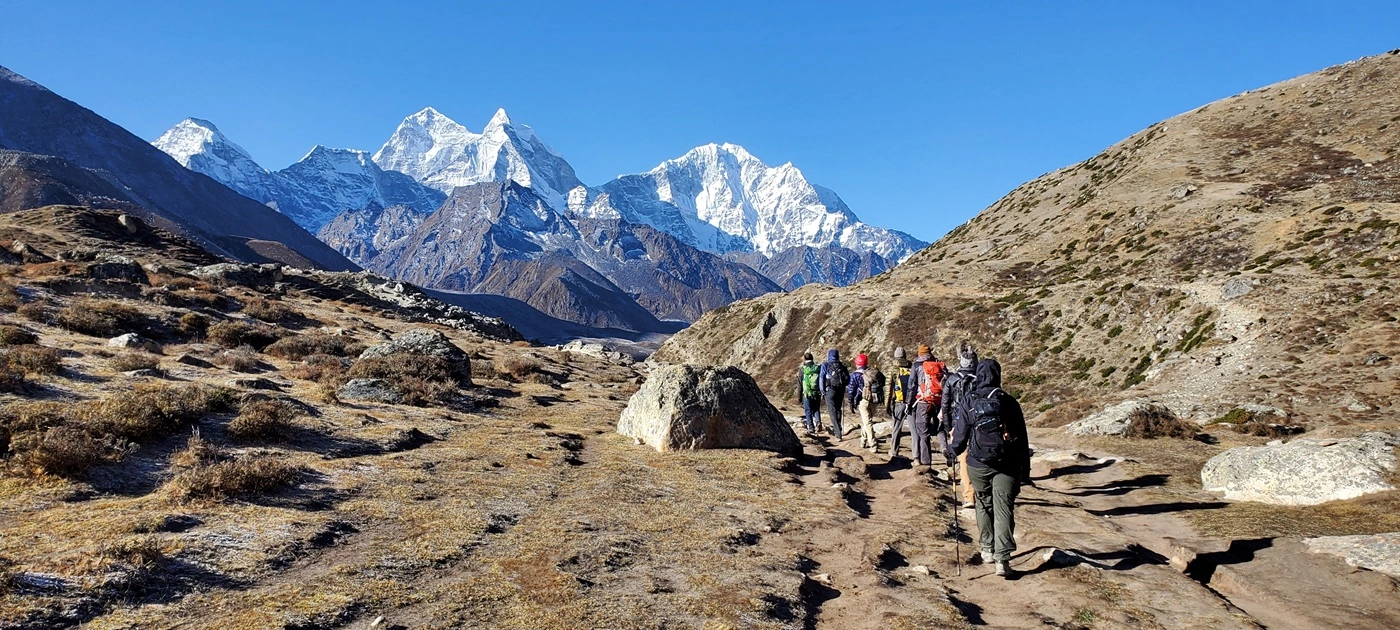
Everest Base Camp Trek in Winter: What the Khumbu Is Really Like from December to February

The Everest Base Camp trek in winter is a different route from the one most people picture. Same trail, same altitudes, almost none of the same conditions.
The autumn crowds are gone by mid-December, the haze goes with them, and what remains is a hard, bright, very cold valley that rewards preparation and punishes improvisation.
We run private winter departures in the Khumbu. They are not for everyone, and we say so before anyone books.
This guide covers what the cold actually does at each elevation, which lodges and clinics close, how the Lukla approach changes, and the gear decisions that separate a good winter trek from a shortened one.
Can you trek to Everest Base Camp in winter?
Yes, the route stays open and walkable through December, January and February, provided you carry winter kit and accept thinner support on the ground. Nothing about the trail is technically closed. What changes is the margin.
Three things shift at once. Lodges above Dingboche start shutting, the trail above Lobuche ices over, and the seasonal medical posts stand empty until spring.
Handled well, none of that is disqualifying. Handled casually, all three compound. A guided winter trek plans around closures before departure rather than discovering them at 4,900 meters.
How cold does it get on the Everest Base Camp trek in winter?
Cold enough that your water freezes indoors. Daytime temperatures between Lukla and Namche Bazaar can still sit pleasantly in the sun, but the drop after sunset is fast and severe, because dry winter air holds no heat once the peaks cut the light.
Here is the pattern by elevation band, in typical January and February conditions:
- Lukla (around 2,845 m): roughly 4°C to 10°C by day, -2°C to -5°C overnight
- Namche Bazaar (3,440 m): 0°C to 5°C by day, -6°C to -10°C overnight
- Dingboche (4,410 m): -2°C to 3°C by day, -13°C to -18°C overnight
- Gorak Shep and Everest Base Camp (5,164 m to 5,364 m): -5°C to 0°C by day, -15°C to -25°C overnight
Wind rewrites all of it. The winter jet stream drops closer to the ridgelines in these months, and a reading of -15°C on the Kala Patthar climb (5,545 m) can feel closer to -30°C on exposed ground.
Daylight is the other constraint. You get eight to ten usable hours, which means an early start, a disciplined lunch stop, and arrival before dusk rather than at it.
Why the winter Khumbu gives the clearest views of the year
Winter is the driest window in the Khumbu, and dry air is what makes the mountains look close enough to touch. Monthly precipitation in January and February usually stays under 20 millimeters.
That absence of moisture strips the haze that softens the skyline in late spring. Everest, Lhotse, Nuptse and Ama Dablam hold hard edges from the Tengboche ridge all the way to the Khumbu Glacier.
Photographers know this and quietly plan around it. The light is low, the contrast is high, and there is nobody standing in your frame.
The ice above Lobuche, and what it does to your feet
The trail above Lobuche (4,940 m) stays iced from late December through mid-February, and standard trekking boots alone are not enough on it. Traction is not an optional extra here.
Microspikes handle most of the compacted sections. Crampons come out where the moraine above Gorak Shep glazes over and on the pre-dawn Kala Patthar climb, which is the single most common place people slip.
Boots matter as much as spikes. Insulated, waterproof, and — this catches people out — not laced so tightly that circulation dies in the toes.
Winter flying: the Lukla approach gets simpler
Winter removes the Ramechhap problem. During busy trekking seasons, Nepal's aviation authority has routed Lukla-bound fixed-wing flights out of Manthali Airport in Ramechhap to ease congestion at Kathmandu's international airport, and that means a 130-kilometer mountain drive of four to six hours, usually starting around 1:00 AM.
Winter traffic drops far enough that direct Kathmandu departures generally resume. No pre-dawn drive, no arriving at the trailhead already tired.
Tenzing-Hillary Airport itself is unchanged by season. A 527-meter runway with a 12% uphill gradient, a mountain wall at the far end, visual flight rules only, and clear winter skies that help until the wind picks up.
Our Khumbu standard removes the variable altogether: we fly our guests by private helicopter in both directions between Kathmandu and Lukla, in every season. It costs more than a fixed-wing seat. It also means no Ramechhap drive, no queue for a rescheduled flight, and a start time that suits the guest rather than the manifest.
What closes in the Khumbu in winter
Two closures matter more than any weather forecast: high lodges and the seasonal aid posts. Both are predictable, and both need checking before you leave Namche Bazaar rather than after.
Lodges above Dingboche
After mid-December, many lodge families above Dingboche (4,410 m) shut and descend to lower ground, including operators at Lobuche and Gorak Shep. Enough stay open to make the route viable, but not enough to leave it to chance.
Before every winter departure, we have our Khumbu team confirm by phone and radio which specific lodges above 4,000 meters are running that week, and we shape the plan around the answer. It is unglamorous work.
It is also the difference between a warm dining room at 5,164 meters and a very long walk back down.
Expect the rooms themselves to be unheated whatever the altitude. Only the dining hall is warm, heated by a central bukhari stove burning dried yak dung and wood, and everyone in the lodge gathers there from mid-afternoon.
The Pheriche aid post and Everest ER
The Himalayan Rescue Association's aid post at Pheriche (4,250 m) operates during the spring and autumn trekking seasons only. Through December, January and February it is closed, as is the base camp clinic that runs alongside the spring climbing season.
The post exists because altitude illness in this valley used to kill trekkers regularly. It began as a rented yak hut staffed by volunteers, grew into a stone building with radios, diagnostics and a lecture room, and has done more to cut altitude deaths in the Khumbu than any piece of equipment.
In winter, that safety net is not there. Intermediate stabilization — oxygen, a portable hyperbaric bag, a doctor's second opinion — has to travel with your team or it does not exist on the mountain.
Altitude still runs the trek, cold or not
Cold does not change the acclimatization maths; it makes following it harder. Sleeping altitude above 3,000 meters should rise no more than 300 to 500 meters a day, with rest days built in around Namche Bazaar and Dingboche.
Acute mountain sickness typically announces itself between Namche and Dingboche, where the nightly altitude gain steepens. Headache, poor appetite, broken sleep, nausea. Most cases resolve with a halted ascent, fluids, and a day of rest.
The two emergencies — fluid on the brain and fluid in the lungs — are rare but unforgiving, and both are treated the same way first: descend, immediately, at least 500 meters, with oxygen if it is available.
Winter adds a quieter risk. Dehydration. Altitude blunts thirst and increases fluid loss through the lungs, and when every water source is frozen, people simply stop drinking enough. Thick blood, cold hands, worse headaches, higher chance of turning back.
We take pulse oximeter readings twice daily on our Everest departures, morning and evening, and we log them. Trends matter more than single numbers. A guest whose overnight saturation drops three days running gets a plan change before symptoms arrive, not after. You can read more about how we manage altitude on the Everest route in our dedicated guide.
How people actually get frostbite here
Almost nobody gets frostbite from the weather alone. They get it from a decision that took ninety seconds.
Gloves come off to work a camera on the Kala Patthar climb. Or to retie a frozen bootlace on an exposed ridge. Or to send one message from a spot where the phone finally has signal.
The early stage is numbness and pale skin with no pain, which is exactly why it gets ignored. Deeper injury brings blistering and, at its worst, permanent tissue damage.
The fix is systems, not willpower. Thin liner gloves stay on for every task, heavy mittens go over them, and camera settings get sorted the night before so nobody is fumbling menus at -20°C.
Hypothermia in the Khumbu rarely arrives dramatically. It builds from sweat trapped in the wrong base layer, from a long rest stop in the wind, from an ankle tweak that turns a walking pace into a standing one.
What the trail feels like when nobody is on it
Winter arrivals in Sagarmatha National Park fall by roughly ninety per cent against the peak months, and the trail behaves accordingly. The suspension bridge queues disappear. So do the crowded dining halls and the scramble for a bed at Tengboche.
Some winter days you walk for hours through the upper valley without passing another foreign group. That solitude is the whole reason to come in this season, and it is not a marketing line — it is arithmetic.
It also has a cost, and the cost falls on the Sherpa communities who depend on the season. Lodge income stops in December. Families descend to the Kathmandu valley for the winter or travel on pilgrimage to Bodhgaya, and villages that hummed in October stand half-shuttered by January.
Namche Bazaar in winter is a quieter, more inward place than the one on the postcards. We think it is worth understanding that before you arrive, and worth spending money locally while you are there.
Tengboche Monastery in the cold months
Tengboche (3,867 m) is the cultural anchor of the Khumbu, and winter is when it belongs to the monks again. The gompa sits on a ridge where the Dudh Kosi and Imja Khola valleys meet, framed by Everest, Lhotse, Nuptse and the fluted spire of Ama Dablam.
It was established in the early twentieth century by a Nyingma lama with backing from Sherpa donors, and Sherpa tradition holds that the site was prophesied centuries earlier, with the footprints of the lama who foresaw it still shown in nearby rock. It was the first celibate monastery in Solukhumbu and kept long spiritual ties with Rongbuk, on Everest's Tibetan side.
The building has been lost twice, first to a major earthquake and again to an electrical fire that destroyed murals and scriptures. Both times the community rebuilt it in stone and timber, with international help, and the golden roof you see today is the result.
The masked dances of the Mani Rimdu festival fill the courtyard in the tenth lunar month, which falls in autumn; exact dates shift each year with the lunar calendar and are confirmed closer to the time. In winter, the courtyard is nearly empty, the juniper smoke hangs in the cold air, and an hour sitting through the afternoon chanting does more for tired legs than an extra rest day.
What we pack differently for a winter Khumbu departure
Winter kit is not autumn kit with an extra fleece. The margin at -25°C is small enough that three items are non-negotiable and everything else follows from them.
A four-season sleeping bag rated to -20°C or -25°C, because lodge bedrooms are unheated and drop below freezing every night. A thermal liner adds another 5°C to 10°C for very little weight.
A heavyweight down jacket, worn in the dining hall, worn to bed some nights, and absolutely worn on the pre-dawn Kala Patthar climb.
Wide-mouth insulated bottles. Bladders and hoses freeze solid, usually within the first hour of a cold morning. Our crews fill bottles with boiling water at night, and they go inside the sleeping bag, which keeps you warm and guarantees liquid water at breakfast.
Beyond that: merino or synthetic base layers with no cotton anywhere, a windproof shell, a balaclava, UV goggles for glare off snow, liner gloves under heavy mittens, and traction for the ice above Lobuche. Our full Everest Base Camp packing list covers the rest item by item.
Food shifts too. Dal bhat, Sherpa stew and momos hold up all winter, but fresh vegetables thin out and lodges lean on stores laid in before the freeze.
Should you attempt the Everest Three Passes in winter?
Not as a first winter objective, and not without genuine mountain experience. The Three Passes circuit crosses Kongma La (5,535 m), Cho La (5,420 m) and Renjo La (5,360 m), and in January and February all three carry deep snow and hard ice.
Kongma La is the most isolated and has almost no shelter. Cho La involves a glacier crossing that shifts. White-outs come fast on these saddles and route-finding stops being intuitive the moment fresh snow covers the line.
Lodge availability in the Gokyo and Chhukung valleys thins further than on the main trail, and helicopter access in that terrain is constrained by topography as much as by weather. Crampons are mandatory, not advisable.
We do run it for the right guests, with the right crew ratios and a longer schedule. If the circuit interests you, read the Three Passes circuit in full before deciding on a season.
Permits and paperwork for a winter Everest trek
Permit requirements do not change in winter, and both are handled before you walk. The Khumbu Pasang Lhamu Rural Municipality permit is issued locally at Lukla, and the Sagarmatha National Park entry permit is checked at the Monjo post.
Nepal's national park entry fee for foreign nationals sits at NPR 3,000 at the time of writing, with a lower rate for SAARC nationals and a nominal domestic rate, plus applicable VAT. Fees are set by the park authority and revised periodically.
There is no TIMS card on this route; the municipality permit replaced it. We arrange both permits for our guests as part of the trip, so nothing depends on a queue in Lukla on a cold morning.
Insurance is the item people get wrong. Winter policies need explicit cover for high-altitude trekking to 6,000 meters and for helicopter search, rescue and evacuation. Without the evacuation clause, a winter incident above Dingboche becomes an expensive conversation at the worst possible moment.
Who a winter Everest Base Camp trek suits
It suits people who have trekked at altitude before, who own or will buy proper cold-weather kit, and who value an empty trail more than a warm room. It suits photographers. It suits repeat visitors who found the autumn route too busy.
It does not suit first-time high-altitude trekkers, anyone on a tight schedule with no weather buffer, or anyone hoping the cold will be milder than the numbers suggest.
If you want the Khumbu without the winter penalty, autumn and spring remain the standard windows: mid-March to mid-June and mid-October to mid-December. If you want the Khumbu almost to yourself, this is the season, and it asks a real price for it. Our wider guide to private journeys across the Himalaya sets out how we build these trips.
Frequently asked questions about the winter Everest Base Camp trek
Is the Everest Base Camp trek in winter harder than the autumn trek?
Yes, meaningfully harder. The distance and altitude are identical, but cold, ice above Lobuche, shorter daylight and reduced lodge availability all add load. Most guests find the walking similar and the hours around it far more demanding. Anyone comfortable on an autumn Khumbu trek can manage winter with the right kit and a guided plan.
How cold does it get at Gorak Shep in December, January and February?
Daytime temperatures at Gorak Shep (5,164 m) typically run between -5°C and 0°C, with overnight lows between -15°C and -25°C. Wind chill on exposed ground can make it feel considerably colder. Lodge bedrooms are unheated, so overnight temperatures inside are close to those outside.
Do teahouses stay open at Lobuche and Gorak Shep through the winter months?
Some do, but not all, and availability changes week to week. After mid-December, many lodge families above Dingboche close and descend to lower villages. We confirm which specific lodges are operating before each winter departure rather than relying on the previous season's information.
Are Lukla flights more reliable in winter than in the autumn season?
Winter flights generally depart directly from Kathmandu instead of Manthali Airport in Ramechhap, which removes a long pre-dawn drive. Reliability still depends on wind and visibility at Lukla. We fly our Khumbu guests by private helicopter in both directions, which sidesteps fixed-wing scheduling entirely.
Do you need crampons for the Everest Base Camp trek in winter?
Microspikes are sufficient for most of the main route, and full crampons are worth carrying for the moraine above Gorak Shep and the Kala Patthar climb. Above Lobuche the trail holds ice from late December to mid-February. Boots alone are not adequate on those sections.
Is the Pheriche aid post open during a winter Everest trek?
No. The Himalayan Rescue Association's Pheriche aid post staffs only the spring and autumn trekking seasons and is closed through December, January, and February. Winter groups depend on their guide's assessment and on helicopter evacuation, which makes carried oxygen and comprehensive rescue insurance essential rather than optional.
Can you see Everest more clearly on a winter Khumbu trek than in spring?
Usually, yes. Winter is the driest period in the Khumbu, with monthly precipitation typically under 20 millimetres, and the dry air removes the haze common in late spring. Views of Everest, Lhotse, Nuptse and Ama Dablam are at their sharpest, particularly in the hours after sunrise.
How much snow sits on the trail between Namche Bazaar and Dingboche in winter?
Usually less than people expect. The lower and middle valley sees relatively little accumulation because winter precipitation is low, though shaded sections and north-facing switchbacks hold packed snow and ice. Significant, persistent ice starts higher, above Lobuche, where traction becomes necessary rather than useful.
Is the Everest Three Passes trek possible in January or February?
Possible, but only for experienced mountain trekkers with crampon skills and a guided team. Kongma La, Cho La and Renjo La all carry deep snow and ice in midwinter; shelter between them is sparse, and white-outs can erase the route. We schedule extra contingency days for any winter attempt on the circuit.
Walking the Khumbu with us
We run every Everest departure privately, with helicopter transfers in both directions, a rest day in Kathmandu after arrival, and a buffer night before your flight home. In winter we add the lodge checks, the extra oxygen, and a schedule with room in it. If a quiet Khumbu appeals, look at our private Everest Base Camp trek and tell us which month you have in mind. We will give you a straight answer on which season fits.
Need Help? Call Us+977 9851013196orChat with us on WhatsApp
Need Help? Call Us+977 9851013196