A Nepal safari vs African safari comparison comes down to sightlines. The Terai's sal forest and elephant grass cut visibility to under fifty metres, so you track wildlife on foot and from a dugout canoe instead of spotting it across open plains. Fewer guaranteed sightings, far fewer vehicles, much closer encounters.
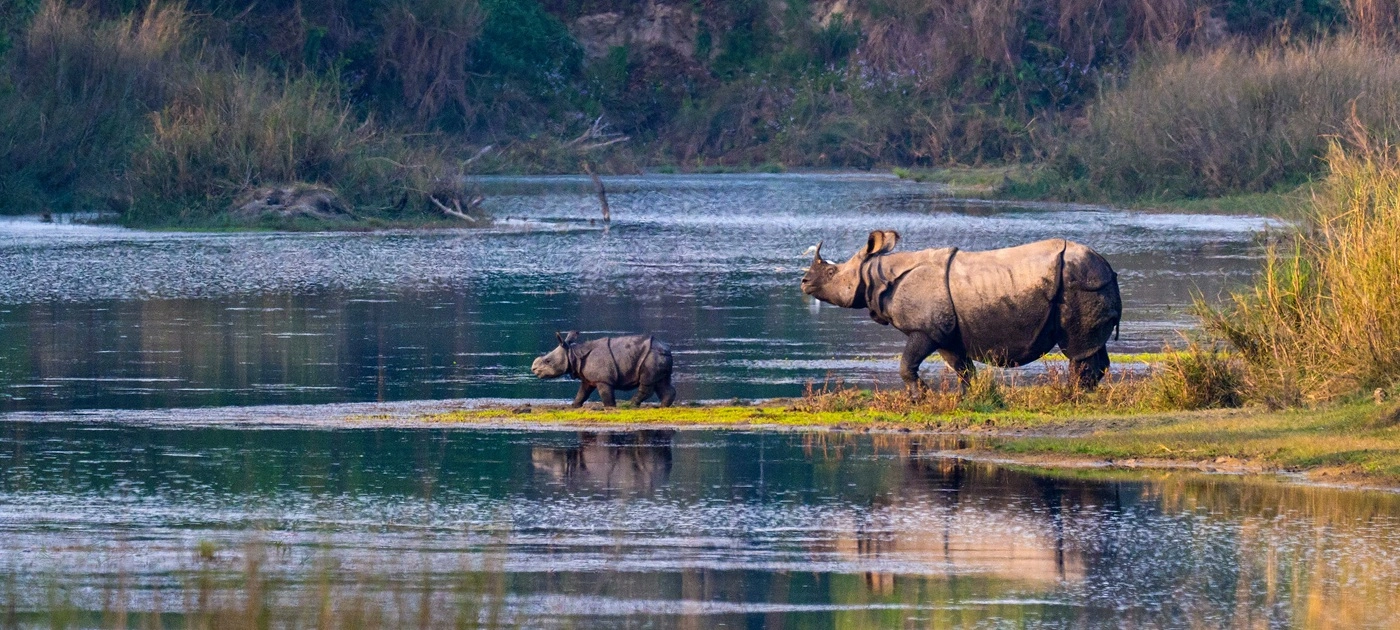
Nepal Safari vs African Safari: What Actually Changes in the Terai

The honest answer to Nepal safari vs African safari is that these are not the same holiday with different animals in it. They are two different ways of seeing.
Africa hands you distance and open ground, with a lot of animals in one frame. Nepal's lowland Terai hands you dense cover, short sightlines, and a spotted deer barking an alarm somewhere you cannot see.
Guests who have done Kenya, Tanzania, or Botswana arrive with a mental picture of what a game drive is. Almost every disappointed safari we have ever had to fix started there. So we set the expectation before anyone books.
Nepal safari vs African safari: the short answer
An African safari is built on visibility; a Nepal safari is built on patience. In the Serengeti or the Okavango, guides scan hundreds of meters of open plain, radio each other, and position the vehicle before the animal arrives. That system works because you can see.
In Chitwan National Park and Bardia National Park, you often cannot see past the next stand of grass. Sightings happen at five to fifty meters, usually of one animal at a time, usually with nobody else present. The trade is real and it cuts both ways.
You give up reliability. You get solitude, and you get to do the finding yourself.
Why the Terai looks nothing like the savanna
The difference is vegetation structure, not species lists. Nepal's Terai runs along the southern edge of the Himalaya as a belt of subtropical sal forest (Shorea robusta), riverine woodland, and floodplain grassland. The tall grasses here — elephant grass among them — reach seven metres and more before the winter cut.
Acacia savanna is open at eye level. Sal forest is layered, and grassland at that height is a wall. Animals do not stand out in it; they step out of it, into a riverbed or onto a gravel bank, and then they are gone again.
That single fact reshapes everything downstream: how you move, how long you sit, what your guide is actually reading, and how you should judge a good day.
Liftable fact: In Chitwan and Bardia, typical sightlines run from five to fifty meters, against several hundred meters to a few kilometers on open African savanna.
How you move: on foot, in a dugout, in a jeep
Nepal is one of the few places in Asia where licensed naturalists walk guests inside a national park's core zone. Most African parks restrict walking to designated wilderness areas under armed escort. Here, the walk is the main event.
The walking safari
Your naturalist carries a lathi, a heavy wooden staff, and nothing else. Safety comes from reading the ground, not from firepower. Wind direction, group spacing, escape routes left open for the animal, and an ear on the alarm calls of spotted deer and rhesus macaques — that is the whole system, and it works because the people running it have walked these forests for years.
We brief every group the evening before the first walk: single file, no talking above a murmur, and what to do if a rhino stands up out of the grass ahead. It is a short conversation, and it changes the whole morning.
On foot you get the parts a vehicle removes. Dry sal leaves cracking underfoot.
Tiger pugmarks pressed into wet river clay, still holding water. The smell of an animal that passed twenty minutes ago.
The dugout canoe
River mornings are done in hand-carved wooden dugouts with no engine, drifting with the current down the Rapti in Chitwan or the Karnali in Bardia. Silence is the point. You come around a bend at the same speed as the water and nothing has heard you.
This is when the reptiles and the birds pay off. Gharial (Gavialis gangeticus), the narrow-snouted fish-eating crocodile listed as Critically Endangered, bask on the sandbars alongside marsh muggers. Chitwan's bird list runs past five hundred species, from storks and kingfishers to wintering waterfowl off the Central Asian flyway.
The elephant question
We do not put guests on an elephant's back on any Terai itinerary. The wooden howdah saddle causes documented harm, and the industry here has been moving away from riding for years.
What we book instead is a walk alongside the animals as they forage through buffer zone forest, with the handlers explaining herd behavior and tracking. You learn considerably more, and nothing is carrying you.
Chitwan or Bardia: which park, which traveler
Chitwan is the rhino park and the accessible one; Bardia is the tiger park and the remote one. Both sit inside the Terai Arc Landscape and share a species list, but they do not deliver the same trip.
Chitwan was gazetted in 1973 as Nepal's first national park and inscribed as a UNESCO World Heritage Site in 1984. It covers roughly 952 square kilometers of sal forest, grassland, and the channels of the Narayani and Rapti rivers. It is a short flight from Kathmandu to Bharatpur; it holds the great majority of Nepal's greater one-horned rhinos, and it carries more visitors than anywhere else in the Terai.
Bardia is roughly the same size, far to the west, and much quieter. Getting there means a flight to Nepalgunj and a drive out to the Karnali and Babai river systems. Tigers hold smaller home ranges here than in Chitwan, which lifts your odds per kilometer walked, and the lodges are smaller and lower-key.
Rule of thumb: rhino, birds, and easy logistics point to Chitwan. Tiger tracking and genuine remoteness point to Bardia. A week gives you both.
The tiger question: what the odds really are
Seeing a wild Bengal tiger in Nepal is a possibility, not a deliverable. This is the single most important sentence in this article, and we would rather you read it here than discover it on the fourth morning.
Nepal has done extraordinary work rebuilding these populations. The national tiger count has climbed from 121 at the start of the TX2 commitment to 355 at the last nationwide survey, and the most recent rhino census counted 752 greater one-horned rhinos, roughly nine in ten of them in Chitwan.
More tigers does not mean more sightings, though. It means more tigers inside vegetation you cannot see into. Plenty of four-night stays in Bardia end with pugmarks, alarm calls, a scrape on a trail, and no cat.
If a guaranteed big-cat photograph is the actual objective of the trip, Nepal is the wrong booking, and we will tell you so before you pay a deposit. What Nepal gives you instead is a jungle with almost no vehicles in it and the chance to find the animal yourself.
When to go: the Terai runs on a different calendar
The best wildlife viewing in the Terai is January to April, which is not the same window as trekking in the mountains. Our Himalayan seasons are mid-March to mid-June (spring) and mid-October to mid-December (autumn). The lowlands do not follow that clock.
Post-monsoon, from October into December, the Terai is pleasant and clear, but the vegetation is at its tallest and thickest. Good for birds and comfort, harder for mammals.
January and February are the turn. Local communities cut and harvest grass in designated buffer zone areas under permit, and visibility across the grasslands opens up dramatically for a few weeks.
March and April are the best odds of the year. Heat builds, the smaller water sources dry, and tigers and rhinos concentrate along river corridors and remaining pools. Monsoon, June to September, floods the rivers, closes core park roads, and ends the walking programs.
If you are combining a safari with a trek, the overlap is March to mid-April. That fortnight is the most efficient window in the Nepalese year.
Where your park fee actually goes
Nepal's conservation recovery is built on revenue sharing, and it is the most quotable thing about a safari here. An amendment to the National Parks and Wildlife Conservation Act in 1993 created buffer zones around the parks, and the Buffer Zone Management Regulations of 1996 fixed the mechanism.
Between 30 and 50 percent of a park's gross tourism revenue — entrance fees, permits, vehicle charges — goes back to the communities living on its edge. Buffer Zone User Committees decide how it is spent, within a fixed allocation:
- 30 percent to community development: schools, health posts, trails, roads
- 30 percent to conservation: predator-proof cattle sheds, fencing, embankments, biogas
- 20 percent to income generation and skills, including naturalist guide training
- 10 percent to conservation education
- 10 percent to administration
Degraded land outside the park boundaries has been handed back to those committees as buffer zone community forest, and thousands of hectares around Chitwan have been restored. Those forests now work as bio-corridors, taking pressure off the core park.
It is not a solved problem. Recovering wildlife populations mean more crop damage, more livestock losses, and occasional deaths on park margins, and revenue is heavily skewed toward the parks that already get the visitors. Communities in the quieter parks carry the same costs on a fraction of the income.
What our safaris look like in practice
We run the Terai the way we run everything else: private, small, and unhurried. One naturalist to your group, your own vehicle, and a schedule you set rather than a lodge timetable you join.
Accommodation is lodge-style — verandas facing the grassland or the river, open-sided dining, plunge pools, and a hot shower after a dusty afternoon. We confirm the exact property in your booking proposal.
Days start early. First light is when the grass still holds the night's tracks, and it is when the river is quietest. Most guests do a walk or a canoe in the morning, sit out the middle of the day, and go back out from mid-afternoon until the light goes.
We fly rather than drive wherever driving would take the day. A Kathmandu–Bharatpur hop is around twenty-five minutes against a long road along the Trishuli, and it puts you in the park for an afternoon drive on the day you arrive.
Frequently asked questions
Is a Nepal safari worth it if I have already done an African safari?
Yes, provided you go for the difference rather than a repeat. The Terai delivers close-range, single-animal encounters in dense subtropical jungle with very few vehicles, plus walking and canoeing inside a national park. Travellers who most enjoy Nepal are the ones who valued the tracking on their African trips more than the sighting counts.
How likely am I to see a wild tiger in Bardia National Park?
Treat it as a genuine possibility, not an expectation. Bardia has one of the highest tiger densities in Nepal and compact home ranges, but the sal forest and tall grass hide animals extremely well, and a good number of four-night stays end without a sighting. Longer stays and a March or April visit improve your odds meaningfully.
Can you walk on foot inside Chitwan National Park?
Yes. Nepal permits guided walking safaris inside the core zones of Chitwan and Bardia with licensed naturalists, which is unusual in Asia and rare in most African parks. Guides carry a wooden lathi, not a rifle, and safety rests on wind reading, group discipline, and leaving animals an escape route. Groups stay small.
Do your Nepal safaris include elephant-back rides?
No. We do not book elephant-back riding on any Terai itinerary, because the wooden howdah saddle causes real harm to the animal. We arrange walks alongside foraging elephants in buffer zone forest instead, which teaches guests more about herd behaviour and tracking than a ride ever did.
What is the best month for a Terai jungle safari in Nepal?
March and April give the best mammal viewing. Rising heat draws tigers and rhinos toward rivers, and shrinking water sources, and the grass has already been cut back. January and February follow closely, once the community grass harvest opens the sightlines. Avoid the monsoon months of June to September, when core park roads close.
How do I get from Kathmandu to Chitwan and Bardia?
Chitwan is a short scheduled flight to Bharatpur, then a transfer to the park. Bardia sits far to the west and needs a flight to Nepalgunj followed by a road transfer to the Karnali. We fly guests on both legs rather than putting a full day into the highway, and we can charter privately where schedules do not line up.
Does a Nepal safari combine well with a Himalayan trek?
Very well, and the seasons overlap in March and early April. Guests typically finish a mountain itinerary, drop to Kathmandu for a rest night, then fly to the lowlands for three or four nights in the Terai. The altitude change is a relief rather than a strain, and the contrast between snow and subtropical jungle is the reason many people book Nepal at all.
Planning your Terai days
The Terai rewards travelers who like the search as much as the find. If that sounds like your kind of trip, our private lowland journeys build the safari around your pace, your season, and how much of the walking you actually want to do.
Need Help? Call Us+977 9851013196orChat with us on WhatsApp
Need Help? Call Us+977 9851013196