The Sacred Month of Merit in Tibetan Buddhism
The Saga Dawa festival is the most revered period in the Tibetan Buddhist calendar, falling in the fourth lunar month and culminating on the full moon day known as Saga Dawa Düchen. It honors three events in the Buddha's life at once — his birth, his Enlightenment, and his parinirvana — and for a full month, it shifts how devotees across Tibet, Nepal, Bhutan, and the wider Himalaya eat, give, walk, and pray. If you are drawn to the Himalaya for more than scenery, this is the window worth planning a journey around.
What Saga Dawa Means
The name comes from old Tibetan astrology. "Saga" is the 28th constellation, prominent in the eastern sky through this month. "Dawa" simply means moon or month. The festival is observed across Tibet, Nepal, Bhutan, Ladakh, Sikkim, and every monastery of the wider diaspora.
What sets Saga Dawa apart from other festivals is the density of what it holds. Most religious holidays commemorate a single moment. Saga Dawa holds three. The Buddha's birth in Lumbini, his Enlightenment beneath the Bodhi tree at Bodh Gaya, and his passing at Kushinagar are remembered in the same lunar cycle, with the full-moon day as the peak.
The Month of Merit
Tibetan spiritual texts describe Saga Dawa as a period when karma behaves differently. The Vinaya text, Treasure of Quotations, teaches that every action performed during the month, whether helpful or harmful, carries a hundred thousand times its normal weight. On the full moon day itself, that multiplier rises to a hundred million. This is why the month is called, simply, the Month of Merit.
For practitioners, the mathematics matter less than the discipline they encourage. Saga Dawa is an annual reset. A month to give more than you take, to speak carefully, to eat lower on the food chain, and to remember that ordinary days still matter.
The Three Events the Festival Honors
Birth in Lumbini. In the Mahayana tradition, the Buddha's birth is not a simple biological event. It is the deliberate return of an awakened being into the world of suffering, chosen to guide others toward liberation. Lumbini, in the Nepal Terai, remains the physical site of that arrival.
Enlightenment at Bodh Gaya. At thirty-five, beneath the Bodhi tree, Siddhartha Gautama saw through the roots of suffering and realized the Four Noble Truths. This is the moment the prince became the Buddha — the Awakened One.
Parinirvana at Kushinagar. The Buddha's passing at eighty is not mourned as ordinary deaths are. It is understood as a full release, the final dissolving of karmic bonds — the reminder that even the most realized teacher walked through impermanence.
The Fire Horse Year and Mount Kailash
The Tibetan calendar runs on a sixty-year cycle pairing twelve animal signs with five elements — wood, fire, earth, metal, and water. Once every sixty years, these align to produce the Year of the Fire Horse, one of the rarest and most charged years in Tibetan astrology.
The Horse is tied directly to Mount Kailash, known in Tibetan as Kang Rinpoche. The Wind Horse, Lungta, governs the movement of vital energy and the pace of spiritual growth. Fire acts as a purifier, burning away attachment. Together, they produce a year in which the sacred mountain is believed to respond more generously to the effort of the pilgrim.
Tradition holds that a single kora of Kailash performed during a Horse Year carries the merit of thirteen koras in an ordinary year. When a Fire Horse Year aligns with Saga Dawa, the two multipliers stack, and devotees from every corner of the Buddhist world begin planning years in advance. We always see our Kailash departures fill up earliest in these years, and we recommend that anyone considering the journey reach out to us well in advance.
Impermanence as the Lesson Underneath
Saga Dawa looks festive on the surface — butter lamps, prayer flags, chanting crowds at Barkhor. Underneath runs a quieter theme: impermanence, or anicca. Even the Buddha passed through sickness, old age, and death.
You see the lesson physically during the month. A butter lamp burns brightly and is gone. New prayer flags fade within a season of Himalayan wind. Butter sculptures melt as the days warm. Tibetan Buddhism treats these cues as teachings rather than sadness. Saga Dawa is sometimes called a school of letting go.
The Rituals You Will See
Kora — Walking the Sacred Circle
The kora is the ritual you will see most often. Pilgrims walk clockwise around a sacred object, reciting mantras — most commonly Om Mani Padme Hum — and spinning prayer wheels. In Lhasa, the kora takes three forms arranged as concentric circles around the Jokhang Temple.
The Nangkhor is the innermost area, about 500 meters inside the Jokhang itself. The Barkhor runs about a kilometer around the outside of the temple, and during Saga Dawa, it becomes a slow river of people thick with juniper smoke. The Lingkhor is the wide outer circuit of roughly five kilometers, encompassing the Potala Palace and the older bounds of the city.
Many pilgrims do not walk the kora. They prostrate along the entire length. Lie flat, mark where the hands reach, stand, step to the mark, prostrate again. A full-body prostration kora can take days on the Lingkhor and weeks on a pilgrimage route like Kailash. It is the most physically demanding act of devotion in the tradition, and it is understood as an offering of the body itself in exchange for the purification of past karma.
Nyung Ne and the Eight Mahayana Precepts
Monasteries across the Himalaya host intensive retreats during the month. The best known is Nyung Ne, a two-day fasting and purification practice centered on Avalokiteshvara, the bodhisattva of compassion. Kopan Monastery on the edge of the Kathmandu Valley often runs a sequence of eight Nyung Ne retreats leading up to the full moon day.
Lay practitioners commonly take the Eight Mahayana Precepts for a single twenty-four-hour period on Saga Dawa Düchen. For one day, a layperson lives as a monk or nun — no harm to any life, no untruthful speech, no intoxicants, no food after midday, no elevated beds, no music or adornment, and celibacy for the day.
Reading the Kangyur
At institutions such as Dolma Ling Nunnery, the entire Tibetan Buddhist canon — the Kangyur, in 108 volumes — is read aloud in communal recitation over several days. The belief is that the sound itself, heard even casually by someone passing through, plants seeds of liberation. If you walk past a monastery during Saga Dawa and hear unbroken chanting for hours, this is often what you are hearing.
Dana — Generosity on the Streets
Saga Dawa is one of the most visible times of year for dana, the practice of generosity. Families distribute food, tsampa, butter tea, and money to the poor, to wandering practitioners, and to monasteries. In Lhasa and at Boudhanath, the pattern repeats hour after hour through the day. Wealth given during this month is believed to multiply in its karmic return, which visibly shifts how the local economy moves for thirty days.
Tsethar — The Practice of Life Release
One of the most moving practices of the month is tsethar, the deliberate release of animals destined for slaughter. Devotees pool funds, visit markets and butchers, purchase the animals outright, and bring monks or lamas to chant over them before setting them free or settling them at sanctuaries.
This is not a secular animal rescue. The animals are walked around sacred objects, given blessed water, and exposed to the Dharma, so that the rescue affects not only this life but the next. In Lhasa, thousands of fish are released into the Kyichu River. In Kathmandu, campaigns release fish into the Bagmati, and the Animal Liberation Sanctuary near Kopan — founded by Lama Zopa Rinpoche — takes in rescued cattle and goats for lifetime care.
For guests traveling with us through the Kathmandu Valley during the month, we often build in a quiet morning to observe or participate in tsethar. It makes the philosophy tangible in a way a temple visit alone cannot.
What People Eat — and Do Not Eat
Tibetan cuisine, shaped by the high plateau, leans heavily on yak, mutton, goat, and dairy for basic caloric survival. Year-round vegetarianism is uncommon. But during Saga Dawa, much of the Tibetan world goes vegetarian for the whole month, and almost everyone does so on the full moon day.
Restaurants in Lhasa, Shigatse, and the Tibetan quarters of Kathmandu pivot to meatless menus. Pilgrims rely on tsampa, roasted barley flour mixed into butter tea, because it is calorie-dense and easy to carry. Dishes like bhatsa marku, a heavy pasta-like preparation made with butter and dried dri cheese, appear more often on family tables. If you are traveling with us during the month, we adjust the menu to respect the festival without you having to ask.
Butter Lamps and Prayer Flags
Darkness in Tibetan cosmology stands in for ignorance. Light is wisdom. During Saga Dawa, butter lamps — kar me — burn in monasteries, temples, and family shrines by the tens of thousands. The scent of clarified butter settles into the stone of old halls and stays there through the month. The flame represents the Buddha's teaching. The melting butter is the reminder that even that flame is temporary.
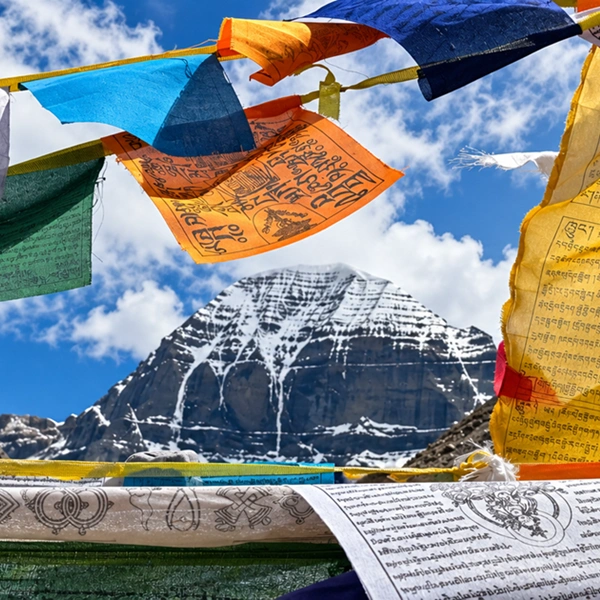
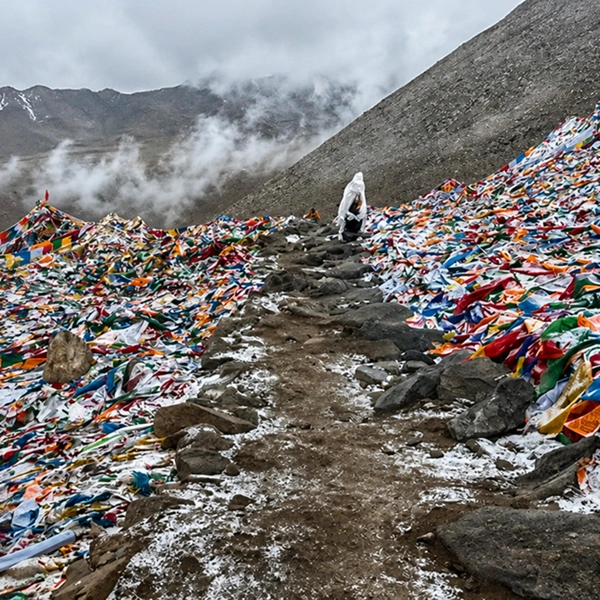
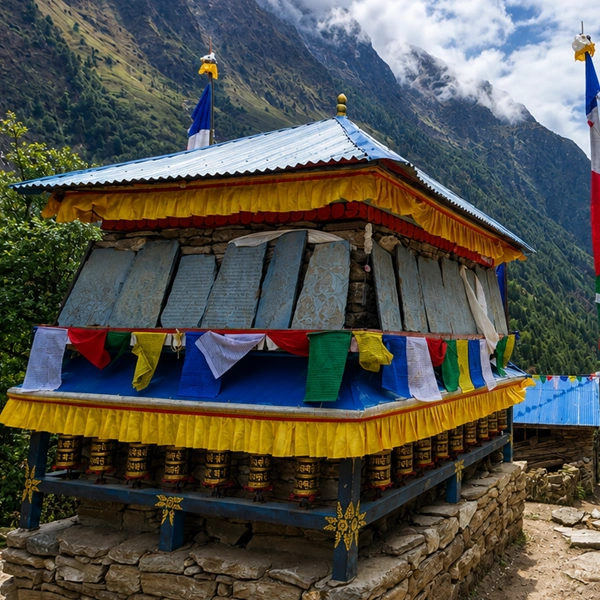
Prayer flags follow a similar logic. The horizontal Lungta strings and vertical Darchor poles are printed with mantras in the five elemental colors — blue for sky, white for wind, red for fire, green for water, and yellow for earth. The flags are not sending prayers to a god. The wind itself carries the printed mantra across the landscape, and the flag's fading over a season is part of the design. Hanging new flags during Saga Dawa is a renewal — old ones retire, new ones take over the broadcasting.
Where the Festival Is Most Alive
Lhasa
Lhasa during Saga Dawa is the closest thing Tibet has to a moving devotional theatre. The Jokhang Temple sits at the center, and the Barkhor around it fills with a continuous tide of pilgrims from before dawn. The sound is layered — low chanting, the steady clack of wooden prostration blocks on stone, the hum of prayer wheels.
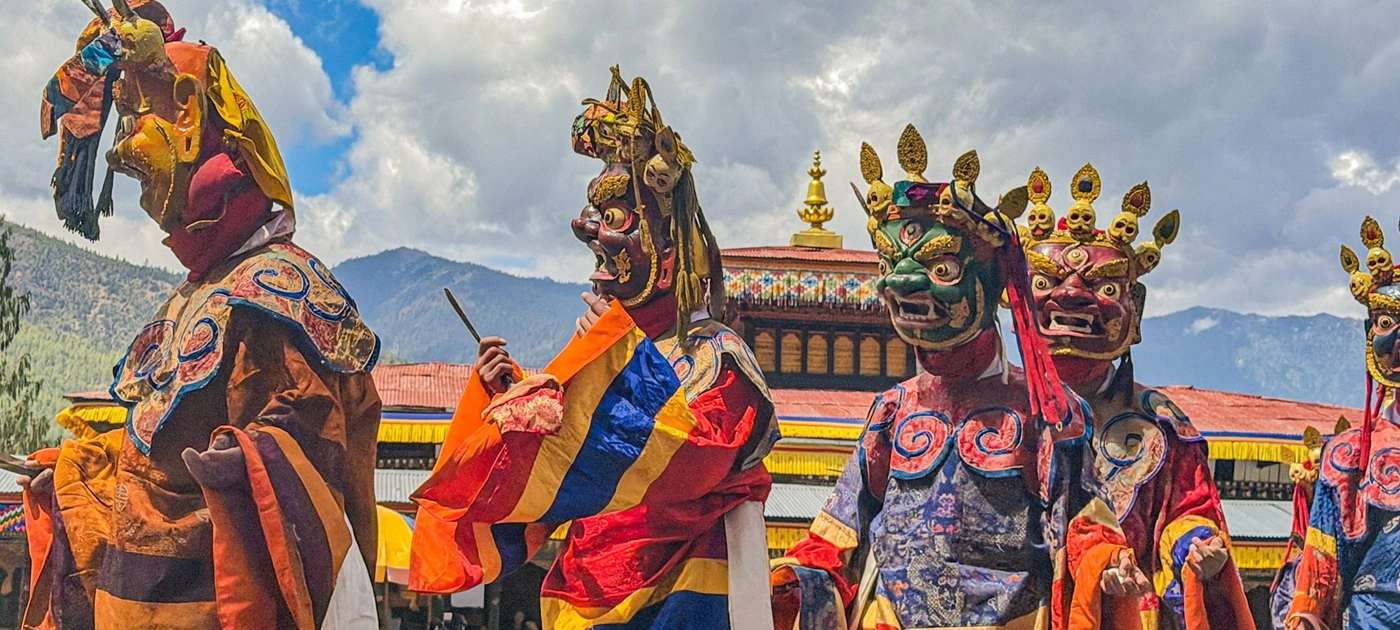
The Potala Palace anchors the wider Lingkhor. In the green spaces near the palace, families gather for linka picnics in the afternoons, sharing vegetarian meals and breaking the day's fast together. Sera and Drepung, the great monastic universities on the outskirts, unfurl giant thangkas down their walls and stage cham dances in which masked monks perform the triumph of enlightened energy over chaos.
Mount Kailash and Lake Manasarovar
The most significant Saga Dawa gatherings happen hundreds of miles west of Lhasa, at the base of Kang Rinpoche. Kailash is understood as the physical form of Mount Meru, the axis of the universe, and is sacred to four traditions: Buddhism, Hinduism, Jainism, and Bon.
The kora around the mountain is a three-day, fifty-two-kilometer trek leading from Darchen to Dirapuk, across the Dolma La pass at 5,630 meters, and down to Zutulpuk past Gauri Kund. The altitude is brutal. The cold is serious. The journey is understood to burn through lifetimes of karma.
The festival at Kailash opens with the Tarboche flagpole ceremony in the valley below the mountain. An enormous wooden pole, wrapped in thousands of prayer flags, is lowered each year, stripped, rewrapped with new flags brought by pilgrims, and raised again. Lamas direct the raising to the sound of long copper radong trumpets and cymbals.
The final angle of the pole is read as an omen for the coming year — upright and true is auspicious, a lean toward the mountain a good sign, a lean away a warning. When the pole locks upright, the valley erupts in shouts of Lha Ghyalo — the gods are victorious — and the kora begins.
Lake Manasarovar sits near the mountain and completes the pilgrimage. Pilgrims bathe in the freezing freshwater to finish the purification that the mountain begins. On the night of the full moon, the moonlight on the lake's surface is why many pilgrims plan their entire journey around this single date.
Boudhanath and Swayambhunath, Kathmandu
For pilgrims who cannot obtain the permits required to travel to Tibet, or who live in the exile diaspora, the Kathmandu Valley is the spiritual center. Two ancient stupas carry that weight.
Boudhanath is one of the largest stupas in the world and the heart of the Tibetan community in exile. Through the month, and especially on the full moon day, the plaza around the stupa holds a continuous clockwise flow of pilgrims. At dusk, the whole circle lights up with butter lamps, and the surrounding gompas chant late into the night. If you can only be in one place in Nepal for Saga Dawa, we usually suggest Boudhanath.
Swayambhunath, often called the Monkey Temple for the macaques that live on the hill, sits above the valley. Legend places its origin in a self-arising lotus that bloomed from a primordial lake before the bodhisattva Manjushri drained the valley with a flaming sword. The climb is 365 stone steps, and the climb itself is part of the devotion. At the top, during Saga Dawa, rare thangkas are unrolled for public viewing — an event that happens only on a few festival days each year.
The stupas themselves are diagrams of the path. The white dome is the earth, the womb of creation. The eyes on the harmika watch in every direction. The thirteen tiers of the golden spire are the thirteen stages of the path to nirvana. The numeral between the eyes at Swayambhunath — the Nepali "ek," or one — is the unity underneath all of it.
If You Are Planning to Travel During Saga Dawa
Saga Dawa falls in the pre-monsoon window, roughly late May into the middle of June, depending on the year. This is one of the best travel windows in the Himalaya. Winter snow has cleared from the high passes, the monsoon has not yet arrived, and the light is clean. We run our Kailash, Lhasa, and Kathmandu Valley departures tightly through this window.
A few things to know before you commit.
Tibet is not an independent travel destination. Every foreign visitor needs a Chinese visa, a Tibet Travel Permit, and, for Kailash, an additional Alien's Travel Permit and Military Area Entry Permit. These are processed only through licensed operators, which is part of what we handle on your behalf.
A Fire Horse Year multiplies demand at every point on the infrastructure — flights into Lhasa, permits, Darchen guesthouses, and the tent camps along the Kailash kora. For these years, we strongly recommend booking about a year in advance. The guesthouses along the kora are basic by design, often shared dormitory rooms at very high altitude, and that is true regardless of budget.
Physical preparation matters more for Kailash than for any other trip we offer. The Dolma La pass at 5,630 meters is the highest point, and the trek lasts three days at high altitude. We build acclimatization days into the itinerary, but the fitness work must be completed before you arrive.
Kathmandu Valley journeys are gentler. If Tibet is not possible for you this time, a Saga Dawa week in the valley — Boudhanath at dusk, a morning tsethar release, Swayambhunath's thangkas, Kopan's Nyung Ne — gives you the essence of the festival without altitude or permits.
Why the Festival Still Matters
Saga Dawa is older than most institutions that shape daily life today, and it still works. It asks three things of anyone who steps inside it for the month: do not cause harm, protect what is vulnerable, and give your merit away instead of keeping it.
You do not need to be Buddhist to feel the weight of those instructions, and you do not need to be in Tibet to practice them. But if you can be at Boudhanath on the full moon night, or on the Dolma La pass in the thin air of a Fire Horse Year, the festival does something to a traveler that is hard to describe and harder to forget.
We'd be glad to help you plan the journey.