Nepal’s Five Days of Light, Animals, and the Defiance of Death
Visitors who arrive during Tihar and call it “Nepalese Diwali” are making a category error. The Indian festival of Diwali celebrates Lord Rama’s return to Ayodhya after a military victory. Tihar celebrates something entirely different: a sister’s trick that defeats the God of Death. The two festivals share oil lamps and the worship of Laxmi on one overlapping night. Beyond that, they diverge completely.
Tihar — also called Yamapanchak (“the Five Days of Yama,” the God of Death) — is an indigenous Nepali festival with its own mythology, ritual architecture, and meaning. It worships animals before it worships gods. It honors the self as a divine object. It uses a flower that biologically cannot wilt to outsmart mortality. And it includes a tradition of door-to-door caroling (Deusi-Bhailo) that exists nowhere else in South Asia.
In 2026, Tihar runs from November 8 to November 12. At Alpine Luxury Treks, our team celebrates Tihar with our own families. Several of our guides grew up in the Newari neighborhoods where Mha Puja and the Nepal Sambat New Year are observed. This guide draws on that lived knowledge.
In This Guide
- The mythology: how a sister tricked the God of Death
- The five days: crows, dogs, cows, the self, and siblings
- Mha Puja: the Newari worship of the self
- Deusi-Bhailo: Nepal’s door-to-door caroling tradition
- Sel Roti: the food that holds the festival together
- The 2026 calendar
- How to experience Tihar as a visitor
- Frequently asked questions
How a Sister Tricked the God of Death
The founding myth of Tihar is a story about a sister who is smarter than Death.
Yama, the God of Death, was always busy. His administrative duties in the underworld left him permanently inaccessible to his sister, the river goddess Yamuna. Desperate to see him, Yamuna sent a series of animal messengers: first a crow, then a dog, then a cow. None succeeded in bringing Yama to her.
On the fifth day, Yamuna went to Yama herself. But she did not go to visit. She went because Yama had arrived to claim the soul of her mortal brother. Yamuna could not fight the God of Death with force. Instead, she used ritual logic.
She asked Yama to participate in one final puja for her brother before taking his soul. She applied a multi-coloured tika to the brother’s forehead. She draped a garland of Makhamali (globe amaranth) flowers around his neck. She drew a protective boundary of mustard oil around him. Then she set one condition: Yama could not take her brother’s soul until the oil boundary dried and the flowers wilted.
Mustard oil drawn over mud does not dry. The Makhamali flower does not wilt. It holds its color and structure for months after being cut. Yama was trapped by the ritual’s own terms. He left empty-handed. The brother lived. Yama decreed that any brother who receives this ceremony from his sister on this day will be protected from untimely death.
The five days of Tihar retrace the exact sequence of Yamuna’s attempts to reach her brother. The animals she sent as messengers are worshipped in the order she sent them. The final day recreates her protective ritual.
The Five Days
|
Day
|
2026 Date
|
Name
|
What Happens
|
|
Day 1
|
Nov 8
|
Kaag Tihar
|
Crows are fed rice, grains, and sweets before any human eats. The messengers of Death are appeased.
|
|
Day 2
|
Nov 9
|
Kukur Tihar
|
Every dog — pet and stray — receives tika, marigold garland, and a feast. Dogs guard the road to the afterlife.
|
|
Day 3
|
Nov 10
|
Gai Tihar / Laxmi Puja
|
Morning: cows worshipped. Evening: Laxmi Puja — houses cleaned, floors painted with rangoli, oil lamps lit at every door. Bhailo caroling begins.
|
|
Day 4
|
Nov 11
|
Goru Tihar / Mha Puja
|
Oxen honored. Newari communities perform Mha Puja (worship of the self) and celebrate the Nepal Sambat New Year. Deusi caroling.
|
|
Day 5
|
Nov 12
|
Bhai Tika
|
Sisters apply seven-colored tika, drape Makhamali garlands, and draw a mustard-oil boundary. Brothers receive protection from Death.
|
Day 1: Kaag Tihar — Feeding the Messengers of Death
Before any human in the household eats, food is placed on rooftops and courtyards for the crows. In Nepali cosmology, crows are Yama’s informants — his physical scouts in the mortal world. Their cawing carries news, both good and fatal. By feeding them, the household appeases the scouts of Death, warding off grief and devastating news for the coming year.
The logic is prophylactic: you do not ignore the forces associated with death. You feed them. You make them your allies. This is the dialectic that runs through the entire five days — confronting mortality directly rather than avoiding it.
Day 2: Kukur Tihar — The Day Every Dog in Nepal Is Sacred
Kukur Tihar is the day that made Nepal internationally famous on social media. The distinction between household pets and street dogs is entirely erased. Every dog — every dog — receives red or yellow tika on the forehead, a marigold garland around the neck, and a feast of meat, milk, eggs, and treats.
The theological reason: dogs are the gatekeepers of the underworld and the guardians of the afterlife. They are the vahana (divine vehicle) of Bhairav, the fierce manifestation of Shiva. By honoring them, devotees ensure that these spiritual guardians will guide the souls of deceased family members safely through the terrifying terrain of the afterlife.
The human reason: Nepal is a country of mountain trails, agricultural villages, and remote communities. Dogs have been protectors, companions, and alarm systems for centuries. Kukur Tihar is the day when the country formally, publicly, and universally acknowledges this relationship.
Day 3: Gai Tihar and Laxmi Puja — The Cow and the Goddess of Wealth
The morning belongs to cows. They are bathed, decorated with tika and garlands, and fed Sel Roti, fruits, and fresh grass. In Nepal’s agrarian world, the cow is the ultimate symbol of motherhood and sustenance. She is believed to be the terrestrial form of Goddess Laxmi herself.
The evening belongs to light. As dusk falls on the darkest night of the lunar month (Amavasya), every household in Nepal transforms. Floors are cleaned and smeared with a traditional mixture of cow dung and red mud. Rangoli patterns are drawn at doorways. A trail of painted footprints is drawn from the front threshold into the prayer room, literally guiding Goddess Laxmi inside. Oil lamps are lit at every window, every door, every balcony. The country glows.
This is the night when Bhailo begins. Groups of girls and women go door to door singing traditional songs, offering blessings to households in exchange for food and donations. The songs describe the house as clean and ready for Laxmi, compare the female head of the household to the goddess herself, and scale their blessings to match the generosity of the donation.
Day 4: Goru Tihar and the Newari Mha Puja
For the agrarian majority, the fourth day honors the ox — the draft animal that plows the steep Himalayan terraces. Horns are decorated. The animal receives a mandatory day of absolute rest from all labor.
For the Newari community of the Kathmandu Valley, the fourth day is something else entirely: Mha Puja — the worship of the self.
MHA PUJA: WORSHIPPING YOUR OWN BODY AND SOUL
Mha Puja translates from Nepal Bhasa as ‘worship of the self.’ It is rooted in the tantric belief that the divine universe resides within the individual human body. The female head of the household (the Nakin) draws a mandala on the floor for each family member, arranged by age. Each mandala is constructed from five piles of unhusked rice representing the five elements (earth, water, fire, air, ether). The Nakin lights a long oil-soaked wick (Khelu Itah) for each person’s inner light, applies tika, drapes ceremonial threads for longevity, and pours a ritual offering (mutumari) over the recipient’s head. A Sagun plate — boiled egg, smoked fish, meat, lentil cakes, and rice wine (refilled three times before setting down) — completes the tantric integration. Mha Puja coincides with Nepal Sambat New Year, the indigenous lunar calendar established in 880 AD by the merchant Shankhadhar Sakhwa, who turned river sand into gold and used the wealth to eliminate the debts of every citizen in the valley.
On this same evening, Deusi begins. Groups of boys and men go door to door, performing the male counterpart to Bhailo. The lead vocalist narrates while the chorus responds with a synchronized “Deusire!” after every line. The funds collected are traditionally pooled for community welfare. In modern urban practice, mixed-gender groups perform on either night.
Day 5: Bhai Tika — The Day a Sister Outsmarts Death
The final day re-enacts Yamuna’s triumph over Yama. The ritual sequence is precise and codified.
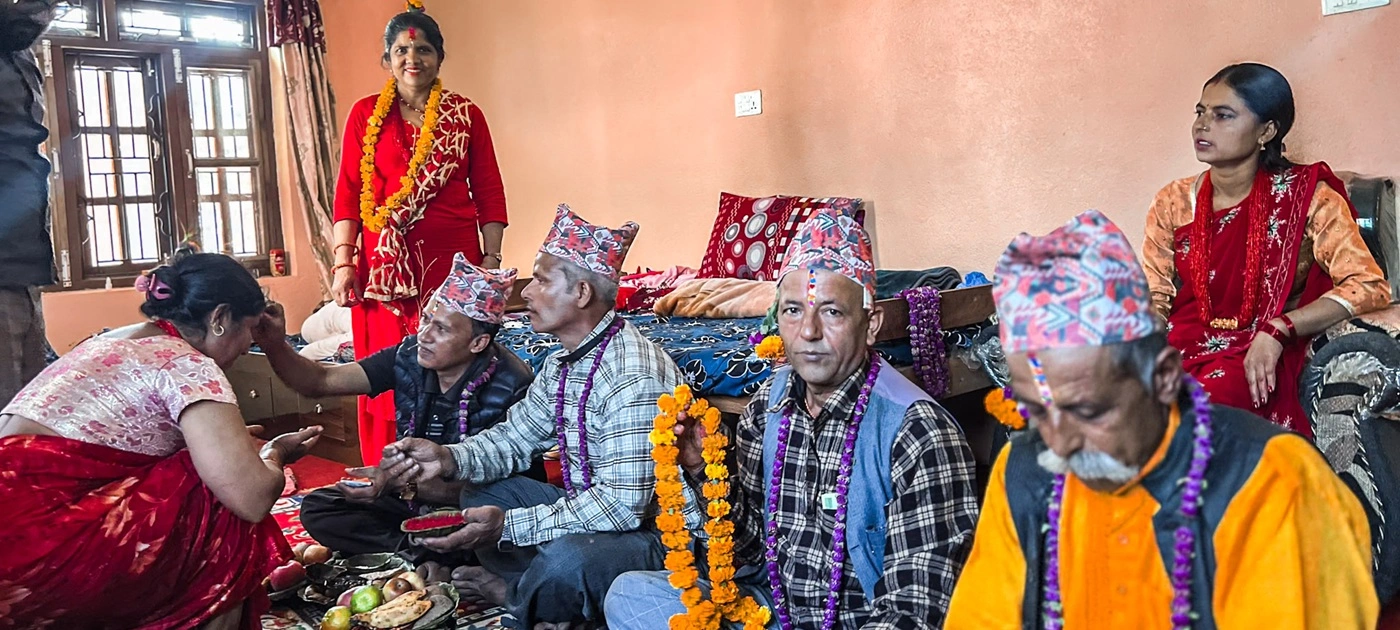
The sister cracks a walnut (okhar) on the doorstep with a heavy stone — symbolically breaking the brother’s enemies and negative energies. She draws a continuous boundary of mustard oil and water around the space where the brother sits, sealing him from the reach of Death. She applies the Saptarangi Tika — a vertical mark of seven distinct colors on his forehead, each representing a different blessing and cosmic energy. She drapes him in a garland of Makhamali flowers.
The Makhamali is the botanical centerpiece of the entire mythology. Globe amaranth (Gomphrena globosa). Deep purple, spherical blooms. The defining property: it does not wilt. It does not lose its color. It holds its structure for months after being cut. The sister stipulates that Death cannot take her brother until the flower withers. It never does.
The brother touches his sister’s feet with his forehead in a gesture of profound respect. He offers cash (dakshina), clothing, and a promise of lifelong protection. The ceremony is performed regardless of age — older sisters worship younger brothers, and vice versa. In the Newari tradition (Kija Puja), the ritual has historically been performed late at night, lasting until sunrise. The mythological logic: Yama cannot claim a soul during daylight. By forcing the ritual to take place past dawn, the sister makes the brother unreachable.
“In November 2024, we hosted Anna and Stefan Lindgren from Stockholm on an 8-day Nepal cultural itinerary timed to overlap with Tihar. On Kukur Tihar, they walked through Patan watching shopkeepers garland street dogs and place tika on the foreheads of strays sleeping in doorways. Anna, a veterinary surgeon, had spent her career treating animals. She stopped in the middle of a side street, watching an elderly woman carefully place a marigold garland around a limping stray. Anna turned to Stefan and said: ‘In thirty years of veterinary medicine, I have never seen an entire country stop what it is doing to honour animals. Not pets. Not livestock. Animals. Including the ones nobody owns.’ On Bhai Tika three days later, Stefan received the Saptarangi Tika from his Nepali guide’s sister — invited as a gesture of inclusion. He told us at the airport: ‘I came for the mountains. The mountains were extraordinary. But the sister putting seven colours on my forehead and telling me the God of Death cannot touch me until the flowers wilt — that is what I will remember.’”
Sel Roti: The Food That Holds Tihar Together
Sel Roti is a ring-shaped, deep-fried sweet bread made from rice flour, sugar, cardamom, cloves, milk, and ghee. It is the culinary centerpiece of Tihar — present at every offering, every feast, every gift exchange for five days.
The preparation is intergenerational. A coarse rice flour batter is mixed to a specific consistency, then poured by hand in a continuous circular motion into a deep cauldron of boiling clarified butter and turned using foot-long sticks called jhir. The technique requires generational practice. The texture — called khuskhus locally, meaning "light and brittle" — is a marker of a well-made Sel Roti.
A properly cooked Sel Roti can be stored at room temperature for up to 20 days. This extended shelf life made it ideal for multi-day festivals and for transport as gifts (koseli) to relatives in distant mountain villages. The ring shape is not accidental. It is an edible circle of life, a required religious offering during Laxmi Puja, a mandatory gift during Bhai Tika, and the ultimate symbol of Nepali warmth.
During Tihar, Sel Roti is everywhere — every household fries it, every shop sells it, and the smell of ghee and cardamom fills the streets. The best is always homemade. Our guides arrange home visits during Tihar itineraries where guests watch the preparation and taste it fresh from the karahi. The communal act of gathering around the boiling ghee while the family’s grandmother shapes the batter is itself one of the festival’s most intimate experiences.
Deusi-Bhailo: Nepal’s Caroling Tradition
Deusi-Bhailo is the Nepali tradition of going door to door singing folk songs during Tihar. Bhailo is performed by girls and women on the night of Laxmi Puja (Day 3). Deusi is performed by boys and men the following night (Day 4). The structure: a lead vocalist narrates while the chorus responds with a synchronized refrain (“Deusire!” or “Bhailo!”). Accompaniment is traditionally provided by madal drums, khaijadi tambourines, and jhyali cymbals.
The lyrics describe the household as clean and blessed. They compare the female head of the household to Goddess Laxmi. They scale their blessings to the donation: a small offering earns a golden roof; a generous offering earns a golden ridge pole. The collected funds are pooled for community welfare — in institutional settings, they fund scholarships for disadvantaged students.
The tradition has no equivalent anywhere else in South Asia. It exists only in Nepal and in the Nepali diaspora communities (Gorkha Regiments in India, Britain, and Singapore). Urbanization has altered the form — amplifiers replacing traditional instruments, entertainment replacing devotion — but the core practice of neighbors singing at neighbors’ doors in exchange for blessings and sweets survives intact in rural communities.
How to Experience Tihar as a Visitor
The Essential Days
If you attend only one day, make it Day 2 (Kukur Tihar, November 9). The sight of an entire country garlanding its dogs is the most immediately accessible and emotionally powerful day of the festival. For the full emotional arc, attend Days 2, 3, and 5 — dogs, light, and siblings.
Where to Be
Patan and Bhaktapur are the best places to experience Tihar at street level. The old Newari neighborhoods celebrate with particular intensity — the oil lamp displays on Laxmi Puja night are densest in the historic lanes between Patan Durbar Square and the Golden Temple. For Mha Puja (Day 4), the Newari communities in Patan and Bhaktapur are the only places where the self-worship ceremony is performed.
We arrange evening walking tours through the lamp-lit streets on Laxmi Puja night and guided home visits during Bhai Tika, where guests can witness (and sometimes participate in) the sibling ceremony with local families.
Photography
Kukur Tihar is the most photogenic day. A fast 35mm or 50mm prime lens for street photography of garlanded dogs. Laxmi Puja night requires a fast lens (f/1.4-2.8) for available-light shots of oil lamps, rangoli, and candlelit doorways. A small tripod for longer exposures of lamp-lit streets. Bhai Tika is intimate and indoor — ask before photographing families during the ceremony.
Frequently Asked Questions
What is Tihar?
Tihar (also called Yamapanchak or Deepawali) is a five-day Nepali festival in October-November honoring animals, the goddess of wealth, the self, and the sibling bond. Unlike Indian Diwali (which celebrates Lord Rama’s return to Ayodhya), Tihar’s mythology centers on the Yama-Yamuna narrative: a sister’s ritual trick that defeats the God of Death to protect her brother’s life.
When is Tihar in 2026?
November 8 to November 12, 2026. Day 1 (Kaag Tihar): November 8. Day 2 (Kukur Tihar): November 9. Day 3 (Laxmi Puja): November 10. Day 4 (Mha Puja / Nepal Sambat New Year): November 11. Day 5 (Bhai Tika): November 12. Dates follow the lunar Bikram Sambat calendar.
What is Kukur Tihar?
Kukur Tihar (Dog Day) is the second day of Tihar. Every dog in Nepal — pets and strays alike — receives vermillion tika on the forehead, a marigold garland, and a feast of meat, milk, and treats. Dogs are venerated as gatekeepers of the afterlife and as the divine vehicle of Bhairav. It is one of the most internationally recognized cultural practices unique to Nepal.
Is Tihar the same as Diwali?
No. Tihar shares one overlapping night with Diwali (the worship of Goddess Laxmi with oil lamps), but the two festivals have fundamentally different mythologies, structures, and meanings. Diwali celebrates Lord Rama’s military victory and return to Ayodhya. Tihar (Yamapanchak) celebrates a sister’s triumph over the God of Death, the veneration of animals as spiritual guardians, and the Newari worship of the self. The Deusi-Bhailo carolling tradition, the five-day animal-worship sequence, and Bhai Tika have no equivalent in Diwali.
What is Mha Puja?
Mha Puja (‘worship of the self’) is a Newari ceremony on Day 4 of Tihar. It is rooted in the tantric belief that the divine resides within the individual body. The female head of the household draws a mandala of five rice piles (representing the five elements) for each family member, lights oil wicks, applies tika, drapes longevity threads, and pours a ritual offering over each person’s head. It coincides with the Nepal Sambat New Year, the indigenous calendar established in 880 AD.
What is Bhai Tika?
Bhai Tika is the fifth and final day of Tihar. Sisters apply a seven-coloured tika (Saptarangi Tika) to their brothers’ foreheads, drape Makhamali flower garlands around their necks, and draw a protective mustard-oil boundary around them. The ritual recreates the myth of Yamuna tricking the God of Death: the Makhamali flower does not wilt biologically, thereby trapping Death in the logic of the ritual. Brothers reciprocate with gifts, cash, and vows of protection.
What is Deusi-Bhailo?
Deusi-Bhailo is Nepal’s unique door-to-door caroling tradition during Tihar. Bhailo is sung by girls on Laxmi Puja night (Day 3); Deusi is sung by boys the following night (Day 4). A lead vocalist narrates while a chorus responds with a synchronized refrain. The tradition includes blessings scaled to the household’s generosity. Collected funds are traditionally pooled for community welfare. It exists only in Nepal and the Nepali diaspora.
What is Sel Roti?
Sel Roti is a ring-shaped, deep-fried sweet bread made from rice flour, ghee, cardamom, and cloves. It is the culinary centerpiece of Tihar — a required offering during Laxmi Puja, a mandatory gift during Bhai Tika, and a present at every feast for five days. Its ring shape symbolizes the circle of life. A well-made Sel Roti can be stored for up to 20 days at room temperature.
What is the Makhamali flower?
Makhamali (globe amaranth, Gomphrena globosa) is the flower used exclusively during Bhai Tika. Its defining property: it does not wilt, lose its color, or drop its petals even months after being cut. In the Yama-Yamuna myth, the sister stipulates that Death cannot take her brother until the Makhamali withers. Since it never does, the brother is protected. The garland is the ultimate physical projection of a sister’s prayer for her brother’s immortal, unfading life.
Can international visitors participate in Tihar?
Yes. Tihar is a participatory festival that actively welcomes outsiders. On Kukur Tihar (Day 2), you can garland dogs alongside local families. On Laxmi Puja night (Day 3), you can walk the lamp-lit streets of Patan and Bhaktapur. During Bhai Tika (Day 5), some Nepali families invite guests to receive tika as an honorary sibling — our guides occasionally arrange this through their own families. The Deusi-Bhailo groups will sing at any door that welcomes them, including hotel lobbies.
The Final Word
Tihar is the festival in which Nepal’s relationship with death, animals, family, and the self is laid bare. The crows are fed because they carry the news of mortality. The dogs are honored for guarding the road to the afterlife. The cows are worshipped because they sustain the living. The self is acknowledged because the divine lives inside the body. And the sister places seven colors on her brother’s forehead and a flower that never wilts around his neck, because love is supposed to be stronger than the God of Death.
If you are in Nepal in early November, this is the festival that will change how you think about what a festival can be. We will walk you through the lamp-lit streets with a guide who can explain every color, every flower, and every song.
Planning a trip during Tihar?
Tell us your November dates. We will align your itinerary with the five days and arrange the evening walks, home visits, and family ceremonies that make Tihar genuinely unforgettable.