Kathmandu’s Eight Days of Gods, Grief, and the Living Goddess
Indra Jatra — known in Nepal Bhasa as Yenya Punhi, “the Kathmandu celebration” — operates on two parallel tracks simultaneously. The daylight hours belong to spectacle: the Living Goddess Kumari carried through the city in a towering chariot, accompanied by chariots bearing Ganesh and Bhairav, while a terrifying red-masked demon dances through the crowds, clearing the path. The evenings belong to grief: solemn processions of bereaved families walking the city’s ancient boundaries carrying oil lamps and incense for their dead.
The festival marks the end of the monsoon and the beginning of the autumn harvest. It is a cosmic transaction: gratitude to Indra for the rains, and a collective prayer that the goddess Dagini will guide the souls of the recently departed to heaven. The agricultural and the eschatological occupy the same eight days.
Indra Jatra is also the festival where political power in the Kathmandu Valley is publicly legitimized. The last Malla king invented the Kumari chariot procession to consolidate his crumbling authority. The Gorkha conqueror who overthrew him chose the day of Indra Jatra to march into the city. Every head of state since has received the Kumari’s blessing during the festival. Theology, agriculture, politics, and grief all operate simultaneously. This guide unpacks each layer.
In This Guide
- The myth: how the King of Heaven was arrested in Kathmandu
- The Living Goddess Kumari: selection, life, and procession
- The three chariot routes through the old city (2026 dates)
- The women’s chariot pull: 258 years of tradition, broken in 2012
- The masked dances: Lakhey, Pulu Kisi, and the Devi Pyakhan
- Swet Bhairava and the sacred rice beer
- The nocturnal grief processions: Dagin and Bau Mata
- The eight-day schedule (2026)
- How to experience Indra Jatra as a visitor
- Frequently asked questions
How the King of Heaven Was Arrested in Kathmandu
The founding story is both cosmic and absurd. Lord Indra — sovereign of the heavenly realm, controller of storms and weather — needed a specific flower. His mother, the goddess Dagini (also called Vasundhara), required the parijat (night-flowering jasmine) for a sacred ritual. Indra disguised himself as a mortal and descended to Maru Tole in Kathmandu to steal the flower from a local garden.
The residents caught him. They did not recognize the King of Heaven in his human form. They imprisoned him and paraded him through the streets like a common thief. To this day, a small wooden cage is erected at the base of the ceremonial pole at Hanuman Dhoka during Indra Jatra, containing an effigy of the imprisoned Indra alongside a golden elephant — his celestial mount, Airavata.
Indra’s capture triggered a cosmic search. Airavata descended to earth and charged frantically through the streets looking for his master. This search is re-enacted during the festival through the Pulu Kisi dance — a white cloth-and-bamboo elephant careening erratically through the crowds. Eventually, Dagini herself descended. Upon revealing her identity, the terrified locals immediately released Indra.
In exchange for her son’s freedom, Dagini made two promises to the people of Kathmandu that hold to this day. First: adequate monsoon rains followed by heavy morning dew for the winter crops. Second: safe passage to heaven for all those who had died during the past year.
The festival re-enacts this transaction every September. By recreating the imprisonment and release of the rain god, the community renews its contract with the divine: agricultural survival in exchange for the god’s freedom, and spiritual salvation as a bonus.
The Living Goddess Kumari
The Kumari is the most recognizable figure of Indra Jatra and arguably the most extraordinary religious institution in South Asia. She is a prepubescent girl from the Buddhist Shakya caste who serves as the living vessel for the divine feminine energy (Sakti) of the supreme goddess Taleju.
The Selection
Candidates must be between four and five years old, from a Shakya family demonstrating three generations of caste purity. The physical requirements are based on the thirty-two lakshanas — divine perfections: the candidate must never have lost a tooth, never shed blood, and possess specific physical traits tied to auspicious qualities in Hindu-Buddhist theology.
If she meets the criteria, she undergoes psychological testing. She must walk fearlessly through a courtyard filled with severed buffalo heads while masked men dance aggressively around her. She must spend a night alone in a room with slaughtered animals without showing fear. She must correctly identify the previous Kumari's personal belongings.
The Life
Once selected, the Kumari is removed from her family and installed in the Kumari Ghar at Basantapur. Her feet are too sacred to touch the ground; she is carried whenever she leaves the building. She wears red permanently. A silver agni chakshu (third eye) is painted on her forehead. Modern reforms have introduced tutors and internet access, but her life remains one of intense ritual restriction. Her tenure ends at first menstruation, when the Sakti is believed to leave her body.
The Procession
During Indra Jatra, the Kumari leaves her sequestered life for three days. She is placed in a massive wooden chariot, accompanied by two smaller chariots carrying young boys representing Ganesh and Bhairav. This divine triumvirate is pulled through the ancient streets of Kathmandu over three distinct routes, blessing the city sector by sector. The Head of State receives her tika — a blessing mark on the forehead — legitimizing temporal authority through divine endorsement. Every ruler of Nepal has received this blessing since 1756.
THE POLITICAL HISTORY OF THE KUMARI PROCESSION
The Kumari Jatra was invented by King Jaya Prakash Malla, the last Malla king of Kathmandu, in 1756. Faced with the military threat posed by Prithvi Narayan Shah’s Gorkha kingdom, Jaya Prakash needed to consolidate his crumbling authority. By integrating a Buddhist Shakya girl into the pre-existing Indra Jatra as a Hindu living goddess, he created a syncretic bond between his Hindu state and the valley’s Buddhist communities. When Prithvi Narayan Shah conquered Kathmandu in 1768, he chose the day of Indra Jatra to enter the city — and immediately received the Kumari’s blessing to legitimize his new regime. The conqueror preserved his enemy’s festival because its political utility was too powerful to destroy.
The Three Chariot Routes Through the Old City
The chariot processions are strictly choreographed across three days. Each route covers a different sector of the old city, ensuring that every neighborhood receives the divine presence.
|
Day
|
Name
|
Sector
|
Key Locations
|
|
Sept 25
|
Kwaneya
|
South
|
Basantapur → Maru → Jaisidewal → Lagan → Hyumata → Bhimsensthan → back to Basantapur. Public holiday.
|
|
Sept 26
|
Thaneya
|
North
|
Basantapur → Pyaphal → Yatkha → Tengal → Asan → Kel Tol → Indra Chowk → Makhan → back to Basantapur.
|
|
Sept 29
|
Nanichaya
|
Central
|
Basantapur → Pyaphal → Kilagal → Bhedasing → Indra Chowk → Makhan → back to Basantapur. Women pull the chariot.
|
The routes trace the ancient boundaries of the Malla-era city. The first route (Kwaneya) targets the southern half and holds particular significance for the residents of Hyumata, who spin wheel-like structures adorned with lights — a tradition honoring their historical loyalty to the fleeing King Jaya Prakash Malla. The second route (Thaneya) brings the deities into the commercial arteries—Asan Market and Indra Chowk. The third route (Nanichaya) was added by Jaya Prakash Malla specifically because one of his concubines from Kilagal had missed the earlier processions.
The Women’s Chariot Pull: 258 Years of Tradition, Broken in 2012
For 258 years, the chariot was pulled exclusively by men on all three days. In 2012, women broke through.
Facilitated by Nani Hira Maharjan and the Jyapu Maha Guthi, nearly 300 women — from grandmothers in traditional Haku Patasi to teenage girls — pulled the Kumari’s chariot on the Nanichaya route. Today, women exclusively pull the chariot on the final procession day. The tradition is now permanent.
This is not a cosmetic reform. The chariot is a multi-ton wooden structure pulled through narrow medieval streets. The physical demand is immense. The women who pull it are performing an act of devotion that was denied to their mothers and grandmothers for over two and a half centuries. The emotional charge on the Nanichaya day is palpable in a way that the other two procession days are not.
The Masked Dances: Lakhey, Pulu Kisi, and the Stage Performances
Majipa Lakhey: The Demon Who Protects Children
The most iconic visual of Indra Jatra, after the Kumari herself, is the Majipa Lakhey. A dancer wearing a terrifying red mask with protruding fangs, wide, glaring eyes, and a chaotic mane of yak hair. He moves through the crowds with frenetic, wild energy, accompanied by crashing cymbals (Jhyalinchha) and drums.
Despite the demonic appearance, the Lakhey is a guardian spirit. His role is to clear the path for the divine chariots by driving away evil spirits through aggressive, unpredictable choreography. He is worshipped as a protector of children. Offerings are placed before him as he roams the city. The visual contrast — a terrifying demon who is actually the neighborhood’s gentlest protector — is one of the emotional paradoxes that make Indra Jatra so deeply human.
Pulu Kisi: The White Elephant
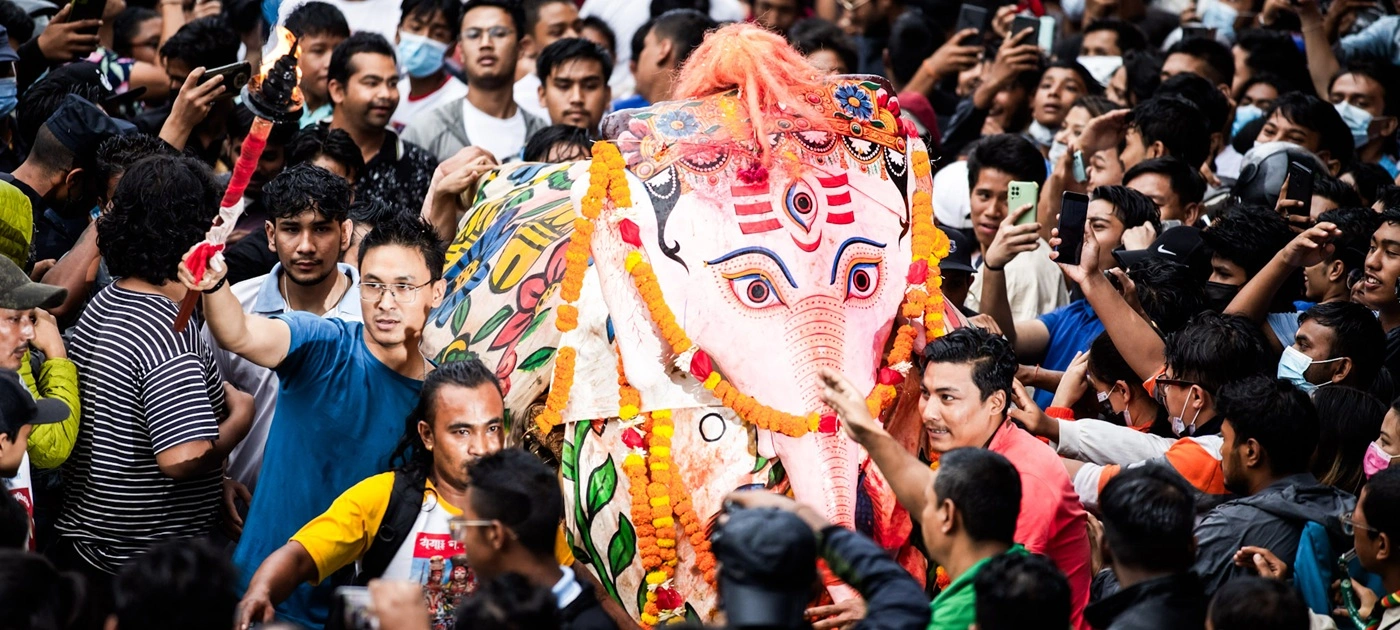
In comic contrast to the Lakhey’s ferocity, the Pulu Kisi is a large, whimsical bamboo-and-white-cloth elephant carried by several men hidden inside its frame. The elephant charges erratically through the streets, occasionally knocking into bystanders. The performers carry torches in broad daylight—an intentional absurdity that symbolizes the elephant’s nighttime search superimposed on the daytime festival.
The Pulu Kisi re-enacts Airavata’s frantic search for his imprisoned master. The comedy and the mythology coexist naturally. Children shriek with laughter when the elephant crashes into a wall. Their parents know the elephant is weeping.
Devi Pyakhan and Dabu Pyakhan
The Devi Pyakhan is a complex seven-deity dance performed by the Kilagal community featuring Bhairav, Kumari, Chandi, Daitya (demon), Kawan, Beta, and Khya. Its choreographic twist: the demon is shown fleeing the goddess rather than fighting her. The Dabu Pyakhan — performed on makeshift stages at market squares — uses irony, humor, and satire to address contemporary social issues. During the liminal time of the festival, commoners can openly mock authority without reprisal. This open-air theatre is the festival’s social pressure valve.
Swet Bhairava and the Sacred Rice Beer
At Hanuman Dhoka, concealed behind a wooden screen for 357 days a year, sits the massive mask of Swet Bhairava (White Bhairava) — the most destructive manifestation of Shiva. Installed in 1795 by Rana Bahadur Shah, the mask is revealed to the public only during Indra Jatra.
The centerpiece ritual is the Hathu Hyayegu. A long pipe is inserted into the mouth of the mask, and home-brewed rice beer (Thwon or Hathu) is siphoned out into the crowd below. The alcohol is prepared using a fermentation starter cake (wanti) made from wild medicinal herbs and roots. The moment it passes through the deity’s mouth, it is transubstantiated into prasad — divine blessing in liquid form.
The crowd beneath the mask is extraordinary. Hundreds of people surge and battle to catch a few drops in their mouths. Drinking the liquor from Swet Bhairava is believed to impart physical strength, ward off disease, and guarantee good fortune. Until 2015, participation was exclusively male. That year, women were permitted to participate for the first time, with dedicated time slots for female devotees.
The Nocturnal Grief Processions: Where the Festival Becomes Quiet
The contrast between Indra Jatra’s days and nights is one of the most emotionally powerful dynamics in any festival anywhere. The days are roaring, kinetic, crowded. The nights are silent, lamp-lit, and achingly sad.
Upaku Wanegu and Mata Biye
On the first evening, families who lost someone in the past year walk the ancient city's boundaries, carrying incense and oil lamps. The lamps trace the outline of the old city, transforming the streets into a massive illuminated memorial. The route mirrors the chariot paths but operates on a different emotional register — quiet grief, reflection, and the provision of light for the departed’s journey into the afterlife.
The Dagin Procession
After the Kwaneya chariot procession, a masked figure representing Dagini — Indra’s mother searching for her imprisoned son — walks through the dark alleys accompanied by sombre traditional music. Hundreds of bereaved families walk behind her. By following Dagini, the mourners place their faith in her mythic promise to guide their departed loved ones to heaven.
The Bau Mata
Immediately after the Dagin returns to the Kasthamandap at Maru Square, the Bau Mata procession departs. Managed by the Manandhar community, it consists of a long serpentine effigy made of reeds, suspended on poles, with oil lamps burning along its spine. The snake is a protective vanguard — it traces the Dagin’s route, warding off malevolent spirits and ensuring the path for the souls remains clear.
“In September 2025, we took Elena and Roberto Santini from Bologna to Indra Jatra. Roberto, a documentary filmmaker, had spent his career covering festivals from Carnival in Brazil to Holi in Rajasthan. He filmed the Kwaneya chariot procession in the afternoon — the Kumari, the Lakhey, the surging crowd. Then he filmed the Dagin procession that same evening — the masked figure of Indra’s mother moving through dark alleys, followed by hundreds of mourning families carrying oil lamps. He put his camera down after the Bau Mata passed. He told Elena: ‘I have filmed joy at a hundred festivals. I have never filmed grief and joy on the same day, in the same streets, from the same mythology. This is the only festival I have seen that does both.’”
The Eight-Day Schedule: September 23–30, 2026
|
Day
|
Date
|
What Happens
|
|
Day 1
|
Sept 23
|
Ya Sin Thanegu: the massive ceremonial pole is raised at Basantapur. Festival formally opens. Indra’s effigy was placed in a cage at the pole’s base. Evening: Upaku Wanegu — bereaved families walk the city boundaries with oil lamps.
|
|
Day 2
|
Sept 24
|
Deity exhibitions across city squares. Localized processions. Evening: Dabu Pyakhan theatrical performances — satire and social commentary on makeshift stages.
|
|
Day 3
|
Sept 25
|
KWANEYA: First chariot procession — southern route. PUBLIC HOLIDAY. Head of State receives Kumari’s tika. Lakhey clears the path. Evening: Dagin and Bau Mata nocturnal grief processions.
|
|
Day 4
|
Sept 26
|
THANEYA: Second chariot procession — northern route through Asan and Indra Chowk commercial districts. Pulu Kisi elephant charges through crowds.
|
|
Day 5
|
Sept 27
|
Swet Bhairava unveiled. Hathu Hyayegu — sacred rice beer dispensed from the giant mask’s mouth into the crowd. Open-air theatre continues.
|
|
Day 6
|
Sept 28
|
Rest day for primary chariots. Regional masked dances continue. Communal feasts. Samay Baji displays at temple squares.
|
|
Day 7
|
Sept 29
|
NANICHAYA: Third chariot procession — central route through Kilagal. Women exclusively pull the chariot.
|
|
Day 8
|
Sept 30
|
Yosin Kwathalegu: The ceremonial pole is lowered. The festival formally closes. The city returns to mundane time.
|
From the moment the pole rises on Day 1 to the moment it falls on Day 8, the city of Kathmandu is understood to exist in a liminal sacred state. The deities are physically present among the populace. Normal social hierarchies are partially suspended — commoners can mock authority through Dabu Pyakhan theatre, women pull the chariot on Day 7, and rice beer from a god’s mouth flows into the crowd. When the pole comes down, the ritual boundaries close. The deities return to their temples. The city becomes ordinary again.
How to Experience Indra Jatra as a Visitor
The Essential Days
If you attend only one day, make it **Day 3 (September 25)** — the Kwaneya procession. The Kumari’s chariot. The Lakhey. The state-level tika ceremony. The Dagin and Bau Mata nocturnal processions that same evening. No other day packs the festival’s full emotional range into a single 12-hour window.
For the complete experience, attend Days 3, 5, and 7. Day 3 for the Kumari and the grief processions. Day 5 for the Swet Bhairava rice beer ceremony. Day 7 for the women’s chariot pull.
Where to Watch
Basantapur Durbar Square is the epicenter. The surrounding rooftop cafes (The Himalayan Cafe, Layaku, Mangale Restro) offer elevated views above the crowd. We arrange rooftop access through local contacts for guests who want safe, elevated viewing. At street level, the Maru-to-Kasthamandap stretch is the best position for the nocturnal processions.
Visitor Etiquette
Indra Jatra is a religious event with deeply emotional nocturnal components. During the Dagin and Bau Mata processions, families are mourning their recent dead. Maintain silence and respectful distance. Do not photograph individual mourners without consent. During the chariot processions, do not attempt to join the chariot-pulling crews — these positions are fiercely guarded by locals with deep spiritual investment. The Lakhey dancers move unpredictably; give them space.
SAMAY BAJI: THE FESTIVAL FEAST
The ubiquitous festival food is Samay Baji — a precisely constructed feast plate that is itself a theological diagram. Flattened rice (baji), puffed rice, fried black soybeans, fresh ginger, marinated buffalo meat (chowella), dried fried fish, lentil patties (woh), and local distilled wine (ailaa). Local Guthis construct massive mountainous displays of Samay Baji in front of the Kumari, Ganesh, and Bhairava temples. These food mountains are offerings to the deities, displays of community wealth, and — once the rituals conclude — prasad distributed to the crowd. The Samay Baji display is a statement: this community can feed its gods and its people simultaneously.
Frequently Asked Questions
What is Indra Jatra?
Indra Jatra (Yenya Punhi) is an eight-day festival in Kathmandu honoring Lord Indra, the god of rain, and featuring the chariot procession of the Royal Living Goddess Kumari. It marks the end of the monsoon, celebrates the autumn harvest, and provides a mechanism for ancestral veneration. It is the largest street festival in Kathmandu, featuring masked dances, sacred rice beer dispensed from a giant deity mask, and solemn nocturnal processions for the dead.
When is Indra Jatra in 2026?
September 23 to September 30, 2026. The main chariot procession day (Kwaneya) is September 25, a public holiday. The women’s chariot pull (Nanichaya) is on September 29. The festival follows the lunar calendar and dates shift annually.
What is the Kumari?
The Kumari is a pre-pubescent girl from the Buddhist Shakya caste who serves as the living vessel of the goddess Taleju. She is selected through rigorous physical and psychological tests, removed from her family, and installed in the Kumari Ghar at Basantapur. Her feet never touch the ground. She wears red permanently and has a third eye painted on her forehead. During Indra Jatra, she is carried through the city in a chariot over three days, blessing each sector. Her tenure ends at her first menstruation.
Who pulls the Kumari’s chariot?
On the first two procession days (Kwaneya and Thaneya), the chariot is pulled by men. On the third and final procession day (Nanichaya), women pull the chariot exclusively. This reform was achieved in 2012, breaking a 258-year-old tradition. Nearly 300 women from diverse communities participated in the first year, and the practice is now permanent.
What is the Lakhey?
The Majipa Lakhey is a masked dancer wearing a terrifying red demon mask with fangs, glaring eyes, and a yak-hair mane. Despite the demonic appearance, the Lakhey is a guardian spirit who protects children and clears the path for the divine chariots by driving away evil spirits through aggressive, unpredictable choreography. The Lakhey is one of the most iconic visual symbols of Indra Jatra.
What is Swet Bhairava?
Swet Bhairava (White Bhairava) is a massive, terrifying mask installed at Hanuman Dhoka in 1795 by Rana Bahadur Shah. It is hidden behind a screen for 357 days a year and revealed only during Indra Jatra. During the Hathu Hyayegu ritual, home-brewed rice beer is dispensed from a pipe inserted into the mask’s mouth. Hundreds of devotees surge beneath the mask to catch the sacred liquor, which is believed to impart strength and good fortune.
What are the nocturnal processions?
The evenings of Indra Jatra feature solemn processions for the dead. The Upaku Wanegu involves bereaved families walking the old city boundaries with oil lamps. The Dagin procession features a masked figure representing Indra’s mother as she searches for her imprisoned son, followed by mourning families. The Bau Mata — a serpentine effigy with oil lamps on its spine — follows the same route as a protective vanguard, clearing malevolent spirits from the path of the souls.
What is Samay Baji?
Samay Baji is the traditional Newari feast plate served during Indra Jatra. It includes flattened rice, puffed rice, fried black soybeans, ginger, marinated buffalo meat (chowella), dried fish, lentil patties (woh), and local distilled wine (ailaa). Each component carries a specific symbolic weight. Local Guthis construct massive food displays in front of temples as offerings that are later distributed as prasad.
How did the 2015 earthquake affect Indra Jatra?
The April 2015 earthquake devastated Kathmandu Durbar Square, collapsing key structures including the Kasthamandap and Maju Dega temple. The festival took place just months later, transforming from a standard celebration into a mechanism for collective psychological recovery. Devotees navigated chariots through streets lined with debris. The grief processions took on overwhelming immediate weight as the community mourned nearly 9,000 earthquake victims alongside those who died naturally that year. Subsequent reconstruction has restored the key festival infrastructure.
How do I attend Indra Jatra?
Indra Jatra takes place in public streets and squares throughout old Kathmandu. No tickets are required. The Kwaneya procession (September 25, 2026) is the essential day. We recommend attending with a cultural guide who can position you at safe viewing points (access to rooftops through local contacts), explain the mythology in real time, and navigate the crowd safely. We build September itineraries specifically around the festival dates.
The Final Word
Indra Jatra is the festival that contains everything. Agricultural gratitude and ancestral grief. A living goddess and a terrifying demon. A stolen flower and a cosmic ransom. Rice beer from a god’s mouth and oil lamps for the dead. The Head of State receives a blessing from a five-year-old girl. A 258-year-old tradition broken by 300 women pulling a chariot through medieval streets.
It is not one thing. It is the entire emotional and spiritual range of the Kathmandu Valley compressed into eight days. If you are in Nepal in late September, this is the festival you attend. We will put you on a rooftop above Basantapur with a guide who can tell you what you are seeing, and leave you to feel it.
Planning a trip during Indra Jatra?
Tell us your September dates. We will align your itinerary with the festival’s key days and arrange safe, elevated viewing positions in Basantapur Durbar Square.